8% Off
Cicloderm1%
Popular Pharmaceuticals Ltd.
৳101.20
Add to cart
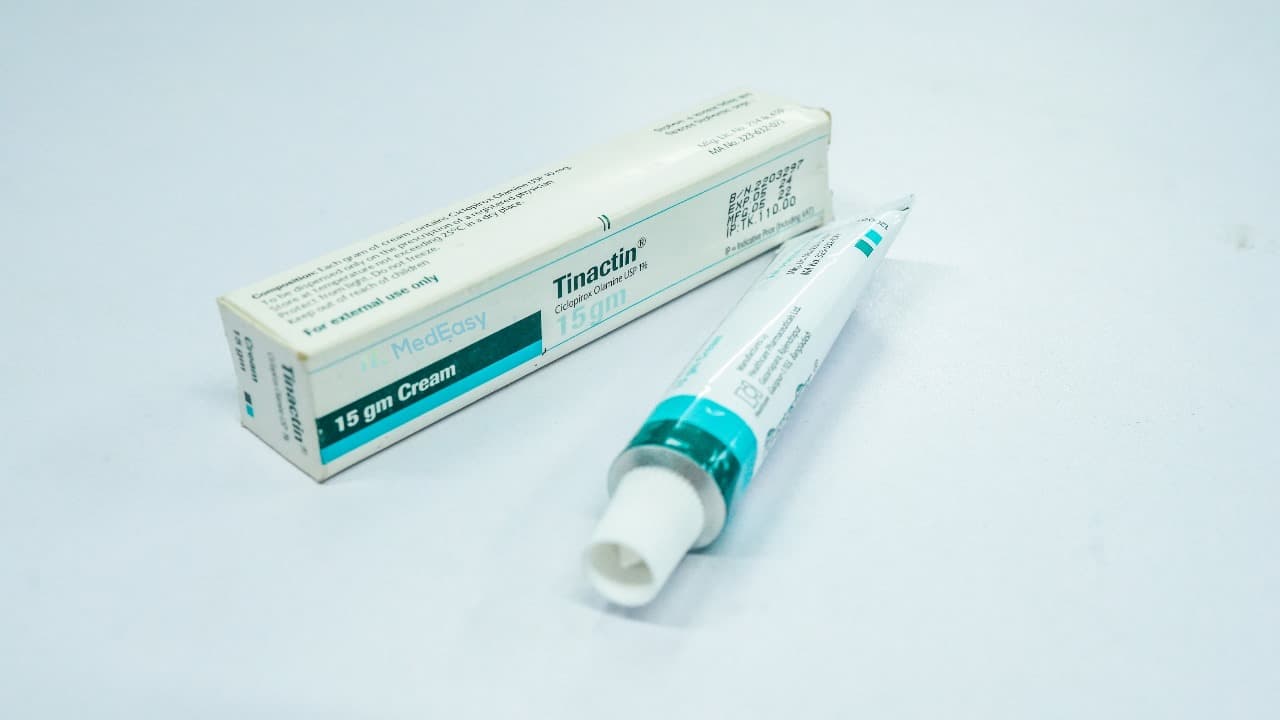

Tinactin is a broad-spectrum topical antifungal agent used for the treatment of various superficial fungal and yeast infections of the skin, scalp, and nails. Indications vary by formulation and are supported by clinical trial data reviewed by regulatory authorities such as the US FDA.
Use of Tinactin for any indication should be guided by a physician's diagnosis, as clinical resemblance to a fungal infection does not always confirm the diagnosis (confirmatory testing such as KOH microscopy or culture may be advised).
Each formulation of Ciclopirox Olamine contains ciclopirox (as the olamine salt) as the active ingredient, typically available as:
Inactive ingredients vary by manufacturer and formulation and may include emulsifying agents, preservatives, and a nail lacquer vehicle base.
Tinactin is a synthetic, broad-spectrum antifungal agent belonging to the hydroxypyridone class, distinct from the azole and allylamine antifungal classes. It is active against a wide range of dermatophytes, yeasts (including Candida species), and some molds, and also has activity against certain Gram-positive and Gram-negative bacteria. Tinactin is formulated for topical use only, in forms including cream, gel, suspension, shampoo, and nail lacquer, depending on the site and type of infection being treated.
Tinactin belongs to the therapeutic class of Topical Antifungal Agents, specifically the hydroxypyridone chemical class of antifungals.
Ciclopirox Olamine's antifungal action is primarily attributed to chelation of polyvalent metal cations, particularly Fe3+ (ferric ions) and Al3+ (aluminum ions), within the fungal cell. This chelation inhibits metal-dependent enzymes responsible for degrading peroxides inside the fungal cell, and disrupts several fungal cellular processes:
These combined actions give Ciclopirox Olamine fungicidal and fungistatic activity, depending on the organism and concentration achieved at the site of infection. Systemic absorption after topical application is generally low, though it can vary with the formulation, area of application, and skin/nail integrity.
Dosing of Tinactin depends on the formulation and the condition being treated:
| Formulation / Indication | Adult Dosage | Typical Duration |
|---|---|---|
| Cream/suspension – tinea pedis, cruris, corporis, cutaneous candidiasis | Apply a thin layer to the affected area and surrounding skin twice daily (morning and evening) | Usually 4 weeks; reassess if no improvement |
| Cream/suspension – tinea versicolor | Apply twice daily | Usually 2 weeks |
| Shampoo 1% – seborrheic dermatitis | Apply approximately 5 mL to wet scalp, lather, leave on scalp for 3 minutes, then rinse | Twice weekly for 4 weeks, with at least 3 days between applications |
| Nail lacquer 8% – onychomycosis | Apply evenly over the entire affected nail(s) and 5 mm of surrounding skin once daily, preferably at bedtime | Up to 48 weeks, with weekly removal of lacquer and unattached, infected nail material |
If no clinical improvement is seen after the recommended treatment period, the diagnosis should be reconsidered and re-evaluated by a physician.
Tinactin is for external/topical use only.
Because Tinactin is applied topically with generally low systemic absorption, clinically significant drug-drug interactions are uncommon. No well-established, clinically significant systemic drug interactions have been documented with therapeutic topical use.
Ciclopirox Olamine is contraindicated in patients with known hypersensitivity to ciclopirox, ciclopirox olamine, or any excipient/component of the specific formulation being used.
Tinactin is generally well tolerated. Reported adverse effects are usually mild and localized to the application site:
With the nail lacquer formulation specifically, additional local effects may include:
Seek medical advice if irritation is severe, persistent, or accompanied by blistering, swelling, or signs of an allergic reaction.
Pregnancy: Tinactin falls under FDA legacy pregnancy category B for topical formulations, based on animal reproduction studies that have not demonstrated fetal harm; however, adequate and well-controlled studies in pregnant women are limited. Tinactin should be used during pregnancy only if clearly needed, applied to the smallest area for the shortest duration necessary, and only after consulting a physician.
Lactation: It is not known whether topically applied Tinactin is excreted in human breast milk. Caution is advised when using Tinactin in nursing mothers; avoid application to the breast/chest area, and consult a physician before use while breastfeeding.
Tinactin is for external use only. The following precautions apply:
Tinactin is intended for topical use only, and clinically significant systemic toxicity from topical overdose is unlikely given low systemic absorption. Excessive or prolonged use beyond directions does not increase effectiveness and may increase local irritation. If Tinactin is accidentally ingested, or if signs of a serious allergic reaction (such as difficulty breathing, swelling of the face/lips/throat, or a widespread rash) occur, seek immediate medical attention or contact a poison control center/emergency services without delay.
Store Tinactin at room temperature (below 30°C), away from direct light, heat, and moisture. Keep the container tightly closed. The nail lacquer formulation's vehicle may be flammable — keep away from open flame or excessive heat, and do not store near sources of ignition. Keep out of reach of children.
Renal/Hepatic Impairment: Because systemic absorption of topically applied Tinactin is low, specific dose adjustments for renal or hepatic impairment have not been established and are generally not required for topical use; however, caution is advised with use over large areas or on damaged/broken skin.
Elderly: No specific dose adjustment is required for elderly patients; general precautions for skin fragility and diabetes-related neuropathy (for nail lacquer) apply.
Diabetic patients: Use the nail lacquer with caution in patients with diabetes, especially those with peripheral neuropathy (see Precautions and Warnings).
Immunocompromised patients: The nail lacquer formulation is intended for immunocompetent patients; safety and efficacy in immunocompromised patients with onychomycosis have not been established.
Duration of treatment with Tinactin depends on the formulation and infection being treated:
If symptoms do not improve within the expected timeframe, consult a physician to reassess the diagnosis and treatment plan for Tinactin.
Ciclopirox Olamine belongs to the hydroxypyridone class of synthetic antifungal agents, a class chemically distinct from azole antifungals (e.g., clotrimazole, ketoconazole) and allylamine antifungals (e.g., terbinafine).
The mode of action of Ciclopirox Olamine centers on chelation of essential polyvalent cations (mainly Fe3+ and Al3+) required by fungal enzymes. By depriving these enzymes of their metal cofactors, Ciclopirox Olamine disrupts fungal mitochondrial energy production and macromolecule (DNA/RNA/protein) synthesis, leading to fungal cell death or growth inhibition. This mechanism differs from azole antifungals, which act by inhibiting ergosterol synthesis, making Ciclopirox Olamine useful even against some organisms with reduced susceptibility to azoles.
B
Use of Tinactin in children should follow formulation-specific labeling:
Parents/caregivers should consult a pediatrician before using Tinactin in children outside these established age ranges.
Q: What is Tinactin 1% Cream used for?
A: Tinactin 1% Cream is a topical antifungal used to treat fungal skin infections such as athlete's foot, ringworm, and jock itch, as well as cutaneous yeast infections, seborrheic dermatitis (shampoo formulation), and mild-to-moderate fungal nail infections (nail lacquer formulation), depending on the product prescribed.
Q: How long does it take for Tinactin 1% Cream to work?
A: Many patients notice relief of itching and other symptoms within the first week of using Tinactin 1% Cream cream, but a full course (usually 2-4 weeks for skin infections) should be completed to prevent recurrence. Nail infections treated with the nail lacquer formulation of Tinactin 1% Cream typically require several months of daily use before visible improvement is seen.
Q: Can I use Tinactin 1% Cream during pregnancy or while breastfeeding?
A: Tinactin 1% Cream is generally considered FDA pregnancy category B, but should be used during pregnancy only if clearly needed and prescribed by a physician, applied to the smallest area for the shortest time necessary. Caution is also advised while breastfeeding; avoid applying Tinactin 1% Cream to the breast/chest area, and consult a physician before use.
Q: What are the common side effects of Tinactin 1% Cream?
A: The most common side effects of Tinactin 1% Cream are mild, local reactions at the application site, including burning, itching, redness, dryness, or irritation. The nail lacquer form may also cause redness of the skin around the nail. Severe or persistent reactions should be reported to a physician.
Q: Is Tinactin 1% Cream safe for children?
A: Safety of Tinactin 1% Cream has not been fully established in young children for most formulations — the cream/suspension is not established for children under 10 years, the shampoo is approved from age 16, and the nail lacquer has not been studied under age 12. Use in children should only be under a physician's guidance.
Q: Do I need to complete the full course of Tinactin 1% Cream treatment even if symptoms improve early?
A: Yes. Even if your symptoms improve, you should continue using Tinactin 1% Cream for the full duration prescribed by your physician (often several weeks for skin infections, and many months for nail infections) to fully clear the fungal infection and reduce the risk of recurrence. Do not stop early or skip applications without medical advice.
Disclaimer
The information provided is accurate to the best of our knowledge, but it does not replace professional medical advice. We cannot guarantee its completeness or accuracy, and the absence of specific information about a drug should not be taken as an endorsement. We are not responsible for any consequences arising from this information, so please consult a healthcare professional for any concerns or questions.