
8% Off
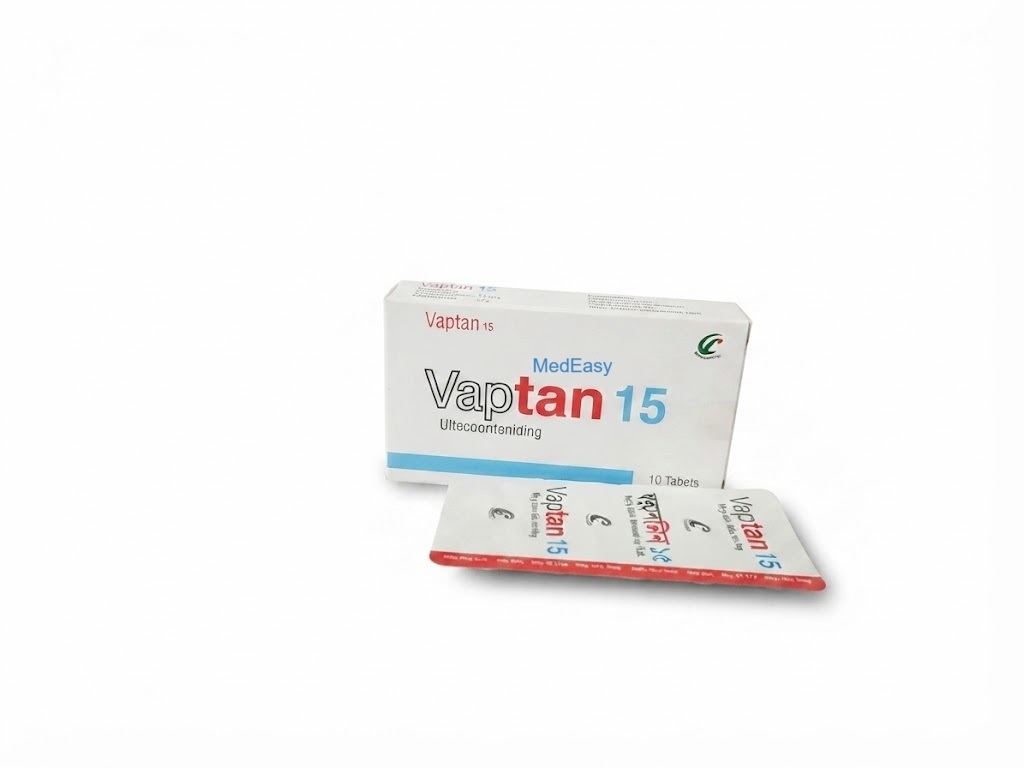
Vaptan15 mg
Popular Pharmaceuticals Ltd.
৳644.00
Add to cart


Tolvan is a selective vasopressin V2-receptor antagonist (aquaretic) approved for two distinct clinical uses, each with its own dosing range and safety program:
Tolvan is not indicated for hypovolemic hyponatremia or for situations requiring urgent correction of serum sodium. It is not a first-line diuretic for volume overload and is not interchangeable across its two approved indications without physician-directed, indication-specific dosing.
Each film-coated oral tablet contains Tolvaptan as the active ingredient, commonly available in strengths such as 15 mg, 30 mg, 45 mg, 60 mg, and 90 mg (exact strengths and combination packs vary by manufacturer/market), along with standard pharmaceutical excipients.
Tolvan is a selective, orally active antagonist of the vasopressin V2 receptor found in the renal collecting ducts. By blocking the antidiuretic action of arginine vasopressin, Tolvan promotes excretion of electrolyte-free water (aquaresis) without a proportional loss of sodium and potassium, which helps correct dilutional hyponatremia. At the higher, specifically titrated doses used in autosomal dominant polycystic kidney disease (ADPKD), Tolvan also reduces cyclic AMP signaling implicated in renal cyst growth, helping to slow the decline in kidney function.
Tolvan carries a boxed warning: initiation and re-initiation for the hyponatremia indication must occur in a hospital setting with frequent serum sodium monitoring because of the risk of too-rapid sodium correction, and the higher-dose ADPKD regimen carries its own boxed warning for serious, potentially irreversible liver injury requiring a structured monitoring program.
Vasopressin V2-receptor antagonist (aquaretic agent) — Tolvan is the prototype drug of this class.
Tolvaptan selectively and competitively antagonizes vasopressin V2 receptors on the basolateral membrane of renal collecting-duct cells. This blocks vasopressin-mediated insertion of aquaporin-2 water channels, reducing water reabsorption and producing aquaresis (excretion of free water with minimal effect on electrolyte excretion). The result is a rise in serum sodium concentration and a reduction in total body water without significant natriuresis.
In ADPKD, V2-receptor blockade by Tolvaptan also lowers intracellular cyclic AMP in renal tubular and cystic epithelial cells, a pathway implicated in cyst cell proliferation and fluid secretion, which underlies its effect of slowing kidney volume growth and function decline.
Tolvaptan is absorbed orally with peak plasma concentration reached in about 2-4 hours; it is highly protein bound and extensively metabolized in the liver mainly via CYP3A4, with a plasma elimination half-life of roughly 6-8 hours. It is excreted predominantly via the biliary/fecal route, with minimal unchanged renal excretion.
Dosing of Tolvan differs substantially by indication and must follow the specific, physician-directed regimen for that indication; the two regimens are not interchangeable.
| Indication | Initiation & titration | Key requirement |
|---|---|---|
| Hyponatremia (hypervolemic/euvolemic, incl. SIADH, heart failure, cirrhosis) | Start Tolvan 15 mg once daily; after at least 24 hours, may increase to 30 mg once daily, then to a maximum of 60 mg once daily as needed, based on serum sodium response | Must be started/restarted in a hospital where serum sodium can be monitored frequently |
| ADPKD (slowing kidney function decline) | Split-dose, morning/evening titration beginning at a lower combination (e.g. lower AM dose plus lower PM dose) and titrated upward at intervals of at least weekly, to the highest tolerated of three approved dose levels | Requires enrollment in a structured monitoring program with baseline and periodic liver function tests |
See Dosage and Administration below for further detail, and Precautions and Warnings for the mandatory monitoring associated with each indication.
Tolvan tablets are taken orally, once daily in the morning for the hyponatremia indication (to allow monitoring of the effects of aquaresis during waking hours), with or without food. For the ADPKD indication, Tolvan is taken as two doses daily — on waking and again about 8-9 hours later, roughly with meals, following a fixed physician-directed schedule.
Patients should have access to water and should drink in response to thirst; fluid should not be restricted during Tolvan initiation or titration unless specifically instructed. Missed doses should not be doubled up; contact the prescribing physician for guidance. Do not stop, skip, or change the Tolvan dose without medical advice, given the structured monitoring these regimens require.
Tolvan is metabolized mainly via CYP3A4, making it prone to clinically significant interactions:
Tolvaptan is contraindicated in the following situations (true absolute contraindications):
The most common adverse effects of Tolvan relate directly to its aquaretic mechanism:
Patients should report unusual fatigue, jaundice, dark urine, severe nausea/vomiting, confusion, difficulty speaking or swallowing, or excessive thirst/urination promptly to their physician.
Pregnancy: Data on Tolvan use in pregnant women are limited. Animal studies have shown adverse effects on fetal development at high doses. Tolvan should be used during pregnancy only if clearly needed and the potential benefit justifies the potential risk to the fetus; use should be under close physician supervision.
Lactation: It is not known whether Tolvan passes into human breast milk. Because of the potential for aquaretic effects and electrolyte disturbance in a nursing infant, a decision should be made by the physician whether to discontinue breastfeeding or discontinue Tolvan, taking into account the importance of treatment to the mother. Consult a physician before use while breastfeeding.
Overdose with Tolvan may cause excessive aquaresis leading to dehydration, hypovolemia, and dangerously elevated serum sodium. There is no specific antidote. If overdose of Tolvan is suspected, seek immediate medical attention or contact a poison control center or emergency services right away; do not attempt unsupervised home treatment. Management in a medical facility typically involves close monitoring of volume status, serum electrolytes, and vital signs, with supportive care as directed by a physician.
Store at room temperature (below 30°C), away from light and moisture. Keep out of reach of children.
For hyponatremia, Tolvan is generally used for a limited course guided by serum sodium normalization and clinical response; continued use beyond 30 days is generally avoided, especially in patients with any hepatic impairment, due to liver injury risk. For ADPKD, Tolvan is used long-term/chronically to slow kidney function decline, with treatment duration and continued eligibility determined by the physician based on ongoing liver function monitoring and tolerability.
Vasopressin receptor antagonists; Aquaretics (Tolvaptan is the representative agent)
Tolvaptan selectively blocks vasopressin V2 receptors in the renal collecting ducts, preventing aquaporin-2-mediated water reabsorption and producing electrolyte-free water excretion (aquaresis), which raises serum sodium; at ADPKD-specific doses it also reduces cyclic AMP signaling linked to renal cyst growth.
C
Safety and efficacy of Tolvan in pediatric patients have not been established. Tolvan is not recommended for use in children.
Q: What is Tolvan 15 mg Tablet used for?
A: Tolvan 15 mg Tablet is used to treat clinically significant hypervolemic and euvolemic hyponatremia (including in heart failure, cirrhosis, and SIADH), and, at a different, higher-dose regimen, to slow the decline in kidney function in adults at risk of rapidly progressing autosomal dominant polycystic kidney disease (ADPKD).
Q: Why does Tolvan 15 mg Tablet need to be started in a hospital?
A: For the hyponatremia indication, Tolvan 15 mg Tablet must be started and restarted in a hospital where serum sodium can be checked frequently. This is because correcting sodium too quickly can cause a rare but serious neurological condition called osmotic demyelination syndrome.
Q: Can I take Tolvan 15 mg Tablet if I have liver problems?
A: Tolvan 15 mg Tablet requires caution in hepatic impairment for the hyponatremia indication, and is contraindicated in significant hepatic impairment or known liver disease for the higher-dose ADPKD indication, because Tolvan 15 mg Tablet at ADPKD doses carries a boxed warning for serious liver injury requiring regular liver function monitoring. Always tell your doctor about any liver condition before starting Tolvan 15 mg Tablet.
Q: Why do I feel very thirsty while taking Tolvan 15 mg Tablet?
A: Thirst and dry mouth are very common and expected side effects of Tolvan 15 mg Tablet because of how it works (it makes the kidneys excrete extra water). You should drink water in response to thirst rather than restricting fluids, unless your doctor tells you otherwise.
Q: Is Tolvan 15 mg Tablet safe during pregnancy or breastfeeding?
A: Tolvan 15 mg Tablet should be used in pregnancy only if clearly needed, since data are limited and animal studies suggest possible fetal risk at high doses. It is not known if Tolvan 15 mg Tablet passes into breast milk, so a physician should be consulted to weigh the benefits and risks before use while breastfeeding.
Q: What should I do if I miss a dose of Tolvan 15 mg Tablet or think I've taken too much?
A: Do not double up a missed dose of Tolvan 15 mg Tablet; contact your physician for guidance. If you suspect an overdose of Tolvan 15 mg Tablet, seek immediate medical attention or contact emergency services/poison control right away, as excessive water loss and dangerously high sodium levels can result.
Disclaimer
The information provided is accurate to the best of our knowledge, but it does not replace professional medical advice. We cannot guarantee its completeness or accuracy, and the absence of specific information about a drug should not be taken as an endorsement. We are not responsible for any consequences arising from this information, so please consult a healthcare professional for any concerns or questions.
