
10% Off
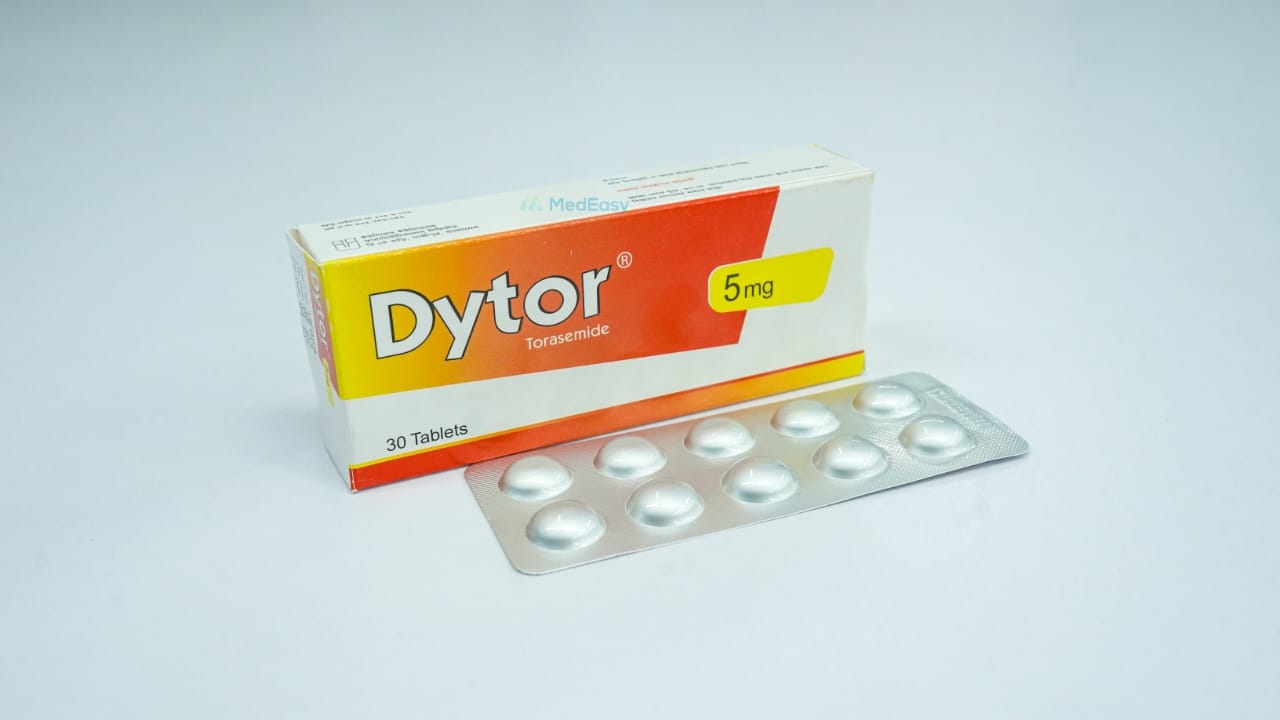
Dytor5 mg
Unimed Unihealth MFG. Ltd.
৳99.00
Add to cart


Tomide is a loop diuretic that is FDA-approved (established indications) for the following uses:
Tomide is not approved for use in children; safety and efficacy in pediatric patients have not been established.
Each tablet of Torasemide generally contains torasemide as the active pharmaceutical ingredient, along with pharmaceutically accepted excipients such as diluents, binders, disintegrants, and lubricants. It is also available as an injectable solution for intravenous use in some markets. Strength and exact formulation vary by manufacturer and dosage form; refer to the specific product label for exact composition.
Tomide is a pyridine-sulfonylurea-derivative loop diuretic that acts primarily on the ascending limb of the loop of Henle in the kidney. It is used to manage fluid retention (edema) associated with heart failure, kidney disease, and liver disease, and to treat hypertension. Tomide has a longer duration of action than furosemide and, in some patients, more consistent oral bioavailability.
Tomide belongs to the loop diuretic class of medications (high-ceiling diuretics), structurally related to the sulfonylureas.
Torasemide inhibits the Na⁺-K⁺-2Cl⁻ (NKCC2) cotransporter in the thick ascending limb of the loop of Henle, blocking reabsorption of sodium and chloride. This increases the delivery of sodium to the distal tubule and promotes excretion of sodium, chloride, and water, producing a diuretic and natriuretic effect. Torasemide also has a mild aldosterone-antagonist-like effect on the distal tubule at higher doses, which may reduce potassium loss compared with some other loop diuretics.
Onset of diuretic action after oral administration of Torasemide is approximately 1 hour, with peak effect at 1-2 hours and a duration of action of about 6-8 hours. Oral bioavailability of Torasemide is high (approximately 80-90%) and largely unaffected by food. It is extensively metabolized in the liver (mainly via CYP2C9) and eliminated both renally and hepatically.
| Indication | Adult Dose |
|---|---|
| Edema - Heart failure | Initial 10-20 mg once daily orally or IV; may be doubled at intervals until desired diuretic response is achieved. Doses above 200 mg have not been adequately studied. |
| Edema - Chronic renal disease | Initial 20 mg once daily; may be doubled at intervals as needed. Maximum studied dose is 200 mg. |
| Edema - Hepatic cirrhosis | Initial 5-10 mg once daily, generally combined with an aldosterone antagonist or potassium-sparing diuretic; may be doubled at intervals. Doses above 40 mg have not been adequately studied in this population. |
| Hypertension | Initial 5 mg once daily; may increase to 10 mg once daily if response is inadequate after 4-6 weeks; a second antihypertensive agent may be added if 10 mg is insufficient. |
Tomide can be taken with or without food, preferably in the morning to avoid nocturnal urination. If administered intravenously, it should be given slowly (over about 2 minutes) to reduce the risk of ototoxicity.
Pediatric dosing: safety and efficacy of Tomide have not been established in patients under 18 years of age; it is not recommended for pediatric use.
Renal/hepatic adjustment: Tomide is contraindicated in anuria. In hepatic cirrhosis, therapy should start at a lower dose (see table) with careful monitoring of fluid/electrolyte status to avoid precipitating hepatic encephalopathy (see Precautions).
Tomide tablets are taken orally, once daily, with or without food, preferably in the morning. The injectable form of Tomide is given by slow intravenous injection or infusion by a healthcare professional; rapid IV administration should be avoided due to the risk of ototoxicity. Do not switch between oral and IV routes without medical guidance, as bioavailability may differ.
Tomide has the following well-established, clinically significant drug interactions:
Torasemide is contraindicated in patients with:
Common side effects of Tomide include increased urination, dizziness, headache, nausea, indigestion, diarrhea or constipation, joint/muscle pain, and cough.
Less common but serious side effects include electrolyte disturbances (low potassium, low sodium, low magnesium), symptomatic hypotension, ototoxicity (hearing loss, tinnitus, vertigo - especially with rapid IV administration or in patients with renal impairment), hyperglycemia (worsening glucose control in diabetics), hyperuricemia (may precipitate gout), and rarely, blood dyscrasias or severe skin reactions. Seek prompt medical attention for sudden hearing changes, severe dizziness, irregular heartbeat, or signs of severe allergic reaction.
Tomide should be used during pregnancy only if clearly needed and if the potential benefit justifies the potential risk to the fetus; animal studies have shown fetal effects at high doses. There are no adequate, well-controlled studies in pregnant women, so a physician must be consulted before use in pregnancy.
It is not known whether Tomide passes into human breast milk. Because many diuretics can suppress lactation and some are excreted in breast milk, Tomide should be used during breastfeeding only under medical supervision, weighing the benefits against potential risks to the infant.
Tomide requires caution and monitoring in the following situations:
Tomide should be taken exactly as prescribed by a physician; do not stop, skip, or change the dose without medical advice, as abrupt discontinuation can lead to fluid retention or rebound symptoms.
Overdose of Tomide may cause excessive diuresis leading to dehydration, electrolyte depletion (particularly low potassium and sodium), hypotension, and acute kidney injury. There is no specific antidote; Tomide is not removed by dialysis. If overdose is suspected, seek immediate medical attention or contact a poison control center; treatment in a medical facility typically involves fluid and electrolyte replacement and supportive care under close monitoring.
Store Tomide at room temperature (below 30°C), away from light and moisture. Keep out of reach of children.
Elderly: Elderly patients are more susceptible to electrolyte disturbances, dehydration, and hypotension with Tomide; a lower starting dose and closer monitoring are advisable.
Renal impairment: Tomide is contraindicated in anuric patients; dose adjustment and monitoring are needed in other degrees of renal impairment.
Hepatic impairment: Lower starting doses are used in hepatic cirrhosis with careful monitoring to avoid encephalopathy (see Precautions).
Pediatric patients: Safety and efficacy of Tomide have not been established in children; its use is not recommended in this population.
Diabetic patients: Tomide may affect glucose tolerance; blood glucose should be monitored.
Duration of treatment with Tomide depends on the underlying condition and clinical response. Edema and hypertension often require long-term or chronic therapy, with periodic reassessment of dose, renal function, and electrolytes by the prescribing physician. Do not stop Tomide abruptly without medical advice.
Torasemide is classified as a loop diuretic (high-ceiling diuretic), within the broader category of diuretics/antihypertensive agents.
Torasemide works by inhibiting the Na⁺-K⁺-2Cl⁻ cotransporter in the thick ascending limb of the loop of Henle, which blocks sodium and chloride reabsorption. This increases urinary excretion of sodium, chloride, and water, reducing fluid volume and blood pressure.
The safety and efficacy of Tomide have not been established in pediatric patients (under 18 years of age). It is therefore not recommended for use in children, and no pediatric dosing regimen is established. Use in children should only occur under specialist medical supervision if no suitable alternative exists.
Q: What is Tomide 5 mg Tablet used for?
A: Tomide 5 mg Tablet is a loop diuretic (water pill) used to treat fluid retention (edema) caused by heart failure, kidney disease, or liver disease, and to treat high blood pressure.
Q: How should I take Tomide 5 mg Tablet?
A: Take Tomide 5 mg Tablet exactly as prescribed by your physician, usually once daily in the morning, with or without food. Do not stop or change the dose without consulting your doctor.
Q: Who should not take Tomide 5 mg Tablet?
A: Tomide 5 mg Tablet should not be used by people who are anuric (produce no urine), are in hepatic coma or precoma with severe electrolyte depletion, are severely dehydrated, or are hypersensitive to Tomide 5 mg Tablet or to sulfonylurea medicines.
Q: What are the common side effects of Tomide 5 mg Tablet?
A: Common side effects of Tomide 5 mg Tablet include increased urination, dizziness, headache, nausea, and muscle or joint pain. Serious but less common effects include low potassium or sodium levels, low blood pressure, and hearing changes (ringing in the ears or hearing loss) - contact your doctor promptly if these occur.
Q: Can Tomide 5 mg Tablet be used during pregnancy or breastfeeding?
A: Tomide 5 mg Tablet should be used in pregnancy only if clearly needed, since animal studies suggest possible risk to the fetus at high doses and there is limited human data; a physician should be consulted. It is not known if it passes into breast milk, so it should be used while breastfeeding only under medical supervision.
Q: What should I do if I take too much Tomide 5 mg Tablet?
A: An overdose of Tomide 5 mg Tablet can cause excessive fluid loss, dehydration, low blood pressure, and electrolyte imbalance. Seek immediate medical attention or contact a poison control center if an overdose is suspected.
Disclaimer
The information provided is accurate to the best of our knowledge, but it does not replace professional medical advice. We cannot guarantee its completeness or accuracy, and the absence of specific information about a drug should not be taken as an endorsement. We are not responsible for any consequences arising from this information, so please consult a healthcare professional for any concerns or questions.

