

10% Off
Avost Plus0.004%+0.5
Ibn-Sina Pharmaceuticals Ltd.
৳450.00
Add to cart
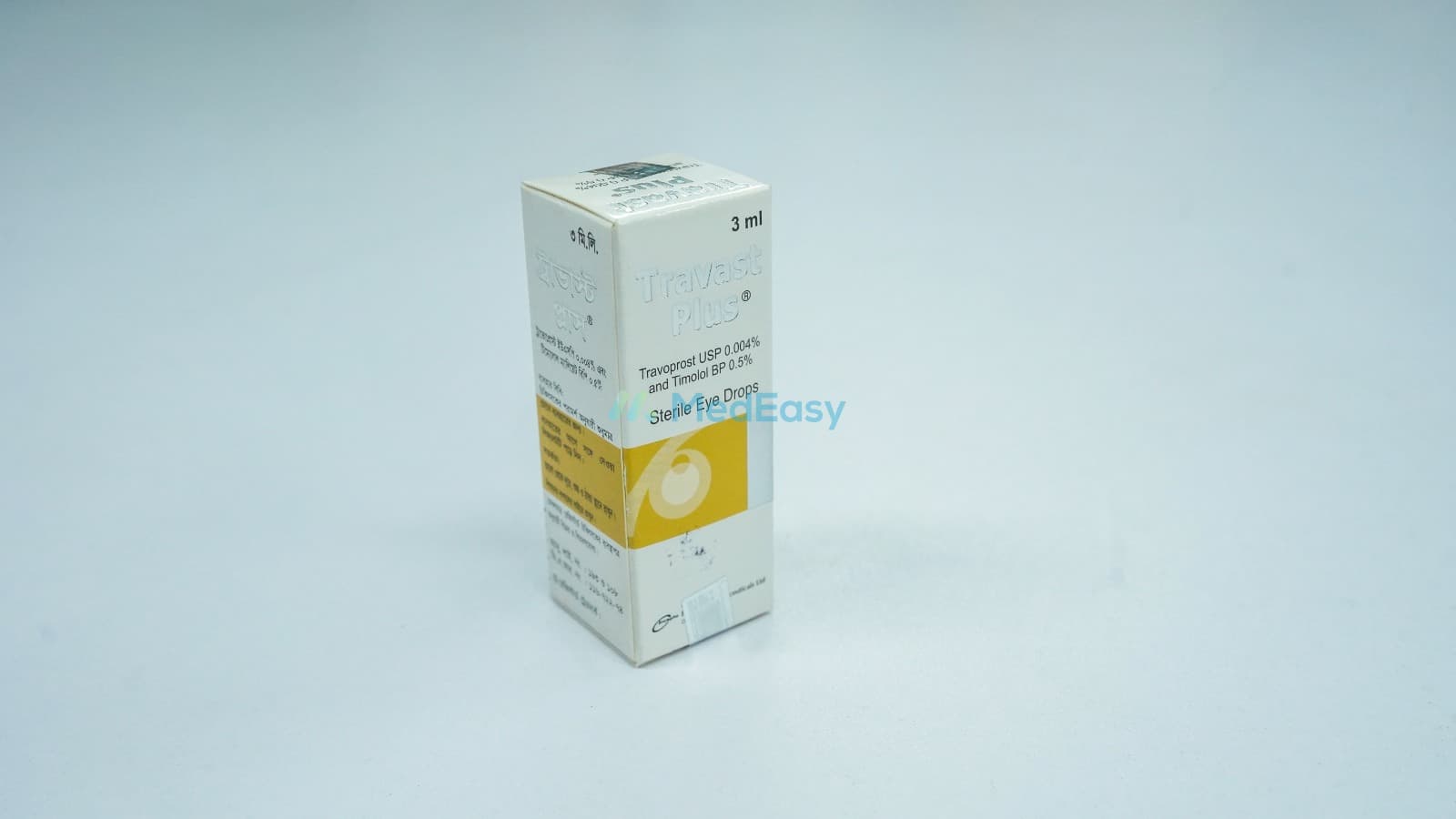

Travast Plus ophthalmic solution is a fixed-dose combination indicated for the reduction of elevated intraocular pressure (IOP) in patients with open-angle glaucoma or ocular hypertension.
Travast Plus is not indicated for angle-closure glaucoma or pediatric glaucoma, for which safety and efficacy have not been established.
Each mL of Travoprost + Timolol Maleate sterile ophthalmic solution contains Travoprost 40 micrograms (0.004% w/v) and Timolol Maleate equivalent to Timolol 5 mg (0.5% w/v), formulated as a preserved, isotonic aqueous solution for topical ocular administration.
Travast Plus is a fixed-combination topical ophthalmic solution combining two complementary classes of ocular hypotensive agents: a prostaglandin F2α analogue (travoprost) and a non-selective beta-adrenergic receptor blocking agent (timolol maleate). It is formulated as a once-daily eye drop for patients with open-angle glaucoma or ocular hypertension who need additional IOP lowering beyond what either agent achieves alone.
Ophthalmic anti-glaucoma agent — fixed-dose combination of a prostaglandin F2α analogue and a non-selective beta-adrenergic blocking agent; Travast Plus belongs to the combination ocular hypotensive drug class.
Travoprost + Timolol Maleate lowers intraocular pressure through two complementary mechanisms:
The two mechanisms — increased outflow and decreased production — act additively to produce a greater reduction in IOP than either component alone.
| Indication | Adult Dose | Pediatric Dose |
|---|---|---|
| Open-angle glaucoma / ocular hypertension inadequately controlled on monotherapy | One drop of Travast Plus in the affected eye(s) once daily, in the morning | Safety and efficacy not established; not recommended |
Do not exceed once-daily administration — more frequent dosing may reduce the IOP-lowering effect. If a dose is missed, continue with the next scheduled dose; do not double up.
No dosage adjustment is established or generally required for renal or hepatic impairment given the low systemic exposure from topical ocular use, but caution is still advised (see Use in Special Populations).
For topical ophthalmic (eye) use only — not for injection or oral use.
Clinically significant interactions with Travast Plus arise mainly from the timolol component's systemic beta-blocking effect:
Travoprost + Timolol Maleate is contraindicated in patients with:
The most commonly reported adverse effects of Travast Plus are ocular and generally mild to moderate:
| Category | Effects |
|---|---|
| Very common/common ocular | Conjunctival/ocular hyperemia (redness), eye irritation or discomfort, foreign body sensation, ocular pruritus, dry eye, punctate keratitis, blurred vision, eye pain |
| Prostaglandin (travoprost)-related | Increased iris pigmentation (often permanent), eyelash changes (increased length, thickness, darkening), periorbital/eyelid skin pigmentation changes |
| Timolol-related systemic (uncommon but serious) | Bradycardia, hypotension, bronchospasm, dyspnea, fatigue, headache |
Patients should report any unusual eye changes, breathing difficulty, or cardiovascular symptoms to their physician promptly.
Pregnancy: Travast Plus should be used during pregnancy only if clearly needed and the potential benefit justifies the potential risk to the fetus. Animal reproduction studies with prostaglandin analogues have shown potential for fetal harm at systemic exposures; adequate, well-controlled human studies are lacking. Use is generally not recommended unless no safer alternative exists.
Lactation: The timolol component is excreted in human breast milk. Because of the potential for serious adverse reactions in nursing infants (including cardiovascular and respiratory effects), a decision should be made whether to discontinue breastfeeding or discontinue Travast Plus, considering the importance of treatment to the mother. Consult a physician before use while breastfeeding.
Ocular overdose: If excess Travast Plus is instilled, flush the eye(s) with lukewarm water.
Systemic overdose (e.g., accidental ingestion): May produce systemic beta-blockade effects such as bradycardia, hypotension, bronchospasm, and acute cardiac failure. There is no specific antidote. Seek immediate medical attention or contact a poison control center/emergency services; treatment is supportive and symptomatic, and should be managed under direct medical supervision.
Store at room temperature (below 30°C), protected from light and moisture. Do not freeze. Once opened, discard any remaining solution after 4 weeks even if some solution remains in the bottle. Keep out of reach of children.
Travast Plus is typically used long-term/chronically for as long as needed to control intraocular pressure, under regular ophthalmologic monitoring (IOP measurement, optic nerve and visual field assessment). Treatment duration and continued suitability should be reassessed periodically by the prescribing physician.
Fixed-dose combination of a prostaglandin F2α analogue (travoprost) and a non-selective beta-adrenergic receptor blocking agent (timolol maleate); classified as an ophthalmic anti-glaucoma / ocular hypotensive combination agent. Travoprost + Timolol Maleate is not an antibiotic or antimicrobial.
Travoprost + Timolol Maleate combines two distinct ocular hypotensive mechanisms in one formulation:
Because the two agents act on different aspects of aqueous humor dynamics (outflow versus production), their combined effect on IOP reduction is additive.
C (FDA legacy pregnancy category, based on the individual components travoprost and timolol)
Safety and efficacy of Travast Plus have not been established in pediatric patients. Use in children and adolescents is not recommended outside of specialist supervision, and alternative, better-studied therapies should generally be considered for pediatric glaucoma.
Q: What is Travast Plus 0.004%+0.5% Ophthalmic Solution used for?
A: Travast Plus 0.004%+0.5% Ophthalmic Solution is a combination eye drop used to lower elevated intraocular pressure in adults with open-angle glaucoma or ocular hypertension who are not adequately controlled on a single eye-pressure-lowering medicine.
Q: How often should I use Travast Plus 0.004%+0.5% Ophthalmic Solution?
A: The usual dose is one drop in the affected eye(s) once daily, in the morning. Using it more often than once daily may actually make it less effective, so do not increase the frequency without your doctor's advice.
Q: Can Travast Plus 0.004%+0.5% Ophthalmic Solution change the color of my eyes?
A: Yes. Travast Plus 0.004%+0.5% Ophthalmic Solution can cause a gradual, often permanent increase in brown pigmentation of the iris, as well as darkening and thickening of the eyelashes and eyelid skin. This is more noticeable if only one eye is treated. Discuss this possibility with your doctor before starting treatment.
Q: Who should not use Travast Plus 0.004%+0.5% Ophthalmic Solution?
A: Travast Plus 0.004%+0.5% Ophthalmic Solution should not be used by people who are allergic to travoprost, timolol, or any ingredient in the drops, or who have asthma or severe COPD, certain heart rhythm problems (such as sinus bradycardia or high-degree heart block not controlled by a pacemaker), overt heart failure, or cardiogenic shock, because the timolol component is absorbed into the body even from eye drops and can affect the heart and lungs.
Q: Is Travast Plus 0.004%+0.5% Ophthalmic Solution safe during pregnancy or breastfeeding?
A: Travast Plus 0.004%+0.5% Ophthalmic Solution should be used in pregnancy only if clearly necessary, as it may pose a risk to the fetus, and the timolol component passes into breast milk and could affect a nursing infant. Always consult your physician before using Travast Plus 0.004%+0.5% Ophthalmic Solution if you are pregnant, planning pregnancy, or breastfeeding.
Q: What should I do if I accidentally swallow Travast Plus 0.004%+0.5% Ophthalmic Solution or use too much?
A: If too much is instilled in the eye, flush the eye with warm water. If someone swallows Travast Plus 0.004%+0.5% Ophthalmic Solution, it can cause slow heart rate, low blood pressure, or breathing difficulty; seek immediate medical attention or contact a poison control center right away.
Disclaimer
The information provided is accurate to the best of our knowledge, but it does not replace professional medical advice. We cannot guarantee its completeness or accuracy, and the absence of specific information about a drug should not be taken as an endorsement. We are not responsible for any consequences arising from this information, so please consult a healthcare professional for any concerns or questions.
