
10% Off
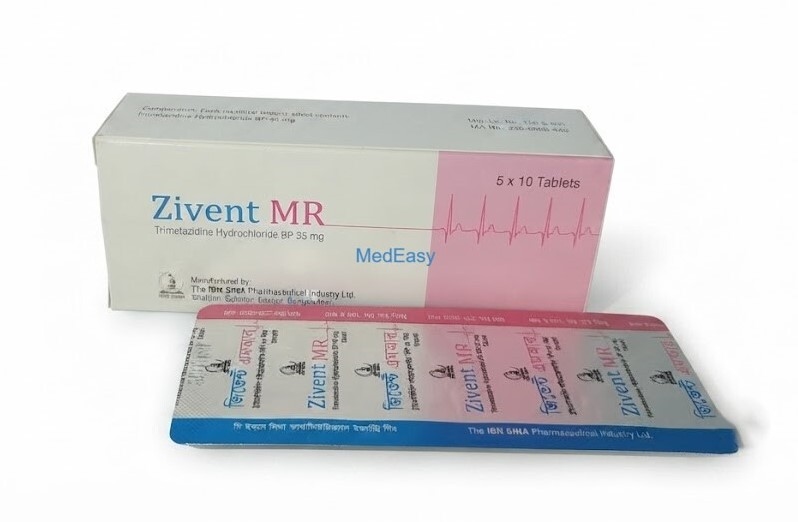
Zivent MR35 mg
Ibn-Sina Pharmaceuticals Ltd.
৳36.00
Add to cart


Tricard MR is indicated as add-on (adjunct) therapy for the symptomatic treatment of adult patients with stable angina pectoris who are inadequately controlled by, or are intolerant to, first-line antianginal therapies (such as beta-blockers or calcium channel blockers).
Full antianginal benefit is generally assessed after about three months of treatment; if no adequate response is seen, the physician may reconsider therapy.
Each tablet contains Trimetazidine Dihydrochloride as the active pharmaceutical ingredient, commonly available as:
Tablets also contain standard pharmaceutical excipients (binders, fillers, coating agents) that vary by manufacturer.
Tricard MR is a piperazine-derivative anti-anginal (anti-ischemic) agent that works through a metabolic mechanism rather than by altering heart rate or blood pressure. It is used as an add-on treatment for chronic stable angina in patients not adequately controlled on conventional antianginal drugs.
Unlike hemodynamic antianginal agents (beta-blockers, nitrates, calcium channel blockers), Tricard MR does not act on coronary blood flow or cardiac workload; instead it improves the heart muscle's tolerance to ischemia by optimizing its energy metabolism.
Tricard MR belongs to the class of anti-anginal / anti-ischemic metabolic agents, distinct from beta-blockers, nitrates, and calcium channel blockers.
Trimetazidine Dihydrochloride is a metabolic (cytoprotective) anti-ischemic agent. It inhibits the mitochondrial enzyme long-chain 3-ketoacyl-CoA thiolase (3-KAT), which partially shifts myocardial energy metabolism away from fatty-acid beta-oxidation toward glucose oxidation.
Because glucose oxidation requires less oxygen per unit of ATP generated than fatty-acid oxidation, this shift improves the efficiency of oxygen use by the ischemic myocardium, reduces intracellular acidosis and calcium overload, and helps maintain cellular energy homeostasis during ischemia.
Importantly, Trimetazidine Dihydrochloride has no significant hemodynamic effects — it does not significantly change heart rate, blood pressure, or coronary vascular tone, distinguishing its mechanism from that of conventional antianginal drugs.
| Formulation | Dose |
|---|---|
| Modified-release (MR) tablet 35 mg | One tablet twice daily, with meals (morning and evening) |
| Immediate-release tablet 20 mg | One tablet three times daily, with meals |
| Creatinine Clearance | Recommended Dose |
|---|---|
| 30–60 mL/min (moderate impairment) | 35 mg once daily (morning) or 20 mg twice daily |
| Below 30 mL/min (severe impairment) | Contraindicated — see Contraindications |
Elderly patients, particularly those with reduced renal function, should be dosed cautiously; the renal-impairment dosing schedule above should be applied if creatinine clearance is reduced.
No well-established dose adjustment has been defined for hepatic impairment; use with caution and physician supervision.
Antianginal benefit with Tricard MR should be reassessed after approximately three months of treatment; if no symptomatic improvement is observed, the physician should consider discontinuing therapy.
Tricard MR tablets should be taken orally, with meals, swallowed whole with water. Modified-release tablets should not be crushed or chewed, as this may alter the controlled-release properties of the tablet.
Tricard MR has a low potential for clinically significant drug interactions and has not been reported to interact adversely with common cardiovascular medicines such as beta-blockers, calcium channel blockers, nitrates, heparin, digitalis (digoxin) preparations, or lipid-lowering agents, and it can generally be co-administered with these drugs.
As with any centrally-acting-symptom-associated medicine, caution is advised when Tricard MR is combined with drugs known to cause or worsen extrapyramidal/movement symptoms (e.g., certain antipsychotics, metoclopramide), because of the shared risk of parkinsonian symptoms — see Precautions and Warnings.
Trimetazidine Dihydrochloride is contraindicated in patients with:
Adverse effects reported with Tricard MR are usually mild and transient. Common effects include:
Important (uncommon/rare) effects: Movement disorders — parkinsonian symptoms (tremor, rigidity, akinesia), gait instability, restless legs syndrome — have been reported, usually reversible after discontinuation (see Precautions and Warnings). Other rare effects include palpitations, extrasystoles, tachycardia, hypotension, and, very rarely, hepatic disorders and severe skin reactions (e.g., acute generalized exanthematous pustulosis).
Pregnancy: Data on use of Tricard MR during pregnancy are insufficient. As a precaution, it is preferable to avoid using Tricard MR during pregnancy. It should be used only if clearly needed and if the potential benefit to the mother justifies the potential risk to the fetus, and only after consulting a physician.
Lactation: It is not known whether Tricard MR or its metabolites are excreted in human breast milk. As a precaution, Tricard MR should not be used during breastfeeding; a physician should be consulted to weigh alternatives.
Movement disorders: Tricard MR may cause or worsen parkinsonian symptoms (tremor, akinesia, hypertonia), gait/balance disorders, restless legs syndrome, and other related movement disorders, particularly in elderly patients. Patients should be monitored regularly, especially early in treatment, and referred to a neurologist if symptoms occur. If such symptoms develop, Tricard MR should be discontinued; symptoms usually resolve within four months of stopping treatment. If parkinsonian symptoms persist beyond four months, neurological evaluation is required.
Not for acute attacks: Tricard MR has no established value in the initial treatment of unstable angina or myocardial infarction, and it does not provide relief for an acute anginal episode; it is intended solely as add-on background therapy.
Renal impairment: Dose should be reduced in moderate renal impairment and Tricard MR is contraindicated in severe renal impairment (see Dosage and Administration and Contraindications).
Falls risk: Because Tricard MR can cause dizziness and movement/balance disturbances, caution is advised in elderly patients and those at risk of falls, and in patients who drive or operate machinery until they know how the medicine affects them.
Limited data exist on overdose with Tricard MR. In case of suspected overdose, symptoms may include exaggeration of known adverse effects. There is no specific antidote. Any suspected overdose should be treated as a medical emergency — seek immediate medical attention or contact a poison control center/emergency services promptly. Management is supportive and symptomatic, based on clinical assessment in a medical facility; do not attempt specific home treatment.
Store at room temperature (below 30°C), away from light and moisture. Keep out of reach of children.
Elderly patients may be more susceptible to movement disorders and dizziness with Tricard MR; caution and renal-function-based dose adjustment are advised (see Dosage and Administration).
Dose reduction required in moderate renal impairment; contraindicated in severe renal impairment (creatinine clearance below 30 mL/min).
No well-established dosing data are available; use with caution under physician supervision.
Safety and efficacy of Tricard MR in children and adolescents have not been established; it is not recommended for use in this population.
Antianginal efficacy of Tricard MR should be evaluated after approximately three months of continuous treatment. If no satisfactory therapeutic response is observed by that time, the treating physician should reassess and consider discontinuing Tricard MR. Beyond this evaluation point, treatment duration is individualized by the prescribing physician based on ongoing symptom control.
Anti-anginal agent; metabolic/anti-ischemic agent (piperazine derivative).
Trimetazidine Dihydrochloride selectively inhibits long-chain 3-ketoacyl-CoA thiolase (3-KAT), a key enzyme in mitochondrial fatty-acid beta-oxidation. By partially inhibiting fatty-acid oxidation, it shifts myocardial substrate utilization toward glucose oxidation, which requires less oxygen per ATP molecule produced. This improves the energy efficiency of ischemic cardiac cells, limits intracellular acidosis and ionic imbalance (sodium/calcium overload), and helps preserve cell membrane integrity during ischemia — without altering heart rate, blood pressure, or coronary blood flow.
The safety and efficacy of Tricard MR in pediatric patients (below 18 years) have not been established. Tricard MR is therefore not recommended for use in children or adolescents.
Q: What is Tricard MR 35 mg Tablet (Modified Release) used for?
A: Tricard MR 35 mg Tablet (Modified Release) is used as an add-on (adjunct) treatment for chronic stable angina in adults who are not adequately controlled by, or cannot tolerate, first-line antianginal medicines such as beta-blockers or calcium channel blockers. It is not used alone to treat an acute angina attack.
Q: Can Tricard MR 35 mg Tablet (Modified Release) stop a sudden chest pain (angina) attack?
A: No. Tricard MR 35 mg Tablet (Modified Release) is not a rescue medication and has no proven role in relieving an acute anginal attack or treating unstable angina or a heart attack. It works over time as background, add-on therapy alongside other antianginal medicines.
Q: Who should not take Tricard MR 35 mg Tablet (Modified Release)?
A: Tricard MR 35 mg Tablet (Modified Release) should not be used by people who are hypersensitive to it or its ingredients, people with Parkinson's disease or other movement disorders (such as tremor or restless legs syndrome), or people with severe kidney impairment. Always inform your physician of your full medical history before starting Tricard MR 35 mg Tablet (Modified Release).
Q: Does Tricard MR 35 mg Tablet (Modified Release) cause any serious side effects?
A: Tricard MR 35 mg Tablet (Modified Release) can, in some patients, cause or worsen movement disorders such as tremor, muscle stiffness, unsteady walking, or restless legs syndrome, resembling Parkinson's disease. These effects are usually reversible after stopping the medicine, but you should tell your doctor right away if they occur so that Tricard MR 35 mg Tablet (Modified Release) can be discontinued and you can be evaluated.
Q: Is Tricard MR 35 mg Tablet (Modified Release) safe during pregnancy or breastfeeding?
A: Data on the use of Tricard MR 35 mg Tablet (Modified Release) during pregnancy are limited, so it is generally avoided in pregnancy and should only be used if a physician determines the benefit clearly outweighs the potential risk. It is also not recommended during breastfeeding, as it is not known whether it passes into breast milk. Always consult your physician before use in these situations.
Q: How should I take Tricard MR 35 mg Tablet (Modified Release), and what if I miss a dose or take too much?
A: Tricard MR 35 mg Tablet (Modified Release) is typically taken with meals, either as a 35 mg modified-release tablet twice daily or a 20 mg tablet three times daily, exactly as prescribed by your physician. If you miss a dose, take it when you remember unless it is close to the next dose — do not double up. If an overdose is suspected, seek immediate medical attention or contact emergency/poison control services right away, as there is no specific antidote.
Disclaimer
The information provided is accurate to the best of our knowledge, but it does not replace professional medical advice. We cannot guarantee its completeness or accuracy, and the absence of specific information about a drug should not be taken as an endorsement. We are not responsible for any consequences arising from this information, so please consult a healthcare professional for any concerns or questions.

