
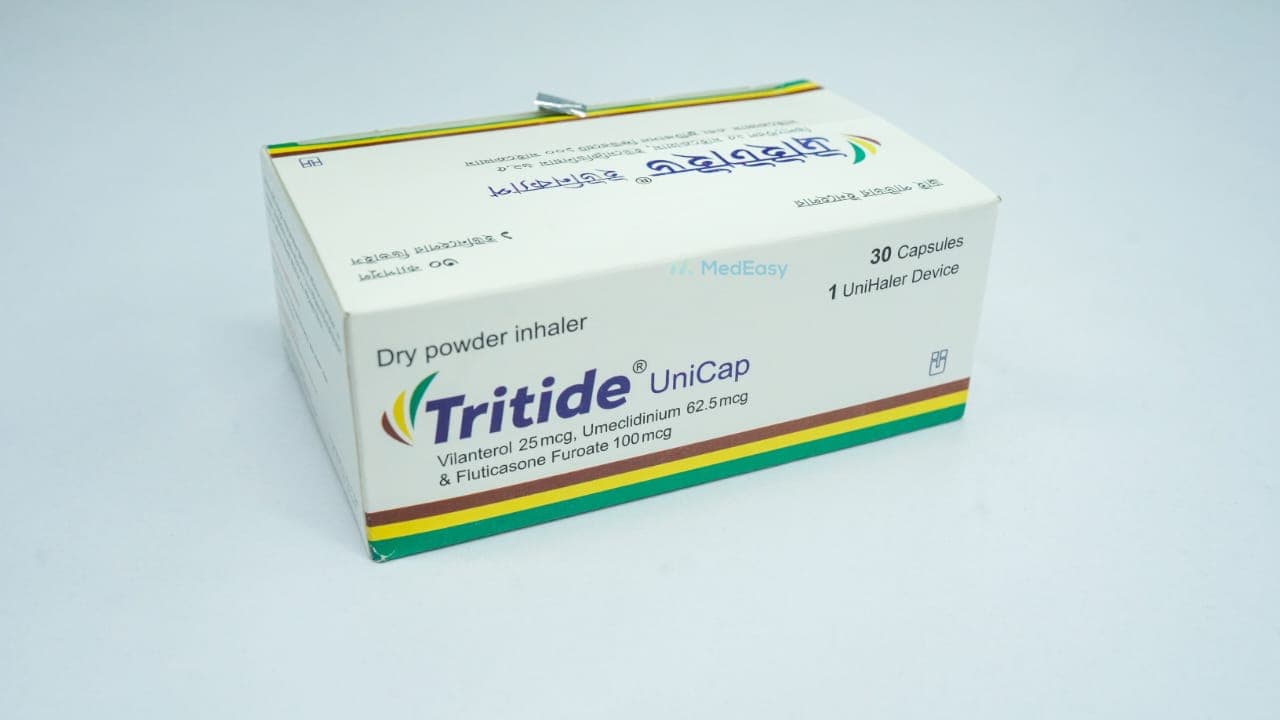
Tritide25 mcg+62.5 mcg+100 mcg

Medicine overview
Indications of Tritide
Tritide is a fixed-dose triple combination inhaled medicine used as long-term, once-daily maintenance treatment of chronic obstructive pulmonary disease (COPD).
Established / Approved Uses
- Maintenance treatment of COPD: for long-term, once-daily maintenance treatment of airflow obstruction in patients with chronic obstructive pulmonary disease, including chronic bronchitis and/or emphysema, and to reduce exacerbations of COPD in patients with a history of exacerbations.
- Step-up (triple) therapy: for patients whose COPD remains symptomatic, or who continue to have exacerbations, on dual therapy with a long-acting bronchodilator combination or an inhaled corticosteroid/long-acting beta-agonist combination, per guideline-directed step-up care (e.g. GOLD strategy).
Important Limitations
- Tritide is not indicated for the relief of acute bronchospasm or as a rescue inhaler; a separate short-acting bronchodilator should be used for acute symptoms.
- Not all formulations of Tritide are approved for asthma; use only for the specific indication approved for the exact product/strength dispensed, and follow the specific product labeling.
Composition
Vilanterol + Umeclidinium and Fluticasone Furote is a fixed-dose combination of three active ingredients delivered as a dry powder inhaler for oral inhalation:
- Vilanterol (as vilanterol trifenatate) – a long-acting beta2-adrenergic agonist (LABA), typically 25 mcg per actuation.
- Umeclidinium (as umeclidinium bromide) – a long-acting muscarinic antagonist (LAMA), typically 62.5 mcg per actuation.
- Fluticasone Furoate – an inhaled corticosteroid (ICS), typically available in 100 mcg or 200 mcg strengths per actuation.
Each actuation delivers a metered dose of all three components in a single inhalation from a multi-dose dry powder inhaler device.
Description
Tritide is a triple combination inhaled therapy that brings together three complementary mechanisms of action in a single once-daily device for the maintenance treatment of chronic obstructive pulmonary disease (COPD).
Vilanterol relaxes airway smooth muscle by stimulating beta2-adrenergic receptors, umeclidinium blocks muscarinic receptors to reduce bronchoconstriction mediated by acetylcholine, and fluticasone furoate reduces airway inflammation as an inhaled corticosteroid. Together, these three components provide sustained bronchodilation and anti-inflammatory control over a 24-hour period with a single daily inhalation.
Tritide is intended for long-term, regular maintenance use and is not a substitute for a fast-acting rescue inhaler during acute symptoms.
Therapeutic Class
Tritide belongs to the therapeutic class of triple combination inhaled bronchodilator and anti-inflammatory therapy for obstructive airway disease, combining:
- A long-acting beta2-agonist (LABA) bronchodilator
- A long-acting muscarinic antagonist (LAMA) bronchodilator
- An inhaled corticosteroid (ICS)
Pharmacology
Vilanterol + Umeclidinium and Fluticasone Furote works through three distinct and complementary pharmacological mechanisms:
Vilanterol (LABA)
Selectively stimulates beta2-adrenergic receptors on airway smooth muscle, increasing intracellular cyclic AMP and producing sustained relaxation of bronchial smooth muscle (bronchodilation) for approximately 24 hours.
Umeclidinium (LAMA)
Competitively and reversibly blocks the action of acetylcholine at M3 muscarinic receptors in airway smooth muscle, inhibiting cholinergically mediated bronchoconstriction and producing additional, complementary bronchodilation.
Fluticasone Furoate (ICS)
Binds to glucocorticoid receptors, exerting broad anti-inflammatory action within the airway (reducing inflammatory cell recruitment, cytokine release, and mucosal edema), which reduces the frequency of COPD exacerbations.
Pharmacokinetically, all three components are absorbed systemically to a small extent following inhalation, with vilanterol and fluticasone furoate undergoing extensive first-pass metabolism (largely via CYP3A4) and umeclidinium undergoing both metabolic and biliary/renal elimination.
Dosage & Administration of Tritide
Dosage
| Indication | Recommended Dose |
|---|---|
| Maintenance treatment of COPD (adults) | One inhalation once daily, at the same time each day, using the specific strength of Tritide prescribed. |
The maximum recommended dose is one inhalation once daily; do not use more than one inhalation in a 24-hour period.
Administration
- For oral inhalation only, using the multi-dose dry powder inhaler device provided.
- Administer at the same time each day to maintain consistent 24-hour bronchodilation.
- Rinse the mouth with water (without swallowing) after each use to reduce the risk of oral candidiasis and hoarseness.
- Do not use with a spacer device; do not exhale into the inhaler.
- If a dose is missed, take the next dose at the usual time the following day; do not take two doses at the same time.
Administration of Tritide
Tritide is administered by oral inhalation using its dedicated dry powder inhaler device. Key steps:
- Slide open the cover of the device until it clicks, exposing the mouthpiece and preparing the dose; do not shake the device.
- Breathe out fully away from the device (never into the mouthpiece).
- Place the mouthpiece between the lips and take one long, steady, deep breath in through the mouth; do not breathe in through the nose.
- Remove the inhaler and hold the breath for about 3-4 seconds or as long as comfortable.
- Close the cover to reset the device for the next dose.
- Rinse the mouth with water after use without swallowing.
- Do not wash or put the mouthpiece in water; keep the device dry.
Interaction of Tritide
Tritide has the following well-documented, clinically significant interactions:
- Strong CYP3A4 inhibitors (e.g. ketoconazole, ritonavir, cobicistat): can substantially increase systemic exposure to the vilanterol and fluticasone furoate components, increasing the risk of cardiovascular effects and systemic corticosteroid effects (including adrenal suppression). Co-administration should generally be avoided; if unavoidable, monitor closely.
- Beta-adrenergic blockers: may block the bronchodilator effect of vilanterol and can produce severe bronchospasm; use with caution, preferring cardioselective agents if a beta-blocker is required.
- Non-potassium-sparing diuretics (e.g. loop or thiazide diuretics): ECG changes and/or hypokalemia associated with beta-agonists may be worsened; use with caution.
- Monoamine oxidase inhibitors (MAOIs) and tricyclic antidepressants: may potentiate the cardiovascular effects of vilanterol (e.g. QT prolongation); use with extreme caution or avoid within 2 weeks of MAOI use.
- Other anticholinergic-containing medicines or other LABA-containing medicines: concomitant use with other medicines containing an anticholinergic or a long-acting beta-agonist is not recommended, due to the risk of additive effects and overdose-type toxicity. See Contraindications and Precautions.
Contraindications
Vilanterol + Umeclidinium and Fluticasone Furote is contraindicated in patients with:
- Known hypersensitivity to vilanterol, umeclidinium, fluticasone furoate, or any excipient of the product.
- Severe hypersensitivity to milk proteins, as some dry powder inhaler formulations use lactose containing trace amounts of milk protein.
Side Effects of Tritide
The most commonly reported side effects of Tritide include:
- Nasopharyngitis (common cold-like symptoms)
- Upper respiratory tract infection
- Headache
- Oral candidiasis (thrush) and hoarseness/dysphonia
- Back pain
- Cough
- Diarrhea
- Arthralgia
Less common but clinically important effects include palpitations, tremor, tachycardia, dysgeusia (altered taste), constipation, dry mouth, and urinary retention. See Precautions and Warnings for serious risks such as paradoxical bronchospasm, pneumonia, and cardiovascular effects.
Pregnancy & Lactation
Pregnancy: There are limited human data on the use of Tritide in pregnant women. It should be used during pregnancy only if the potential benefit to the mother justifies the potential risk to the fetus, since uncontrolled COPD symptoms during pregnancy can themselves pose risks to both mother and fetus. Use only under the guidance of a physician.
Lactation: It is not known whether the components of Tritide are excreted in human milk, though systemic absorption after inhalation is low. A decision should be made whether to continue breastfeeding or discontinue the medicine, considering the benefit of breastfeeding and the mother's clinical need, in consultation with a physician.
Precautions & Warnings
The following precautions and warnings apply to Tritide:
- Not for acute symptoms: not indicated to treat acute episodes of bronchospasm; a separate fast-acting rescue inhaler should be available and used for acute symptoms.
- Cardiovascular effects: the beta-agonist component can produce clinically significant cardiovascular effects (tachycardia, palpitations, and rarely arrhythmia) in some patients; use with caution in patients with cardiovascular disease.
- Paradoxical bronchospasm: may occur with inhaled bronchodilators; discontinue immediately and treat with an alternative therapy if this occurs.
- Increased risk of pneumonia: inhaled corticosteroids in patients with COPD are associated with an increased incidence of pneumonia; monitor for signs and symptoms of lower respiratory tract infection.
- Local oropharyngeal effects: oral candidiasis and dysphonia can occur; rinse the mouth with water after each use to reduce risk.
- Anticholinergic effects: may worsen narrow-angle glaucoma and urinary retention (particularly in patients with prostatic hyperplasia or bladder-neck obstruction); use with caution and seek prompt medical advice if eye pain, blurred vision, or urinary difficulty occurs.
- Systemic corticosteroid effects: long-term use of the inhaled corticosteroid component may cause adrenal suppression, reduced bone mineral density, and other systemic effects, especially at higher doses or with concomitant strong CYP3A4 inhibitors; use the lowest effective dose.
- Immunosuppression: caution is advised in patients with active or quiescent tuberculosis, untreated systemic infections, or ocular herpes simplex, due to the corticosteroid component.
- Do not use with similar medicines: avoid concomitant use with other LABA- or LAMA-containing medicines. See Interactions.
Overdose Effects of Tritide
Overdose of Tritide may produce exaggerated effects of its individual components, such as cardiovascular effects (tachycardia, arrhythmias, chest pain, high or low blood pressure), tremor, headache, dry mouth, blurred vision, urinary retention, and, with excessive corticosteroid exposure, signs of hypercorticism. If an overdose is suspected, seek immediate medical attention or contact emergency services / a poison control center right away. Treatment is supportive and should be managed by a physician; do not attempt specific home treatment.
Storage Conditions
Store at room temperature, ideally between 20-25°C (68-77°F); brief excursions to 15-30°C are permitted. Keep the inhaler inside its sealed foil tray until ready for first use, and keep the mouthpiece cover closed when not in use. Discard the inhaler 6 weeks after opening the foil tray, or when the dose counter reads 0, whichever comes first. Do not wash or get the mouthpiece wet. Keep out of reach and sight of children.
Use In Special Populations
Renal Impairment
No dose adjustment of Tritide is required in patients with mild to moderate renal impairment. Use with caution in patients with severe renal impairment, including those with end-stage renal disease requiring dialysis, due to potential accumulation of the umeclidinium component.
Hepatic Impairment
No dose adjustment is required in mild to moderate hepatic impairment. Use with caution in patients with severe hepatic impairment, as increased systemic exposure to fluticasone furoate may raise the risk of systemic corticosteroid effects.
Elderly
No dose adjustment is required based on age alone; safety and efficacy in elderly patients are generally comparable to younger adults, though age-related comorbidities should be considered.
Duration Of Treatment
Tritide is intended for long-term, regular, once-daily maintenance treatment of COPD and is not intended for short-term or as-needed use. It should be continued for as long as prescribed by the physician for ongoing control of symptoms and reduction of exacerbations, with periodic review of continued need and response to treatment. Do not stop treatment abruptly without medical advice, even if symptoms improve.
Drug Classes
Triple combination inhaled therapy: long-acting beta2-agonist (LABA) + long-acting muscarinic antagonist (LAMA) + inhaled corticosteroid (ICS).
Mode Of Action
Vilanterol + Umeclidinium and Fluticasone Furote acts through three complementary mechanisms: vilanterol stimulates beta2-adrenergic receptors to relax airway smooth muscle; umeclidinium blocks M3 muscarinic receptors to inhibit cholinergically mediated bronchoconstriction; and fluticasone furoate binds glucocorticoid receptors to suppress airway inflammation. Together they provide sustained, 24-hour bronchodilation combined with anti-inflammatory control that reduces COPD exacerbations.
Pediatric Uses
The safety and efficacy of Tritide have not been established in pediatric patients. It is not indicated for use in children, and COPD itself is rare in the pediatric population. Use in this age group should only occur under specialist physician guidance if no suitable alternative exists.
Frequently Asked Questions
Q: What is Tritide 25 mcg+62.5 mcg+100 mcg UniCap used for?
A: Tritide 25 mcg+62.5 mcg+100 mcg UniCap is a once-daily inhaled medicine used for the long-term maintenance treatment of chronic obstructive pulmonary disease (COPD). It is not for treating sudden breathing attacks.
Q: How often should I use Tritide 25 mcg+62.5 mcg+100 mcg UniCap?
A: Tritide 25 mcg+62.5 mcg+100 mcg UniCap should be inhaled once daily, at the same time each day, using exactly one inhalation. Do not use it more than once a day.
Q: Can Tritide 25 mcg+62.5 mcg+100 mcg UniCap be used for a sudden asthma or COPD attack?
A: No. Tritide 25 mcg+62.5 mcg+100 mcg UniCap is a maintenance medicine and does not act quickly enough to relieve sudden breathing difficulty. A separate fast-acting rescue inhaler should be used for acute symptoms, and you should seek medical attention if symptoms worsen suddenly.
Q: What should I do after using Tritide 25 mcg+62.5 mcg+100 mcg UniCap?
A: Rinse your mouth with water and spit it out (do not swallow) after every dose. This helps prevent oral thrush and hoarseness, which are known side effects of the inhaled corticosteroid component.
Q: Is Tritide 25 mcg+62.5 mcg+100 mcg UniCap safe during pregnancy?
A: Tritide 25 mcg+62.5 mcg+100 mcg UniCap should only be used during pregnancy if your physician determines that the benefit outweighs the potential risk, since uncontrolled COPD itself can be harmful during pregnancy. Always consult your physician before use if you are pregnant or planning pregnancy.
Q: Who should not use Tritide 25 mcg+62.5 mcg+100 mcg UniCap?
A: Tritide 25 mcg+62.5 mcg+100 mcg UniCap should not be used by anyone with a known hypersensitivity to vilanterol, umeclidinium, fluticasone furoate, or any ingredient of the product, or by those with a severe milk-protein allergy, since some inhaler formulations contain trace milk proteins.
Disclaimer
The information provided is accurate to the best of our knowledge, but it does not replace professional medical advice. We cannot guarantee its completeness or accuracy, and the absence of specific information about a drug should not be taken as an endorsement. We are not responsible for any consequences arising from this information, so please consult a healthcare professional for any concerns or questions.
