
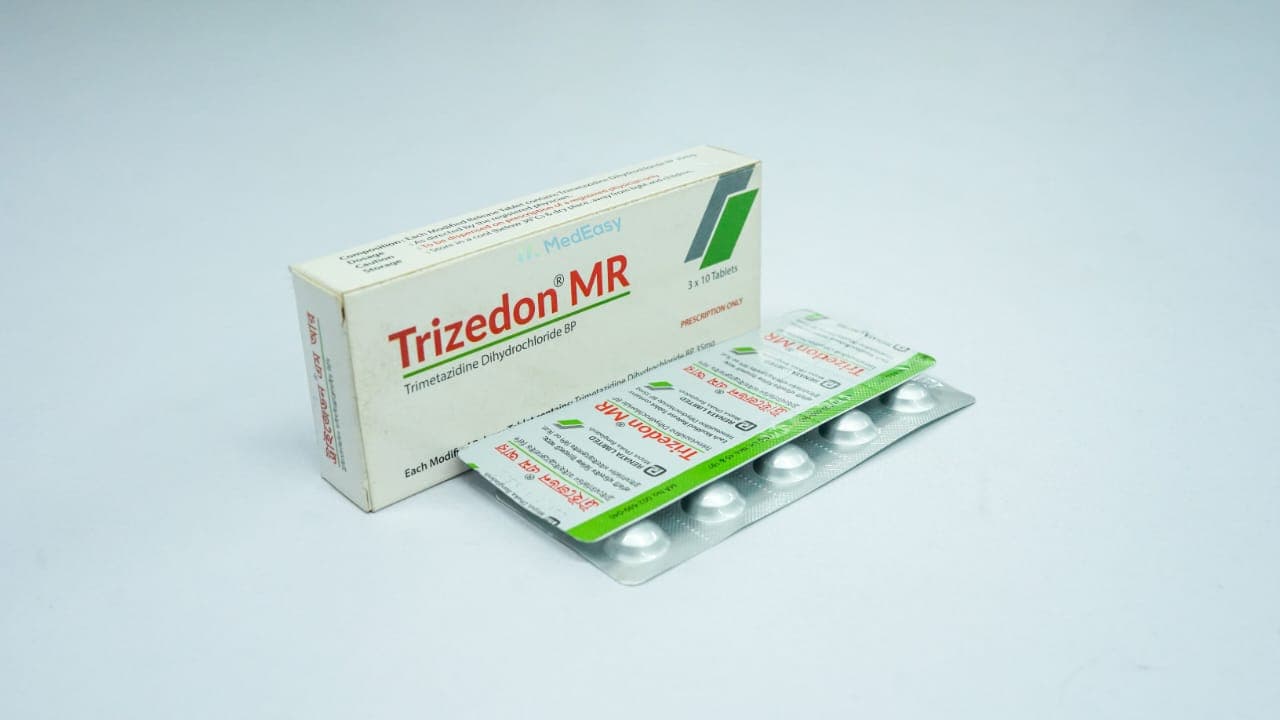

Medicine overview
Indications of Trizedon MR
Trizedon MR is indicated as an add-on (adjunct) symptomatic treatment of stable angina pectoris in adult patients who are inadequately controlled by, or intolerant of, first-line anti-anginal therapies such as beta-blockers, calcium channel blockers, or nitrates.
- Established/guideline-supported use: Adjunct treatment of chronic stable angina pectoris, used in combination with first-line anti-anginal agents, not as monotherapy or first-line treatment.
- Historical/off-label use (not recommended currently): Trizedon MR was previously used in some markets as adjunct therapy for vertigo, tinnitus, and visual disturbances of vascular origin; due to safety concerns (movement disorders), regulatory authorities have restricted labeling to angina only, and such other uses are no longer recommended.
Trizedon MR should not replace first-line anti-anginal therapy; it should only be initiated by, or under the supervision of, a specialist physician.
Composition
Each tablet of Trimetazidine Dihydrochloride BP contains Trimetazidine Dihydrochloride USP/BP equivalent to the labelled strength (commonly 20 mg as a conventional immediate-release tablet, or 35 mg as a modified-release tablet), along with pharmaceutically accepted excipients.
Description
Trizedon MR is a metabolic anti-anginal agent chemically unrelated to nitrates, beta-blockers, or calcium channel blockers. It is classified as a partial fatty-acid oxidation (pFOX) inhibitor that acts directly at the level of ischemic myocardial cells.
Unlike conventional hemodynamically-acting anti-anginal drugs, Trizedon MR does not lower heart rate or blood pressure; instead, it optimizes cardiac cellular energy metabolism, helping the heart tolerate reduced oxygen and nutrient supply during ischemia.
Therapeutic Class
Trizedon MR belongs to the therapeutic class of anti-anginal agents (myocardial cytoprotective / metabolic agents), distinct from nitrates, beta-blockers, and calcium channel blockers.
Pharmacology
Trimetazidine Dihydrochloride BP is a partial inhibitor of fatty-acid oxidation. It selectively inhibits the mitochondrial enzyme long-chain 3-ketoacyl coenzyme A thiolase (3-KAT), which shifts myocardial energy production away from fatty-acid beta-oxidation toward glucose oxidation.
- Glucose oxidation requires less oxygen per unit of ATP generated compared with fatty-acid oxidation, making it a more oxygen-efficient energy source during ischemia.
- This metabolic shift helps maintain intracellular ATP levels, limit intracellular acidosis and sodium/calcium overload, and preserve cell membrane integrity in ischemic myocardium.
- Trimetazidine Dihydrochloride BP has no clinically significant effect on heart rate, blood pressure, or coronary blood flow (no hemodynamic effect), distinguishing its mechanism from nitrates, beta-blockers, and calcium channel blockers.
Pharmacokinetically, Trimetazidine Dihydrochloride BP is well absorbed orally, undergoes minimal hepatic metabolism, and is eliminated predominantly unchanged via the kidneys, with a plasma elimination half-life of approximately 6 hours (conventional formulation).
Dosage & Administration of Trizedon MR
| Formulation | Usual Adult Dose |
|---|---|
| Conventional (immediate-release) tablet, 20 mg | 20 mg three times daily, taken with meals |
| Modified-release (MR) tablet, 35 mg | 35 mg twice daily (morning and evening), taken with meals |
Renal impairment: In patients with moderate renal impairment (creatinine clearance 30-60 mL/min), the dose of Trizedon MR should be reduced (e.g., 20 mg twice daily for the conventional tablet, or one 35 mg MR tablet in the morning only). Severe renal impairment is a contraindication (see Contraindications).
Elderly patients: Dose adjustment should be considered based on renal function, as elderly patients may have higher plasma exposure (see Use in Special Populations).
Duration: Clinical benefit should be reassessed after approximately 3 months of treatment; therapy with Trizedon MR should be discontinued if no symptomatic benefit is observed.
Administration of Trizedon MR
Trizedon MR should be taken orally with meals to reduce the risk of gastrointestinal discomfort. Modified-release tablets should be swallowed whole and not crushed or chewed.
Interaction of Trizedon MR
Trizedon MR has a low potential for pharmacokinetic drug interactions, as it undergoes minimal hepatic metabolism and is largely excreted unchanged by the kidneys. However, the following clinically relevant interaction should be noted:
- Dopaminergic antagonists and drugs causing extrapyramidal symptoms (e.g., certain antipsychotics/neuroleptics, metoclopramide): Concomitant use with Trizedon MR may additively increase the risk of movement disorders (parkinsonism, tremor) and is generally not recommended; see Precautions and Warnings for details on this movement-disorder risk.
Contraindications
Trimetazidine Dihydrochloride BP is contraindicated in the following situations:
- Known hypersensitivity to trimetazidine or to any excipient of the formulation.
- Parkinson's disease, parkinsonian symptoms, tremor, restless legs syndrome, and other related movement disorders — a well-established safety signal has led regulatory authorities to contraindicate Trimetazidine Dihydrochloride BP in patients with pre-existing movement disorders.
- Severe renal impairment (creatinine clearance less than 30 mL/min).
Side Effects of Trizedon MR
Adverse effects reported with Trizedon MR include:
- Common: Dizziness, headache, abdominal pain, diarrhea, dyspepsia, nausea, vomiting, rash, pruritus, and general weakness (asthenia).
- Uncommon: Palpitations, extrasystoles, tachycardia, hypotension (including postural hypotension, which may cause dizziness or unsteadiness), malaise, and flushing.
- Rare/serious: Movement disorders (parkinsonism, tremor, gait instability, restless legs syndrome — see Precautions and Warnings), sleep disturbances (insomnia, drowsiness), thrombocytopenia, acute hepatic reactions, and severe skin reactions (urticaria, angioedema).
Pregnancy & Lactation
Pregnancy: Data on the use of Trizedon MR in pregnant women are limited. As a precaution, Trizedon MR should be used during pregnancy only if clearly needed and if the potential benefit justifies the potential risk to the fetus; a physician should be consulted before use.
Lactation: It is not known whether trimetazidine is excreted in human breast milk. As a precaution, use of Trizedon MR during breastfeeding is not recommended unless considered essential by the treating physician, who should weigh the benefit of treatment against any potential risk to the infant.
Precautions & Warnings
Movement disorders: Trizedon MR may cause or worsen parkinsonian symptoms (tremor, akinesia, hypertonia), gait instability, restless legs syndrome, and other related movement disorders. Patients, especially the elderly, should be monitored regularly, and Trizedon MR should be discontinued if such symptoms occur; these symptoms usually, but not always, resolve completely within about 4 months of stopping treatment. If symptoms persist beyond this period, a neurologist should be consulted.
Dizziness, hypotension, and falls: Trizedon MR may cause dizziness and postural hypotension, particularly in elderly patients, increasing the risk of falls; caution is advised, especially when initiating treatment.
Not a substitute for first-line therapy: Trizedon MR is an adjunct treatment only and must not replace beta-blockers, calcium channel blockers, or nitrates, nor should it be used to manage an acute angina attack or acute coronary syndrome.
Renal impairment: Dose reduction is required in moderate renal impairment; use is contraindicated in severe renal impairment (see Contraindications and Dosage and Administration).
Rare hematologic/hepatic effects: Rare cases of thrombocytopenia and acute hepatic reactions have been reported; monitor and discontinue if such reactions are suspected.
Trizedon MR is not an antibiotic and stewardship language for antimicrobials does not apply.
Overdose Effects of Trizedon MR
Data on overdose with Trizedon MR are limited. In case of suspected overdose, seek immediate medical attention or contact a poison control center. Treatment should be symptomatic and supportive under medical supervision, as there is no specific antidote for Trizedon MR.
Storage Conditions
Store at room temperature (below 30°C), away from light and moisture. Keep out of reach of children.
Use In Special Populations
Elderly: Elderly patients may have higher plasma exposure to Trizedon MR and are at greater risk of movement disorders, dizziness, and falls; dose adjustment based on renal function and close monitoring are recommended.
Renal impairment: Dose reduction is required in moderate renal impairment (creatinine clearance 30-60 mL/min); Trizedon MR is contraindicated in severe renal impairment (see Contraindications).
Hepatic impairment: Data are limited; use with caution and clinical monitoring.
Children and adolescents: The safety and efficacy of Trizedon MR in patients under 18 years have not been established; use in this population is not recommended.
Duration Of Treatment
Clinical response to Trizedon MR should be reviewed approximately every 3 months. If no meaningful symptomatic improvement in angina is observed, treatment should be discontinued.
Drug Classes
Anti-anginal agent; myocardial metabolic cytoprotective agent (partial fatty-acid oxidation inhibitor).
Mode Of Action
Trimetazidine Dihydrochloride BP inhibits long-chain 3-ketoacyl coenzyme A thiolase (3-KAT), shifting cardiac energy production from fatty-acid oxidation to the more oxygen-efficient glucose oxidation pathway, thereby preserving myocardial energy metabolism and cell membrane integrity during ischemia, without altering heart rate, blood pressure, or coronary blood flow.
Pediatric Uses
The safety and efficacy of Trizedon MR in children and adolescents (under 18 years) have not been established. Trizedon MR is therefore not recommended for use in the pediatric population.
Frequently Asked Questions
Q: What is Trizedon MR 35 mg Tablet used for?
A: Trizedon MR 35 mg Tablet is used as an add-on (adjunct) treatment for the symptoms of stable angina pectoris (chest pain due to reduced blood flow to the heart) in patients who are not adequately controlled by, or cannot tolerate, first-line anti-anginal medicines such as beta-blockers, calcium channel blockers, or nitrates. It is not meant to replace these first-line treatments.
Q: Can Trizedon MR 35 mg Tablet lower my blood pressure or heart rate?
A: No. Unlike many other anti-anginal medicines, Trizedon MR 35 mg Tablet works by improving how the heart muscle uses energy rather than by changing heart rate or blood pressure, so it does not have a significant hemodynamic effect.
Q: Who should not take Trizedon MR 35 mg Tablet?
A: Trizedon MR 35 mg Tablet should not be used by people with Parkinson's disease, parkinsonian symptoms, tremor, restless legs syndrome, or other movement disorders, by people with severe kidney impairment, or by anyone with a known allergy to the medicine. These are the true contraindications; discuss your full medical history with your physician before starting treatment.
Q: What side effects should I watch for with Trizedon MR 35 mg Tablet?
A: Common side effects of Trizedon MR 35 mg Tablet include dizziness, headache, stomach upset, diarrhea, nausea, and rash. More seriously, it can occasionally cause or worsen tremor, stiffness, unsteady walking, or restless legs; if any of these occur, stop the medicine and contact your physician, as these effects usually improve after stopping but should always be evaluated.
Q: Is Trizedon MR 35 mg Tablet safe during pregnancy or breastfeeding?
A: Information on use of Trizedon MR 35 mg Tablet during pregnancy is limited, so it should only be used if clearly needed and if your physician judges that the benefit outweighs any potential risk to the baby. It is also not recommended during breastfeeding unless your physician considers it essential, since it is not known whether it passes into breast milk.
Q: What should I do if I take too much Trizedon MR 35 mg Tablet?
A: If an overdose of Trizedon MR 35 mg Tablet is suspected, seek immediate medical attention or contact a poison control center right away. Do not attempt to treat an overdose at home, as treatment needs to be supervised by medical professionals.
Disclaimer
The information provided is accurate to the best of our knowledge, but it does not replace professional medical advice. We cannot guarantee its completeness or accuracy, and the absence of specific information about a drug should not be taken as an endorsement. We are not responsible for any consequences arising from this information, so please consult a healthcare professional for any concerns or questions.
