
8% Off
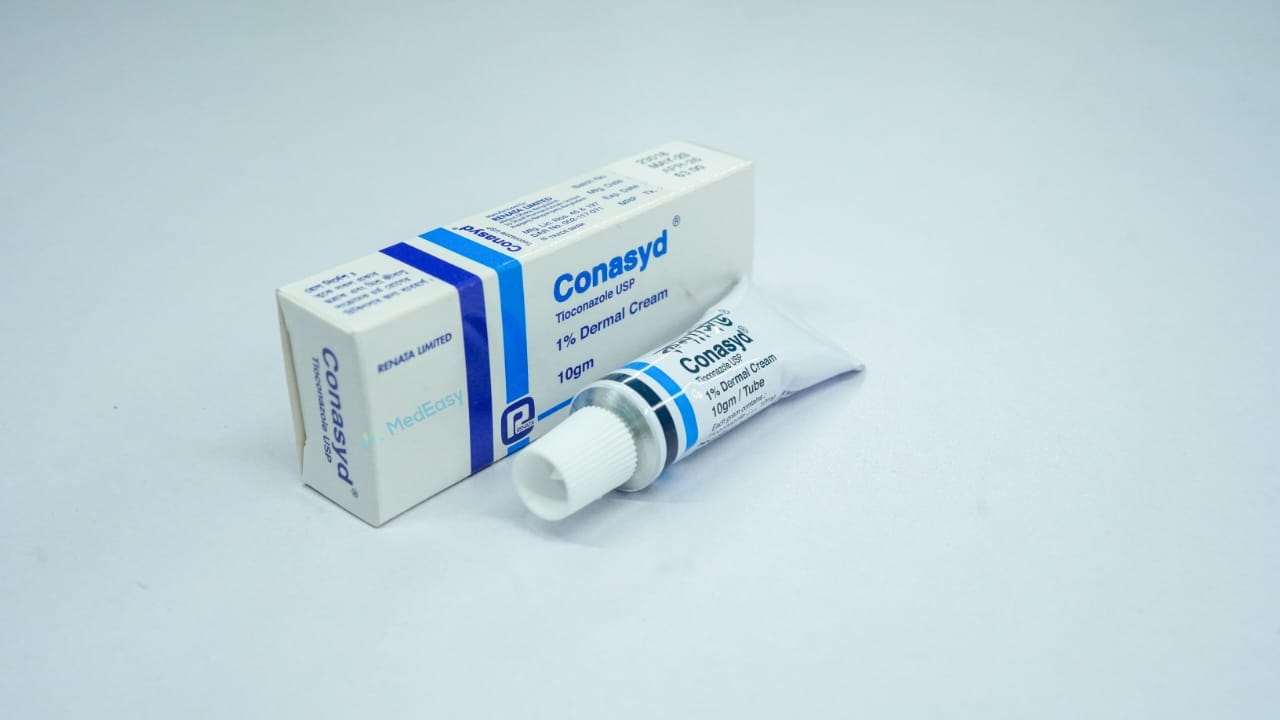
Conasyd1%
Renata Limited
৳57.96
Add to cart

Tycon 1% Cream is available on MedEasy for ৳43.07 per 10 gm tube, with home delivery anywhere in Bangladesh. It is manufactured by ACME Laboratories Ltd. Its generic name is Tioconazole.

Tycon is an imidazole antifungal indicated for the following conditions:
Note: Tycon should not be used for a first episode of vaginal symptoms without prior physician diagnosis, since other conditions (e.g., bacterial vaginosis, sexually transmitted infections) can mimic yeast infection symptoms.
Each formulation of Tioconazole contains Tioconazole as the active ingredient, in one of the following common strengths and forms marketed for topical/vaginal antifungal therapy:
Inactive ingredients vary by brand and formulation and typically include a petrolatum or oil-based ointment base, emulsifiers, and preservatives.
Tycon is a synthetic imidazole-derivative antifungal agent used topically and intravaginally. It is classified chemically among the azole antifungals and exhibits broad-spectrum activity against dermatophytes and yeasts, particularly Candida albicans and other Candida/Torulopsis species.
Tycon is available as a dermal cream for fungal skin infections and as a vaginal cream, ointment, or suppository for vulvovaginal candidiasis. It is marketed both as a physician-prescribed product and, in some markets, as an over-the-counter single-dose or short-course therapy for previously diagnosed vaginal yeast infections.
Tycon belongs to the imidazole antifungal class (azole antifungals), used for topical and vaginal fungal infections.
Tioconazole exerts its antifungal effect by inhibiting the fungal cytochrome P450-dependent enzyme 14-alpha-demethylase, which is required to convert lanosterol to ergosterol, the principal sterol of the fungal cell membrane.
Depletion of ergosterol and accumulation of abnormal sterol precursors disrupts fungal cell membrane structure and function, increasing membrane permeability and leading to leakage of cellular contents. This action is fungistatic at lower concentrations and fungicidal at higher concentrations against susceptible organisms, including Candida albicans, other Candida species, Torulopsis glabrata, and common dermatophytes (Trichophyton, Epidermophyton, and Microsporum species).
Systemic absorption of Tioconazole after topical or intravaginal application is minimal.
Dosage and duration of Tycon depend on the indication and formulation used. Always complete the full prescribed course, even if symptoms improve early, to ensure complete fungal eradication and reduce the chance of recurrence.
| Indication / Formulation | Adult Dose | Duration |
|---|---|---|
| Vulvovaginal candidiasis — 6.5% vaginal ointment (single-dose) | One full applicator (~4.6 g) inserted intravaginally, once, preferably at bedtime | Single application (1-day therapy) |
| Vulvovaginal candidiasis — 1% vaginal cream | One applicatorful inserted intravaginally once daily at bedtime | Typically 3 consecutive nights (3-day therapy), per product labeling |
| Vulvovaginal candidiasis — 300 mg vaginal suppository | One suppository inserted intravaginally once at bedtime | Single dose; may be repeated after one week if directed by a physician |
| Tinea corporis / tinea cruris / pityriasis versicolor — 1% dermal cream | Apply a thin layer to the affected area and surrounding skin once or twice daily | Usually 2 weeks, or as directed by a physician |
| Tinea pedis — 1% dermal cream | Apply a thin layer to the affected area twice daily | Up to 4-6 weeks for complete resolution |
For vaginal use, insert the applicator high into the vagina. Wash hands before and after application. Avoid intercourse and the use of tampons during treatment with Tycon. If using the dermal cream, wash and dry the affected area gently before application.
If symptoms do not improve within 3 days, or persist beyond 7 days after starting Tycon, or if symptoms recur within two months, stop use and consult a physician to confirm the diagnosis and rule out other causes.
Tycon vaginal preparations are for intravaginal use only and are usually applied at bedtime using the applicator provided, so the medicine remains in contact with the vaginal tissue overnight. Tycon dermal cream is for external use only on the skin.
Latex contraceptive devices: Vaginal formulations of Tycon contain an oil/petrolatum-based vehicle that can weaken and damage latex or rubber products, including condoms, diaphragms, and cervical caps, reducing their effectiveness in preventing pregnancy and sexually transmitted infections. Avoid reliance on these latex barrier devices for contraception during treatment and for at least 3 days after completing Tycon therapy; use an alternative, non-hormonal barrier method or abstain during this period.
Clinically significant systemic drug interactions with Tycon are unlikely because systemic absorption after topical or vaginal application is minimal. No other well-established, clinically significant drug interactions have been documented for topical/vaginal Tycon.
Tioconazole is contraindicated in individuals with a known hypersensitivity to Tioconazole or to any other imidazole antifungal agent (e.g., clotrimazole, miconazole) or to any component of the specific product formulation.
Tycon is generally well tolerated when used as directed. Most reported side effects are local and mild-to-moderate in severity.
Seek medical attention if a rash, hives, severe irritation, abdominal pain, fever, chills, nausea, vomiting, or foul-smelling vaginal discharge develops during treatment with Tycon, as these may indicate an allergic reaction or a different underlying condition.
Pregnancy: Systemic absorption of Tycon after topical or vaginal use is minimal; however, data in pregnant women are limited. Tycon should be used during pregnancy only if clearly needed and if the potential benefit justifies the potential risk to the fetus. Use during pregnancy, especially the first trimester, should occur only under medical supervision after a confirmed diagnosis.
Lactation: It is not known whether topically or vaginally applied Tycon is excreted in human breast milk in clinically significant amounts. Because systemic absorption is minimal, risk to a nursing infant is expected to be low, but a physician should be consulted before use of Tycon while breastfeeding.
In all cases, consult a physician before using Tycon during pregnancy or breastfeeding.
Complete the entire course of Tycon as directed, even if symptoms improve before the course is finished, to ensure the fungal infection is fully eradicated and to reduce the risk of recurrence.
Significant systemic toxicity from Tycon overdose is unlikely given its low systemic absorption after topical or vaginal use. Application of excess product may increase local irritation. If Tycon is accidentally ingested (swallowed) or if an excessive amount is applied and irritation or other symptoms develop, seek immediate medical attention or contact a poison control center. Do not attempt to manage a suspected overdose at home without professional guidance.
Store at room temperature (below 30°C), away from light and moisture. Keep out of reach of children.
Renal impairment: No dose adjustment is established or generally required, as systemic absorption of Tycon is minimal after topical/vaginal application.
Hepatic impairment: No specific dose adjustment is established for Tycon in hepatic impairment, again reflecting its minimal systemic absorption.
Elderly: No specific dosage adjustment has been established; use as directed for the relevant indication.
Pediatric use: See Pediatric Uses section.
Pregnancy and lactation: See Pregnancy and Lactation section.
Duration of Tycon therapy depends on the formulation and indication: a single intravaginal dose (1-day ointment or suppository) or a 3-day course (vaginal cream) for vulvovaginal candidiasis, and typically 2 to 6 weeks of twice-daily application for fungal skin infections such as tinea corporis, tinea cruris, or tinea pedis. The full course should be completed as directed even if symptoms resolve earlier.
Tioconazole is classified as an imidazole (azole) antifungal.
Tioconazole inhibits the fungal enzyme lanosterol 14-alpha-demethylase (a cytochrome P450-dependent enzyme), blocking conversion of lanosterol to ergosterol. The resulting depletion of ergosterol and accumulation of toxic sterol intermediates disrupts the structural integrity and function of the fungal cell membrane, causing increased membrane permeability, leakage of intracellular contents, and ultimately fungal cell growth inhibition or death.
C
The safety and efficacy of Tycon vaginal products have not been established in girls under 12 years of age; these products should not be used in this age group without physician guidance, and any vaginal symptoms in a child should be evaluated by a physician first.
For Tycon dermal cream in the treatment of fungal skin infections in children, safety and efficacy data are limited; use in pediatric patients should occur under medical supervision and as directed by a physician.
Q: What is Tycon 1% Cream used for?
A: Tycon 1% Cream is an antifungal medicine used to treat vaginal yeast infections (vulvovaginal candidiasis) and fungal skin infections such as tinea corporis (ringworm), tinea cruris (jock itch), tinea pedis (athlete's foot), and pityriasis versicolor.
Q: How is Tycon 1% Cream vaginal ointment used?
A: The single-dose 6.5% Tycon 1% Cream vaginal ointment is inserted intravaginally as one complete applicator, one time only, preferably at bedtime. It is intended only for women who have previously been diagnosed by a physician with a vaginal yeast infection and recognize the same symptoms recurring.
Q: Can Tycon 1% Cream affect condoms or diaphragms?
A: Yes. Vaginal formulations of Tycon 1% Cream contain an oil-based vehicle that can weaken latex condoms, diaphragms, and cervical caps, making them less effective at preventing pregnancy and sexually transmitted infections. Use an alternative form of contraception during treatment and for at least 3 days afterward.
Q: What are the common side effects of Tycon 1% Cream?
A: The most common side effects of Tycon 1% Cream are mild, local reactions such as burning, itching, and irritation at the application site. These are usually transient. Seek medical attention if you develop a rash, hives, severe irritation, fever, or unusual vaginal discharge.
Q: Is it safe to use Tycon 1% Cream during pregnancy or breastfeeding?
A: Tycon 1% Cream has minimal systemic absorption, but data in pregnant and breastfeeding women are limited. It should be used during pregnancy or lactation only if clearly needed and after consulting a physician, who can weigh the potential benefit against any potential risk.
Q: What should I do if my symptoms don't improve after using Tycon 1% Cream?
A: If your symptoms do not improve within 3 days, persist beyond 7 days, or return within two months of using Tycon 1% Cream, stop use and see a physician. This may indicate that the diagnosis needs to be reconfirmed or that another condition is responsible for your symptoms.
Disclaimer
The information provided is accurate to the best of our knowledge, but it does not replace professional medical advice. We cannot guarantee its completeness or accuracy, and the absence of specific information about a drug should not be taken as an endorsement. We are not responsible for any consequences arising from this information, so please consult a healthcare professional for any concerns or questions.