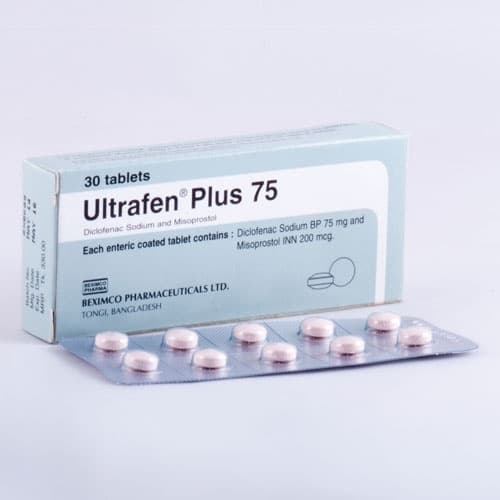
Product gallery
MRP 110.1010 % Off
Best PriceTk 99.09/10's Strip
1
Section

Medicine overview

Indications of Ultrafen Plus

Established / FDA-Approved Uses

  • Osteoarthritis — for relief of the signs and symptoms of osteoarthritis in adult patients who, in the judgment of their physician, are at high risk of developing NSAID-induced gastric or duodenal ulcers and who require an NSAID.
  • Rheumatoid arthritis — for relief of the signs and symptoms of rheumatoid arthritis in adult patients at high risk for NSAID-induced gastric or duodenal ulcers and who require an NSAID.

Ultrafen Plus is specifically indicated for patients who need ongoing NSAID therapy for arthritis and who are at elevated risk of NSAID-associated gastrointestinal ulceration (e.g., older age, prior peptic ulcer disease, concomitant corticosteroid, anticoagulant, or antiplatelet use). It is not a first-line analgesic for patients without this elevated GI risk, since it commits the patient to an additional medication (misoprostol) and its associated side effects.

Ultrafen Plus is not indicated for the initial treatment of acute pain, and it is not an abortifacient medication approved for pregnancy termination, despite the pharmacologic activity of its misoprostol component (see Contraindications and Pregnancy and Lactation).

Composition

Diclofenac Sodium + Misoprostol is a fixed-dose combination tablet available (per FDA-approved labeling) in two strengths:

  • Diclofenac sodium 50 mg (delayed-release core) + Misoprostol 200 mcg
  • Diclofenac sodium 75 mg (delayed-release core) + Misoprostol 200 mcg

The diclofenac component is enteric-coated/delayed-release to reduce direct gastric mucosal irritation, while the misoprostol component is formulated for immediate release to provide gastric mucosal protection.

Description

Ultrafen Plus is an oral fixed-dose combination product that pairs a non-steroidal anti-inflammatory drug (NSAID) with a synthetic prostaglandin E1 analog. The diclofenac component provides analgesic and anti-inflammatory activity for arthritis, while the misoprostol component is added specifically to reduce the risk of NSAID-induced gastric and duodenal ulcers by protecting the gastric mucosa.

Ultrafen Plus is used only in adults with osteoarthritis or rheumatoid arthritis who need long-term NSAID therapy and who are also at increased risk of NSAID-associated ulcers. Because misoprostol is a potent uterotonic (abortifacient) agent, Ultrafen Plus carries an important pregnancy contraindication that patients and prescribers must understand before starting treatment (see Contraindications).

Therapeutic Class

Ultrafen Plus belongs to a combination therapeutic class: Non-selective NSAID (COX-1/COX-2 inhibitor) combined with a synthetic prostaglandin E1 analog (gastroprotective agent). It is classified therapeutically as an anti-inflammatory/analgesic agent with built-in gastrointestinal mucosal protection, distinct from plain diclofenac formulations and from NSAID + proton pump inhibitor combinations.

Pharmacology

Diclofenac Component

Diclofenac sodium is a potent inhibitor of cyclooxygenase-1 (COX-1) and cyclooxygenase-2 (COX-2), the enzymes responsible for prostaglandin synthesis. By reducing prostaglandin production peripherally, diclofenac produces analgesic, anti-inflammatory, and antipyretic effects. This same prostaglandin inhibition, however, reduces the gastric mucosa's natural protective mechanisms, predisposing to ulceration.

Misoprostol Component

Misoprostol is a synthetic analog of prostaglandin E1. In Diclofenac Sodium + Misoprostol, it is included specifically to counteract the gastric mucosal damage caused by the diclofenac component — it inhibits basal and stimulated gastric acid secretion and increases gastric mucus and bicarbonate production, thereby protecting the gastric and duodenal mucosa. Misoprostol also has potent uterotonic (oxytocic) activity, which is the pharmacologic basis for its absolute contraindication in pregnancy.

Pharmacokinetics

Diclofenac is well absorbed orally, is highly (>99%) protein bound, undergoes hepatic metabolism via CYP2C9, and has an elimination half-life of approximately 2 hours. Misoprostol is rapidly absorbed and converted to its active metabolite, misoprostol acid, which peaks in about 20 minutes; food reduces its peak concentration. There is no clinically significant pharmacokinetic interaction between the two components when given together as Diclofenac Sodium + Misoprostol.

Dosage & Administration of Ultrafen Plus

General Principles

Use the lowest effective dose of Ultrafen Plus for the shortest duration consistent with the individual patient's treatment goals, and reassess the need for continued NSAID therapy periodically.

IndicationTypical Adult DosingMaximum Diclofenac Dose
Osteoarthritis50 mg/200 mcg three times daily (preferred for maximal GI protection); alternatively 75 mg/200 mcg or 50 mg/200 mcg twice daily for patients who cannot tolerate the three-times-daily regimen (twice-daily 50 mg/200 mcg regimen is less well studied for ulcer prevention)150 mg/day
Rheumatoid arthritis50 mg/200 mcg three or four times daily; 75 mg/200 mcg twice daily may be used if better tolerated200 mg/day

Dose Adjustment

  • When a CYP2C9 inhibitor cannot be avoided, limit total diclofenac exposure to 100 mg/day.
  • Misoprostol component should not exceed 200 mcg per single dose or 800 mcg/day total.
  • Use the lowest available dose in patients with hepatic impairment; avoid in severe hepatic impairment.
  • Use with caution and monitor renal function in patients with renal impairment (see Use in Special Populations).

Ultrafen Plus should be swallowed whole with food or immediately after meals, and not crushed, split, or chewed, since the diclofenac core is delayed-release.

Administration of Ultrafen Plus

  • Take Ultrafen Plus by mouth with food or immediately after a meal to reduce gastrointestinal irritation and misoprostol-related diarrhea.
  • Swallow the tablet whole; do not crush, chew, or split it, as this destroys the delayed-release coating that protects the stomach from direct diclofenac contact.
  • Take doses at evenly spaced intervals as prescribed (e.g., two, three, or four times daily) rather than doubling up on a missed dose.
  • Do not take with magnesium-containing antacids, as these can worsen misoprostol-induced diarrhea.
  • Continue taking Ultrafen Plus only for as long as your physician advises, and do not exceed the prescribed frequency or number of tablets per day.

Interaction of Ultrafen Plus

Ultrafen Plus should be used cautiously with the following agents, since interactions may increase toxicity or reduce efficacy:

  • Anticoagulants (e.g., warfarin): increased risk of serious bleeding; monitor closely.
  • Aspirin and other NSAIDs: increased risk of GI adverse events without added efficacy; concurrent use is not recommended. Low-dose aspirin for cardioprotection may still be co-prescribed under physician guidance, but Ultrafen Plus does not substitute for it.
  • ACE inhibitors, angiotensin receptor blockers (ARBs), and diuretics: Ultrafen Plus can reduce their antihypertensive/natriuretic effect and increase the risk of acute kidney injury, especially in volume-depleted or elderly patients; monitor blood pressure and renal function.
  • Lithium: NSAIDs can raise plasma lithium levels and reduce renal clearance; monitor for lithium toxicity.
  • Methotrexate: increased risk of methotrexate toxicity, particularly at higher methotrexate doses; monitor closely.
  • Cyclosporine: increased risk of nephrotoxicity; monitor renal function.
  • SSRIs/SNRIs and corticosteroids: additive risk of gastrointestinal bleeding and ulceration.
  • Digoxin: may increase serum digoxin concentration; monitor levels.
  • CYP2C9 inhibitors (e.g., voriconazole, fluconazole): increase diclofenac exposure; dose limitation to 100 mg/day diclofenac may be needed.
  • Magnesium-containing antacids: worsen misoprostol-associated diarrhea; avoid.

Contraindications

Diclofenac Sodium + Misoprostol is contraindicated in:

  • Pregnancy — absolute contraindication. The misoprostol component is a potent uterotonic (abortifacient) agent that can cause uterine contractions, bleeding, uterine rupture, miscarriage, premature labor, or birth defects (see Pregnancy and Lactation). Diclofenac Sodium + Misoprostol must never be given to a patient who is or may be pregnant.
  • Known hypersensitivity to diclofenac, misoprostol, other prostaglandins, or any component of Diclofenac Sodium + Misoprostol.
  • History of asthma, urticaria, or other allergic-type reactions after taking aspirin or other NSAIDs (aspirin-sensitive asthma).
  • Setting of coronary artery bypass graft (CABG) surgery — the diclofenac component is contraindicated for perioperative pain in this setting due to increased risk of myocardial infarction and stroke.
  • Active gastrointestinal bleeding.

Side Effects of Ultrafen Plus

Very Common

  • Diarrhea (up to ~19%) and abdominal pain (up to ~21%) — most often occur early in treatment (first 2–7 days) and are typically dose-related; magnesium antacids should be avoided as they worsen diarrhea.
  • Dyspepsia, nausea, flatulence, gastritis, vomiting, constipation.

Common

  • Headache, dizziness.
  • Menstrual disorders in women — dysmenorrhea, menorrhagia, or intermenstrual/vaginal bleeding.
  • Mild, usually asymptomatic elevation of liver transaminases.

Serious (Less Common but Important)

  • Gastrointestinal bleeding, ulceration, or perforation (see Precautions and Warnings).
  • Cardiovascular thrombotic events — myocardial infarction, stroke (see Precautions and Warnings).
  • Severe skin reactions — Stevens-Johnson syndrome, toxic epidermal necrolysis, DRESS syndrome.
  • Hepatotoxicity, including rare cases of liver failure.
  • Renal impairment, including papillary necrosis with long-term use.
  • Anaphylactic reactions.
  • Severe dehydration from profound diarrhea (rare).

Patients should seek prompt medical attention for signs of GI bleeding (black stools, blood in vomit), chest pain, sudden weakness, shortness of breath, jaundice, severe rash, or unusual bruising/bleeding while taking Ultrafen Plus.

Pregnancy & Lactation

Pregnancy

Ultrafen Plus is absolutely contraindicated in pregnancy. The misoprostol component can cause uterine contractions, bleeding, uterine rupture, spontaneous abortion, premature labor, or fetal birth defects. In addition, the diclofenac (NSAID) component can cause premature closure of the fetal ductus arteriosus (from around 30 weeks gestation) and, from around 20 weeks gestation onward, fetal renal dysfunction leading to oligohydramnios, sometimes irreversible.

Before starting Ultrafen Plus, a negative pregnancy test must be confirmed, therapy should begin only on the second or third day of a normal menstrual cycle, and patients of childbearing potential must use effective contraception and be counseled in detail about these risks. If pregnancy is suspected or confirmed at any point, Ultrafen Plus must be stopped immediately and a physician contacted without delay.

Lactation

Both diclofenac and misoprostol (as misoprostol acid) pass into breast milk in small amounts. Because of the potential for serious adverse effects in a nursing infant, use Ultrafen Plus during breastfeeding only if clearly needed and if the potential benefit justifies the potential risk to the infant; consult a physician before use while breastfeeding.

Precautions & Warnings

Boxed Warning — Pregnancy and Cardiovascular/GI Risk

Ultrafen Plus must never be used in pregnancy due to the abortifacient and teratogenic potential of the misoprostol component (see Contraindications and Pregnancy and Lactation). Separately, as with all NSAIDs, the diclofenac component carries a boxed-warning-level risk of serious, potentially fatal cardiovascular thrombotic events (myocardial infarction, stroke) and serious gastrointestinal bleeding, ulceration, and perforation, which can occur at any time during use, with or without warning symptoms, and which are more likely with longer duration of use, higher doses, and in patients with pre-existing GI or cardiovascular disease.

Cardiovascular

Avoid use in patients with recent myocardial infarction if possible; if use is necessary, monitor for signs of cardiac ischemia. Ultrafen Plus is contraindicated for perioperative pain in the setting of CABG surgery. NSAIDs can cause new-onset or worsening hypertension and fluid retention/edema; use caution in heart failure and monitor blood pressure.

Hepatic

Elevated liver enzymes can occur, usually within the first two months of therapy. Monitor liver function periodically during prolonged use and discontinue Ultrafen Plus if abnormal liver tests persist or worsen, or if signs/symptoms of liver disease develop.

Renal

Long-term use may cause renal papillary necrosis and other renal injury, particularly in patients with pre-existing renal impairment, volume depletion, heart failure, or those on ACE inhibitors/ARBs/diuretics. Monitor renal function in at-risk patients.

Gastrointestinal

Despite the gastroprotective misoprostol component, serious GI bleeding, ulceration, and perforation can still occur, particularly in elderly patients or those with a prior history of peptic ulcer disease. Discontinue immediately for signs of GI bleeding.

Diarrhea

Misoprostol-induced diarrhea is common, especially in the first weeks of treatment, and is usually dose-related and self-limiting; avoid magnesium-containing antacids, which worsen it. Severe or persistent diarrhea causing dehydration requires medical evaluation.

Hematologic and Hypersensitivity

Ultrafen Plus can increase bleeding risk, particularly with concurrent anticoagulants or antiplatelet agents. Anaphylactic reactions can occur even without prior exposure; discontinue and seek emergency care if this occurs. Serious skin reactions (Stevens-Johnson syndrome, toxic epidermal necrolysis, DRESS) can occur at any time; discontinue at the first appearance of rash or other hypersensitivity signs.

Masking of Infection/Inflammation Signs

The anti-inflammatory and antipyretic effects of the diclofenac component may reduce fever and inflammation, potentially masking signs of an underlying infection.

Overdose Effects of Ultrafen Plus

Suspected overdose of Ultrafen Plus is a medical emergency. Seek immediate medical attention or contact a poison control center/emergency services right away; do not wait for symptoms to appear or attempt specific home treatment.

Diclofenac component: Overdose may cause lethargy, drowsiness, nausea, vomiting, and epigastric pain; rarely, hypertension, acute kidney injury, respiratory depression, gastrointestinal bleeding, or coma can occur.

Misoprostol component: Overdose may cause sedation, tremor, seizures, difficulty breathing, abdominal pain, diarrhea, fever, palpitations, hypotension, or bradycardia.

Management is supportive and symptomatic; there is no specific antidote. A physician may consider gastric decontamination or activated charcoal if presenting soon after a substantial overdose. Hemodialysis is generally not expected to be effective due to high protein binding of diclofenac. Do not attempt to induce vomiting or give any home remedy without direct medical guidance.

Storage Conditions

Store at room temperature (below 30°C), away from light and moisture. Keep out of reach of children.

Use In Special Populations

Renal Impairment

Use Ultrafen Plus with caution and monitor renal function; long-term NSAID use can cause renal injury, and risk is higher with pre-existing renal impairment, dehydration, heart failure, or concurrent use of ACE inhibitors/ARBs/diuretics (see Precautions and Warnings).

Hepatic Impairment

Use the lowest effective dose in patients with hepatic impairment and monitor liver function closely; avoid use in patients with severe hepatic impairment (see Precautions and Warnings).

Elderly

Patients 65 years and older are at substantially increased risk of NSAID-related cardiovascular, gastrointestinal, and renal adverse effects. Use the lowest effective dose for the shortest duration and monitor closely, especially if other risk factors or concomitant medications (e.g., ACE inhibitors/ARBs) are present (see Pediatric Uses for pediatric-specific information).

Women of Childbearing Potential

Because of the absolute pregnancy contraindication, effective contraception, a confirmed negative pregnancy test, and initiation only during the early days of a menstrual cycle are required before starting Ultrafen Plus (see Pregnancy and Lactation).

Duration Of Treatment

Ultrafen Plus should be used at the lowest effective dose for the shortest duration consistent with individual treatment goals. Because it is intended for chronic arthritis conditions (osteoarthritis, rheumatoid arthritis) in patients at elevated GI risk, treatment is often continued long-term under regular physician supervision, with periodic reassessment of continued need, effectiveness, and monitoring of liver, renal, and cardiovascular status. There is no fixed maximum duration, but the need for ongoing therapy should be reviewed at routine follow-up visits.

Drug Classes

Non-steroidal anti-inflammatory drug (NSAID) + Prostaglandin E1 analog (gastroprotective agent) — fixed-dose combination

Mode Of Action

Diclofenac Sodium + Misoprostol combines two complementary mechanisms. Diclofenac non-selectively inhibits cyclooxygenase-1 (COX-1) and cyclooxygenase-2 (COX-2), reducing prostaglandin synthesis to relieve pain, inflammation, and fever in arthritis. Because prostaglandins also normally protect the gastric lining, this same inhibition increases the risk of gastric and duodenal ulceration. Misoprostol, a synthetic prostaglandin E1 analog, offsets this risk by restoring prostaglandin-like activity locally in the stomach: it suppresses gastric acid secretion and stimulates protective mucus and bicarbonate production, protecting the gastric mucosa from the ulcerogenic effect of diclofenac. Misoprostol additionally stimulates uterine smooth muscle contraction, which is the pharmacologic basis of its abortifacient effect and the reason Diclofenac Sodium + Misoprostol is contraindicated in pregnancy.

Pregnancy

X (contraindicated in pregnancy) — FDA legacy pregnancy category, based on misoprostol's abortifacient and teratogenic potential

Pediatric Uses

The safety and efficacy of Ultrafen Plus in pediatric patients have not been established. Ultrafen Plus is therefore not recommended for use in children or adolescents. Pediatric patients requiring NSAID therapy for arthritis should be managed with agents and regimens specifically studied and approved for pediatric use, under the direction of a physician.

Frequently Asked Questions

Q: Can I take Ultrafen Plus 75 mg+200 mcg Tablet if I am pregnant or trying to become pregnant?

A: No. Ultrafen Plus 75 mg+200 mcg Tablet is absolutely contraindicated in pregnancy. Its misoprostol component can cause uterine contractions, bleeding, miscarriage, premature labor, or birth defects. You must have a confirmed negative pregnancy test before starting, use effective contraception throughout treatment, and stop the medicine immediately and contact your physician if you become pregnant or suspect pregnancy.

Q: Why does this medicine contain misoprostol along with diclofenac?

A: Ultrafen Plus 75 mg+200 mcg Tablet combines diclofenac, an NSAID that relieves arthritis pain and inflammation, with misoprostol, which protects the stomach lining from ulcers that NSAIDs like diclofenac can cause. This combination is intended for patients who need long-term NSAID therapy and are also at higher risk of developing stomach or duodenal ulcers.

Q: Why do I have diarrhea after starting this medicine?

A: Diarrhea is a very common side effect of Ultrafen Plus 75 mg+200 mcg Tablet, caused by the misoprostol component, and usually occurs early in treatment. It is often dose-related and tends to improve within a few days. Avoid magnesium-containing antacids, as they can worsen it. Contact your physician if diarrhea is severe, persistent, or causes signs of dehydration.

Q: Can I take this medicine if I have heart disease or have had a heart attack?

A: Use caution. Ultrafen Plus 75 mg+200 mcg Tablet contains an NSAID that can increase the risk of heart attack and stroke, and it is contraindicated for pain after coronary artery bypass graft (CABG) surgery. Discuss your full cardiovascular history with your physician before starting Ultrafen Plus 75 mg+200 mcg Tablet, as they may choose a different treatment or monitor you more closely.

Q: What should I do if I accidentally take too much Ultrafen Plus 75 mg+200 mcg Tablet?

A: Seek immediate medical attention or contact a poison control center or emergency services right away. Overdose of Ultrafen Plus 75 mg+200 mcg Tablet can cause serious effects from both components, including drowsiness, vomiting, abdominal pain, tremor, seizures, or dangerously low blood pressure. Do not wait for symptoms or attempt home treatment.

Q: Can I take Ultrafen Plus 75 mg+200 mcg Tablet with aspirin or other pain relievers?

A: Combining Ultrafen Plus 75 mg+200 mcg Tablet with aspirin or other NSAIDs is not recommended, as it increases the risk of stomach bleeding without added pain relief. If you take low-dose aspirin for heart protection, tell your physician, since Ultrafen Plus 75 mg+200 mcg Tablet does not replace aspirin's cardioprotective effect and the combination needs careful medical supervision.

Disclaimer

The information provided is accurate to the best of our knowledge, but it does not replace professional medical advice. We cannot guarantee its completeness or accuracy, and the absence of specific information about a drug should not be taken as an endorsement. We are not responsible for any consequences arising from this information, so please consult a healthcare professional for any concerns or questions.

Doctor
Cart
Account