
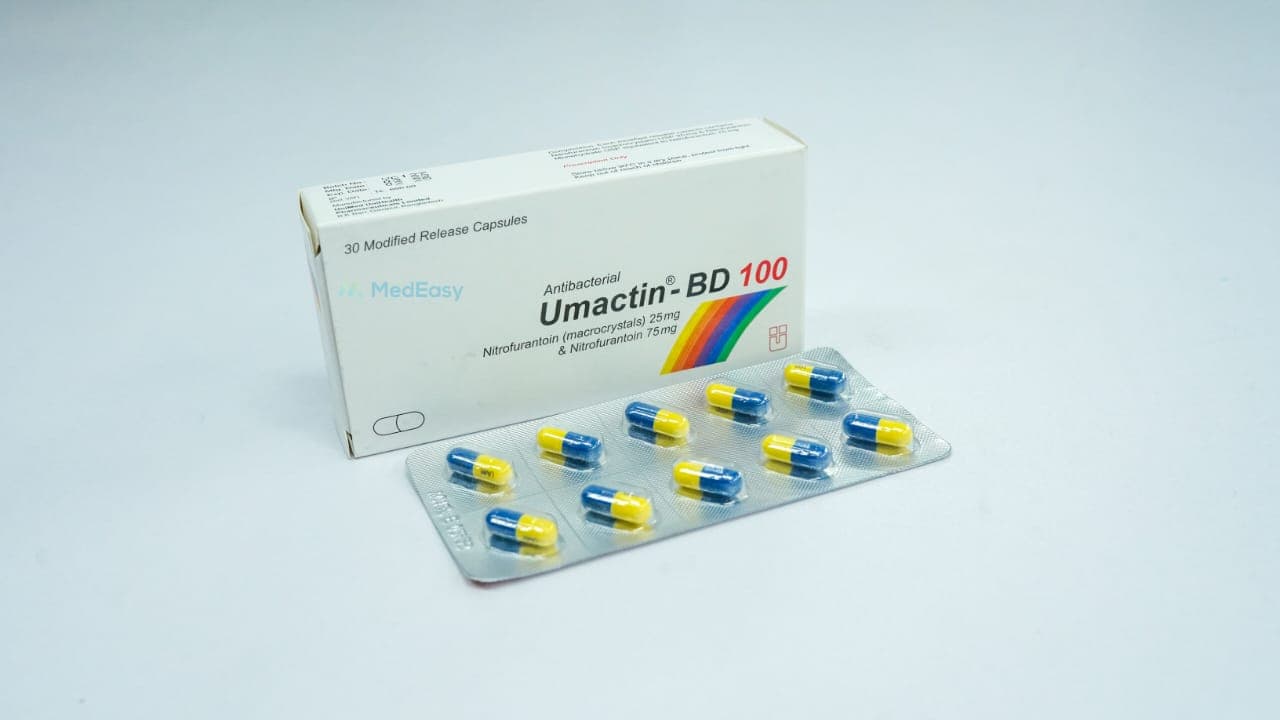
Umactin BD75 mg+25 mg

Medicine overview
Indications of Umactin BD
Umactin BD is a dual-release oral antibacterial combining nitrofurantoin macrocrystals/monohydrate with nitrofurantoin microcrystals. Its established and guideline-supported use is:
Established (FDA-approved) use
- Treatment of uncomplicated urinary tract infections (acute cystitis) caused by susceptible strains of Escherichia coli, Staphylococcus saprophyticus, or Enterococcus faecalis.
Guideline-supported use
- First-line empiric therapy for acute uncomplicated cystitis in non-pregnant women, per major treatment guidelines, where local resistance patterns are favorable.
Not indicated for
- Pyelonephritis, perinephric abscess, or complicated UTIs (including suspected renal parenchymal or systemic infection) — Umactin BD does not achieve adequate tissue or serum levels for these conditions.
Umactin BD should be used only after a physician has confirmed it is an appropriate choice based on infection type and local susceptibility patterns.
Composition
Nitrofurantoin + Nitrofurantoin Microcrystals capsules contain a dual-release blend: approximately 25% nitrofurantoin microcrystals (immediate release) and 75% nitrofurantoin macrocrystals/monohydrate (slower release), combining to provide both a rapid initial and a sustained antibacterial effect over the dosing interval.
Description
Umactin BD is a nitrofuran-class antibacterial formulated as a dual-release capsule. The microcrystalline component dissolves quickly to produce an early peak concentration, while the macrocrystalline/monohydrate component dissolves more slowly, sustaining antibacterial urinary concentrations between doses. This formulation allows twice-daily dosing for uncomplicated urinary tract infections.
Therapeutic Class
Umactin BD belongs to the nitrofuran derivative antibacterial class, used specifically for urinary tract infections.
Pharmacology
Mechanism
Nitrofurantoin + Nitrofurantoin Microcrystals is reduced by bacterial flavoproteins (nitrofuran reductase) into highly reactive intermediates that damage bacterial ribosomal proteins, DNA, and other macromolecules, inhibiting protein synthesis, DNA/RNA synthesis, and aerobic energy metabolism. This multi-target action gives a low propensity for resistance development.
Pharmacokinetics
- Absorption: Enhanced by food, which increases bioavailability and reduces gastrointestinal irritation.
- Distribution: Rapidly cleared from the bloodstream and concentrated in the urine; therapeutic drug levels are not achieved in blood or most tissues, which is why it is ineffective for systemic or renal-parenchymal infections.
- Elimination: Primarily renal, via glomerular filtration and tubular secretion; excretion (and thus efficacy) depends on adequate renal function.
Dosage & Administration of Umactin BD
Umactin BD is for oral use only. Take exactly as prescribed by your physician; do not stop, extend, skip doses, or share this medicine with others without medical advice.
| Indication | Population | Dose | Typical duration |
|---|---|---|---|
| Uncomplicated UTI (acute cystitis) | Adults | 100 mg orally every 12 hours, with food | 5–7 days, as directed by the physician |
| Uncomplicated UTI (acute cystitis) | Children ≥ 12 years able to swallow capsules | As directed by physician; not generally recommended below this age for the dual-release capsule form | As directed by physician |
Renal impairment
Contraindicated in significant renal impairment (creatinine clearance < 60 mL/min) — see Contraindications.
Complete the full prescribed course even if symptoms improve early, to reduce the risk of treatment failure and antibiotic resistance.
Administration of Umactin BD
Take Umactin BD with food or milk to improve absorption and reduce stomach upset. Swallow the capsule whole; do not crush or chew it. Take doses at evenly spaced intervals (approximately every 12 hours) and complete the entire prescribed course.
Interaction of Umactin BD
- Magnesium trisilicate / antacids: May reduce the absorption and effectiveness of Umactin BD; avoid concurrent administration.
- Probenecid and sulfinpyrazone: Inhibit renal tubular secretion of Umactin BD, raising blood levels (increasing toxicity risk) while lowering urinary concentrations (reducing effectiveness against the urinary infection). Avoid combined use unless directed by a physician.
- Fluoroquinolone antibiotics: Nitrofurantoin may antagonize the antibacterial activity of quinolones; concurrent use for the same infection is generally avoided.
Inform your physician of all medicines, supplements, and antacids you are taking before starting Umactin BD.
Contraindications
- Known hypersensitivity to nitrofurantoin or any component of Nitrofurantoin + Nitrofurantoin Microcrystals.
- Significant renal impairment (creatinine clearance < 60 mL/min), due to reduced efficacy and increased risk of toxic drug accumulation.
- Pregnant women at term (38–42 weeks gestation) and during labor and delivery, due to the risk of hemolytic anemia in the newborn.
- Infants under 1 month of age, due to immature enzyme systems and risk of hemolytic anemia.
- History of cholestatic jaundice or hepatic dysfunction associated with previous nitrofurantoin use.
- Glucose-6-phosphate dehydrogenase (G6PD) deficiency, due to risk of hemolytic anemia.
- Anuria or oliguria.
Side Effects of Umactin BD
Common
- Nausea, vomiting, loss of appetite, diarrhea
- Headache
- Brown or rust-colored discoloration of urine (harmless)
Less common but serious
- Pulmonary reactions — acute (fever, chills, cough, chest pain, shortness of breath) or chronic (including pulmonary fibrosis with long-term use); seek prompt medical attention for breathing difficulty.
- Hepatotoxicity, including hepatitis and cholestatic jaundice (rare but potentially serious).
- Peripheral neuropathy, which can be severe or irreversible, especially with renal impairment, prolonged therapy, anemia, diabetes, or vitamin B deficiency.
- Hemolytic anemia, particularly in individuals with G6PD deficiency — see Contraindications.
- Hypersensitivity reactions: rash, urticaria, and rarely severe skin reactions or anaphylaxis.
Report any breathing difficulty, yellowing of skin/eyes, unusual tingling/numbness, or signs of allergic reaction to a physician immediately.
Pregnancy & Lactation
Pregnancy: Umactin BD should be used during pregnancy only if clearly needed and if the potential benefit justifies the potential risk to the fetus; consult a physician. It is contraindicated at term (38–42 weeks gestation) and during labor and delivery due to the risk of hemolytic anemia in the newborn — see Contraindications.
Lactation: Umactin BD passes into breast milk in small amounts. It should be used with caution while breastfeeding, and avoided if the nursing infant is under 1 month old or known/suspected to have G6PD deficiency, due to the risk of hemolytic anemia in the infant. Discuss breastfeeding with a physician before use.
Precautions & Warnings
- Antibiotic stewardship: Take Umactin BD exactly as prescribed by your physician; do not stop, extend, skip doses, or share this medicine with others without medical advice.
- Pulmonary reactions: Acute and chronic pulmonary reactions, including pulmonary fibrosis with long-term use, have occurred; discontinue and seek medical attention if breathing symptoms develop.
- Hepatotoxicity: Rare but serious liver injury has been reported; seek medical advice for jaundice, dark urine, or unexplained fatigue.
- Peripheral neuropathy: Risk is increased with renal impairment, prolonged use, anemia, diabetes, electrolyte imbalance, vitamin B deficiency, or debilitation; report tingling or numbness promptly.
- Not for pyelonephritis or complicated UTI: Umactin BD does not achieve adequate tissue levels for these conditions — see Indications.
- Administration: Take with food to improve absorption and reduce gastrointestinal upset.
- Superinfection: Prolonged or repeated use may result in overgrowth of non-susceptible organisms, including fungi.
Overdose Effects of Umactin BD
Acute overdose of Umactin BD is expected to produce mainly gastrointestinal symptoms (nausea, vomiting). No specific antidote exists. In case of suspected overdose, seek immediate medical attention or contact a poison control center right away. Treatment is supportive; hemodialysis and peritoneal dialysis do not effectively remove nitrofurantoin from the body. Do not attempt home treatment beyond basic first aid before reaching medical help.
Storage Conditions
Store at room temperature (below 30°C), away from light and moisture. Keep out of reach of children.
Use In Special Populations
- Renal impairment: Contraindicated when creatinine clearance is below 60 mL/min due to reduced efficacy and drug accumulation — see Contraindications.
- Hepatic impairment: Use with caution; Umactin BD is contraindicated in patients with a history of cholestatic jaundice or hepatic dysfunction linked to prior nitrofurantoin use.
- Elderly: Use with caution; assess renal function before and during therapy, as age-related decline in renal function increases the risk of toxicity and reduced efficacy.
- G6PD deficiency: Contraindicated due to hemolytic anemia risk — see Contraindications.
- Pregnancy and lactation: See Pregnancy and Lactation section.
- Pediatric use: See Pediatric Uses section.
Duration Of Treatment
For uncomplicated cystitis, Umactin BD is typically given for 5 to 7 days, as directed by the physician. Do not extend or shorten the course without medical advice, even if symptoms resolve early.
Drug Classes
Nitrofuran derivative; urinary tract antibacterial (antimicrobial).
Mode Of Action
Nitrofurantoin + Nitrofurantoin Microcrystals is activated inside susceptible bacteria by bacterial flavoprotein enzymes (nitrofuran reductases) into reactive intermediates. These intermediates attack bacterial ribosomal proteins and inhibit protein synthesis, and also damage DNA, RNA, and cell wall/membrane components, disrupting multiple essential metabolic pathways simultaneously. This multi-target mechanism accounts for its bactericidal activity and low rate of acquired resistance.
Pregnancy
B
Pediatric Uses
Umactin BD is contraindicated in infants under 1 month of age because of the risk of hemolytic anemia from immature red-cell enzyme systems — see Contraindications. Safety and efficacy of the dual-release capsule formulation have not been established in children unable to reliably swallow capsules; the dual-release capsule is generally not recommended for young children. Where nitrofurantoin therapy is appropriate in older children or adolescents able to swallow capsules, dosing must be individualized by the physician based on age, weight, and renal function.
Frequently Asked Questions
Q: What is Umactin BD 75 mg+25 mg Capsule used for?
A: Umactin BD 75 mg+25 mg Capsule is an antibiotic used to treat uncomplicated urinary tract infections (acute cystitis) caused by susceptible bacteria such as E. coli. It is not used for kidney infections (pyelonephritis) or complicated UTIs.
Q: How should I take Umactin BD 75 mg+25 mg Capsule?
A: Take Umactin BD 75 mg+25 mg Capsule by mouth with food, exactly as prescribed by your physician, usually every 12 hours, and complete the full course (typically 5–7 days) even if you feel better sooner. Do not stop, extend, skip doses, or share this medicine with others without medical advice.
Q: Can I take Umactin BD 75 mg+25 mg Capsule during pregnancy or while breastfeeding?
A: Umactin BD 75 mg+25 mg Capsule should be used in pregnancy only if clearly needed and if the benefit outweighs the potential risk to the fetus; it must not be used at term (38–42 weeks) or during labor because of the risk of hemolytic anemia in the newborn. While breastfeeding, use with caution and avoid if the infant is under 1 month old or has G6PD deficiency. Always consult a physician first.
Q: Who should not take Umactin BD 75 mg+25 mg Capsule?
A: Umactin BD 75 mg+25 mg Capsule should not be used by people with significant kidney impairment (creatinine clearance below 60 mL/min), infants under 1 month, pregnant women at term or in labor, people with G6PD deficiency, those with a past history of nitrofurantoin-related liver problems, or anyone with a known allergy to nitrofurantoin.
Q: Why does my urine turn brown while taking Umactin BD 75 mg+25 mg Capsule?
A: Umactin BD 75 mg+25 mg Capsule commonly causes a harmless brown or rust-colored discoloration of the urine. This is a normal, expected effect and is not a cause for concern on its own, but you should still tell your doctor about any new or unusual symptoms.
Q: What side effects of Umactin BD 75 mg+25 mg Capsule need urgent medical attention?
A: Seek immediate medical care if you develop shortness of breath, cough, chest pain, or fever (possible lung reaction); yellowing of the skin or eyes (possible liver problem); or tingling/numbness in the hands or feet (possible nerve problem) while taking Umactin BD 75 mg+25 mg Capsule.
Disclaimer
The information provided is accurate to the best of our knowledge, but it does not replace professional medical advice. We cannot guarantee its completeness or accuracy, and the absence of specific information about a drug should not be taken as an endorsement. We are not responsible for any consequences arising from this information, so please consult a healthcare professional for any concerns or questions.
