
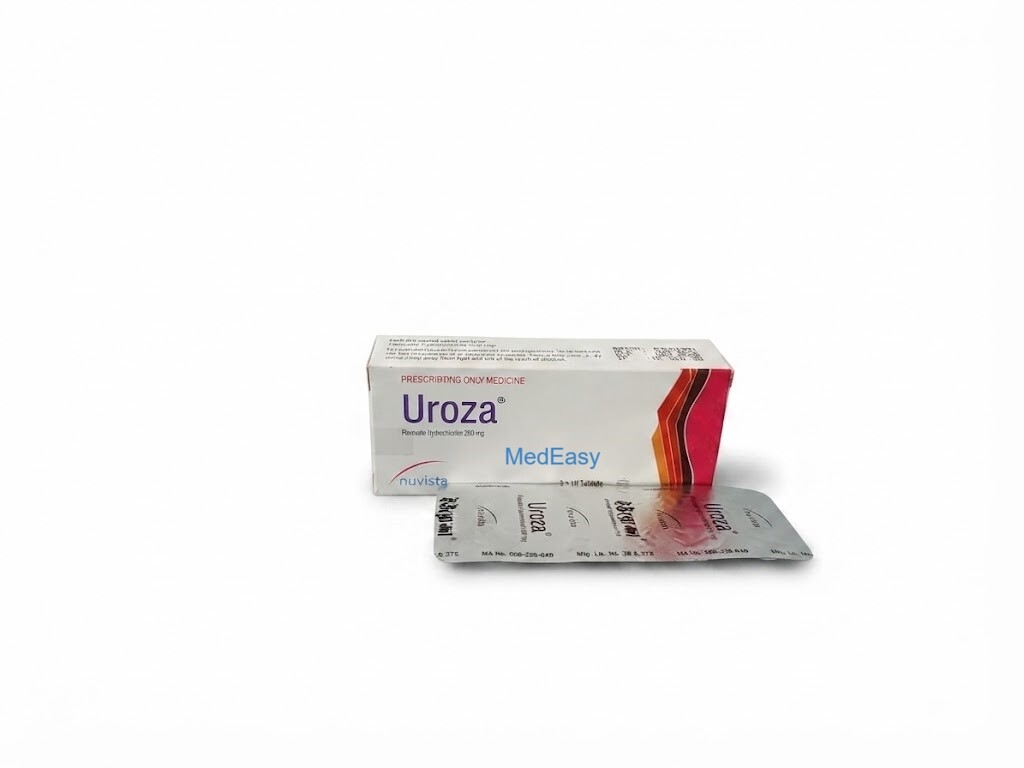
8% Off
Uroza200 mg
Nuvista Pharma Ltd.
৳165.60
Add to cart


Urilax is indicated for the symptomatic relief of urinary tract symptoms associated with lower urinary tract conditions. This is an FDA-approved, established indication.
These symptoms may occur in association with cystitis, prostatitis, urethritis, and urethrocystitis.
Important limitation: Urilax provides symptomatic relief only; it does not treat the underlying infection or cause of the urinary tract condition. When an infection is present, Urilax should be used as an adjunct alongside appropriate antimicrobial or other definitive therapy directed at the underlying cause, not as a substitute for it.
Each tablet contains Flavoxate Hydrochloride as the active ingredient, commonly available in strengths of 100 mg and 200 mg.
Urilax is a synthetic anticholinergic (antimuscarinic) and direct-acting smooth muscle antispasmodic agent. It acts on the smooth muscle of the urinary tract to relieve spasm, thereby reducing the associated symptoms of urgency, frequency, nocturia, and dysuria. Urilax is administered orally, usually as a tablet, and is used for short-term symptomatic management rather than as a cure for the underlying urinary tract disorder.
Urilax belongs to the class of urinary antispasmodics / anticholinergic (antimuscarinic) agents used for genitourinary smooth muscle relaxation.
Flavoxate Hydrochloride exerts a direct antispasmodic action on smooth muscle of the urinary tract, counteracting spasm. It also has anticholinergic (antimuscarinic), local anesthetic, and analgesic properties, along with mild calcium channel-blocking activity. Through these combined mechanisms, Flavoxate Hydrochloride relaxes detrusor and other urinary tract smooth muscle, increases bladder capacity, and reduces the frequency of uninhibited bladder contractions, thereby relieving symptoms such as urgency, frequency, nocturia, dysuria, and suprapubic discomfort. It does not have antimicrobial activity and does not treat the underlying cause of urinary tract infection or inflammation.
| Population | Dose |
|---|---|
| Adults and children over 12 years | 100–200 mg (one or two 100 mg tablets, or one 200 mg tablet) taken 3 to 4 times daily. Dose may be reduced once symptoms improve. |
| Children 12 years and under | Not recommended; safety and efficacy have not been established in this age group. |
Tablets should be swallowed whole with water and may be taken with or without food. Urilax is intended for symptomatic relief; if an underlying infection is present, it should be used together with, not instead of, appropriate antimicrobial therapy. Take exactly as prescribed by your physician and do not exceed the recommended dose.
Urilax tablets are taken orally, swallowed whole with a glass of water, with or without food, at evenly spaced intervals as directed by the physician.
Formal drug-interaction studies with Urilax are limited, but as an anticholinergic agent, clinically relevant interactions are anticipated based on its pharmacologic class:
Inform your physician of all medicines being taken before starting Urilax.
Flavoxate Hydrochloride is contraindicated in patients with:
Adverse effects associated with Urilax are generally related to its anticholinergic activity and are usually mild and reversible on dose reduction or discontinuation.
Seek medical advice if any side effect is severe or persistent.
Data on the use of Urilax in human pregnancy are limited. Animal reproduction studies have not shown evidence of impaired fertility or fetal harm, but this does not guarantee safety in humans. Urilax should be used during pregnancy only if clearly needed and if the potential benefit justifies the potential risk to the fetus; consult a physician before use.
It is not known whether Urilax is excreted in human breast milk. Caution should be exercised, and a physician should be consulted, before using Urilax during breastfeeding.
Urilax should be used with caution in the following situations:
Symptoms of overdose with Urilax may include exaggerated anticholinergic effects such as severe dry mouth, blurred vision, marked drowsiness, confusion, tachycardia, and, rarely, mental disturbances. In case of a suspected overdose of Urilax, seek immediate medical attention or contact a poison control center/emergency services; do not attempt to manage overdose at home.
Store at room temperature (below 30°C), away from light and moisture. Keep out of reach of children.
Pediatric use: Urilax is not recommended for children 12 years of age and under, as safety and efficacy have not been established in this age group.
Elderly: Elderly patients may be more susceptible to anticholinergic adverse effects of Urilax, such as confusion, drowsiness, and visual disturbances; use with caution and monitor closely.
Renal/hepatic impairment: Specific dose-adjustment data are not well established; use with caution and physician supervision in patients with significant renal or hepatic impairment.
Duration of treatment with Urilax should be individualized by the treating physician based on symptom response, generally continued only as long as symptoms persist, with dose reduction as symptoms improve. Prolonged use without periodic medical review is not recommended.
Anticholinergic (antimuscarinic) agent; urinary antispasmodic.
Flavoxate Hydrochloride acts directly on urinary tract smooth muscle to relieve spasm and also exerts anticholinergic, local anesthetic, and mild calcium channel-blocking effects, resulting in relaxation of the detrusor muscle, increased bladder capacity, and relief of urgency, frequency, nocturia, and dysuria.
Urilax is not recommended for use in children 12 years of age and under because safety and efficacy have not been established in this population. Use in adolescents over 12 years follows adult dosing recommendations under medical supervision.
Q: What is Urilax 200 mg Tablet used for?
A: Urilax 200 mg Tablet is used to relieve urinary symptoms such as urgency, frequency, nocturia (nighttime urination), suprapubic pain, dysuria (painful urination), and incontinence that may occur with conditions like cystitis, prostatitis, urethritis, and urethrocystitis. It relieves symptoms but does not treat the underlying infection.
Q: How should I take Urilax 200 mg Tablet?
A: Adults and children over 12 years typically take 100–200 mg of Urilax 200 mg Tablet three to four times daily, swallowed whole with water, with or without food. Always follow your physician's specific instructions and do not exceed the prescribed dose.
Q: Can I take Urilax 200 mg Tablet if I have glaucoma?
A: Urilax 200 mg Tablet should be used with caution in people with suspected or diagnosed glaucoma, especially narrow-angle glaucoma, because its anticholinergic effect can raise pressure inside the eye. Inform your physician if you have glaucoma before starting Urilax 200 mg Tablet.
Q: Is Urilax 200 mg Tablet safe during pregnancy or breastfeeding?
A: Data on Urilax 200 mg Tablet in human pregnancy are limited, and it is not known if it passes into breast milk. It should be used during pregnancy or breastfeeding only if clearly needed and if the potential benefit outweighs potential risk; consult your physician before use.
Q: What are the common side effects of Urilax 200 mg Tablet?
A: Common side effects of Urilax 200 mg Tablet include dry mouth, blurred vision, dizziness, nausea, and drowsiness. Less commonly, constipation, headache, nervousness, or a fast heartbeat may occur. Contact your physician if side effects are severe or persistent.
Q: Who should not take Urilax 200 mg Tablet?
A: Urilax 200 mg Tablet should not be taken by anyone with a known hypersensitivity to it, or who has pyloric or duodenal obstruction, obstructive intestinal lesions or ileus, achalasia, gastrointestinal hemorrhage, or obstructive uropathy of the lower urinary tract.
Disclaimer
The information provided is accurate to the best of our knowledge, but it does not replace professional medical advice. We cannot guarantee its completeness or accuracy, and the absence of specific information about a drug should not be taken as an endorsement. We are not responsible for any consequences arising from this information, so please consult a healthcare professional for any concerns or questions.
