
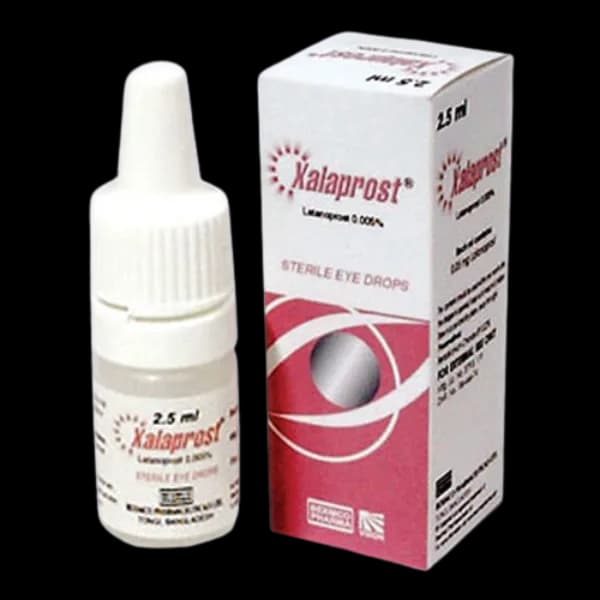

Medicine overview
Indications of Xalaprost
Xalaprost ophthalmic solution is indicated for the reduction of elevated intraocular pressure (IOP) in patients with:
- Open-angle glaucoma — an FDA-approved, first-line indication supported by extensive clinical evidence.
- Ocular hypertension — an FDA-approved indication for patients with elevated IOP without optic nerve damage or visual field loss.
In specialist practice, Xalaprost is also used off-label in the management of certain forms of pediatric and secondary glaucomas under close ophthalmologist supervision, although this is not an FDA-approved use and safety/efficacy have not been formally established in children.
Composition
Each mL of Latanoprost ophthalmic solution contains 50 micrograms (0.005% w/v) of Latanoprost as the active ingredient, formulated as a sterile, isotonic, buffered aqueous solution preserved with benzalkonium chloride.
Description
Xalaprost is a synthetic prostaglandin F2-alpha analogue used topically in the eye to lower intraocular pressure. It is prepared as a preservative-containing ophthalmic solution and is one of the most widely prescribed first-line agents for chronic management of open-angle glaucoma and ocular hypertension. Xalaprost works by increasing the outflow of aqueous humor from the eye, thereby reducing pressure inside the eye and helping to protect the optic nerve from pressure-related damage.
Therapeutic Class
Xalaprost belongs to the prostaglandin F2-alpha analogue class of drugs, used as an ophthalmic ocular hypotensive (anti-glaucoma) agent.
Pharmacology
Latanoprost is a prodrug that is hydrolyzed by corneal esterases to its biologically active acid form. This active metabolite is a selective prostaglandin FP receptor agonist that lowers intraocular pressure by increasing the outflow of aqueous humor, primarily through the uveoscleral (non-conventional) outflow pathway, with some contribution from the conventional trabecular outflow pathway.
Onset of IOP-lowering action with Latanoprost begins approximately 3-4 hours after instillation, with maximum effect occurring at 8-12 hours; the reduction in IOP is maintained for at least 24 hours, supporting once-daily dosing.
Dosage & Administration of Xalaprost
Adults
The recommended dose of Xalaprost is one drop in the affected eye(s) once daily, in the evening. The dose should not exceed once daily, as more frequent administration has been shown to paradoxically reduce the IOP-lowering effect of Xalaprost.
Pediatric use
A specific pediatric dosing regimen for Xalaprost has not been established; safety and efficacy in children have not been formally demonstrated (see Use in Special Populations).
Renal/Hepatic impairment
No dose adjustment of Xalaprost is required for renal or hepatic impairment based on available data, as systemic exposure after ocular administration is minimal.
Administration technique
- Wash hands before use; avoid letting the dropper tip touch the eye or any surface.
- Tilt the head back, pull down the lower eyelid to form a pocket, and instill one drop into the affected eye(s).
- If wearing contact lenses, remove them before instillation and wait at least 15 minutes before reinserting, as the preservative (benzalkonium chloride) may be absorbed by soft contact lenses.
- If using more than one topical ophthalmic medicine, space each product at least 5 minutes apart.
- If a dose is missed, do not double the next dose; continue with the regular once-daily evening schedule.
Administration of Xalaprost
Xalaprost is for topical ophthalmic (eye) use only and must not be injected or taken orally. Remove contact lenses before instilling Xalaprost and wait at least 15 minutes before reinserting them. Space other topical eye medicines at least 5 minutes apart from Xalaprost.
Interaction of Xalaprost
Xalaprost has few clinically significant drug interactions because systemic absorption after topical ocular use is very low. The following is well-documented:
- Thimerosal-containing eye drops: Precipitation can occur if Xalaprost is administered together with eye drops containing thimerosal; these products should be given at least 5 minutes apart.
- Other prostaglandin analogues: Concurrent use of Xalaprost with other prostaglandin or prostamide analogues is not recommended, as this may paradoxically increase IOP or increase the risk of additive local side effects rather than provide additional benefit.
Contraindications
Latanoprost is contraindicated in patients with known hypersensitivity to Latanoprost, benzalkonium chloride, or any other ingredient in the formulation.
Side Effects of Xalaprost
The most common side effects of Xalaprost affect the eyes and are generally mild to moderate.
Common (occurring in approximately 5-15% of patients)
- Blurred vision
- Ocular burning or stinging
- Conjunctival hyperemia (eye redness)
- Foreign body sensation
- Itching
- Increased iris pigmentation
- Punctate keratitis (superficial corneal irritation)
Less common (1-5%)
- Excessive tearing
- Eyelid discomfort or crusting
- Dry eye
- Eye pain
- Photophobia (light sensitivity)
Uncommon/Postmarketing
- Eyelash and vellus hair changes (increased length, thickness, pigmentation, number) — see Precautions and Warnings
- Iris/periorbital pigmentation changes — see Precautions and Warnings
- Corneal edema and corneal erosions
- Cystoid macular edema
- Iris cysts
- Eyelid skin darkening
- Reactivation of herpes keratitis
- Exacerbation of asthma or dyspnea (rare)
Pregnancy & Lactation
Pregnancy: Animal reproduction studies with Xalaprost have shown adverse effects (including cleft palate and skeletal anomalies) at doses substantially higher than the recommended human ophthalmic dose. There are no adequate and well-controlled studies of Xalaprost in pregnant women. Xalaprost should be used during pregnancy only if the potential benefit justifies the potential risk to the fetus, and only under the direct advice of a physician.
Lactation: It is not known whether Xalaprost or its metabolites are excreted in human breast milk. Because many drugs are excreted in breast milk, caution should be exercised, and a physician should be consulted to weigh the benefits of breastfeeding against the potential for exposure of the infant to Xalaprost.
Precautions & Warnings
Pigmentation changes: Xalaprost can gradually increase the amount of brown pigment in the iris, periorbital tissue (eyelid skin), and eyelashes. Iris pigmentation change is likely to be permanent and may result in a difference in eye color between the two eyes if only one eye is treated; patients should be informed of this possibility before and during treatment. Periorbital skin darkening may be reversible after stopping treatment.
Eyelash changes: Gradual changes to eyelashes and vellus hair in the treated eye may occur, including increased length, thickness, pigmentation, and number of lashes; these changes are usually reversible upon discontinuation.
Intraocular inflammation: Xalaprost should be used with caution in patients with a history of intraocular inflammation (iritis/uveitis) and is generally not recommended in patients with active intraocular inflammation, as it may exacerbate the condition.
Macular edema: Macular edema, including cystoid macular edema, has been reported during treatment with Xalaprost, predominantly in aphakic patients, pseudophakic patients with a torn posterior lens capsule, or patients with known risk factors. Use with caution in these patients.
Herpetic keratitis: Use Xalaprost with caution in patients with a history of herpetic keratitis; avoid use in patients with active herpes simplex keratitis.
Bacterial keratitis: Multiple-dose containers of topical ophthalmic products, including Xalaprost, have been associated with bacterial keratitis caused by inadvertent contamination of the dropper tip with the ocular surface. Patients should be instructed to avoid touching the dropper tip to the eye or surrounding structures.
Contact lenses: Contact lenses should be removed prior to instillation of Xalaprost and may be reinserted 15 minutes after administration, as the preservative benzalkonium chloride may be absorbed by soft contact lenses.
Overdose Effects of Xalaprost
Overdose with topical ocular Xalaprost is unlikely to cause any effects other than local eye irritation if a drop is accidentally instilled more than once. If Xalaprost is accidentally ingested or ocular exposure results in systemic symptoms such as abdominal pain, dizziness, fatigue, flushing, nausea, or sweating, seek immediate medical attention or contact a poison control center. There is no specific antidote; management is supportive and symptomatic and should be provided by a healthcare professional.
Storage Conditions
Store unopened bottles of Xalaprost ophthalmic solution refrigerated at 2°C to 8°C (36°F to 46°F), protected from light. Once opened, the bottle may be kept at room temperature (up to 25°C/77°F) for up to 6 weeks. Keep the bottle tightly closed when not in use, and keep out of reach of children.
Use In Special Populations
Pediatric use
Safety and effectiveness of Xalaprost in pediatric patients have not been formally established by the manufacturer; use in children should only occur under specialist ophthalmologist supervision (see Pediatric Uses).
Geriatric use
No overall differences in safety or effectiveness of Xalaprost have been observed between elderly and younger adult patients; no dose adjustment is necessary based on age alone.
Renal and hepatic impairment
No specific dose adjustment of Xalaprost is required in patients with renal or hepatic impairment, as systemic exposure following ocular administration is minimal.
Pregnancy and lactation
See Pregnancy and Lactation section for full details.
Duration Of Treatment
Xalaprost is typically used as a long-term, chronic therapy for open-angle glaucoma and ocular hypertension, since these are usually lifelong conditions requiring continuous control of intraocular pressure to prevent optic nerve damage and vision loss. There is no fixed treatment duration; the ophthalmologist determines how long Xalaprost should be continued based on regular monitoring of intraocular pressure, optic nerve status, and visual fields. Treatment should not be stopped abruptly without medical advice.
Drug Classes
Latanoprost is classified under: Prostaglandin F2-alpha analogues; Ophthalmic anti-glaucoma / ocular hypotensive agents.
Mode Of Action
Latanoprost is a prodrug hydrolyzed in the cornea to its active acid form, which acts as a selective agonist at prostaglandin FP receptors. This activation increases aqueous humor outflow, mainly via the uveoscleral pathway, resulting in a sustained reduction of intraocular pressure without significantly affecting aqueous humor production.
Pregnancy
C
Pediatric Uses
The safety and effectiveness of Xalaprost in pediatric patients have not been established through adequate, well-controlled clinical trials, and it is not FDA-approved for use in children. Some pediatric glaucoma specialists use Xalaprost off-label in select cases of congenital or juvenile glaucoma when other options have failed, but this should occur only under close specialist supervision with careful monitoring for pigmentation changes and other adverse effects. Parents/caregivers should discuss the risks and benefits of using Xalaprost in a child with the treating ophthalmologist before starting therapy.
Frequently Asked Questions
Q: What is Xalaprost 0.005% Ophthalmic Solution used for?
A: Xalaprost 0.005% Ophthalmic Solution is an eye drop used to lower elevated pressure inside the eye in people with open-angle glaucoma or ocular hypertension, helping to protect the optic nerve and preserve vision.
Q: How should I use Xalaprost 0.005% Ophthalmic Solution eye drops?
A: Instill one drop of Xalaprost 0.005% Ophthalmic Solution into the affected eye(s) once daily in the evening. Do not use it more than once a day, as this may reduce its effectiveness. Wash your hands before use and avoid touching the dropper tip to your eye.
Q: Can Xalaprost 0.005% Ophthalmic Solution change the color of my eyes?
A: Yes. Xalaprost 0.005% Ophthalmic Solution can gradually and permanently increase brown pigmentation in the iris, and it may also darken the skin around the eyes and lengthen or thicken the eyelashes. This is more noticeable in people with mixed-color (e.g., green-brown or blue-brown) eyes and can cause a difference in eye color if only one eye is treated. Tell your doctor if you notice these changes.
Q: Can I wear contact lenses while using Xalaprost 0.005% Ophthalmic Solution?
A: You should remove your contact lenses before instilling Xalaprost 0.005% Ophthalmic Solution and wait at least 15 minutes before putting them back in, because a preservative in the solution can be absorbed by soft contact lenses.
Q: Is Xalaprost 0.005% Ophthalmic Solution safe during pregnancy or breastfeeding?
A: Xalaprost 0.005% Ophthalmic Solution should be used during pregnancy only if clearly needed and if the potential benefit justifies the potential risk to the baby, as animal studies have shown risks at high doses and there is limited human data. It is not known if Xalaprost 0.005% Ophthalmic Solution passes into breast milk, so breastfeeding mothers should consult their physician before use.
Q: What should I do if I accidentally use too much Xalaprost 0.005% Ophthalmic Solution or swallow it?
A: If too much Xalaprost 0.005% Ophthalmic Solution is instilled in the eye or it is accidentally swallowed and you notice symptoms such as stomach pain, dizziness, flushing, nausea, or sweating, seek immediate medical attention or contact emergency services or a poison control center right away.
Disclaimer
The information provided is accurate to the best of our knowledge, but it does not replace professional medical advice. We cannot guarantee its completeness or accuracy, and the absence of specific information about a drug should not be taken as an endorsement. We are not responsible for any consequences arising from this information, so please consult a healthcare professional for any concerns or questions.
