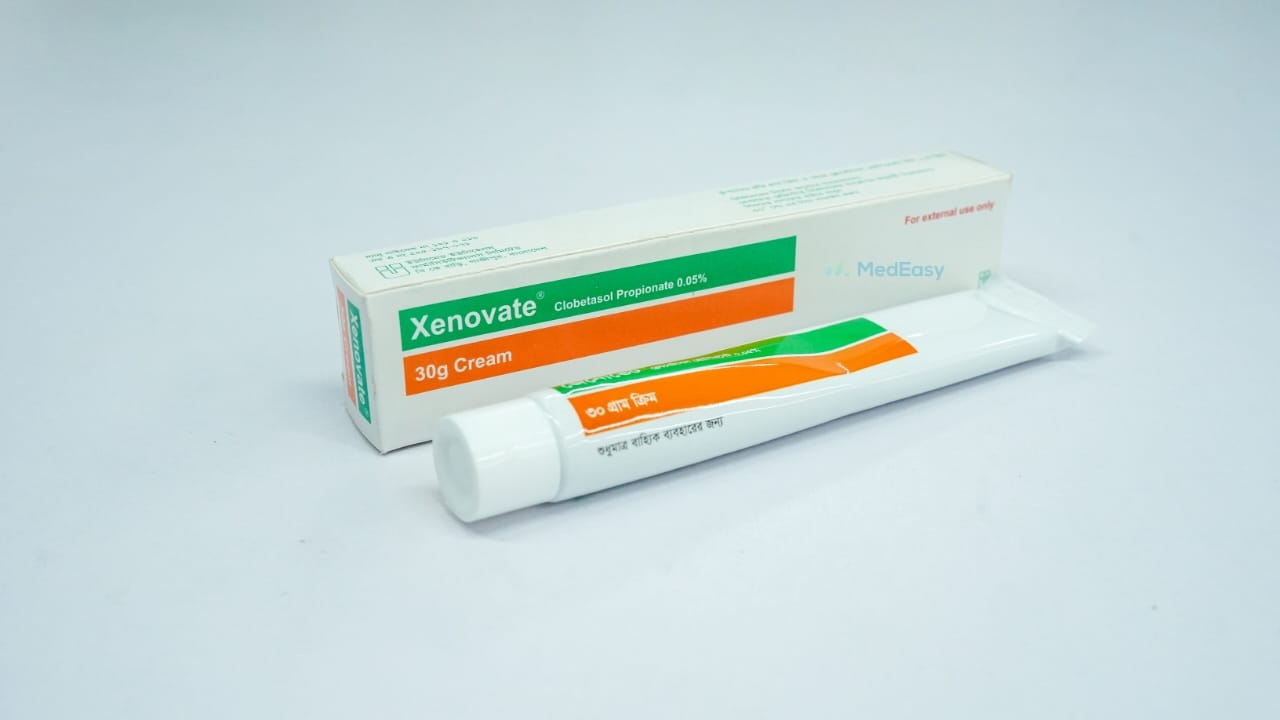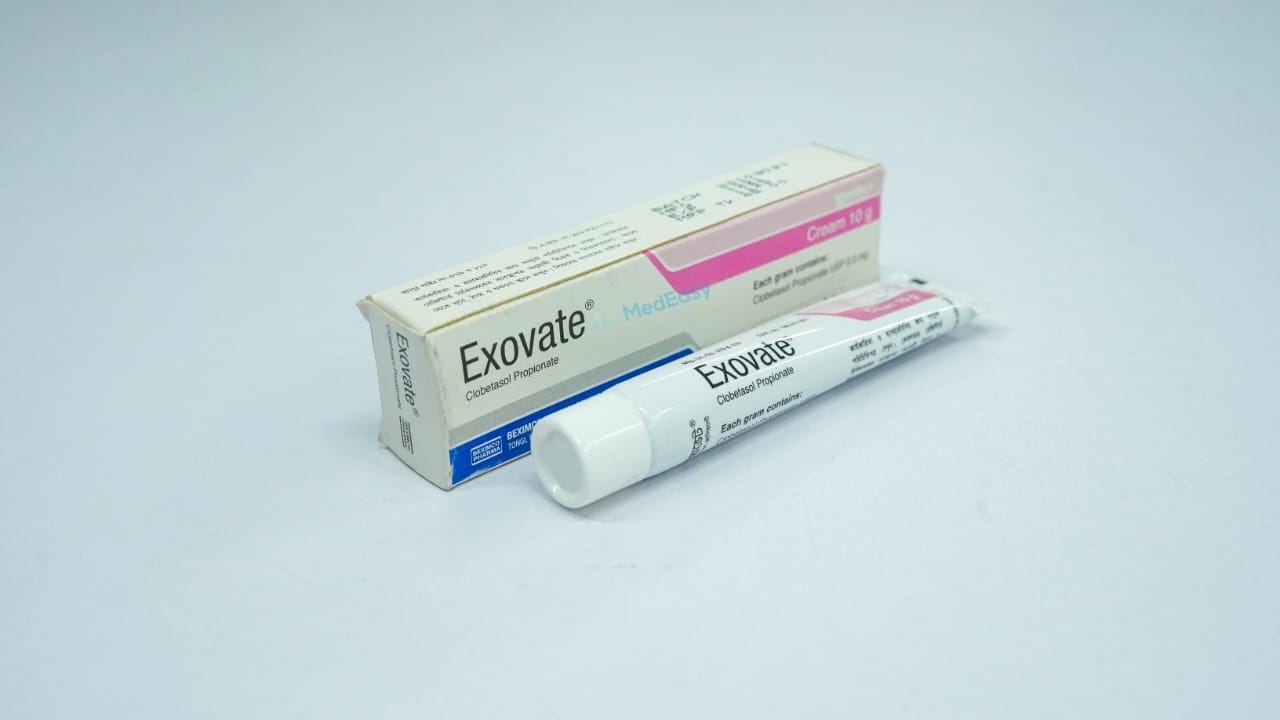
8% Off
Exovate0.05%
Beximco Pharmaceuticals Ltd.
৳41.40
Add to cart


Xderm is a super-high-potency (Group I) topical corticosteroid. Its use is classified by strength of evidence as follows:
Xderm is reserved for short courses on limited body-surface areas and is not intended for long-term or first-line use in mild skin conditions.
Clobetasol Propionate [Topical Preparation] is available as a topical preparation (cream, ointment, lotion, gel, solution, or scalp application, depending on brand) containing Clobetasol Propionate as the active ingredient, typically at a strength of 0.05% w/w (0.5 mg per gram or per mL) in a pharmaceutically suitable base appropriate to the formulation and body site being treated.
Xderm is a synthetic, halogenated corticosteroid belonging to the super-high-potency (Group I/Class I) category of topical steroids — among the most potent topical corticosteroids available. It is formulated for cutaneous (skin) application only and is used to relieve inflammation, redness, swelling, and itching associated with a range of steroid-responsive dermatological conditions that have failed to respond to weaker corticosteroids.
Because of its high potency, Xderm is intended for short, well-defined courses of treatment on limited areas of the body, under medical supervision, rather than for routine or prolonged use.
Clobetasol Propionate [Topical Preparation] works by binding to intracellular glucocorticoid receptors in skin cells, forming a complex that translocates to the nucleus and modulates gene transcription. This produces:
Topical application generally limits systemic absorption, but because Clobetasol Propionate [Topical Preparation] is extremely potent, clinically significant systemic absorption can occur with extensive application, prolonged use, use on thin or damaged skin, or use under occlusion, which can suppress the hypothalamic-pituitary-adrenal (HPA) axis.
Xderm must be used exactly as directed by a physician, on the smallest area and for the shortest duration necessary to control symptoms.
| Indication | Population | Typical Regimen |
|---|---|---|
| Corticosteroid-responsive dermatoses (eczema, localized psoriasis, lichen planus, discoid lupus) | Adults and adolescents ≥12 years | Apply a thin film to the affected area twice daily (morning and night); maximum 2 consecutive weeks; total weekly dose should not exceed 50 g (cream/ointment) or the equivalent for other forms |
| Plaque psoriasis (localized, up to 5–10% body surface area) | Adults ≥16–18 years, under specialist supervision | Twice daily application, may be extended up to 4 consecutive weeks with close monitoring; discontinue once control is achieved |
| Scalp conditions (using scalp solution/shampoo formulations) | Adults | Applied once or twice daily to the affected scalp area as directed on the product label; discontinue if no improvement after 1–2 weeks |
| Any indication | Children (where use is specifically directed by a physician) | Smallest effective amount, shortest possible course (often limited to about 5 days), under close medical supervision only |
Treatment should be reassessed if there is no improvement within 2 weeks. Xderm should not be used with occlusive dressings unless specifically directed by a physician, and should not be applied to the face, groin, axillae, or other skin folds unless specifically instructed, due to increased absorption and risk of skin thinning in these areas.
Xderm is for external (topical/cutaneous) use only and must not be swallowed, or applied to the eyes, mouth, or mucous membranes.
Xderm has a low potential for clinically significant drug interactions when used topically on limited areas for short durations, since systemic absorption is normally minimal. However, the following are recognized as clinically relevant when significant systemic absorption occurs (e.g., with extensive application, prolonged use, or use under occlusion):
Always inform your physician or pharmacist about all other medicines, including other topical products, being used with Xderm.
Clobetasol Propionate [Topical Preparation] is contraindicated in patients with:
Most side effects of Xderm are local and occur at the application site. Systemic side effects are uncommon with short-term, limited-area use but become more likely with prolonged or extensive application.
Patients should contact their physician if any persistent, worsening, or unusual reaction occurs.
Pregnancy: There are no adequate, well-controlled studies of Xderm in pregnant women, and high-potency topical corticosteroids have shown adverse effects on the fetus in animal studies at high systemic exposures. Xderm should be used during pregnancy only if clearly needed, at the smallest effective amount and for the shortest duration, and only if the potential benefit justifies the potential risk to the fetus. A physician should always be consulted before use in pregnancy.
Lactation: It is not known whether topical use of Xderm results in sufficient systemic absorption to appear in breast milk in clinically significant amounts. As a precaution, breastfeeding mothers should avoid applying Xderm directly to the breast/nipple area and should consult a physician before use, using it only if clearly needed and for the shortest necessary duration.
Xderm is one of the most potent topical corticosteroids available and requires strict adherence to the following precautions:
Excessive or prolonged use of Xderm, especially over large areas of the body or under occlusion, can lead to significant systemic absorption of the corticosteroid, resulting in effects such as HPA-axis suppression, Cushingoid features (rounded face, weight gain, thinning skin), high blood sugar, or, in children, growth suppression.
If accidental ingestion occurs, or if signs of systemic corticosteroid excess (such as unusual weight gain, marked mood changes, high blood sugar, or severe skin thinning) develop, seek immediate medical attention or contact a poison control center. Do not attempt to self-treat a suspected overdose; management should be guided by a physician and generally involves discontinuing the drug and gradual tapering when the drug has been used long-term, along with monitoring and supportive care as advised by a doctor.
Store at room temperature (below 30°C), away from light and moisture. Do not freeze. Keep the container tightly closed and out of reach of children.
Pediatric patients: Xderm is generally not recommended for children under 12 years of age (some formulations restrict use under 1 year); when a physician determines it is necessary in a child, it should be used at the lowest effective amount for the shortest possible duration due to a heightened risk of HPA-axis suppression and Cushingoid effects (see Pediatric Use).
Elderly patients: Limited specific data exist in elderly patients; general dosing recommendations apply, with attention to thinner, more fragile skin, which may increase local absorption and risk of skin atrophy.
Hepatic/renal impairment: No specific dose adjustment has been established for topical use, as systemic exposure is normally low; however, caution is advised with extensive application, since impaired hepatic or renal function could theoretically reduce clearance of any absorbed drug.
Pregnancy and lactation: See Pregnancy and Lactation section for detailed guidance.
Treatment with Xderm should generally be limited to a maximum of 2 consecutive weeks for most corticosteroid-responsive dermatoses, and up to 4 consecutive weeks for localized plaque psoriasis under close physician supervision. The total amount used should not exceed 50 g per week. If there is no improvement within 2 weeks, treatment should be reassessed by a physician. Xderm is not intended for continuous, long-term use; repeated or extended courses should only occur under medical supervision, with periodic reassessment of the need for continued therapy.
Topical Corticosteroid (Super-High Potency / Group I)
Clobetasol Propionate [Topical Preparation] exerts its effect by diffusing across cell membranes and binding to glucocorticoid receptors in the cytoplasm of skin cells. The activated receptor-drug complex enters the nucleus and alters the transcription of genes involved in inflammation, resulting in:
The net effect is a marked reduction in cutaneous inflammation, itching, and abnormal cell proliferation at the site of application.
C
The safety and efficacy of Xderm in children have not been as thoroughly established as in adults, and most labeling restricts routine use to patients 12 years of age and older (with some specific formulations restricted further, e.g., not for use under 1 year of age, and scalp/shampoo forms generally not recommended under 18 years).
Children, because of a larger skin-surface-area-to-body-weight ratio, absorb proportionally more topical corticosteroid and are therefore at greater risk of HPA-axis suppression, Cushing's syndrome, and, with prolonged use, growth retardation and delayed weight gain, as well as intracranial hypertension (reported rarely with potent topical corticosteroids in children).
When a physician determines that use in a child is necessary, treatment should be limited to the smallest effective area and the shortest possible duration (often around 5 days), with close medical supervision and monitoring for signs of systemic absorption.
Q: What is Xderm 0.05% Cream used for?
A: Xderm 0.05% Cream is a very potent topical corticosteroid used for the short-term treatment of moderate-to-severe inflammatory and itchy skin conditions — such as certain types of psoriasis, eczema, lichen planus, and discoid lupus erythematosus of the skin — that have not improved with weaker corticosteroid creams or ointments.
Q: How long can I use Xderm 0.05% Cream?
A: Most courses of Xderm 0.05% Cream should not exceed 2 consecutive weeks of use, and the total amount used should not exceed 50 g per week. For localized psoriasis, a physician may extend treatment to up to 4 weeks with close monitoring. If your symptoms have not improved within 2 weeks, contact your physician rather than continuing treatment on your own, since prolonged use increases the risk of skin thinning and other side effects.
Q: Can I use Xderm 0.05% Cream on my face or in skin folds?
A: No, Xderm 0.05% Cream should not be applied to the face, groin, armpits, or other skin folds unless your physician specifically instructs you to, because the skin in these areas absorbs the medicine more readily, increasing the risk of skin thinning, stretch marks, and other local side effects.
Q: Is Xderm 0.05% Cream safe to use during pregnancy or while breastfeeding?
A: Xderm 0.05% Cream should be used during pregnancy only if clearly needed, and at the smallest effective amount for the shortest possible time, because there are no adequate, well-controlled studies in pregnant women and high-potency topical corticosteroids have shown effects on the fetus in animal studies at high exposures. Similarly, while breastfeeding, it is not known whether enough of the drug passes into breast milk to affect a nursing infant; as a precaution, avoid applying it to the breast or nipple area and consult your physician before use.
Q: What are the most common side effects of Xderm 0.05% Cream?
A: The most common side effects of Xderm 0.05% Cream are local reactions at the application site, such as a burning or stinging sensation, dryness, itching, and redness. With prolonged or extensive use, more significant effects such as skin thinning, stretch marks, visible small blood vessels, or, rarely, suppression of the body's natural cortisol production (HPA-axis suppression) can occur, which is why treatment duration and area are strictly limited.
Q: What should I do if I accidentally use too much Xderm 0.05% Cream or my child swallows it?
A: Using more Xderm 0.05% Cream than directed, or using it over a larger area or for longer than prescribed, can lead to significant absorption of the corticosteroid into the body and side effects such as high blood sugar or hormonal changes. If you suspect an overdose, accidental ingestion (especially in a child), or notice unusual symptoms such as marked weight gain, mood changes, or severe skin thinning, seek immediate medical attention or contact a poison control center rather than trying to manage it at home.
Disclaimer
The information provided is accurate to the best of our knowledge, but it does not replace professional medical advice. We cannot guarantee its completeness or accuracy, and the absence of specific information about a drug should not be taken as an endorsement. We are not responsible for any consequences arising from this information, so please consult a healthcare professional for any concerns or questions.