
8% Off
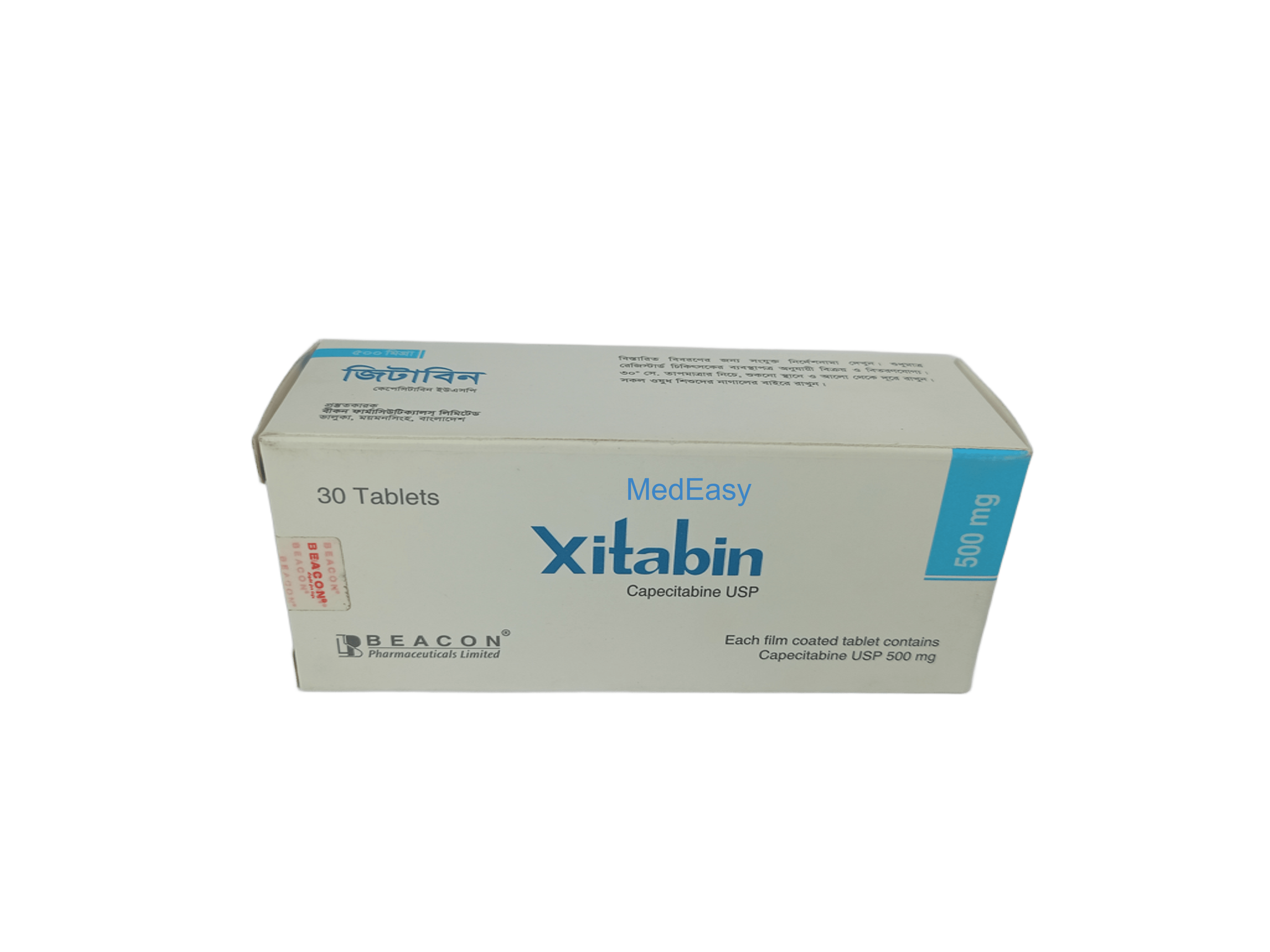
Xitabin500 mg
Beacon Pharmaceuticals PLC
৳690.00
Add to cart


Xelobine is a cytotoxic chemotherapy medicine and must only be prescribed and monitored by a qualified oncologist or physician experienced in cancer chemotherapy.
Each film-coated tablet of Capecitabine contains 150 mg or 500 mg of capecitabine as the active ingredient, along with standard pharmaceutical excipients such as lactose, microcrystalline cellulose, croscarmellose sodium, hypromellose, and magnesium stearate (exact formulation may vary by manufacturer).
Xelobine is an orally administered fluoropyrimidine carbamate that acts as a prodrug of 5-fluorouracil (5-FU). It is designed to be selectively activated within tumor tissue, generating cytotoxic 5-FU preferentially at the tumor site rather than in normal tissue. Xelobine is used in the treatment of certain solid tumors, most notably breast cancer and colorectal cancer, and is administered as tablets under the close supervision of an oncology specialist.
Xelobine belongs to the therapeutic class of antineoplastic agents, specifically the fluoropyrimidine carbamates, a subclass of antimetabolite chemotherapy drugs.
Capecitabine itself is pharmacologically inactive; it undergoes a three-step enzymatic conversion in the body. It is first hydrolyzed in the liver by carboxylesterase to 5'-deoxy-5-fluorocytidine (5'-DFCR), which is then converted by cytidine deaminase (found mainly in the liver and in tumor tissue) to 5'-deoxy-5-fluorouridine (5'-DFUR). The final step converts 5'-DFUR to the active cytotoxic moiety, 5-fluorouracil (5-FU), by thymidine phosphorylase, an enzyme present in higher concentrations in tumor tissue than in normal tissue. This selective activation is intended to concentrate 5-FU at the tumor site. 5-FU is further metabolized to disrupt DNA synthesis and repair (via inhibition of thymidylate synthase) and to interfere with RNA processing, leading to cell death, particularly in rapidly dividing malignant cells.
1250 mg/m² taken orally twice daily (total 2500 mg/m²/day) for 14 days, followed by a 7-day rest period, given as repeated 21-day cycles, continued until disease progression or unacceptable toxicity.
Xelobine 1250 mg/m² twice daily on Days 1–14 of a 21-day cycle, combined with docetaxel 75 mg/m² intravenously on Day 1 of the same cycle.
1250 mg/m² twice daily for 14 days followed by a 7-day rest period, given as 21-day cycles, for a total of 8 cycles (24 weeks).
1250 mg/m² twice daily for 14 days followed by a 7-day rest, as 21-day cycles, either as monotherapy or in combination with other approved chemotherapy agents per oncologist-directed protocol.
| Indication | Dose | Schedule |
|---|---|---|
| Metastatic breast cancer (monotherapy) | 1250 mg/m² twice daily | Days 1–14 of 21-day cycle |
| Metastatic breast cancer (with docetaxel) | 1250 mg/m² twice daily | Days 1–14 of 21-day cycle |
| Adjuvant colon cancer (Dukes' C) | 1250 mg/m² twice daily | Days 1–14 of 21-day cycle, 8 cycles |
| Metastatic colorectal cancer | 1250 mg/m² twice daily | Days 1–14 of 21-day cycle |
No dose adjustment is needed in mild renal impairment (creatinine clearance 51–80 mL/min). In moderate renal impairment (creatinine clearance 30–50 mL/min), a dose reduction to 75% of the standard dose is recommended. Xelobine is contraindicated in patients with severe renal impairment (creatinine clearance below 30 mL/min).
Close monitoring is recommended in patients with mild to moderate hepatic dysfunction due to liver metastases; Xelobine has not been studied in patients with severe hepatic impairment.
Dose modifications or interruptions may be required for hematologic, gastrointestinal, dermatologic (e.g., hand-foot syndrome), or other toxicities, as directed by the treating oncologist.
Xelobine tablets should be swallowed whole with water within 30 minutes after a meal (breakfast and dinner), approximately 12 hours apart. Tablets must not be crushed or split unless specifically instructed. Caregivers should avoid direct skin contact with crushed or broken tablets, as Xelobine is a cytotoxic drug; hands should be washed thoroughly after handling. Doses should never be adjusted or stopped without consulting the prescribing oncologist.
Concurrent use of Xelobine with warfarin or other coumarin-derivative anticoagulants can significantly increase anticoagulant exposure, leading to elevated INR and serious, sometimes fatal, bleeding events. This interaction can occur days to months after starting Xelobine, or even after stopping it. Frequent monitoring of INR/prothrombin time and anticoagulant dose adjustment are required in patients receiving both drugs.
Xelobine can increase phenytoin plasma concentrations, potentially leading to phenytoin toxicity; phenytoin levels should be monitored closely during concurrent use.
Leucovorin increases the toxicity of the active metabolite of Xelobine (5-fluorouracil) and may increase both efficacy and toxicity; combined use requires careful clinical monitoring.
Sorivudine and chemically related analogs (e.g., brivudine) markedly increase the toxicity of fluoropyrimidines and must never be co-administered with Xelobine (see Contraindications).
Xelobine may increase exposure to other drugs metabolized by CYP2C9; caution and monitoring are advised when such drugs are used concurrently.
Patients should seek prompt medical attention for severe or persistent diarrhea, fever, signs of infection, unusual bleeding or bruising, or severe hand-foot symptoms.
Xelobine is contraindicated during pregnancy. As a cytotoxic chemotherapy agent, it can cause fetal harm based on its mechanism of action and animal reproduction data; women of childbearing potential should use effective contraception during treatment and for a period after stopping Xelobine, and should be advised of the potential risk to the fetus. If pregnancy occurs during treatment, the patient should be informed of the potential hazard and referred for immediate medical evaluation.
Xelobine is also contraindicated during breastfeeding; breastfeeding should be discontinued during treatment due to the potential for serious adverse effects in the nursing infant.
See Interactions — concurrent use with warfarin or other coumarin anticoagulants requires frequent coagulation monitoring due to the risk of serious, sometimes fatal, bleeding.
Patients with DPD deficiency are at increased risk of severe, life-threatening, or fatal toxicity from Xelobine. Testing for DPD deficiency may be considered before starting treatment; Xelobine should be withheld immediately in any patient who develops evidence of acute, early-onset, or unusually severe toxicity, which may indicate DPD deficiency.
Severe diarrhea can occur and may require dose interruption, dose reduction, and aggressive rehydration; patients should be instructed to report diarrhea promptly.
Monitor for palmar-plantar erythrodysesthesia; dose interruption or reduction may be required for moderate to severe cases (see Side Effects).
Regular monitoring of complete blood counts is recommended; treatment should be withheld for significant hematologic toxicity.
Xelobine should be used with caution in patients with a history of coronary artery disease due to a risk of cardiotoxicity, including angina, arrhythmias, and myocardial infarction.
Dose adjustment is required in moderate renal impairment, and Xelobine is contraindicated in severe renal impairment. Use with caution and close monitoring in patients with hepatic impairment (see Dosage and Administration).
Elderly patients may be more susceptible to gastrointestinal toxicity from Xelobine and should be monitored closely (see Use in Special Populations).
Xelobine is a cytotoxic drug; it should be handled and disposed of according to institutional guidelines for hazardous drugs, and should be taken exactly as prescribed by the treating oncologist — do not alter the dose, stop treatment, or share this medicine with others without medical advice.
Manifestations of Xelobine overdose may include nausea, vomiting, diarrhea, gastrointestinal irritation and bleeding, bone marrow suppression, and mucositis. There is no specific antidote for Xelobine overdose. In case of suspected overdose, seek immediate medical attention or contact emergency services/poison control; management is supportive and may include interruption of therapy, hospitalization, and treatment of the resulting toxicities, guided by the treating physician.
Store at room temperature (below 30°C), away from light and moisture, in the original packaging with the container tightly closed. Keep out of reach of children. Handle with care, as Xelobine is a cytotoxic medicine.
No adjustment is needed for mild impairment; a dose reduction is required for moderate impairment; Xelobine is contraindicated in severe renal impairment (see Dosage and Administration and Contraindications).
Use with caution and close monitoring in mild to moderate hepatic dysfunction due to liver metastases; Xelobine has not been studied in severe hepatic impairment.
Elderly patients receiving Xelobine, particularly in combination regimens, have shown higher rates of severe gastrointestinal toxicity; closer monitoring is recommended, though no specific starting dose reduction is required based on age alone.
Safety and efficacy of Xelobine in pediatric patients have not been established (see Pediatric Uses).
See Pregnancy and Lactation — Xelobine is contraindicated in both.
Treatment with Xelobine is given in repeated 21-day cycles (14 days of therapy followed by a 7-day rest). For metastatic disease, treatment is generally continued until disease progression or unacceptable toxicity, as determined by the treating oncologist. For adjuvant treatment of Dukes' C colon cancer, the recommended duration is 8 cycles (approximately 24 weeks).
Antineoplastic agent; fluoropyrimidine carbamate; antimetabolite (prodrug of 5-fluorouracil).
Capecitabine is enzymatically converted in vivo to 5-fluorouracil (5-FU), with the final activation step catalyzed by thymidine phosphorylase, an enzyme present at higher levels in tumor tissue than in normal tissue. 5-FU is incorporated into RNA and inhibits thymidylate synthase, blocking DNA synthesis and repair, which leads to selective cytotoxicity against rapidly dividing cancer cells.
D
The safety and efficacy of Xelobine have not been established in pediatric patients. Xelobine is not recommended for use in children or adolescents outside of a clinical trial setting.
Q: What is Xelobine 500 mg Tablet used for?
A: Xelobine 500 mg Tablet is an oral chemotherapy medicine used to treat metastatic breast cancer (alone or in combination with docetaxel) and colorectal cancer, including adjuvant treatment of Dukes' C colon cancer and metastatic colorectal cancer, as directed by an oncologist.
Q: How should I take Xelobine 500 mg Tablet tablets?
A: Xelobine 500 mg Tablet tablets should be swallowed whole with water within 30 minutes after a meal, taken twice daily about 12 hours apart, for 14 days followed by a 7-day rest period, exactly as prescribed by your oncologist. Never change the dose or stop treatment on your own.
Q: Can Xelobine 500 mg Tablet be taken with warfarin (blood thinners)?
A: Taking Xelobine 500 mg Tablet together with warfarin or other coumarin-type blood thinners can significantly increase bleeding risk, sometimes fatally, because Xelobine 500 mg Tablet raises the blood thinner's effect. If you are taking warfarin, tell your doctor immediately; frequent blood clotting (INR) tests will be needed throughout treatment.
Q: What is hand-foot syndrome, and is it related to Xelobine 500 mg Tablet?
A: Hand-foot syndrome (palmar-plantar erythrodysesthesia) is a common side effect of Xelobine 500 mg Tablet causing redness, swelling, pain, and peeling of the palms and soles. Tell your doctor if this occurs, as your Xelobine 500 mg Tablet dose may need to be adjusted or temporarily stopped.
Q: Is Xelobine 500 mg Tablet safe during pregnancy or breastfeeding?
A: No. Xelobine 500 mg Tablet is contraindicated in pregnancy because it can cause serious harm to a developing fetus, and it is also contraindicated during breastfeeding. Effective contraception is recommended during treatment; discuss this with your oncologist before starting Xelobine 500 mg Tablet.
Q: What should I do if I miss a dose, or think I have taken too much Xelobine 500 mg Tablet?
A: Do not take a double dose to make up for a missed one — contact your oncologist for guidance on missed doses. If you suspect you have taken too much Xelobine 500 mg Tablet, seek immediate medical attention or contact emergency services/poison control, as overdose can cause serious toxicity such as severe diarrhea, bone marrow suppression, and bleeding.
Disclaimer
The information provided is accurate to the best of our knowledge, but it does not replace professional medical advice. We cannot guarantee its completeness or accuracy, and the absence of specific information about a drug should not be taken as an endorsement. We are not responsible for any consequences arising from this information, so please consult a healthcare professional for any concerns or questions.

