
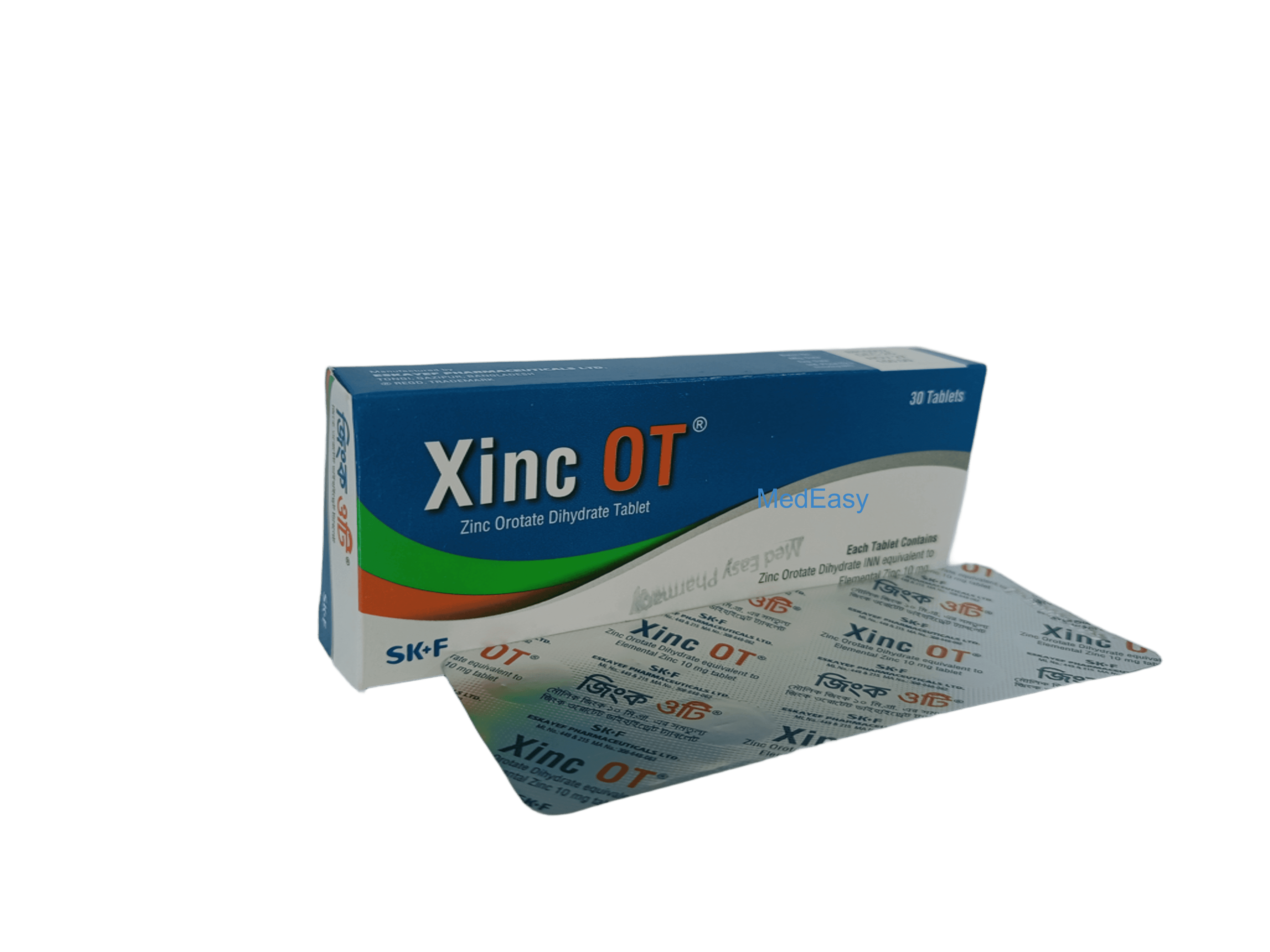

Medicine overview
Indications of Xinc OT
Xinc OT is an oral zinc supplement (zinc bound to orotic acid) used for the following indications:
- Prevention and treatment of zinc deficiency - established use, including deficiency due to inadequate dietary intake, malabsorption syndromes, chronic diarrhea, or increased physiological needs.
- Adjunct nutritional support in conditions associated with increased zinc requirements or losses, such as chronic diarrheal illness, malnutrition, and certain gastrointestinal or malabsorptive disorders, used alongside treatment of the underlying condition.
- Supportive therapy for poor wound healing, hair loss (alopecia), skin conditions, and recurrent infections when these are attributable to documented or clinically suspected zinc deficiency - adjunct use, not a substitute for evaluating the underlying cause.
- Growth and immune support in children with confirmed or suspected zinc deficiency - use guided by a physician.
Xinc OT is not a treatment for conditions unrelated to zinc deficiency, and general claims (e.g., for infertility, sensory disturbances, or mood symptoms) should be regarded as adjunctive at best and are not strongly evidence-supported; a physician should evaluate the underlying cause before long-term use.
Composition
Each tablet/capsule of Zinc Orotate contains zinc in the form of zinc orotate, providing a specified amount of elemental zinc (commonly formulated to deliver approximately 5-60 mg elemental zinc per unit dose, depending on the product strength). Excipients vary by manufacturer.
Description
Xinc OT is a mineral (trace element) supplement in which zinc is chelated to orotic acid, a naturally occurring compound that may facilitate zinc transport across cell membranes. Zinc is an essential trace mineral required as a cofactor for over 300 enzymes involved in protein synthesis, immune function, wound healing, DNA synthesis, cell division, growth, and taste/smell perception.
Xinc OT is used as a dietary supplement to prevent or correct zinc deficiency and to provide adjunct nutritional support in states of increased zinc need or loss.
Therapeutic Class
Trace element / mineral supplement (zinc preparation)
Pharmacology
Zinc is an essential trace element that serves as a catalytic and structural cofactor for numerous metalloenzymes and transcription factors (zinc-finger proteins). It is required for normal immune cell function (T-lymphocyte and neutrophil activity), wound healing, protein and nucleic acid synthesis, growth and development, and maintenance of taste and smell (gustatory/olfactory function).
In Zinc Orotate, zinc is combined with orotic acid (orotate), which is proposed to improve transport of zinc across cell membranes and enhance intracellular bioavailability compared with some inorganic zinc salts, although comparative clinical evidence for superiority over other zinc salts (e.g., zinc sulfate, zinc gluconate) is limited. Zinc is absorbed primarily in the small intestine via both carrier-mediated and passive diffusion processes; absorption is reduced by phytates, calcium, and iron, and by concurrent food intake to a modest degree.
Dosage & Administration of Xinc OT
| Indication | Population | Typical Dose |
|---|---|---|
| Zinc deficiency (prevention/treatment) | Adults | One tablet (elemental zinc dose per product labeling, commonly 15-60 mg elemental zinc) once or twice daily with meals, or as directed by a physician |
| Zinc deficiency | Children | Weight-based dosing as determined by a physician; not for self-administration in children without medical supervision |
| Adjunct nutritional support (e.g., chronic diarrhea, malabsorption) | Adults | As directed by physician, typically for a defined course alongside treatment of the underlying condition |
Xinc OT is best taken with food to minimize gastrointestinal upset, though taking it on an empty stomach may modestly improve absorption; a physician or pharmacist should be consulted for the specific product strength and duration appropriate to the individual.
Administration of Xinc OT
Take Xinc OT orally, preferably with a meal to reduce the chance of nausea or stomach upset. Swallow the tablet whole with a glass of water. If gastrointestinal upset occurs even with food, consult a physician before adjusting the dose. Avoid taking Xinc OT at the same time as tetracycline or fluoroquinolone antibiotics, or penicillamine; separate dosing by at least 2 hours (see Interactions).
Interaction of Xinc OT
Xinc OT can reduce the absorption and clinical effectiveness of certain oral medications, and its own absorption can likewise be reduced by some agents. Clinically significant interactions include:
- Tetracycline and fluoroquinolone antibiotics (e.g., doxycycline, ciprofloxacin) - zinc chelates with these antibiotics in the gut, reducing absorption of both the antibiotic and zinc. Separate administration by at least 2 hours before or 4-6 hours after the antibiotic dose.
- Penicillamine - zinc can reduce penicillamine absorption and efficacy; separate doses by at least 1-2 hours.
- Copper - chronic zinc supplementation, especially at doses above the tolerable upper intake level, competitively inhibits copper absorption and can precipitate copper deficiency with prolonged use (see Precautions).
- Thiazide diuretics - may increase urinary zinc excretion, potentially lowering zinc levels with long-term co-administration.
- Iron and calcium supplements - high doses taken concurrently may reduce zinc absorption; consider separating dosing times if taken together long-term.
Contraindications
Zinc Orotate is contraindicated in patients with known hypersensitivity to zinc orotate or any component of the formulation.
Side Effects of Xinc OT
Most patients tolerate Xinc OT well at recommended doses. Reported side effects include:
- Common: Nausea, stomach upset, and mild abdominal discomfort, particularly when taken on an empty stomach.
- Less common: Vomiting, diarrhea or constipation, metallic or unpleasant taste in the mouth, headache.
- With prolonged high-dose use (typically above the tolerable upper intake level): Copper deficiency (which can cause anemia and neurological symptoms), reduced immune function, and lowered HDL cholesterol.
Seek medical advice if side effects are persistent or severe.
Pregnancy & Lactation
Zinc is an essential nutrient required in slightly higher amounts during pregnancy and lactation, and dietary supplementation up to the recommended dietary allowance is generally considered appropriate. However, Xinc OT should be used during pregnancy and breastfeeding only if clearly needed and under medical supervision, since doses above the recommended allowance and tolerable upper intake level have not been established as safe in these populations and could theoretically affect maternal copper and mineral balance. A physician should be consulted before use to confirm the appropriate dose.
Precautions & Warnings
Use Xinc OT with the following precautions:
- Copper deficiency risk: Prolonged use of zinc supplementation, particularly at doses exceeding the tolerable upper intake level (40 mg elemental zinc/day for adults), can cause copper deficiency due to competitive inhibition of copper absorption. This may present as anemia or neurological symptoms. Periodic monitoring is reasonable with long-term high-dose use, and copper supplementation may be advised by a physician in such cases.
- Drug absorption interference: May reduce absorption of tetracyclines, fluoroquinolones, and penicillamine (see Interactions) - separate dosing by at least 2 hours.
- Not a substitute for diagnosis: Xinc OT is not a substitute for identifying and treating the underlying cause of suspected zinc deficiency (e.g., malabsorption, chronic disease, dietary insufficiency); underlying conditions should be evaluated by a physician.
- Renal impairment: Patients with significant renal impairment should use zinc supplements only under medical supervision, as zinc excretion may be altered.
- Keep out of reach of children; accidental ingestion of large amounts of zinc-containing products can cause toxicity.
Overdose Effects of Xinc OT
Acute overdose of Xinc OT can cause nausea, vomiting, abdominal cramps, diarrhea, headache, and a metallic taste. Very high acute ingestion may cause fever, lethargy, and gastric bleeding. Chronic excessive intake can lead to copper deficiency, sideroblastic anemia, neutropenia, and neurological impairment. If overdose is suspected, seek immediate medical attention or contact a poison control center; do not attempt to manage a suspected overdose at home without professional guidance.
Storage Conditions
Store at room temperature (below 30°C), away from light and moisture. Keep out of reach of children.
Use In Special Populations
Elderly: No specific dose adjustment is generally required, but elderly patients should be monitored for gastrointestinal tolerance and, with long-term use, for signs of copper deficiency.
Renal impairment: Use with caution and under medical supervision; zinc handling may be altered in significant renal disease.
Hepatic impairment: No specific well-established dose adjustment; use as directed by a physician.
Pediatric: See Pediatric Uses section.
Duration Of Treatment
Duration of Xinc OT therapy depends on the indication. For correction of documented zinc deficiency, treatment is typically continued for several weeks to a few months, with reassessment of zinc status by a physician. For adjunct use in conditions such as chronic diarrhea, treatment duration follows the course of the underlying condition. Long-term, high-dose use beyond what is recommended should be avoided without medical supervision due to the risk of copper deficiency.
Drug Classes
Minerals and trace elements; nutritional supplements
Mode Of Action
Zinc functions as an essential cofactor for more than 300 enzymes and numerous zinc-finger transcription factors, supporting protein and nucleic acid synthesis, cell division, immune cell function, and wound healing. In Zinc Orotate, the orotate carrier is proposed to enhance transport of the zinc ion across cell membranes, improving intracellular delivery compared with some other zinc salts, thereby helping restore normal cellular zinc-dependent processes in deficient states.
Pediatric Uses
Zinc is an essential nutrient in children, and Xinc OT may be used under medical supervision for prevention or treatment of documented zinc deficiency, or as adjunct therapy in conditions such as persistent diarrhea associated with zinc deficiency. Dosing must be individualized by a physician based on the child's age, weight, and indication, and should follow recommended dietary allowance and tolerable upper intake limits for age. Safety and efficacy of specific Xinc OT product formulations have not been separately established for all pediatric age groups, and self-administration in children without medical guidance is not recommended.
Frequently Asked Questions
Q: What is Xinc OT 10 mg Tablet used for?
A: Xinc OT 10 mg Tablet is a zinc supplement used to prevent or treat zinc deficiency and to provide adjunct nutritional support in conditions associated with increased zinc needs, such as chronic diarrhea or malabsorption. It supports immune function, wound healing, and normal growth.
Q: How should I take Xinc OT 10 mg Tablet?
A: Xinc OT 10 mg Tablet is usually taken by mouth once or twice daily with meals to reduce stomach upset, though your physician may advise a specific schedule. Always follow the dose and duration prescribed rather than taking it indefinitely on your own.
Q: Can I take Xinc OT 10 mg Tablet with antibiotics?
A: Xinc OT 10 mg Tablet can bind to tetracycline and fluoroquinolone antibiotics in the gut, reducing absorption of both. If you are prescribed such an antibiotic, take it at least 2 hours before or 4-6 hours after Xinc OT 10 mg Tablet, or as your physician advises.
Q: Is it safe to take Xinc OT 10 mg Tablet during pregnancy?
A: Xinc OT 10 mg Tablet should be used during pregnancy or breastfeeding only if clearly needed and recommended by a physician, since doses above the standard recommended allowance have not been established as safe in these populations. Always consult your doctor before use.
Q: What happens if I take too much Xinc OT 10 mg Tablet for a long time?
A: Prolonged high-dose use of Xinc OT 10 mg Tablet can cause copper deficiency, since zinc competes with copper for absorption; this can lead to anemia, reduced immune function, and neurological symptoms. Long-term use above the recommended dose should only occur under medical supervision.
Q: What should I do if I suspect a Xinc OT 10 mg Tablet overdose?
A: Symptoms of overdose can include nausea, vomiting, abdominal cramps, and headache. If you suspect an overdose of Xinc OT 10 mg Tablet, seek immediate medical attention or contact a poison control center rather than treating it at home.
Disclaimer
The information provided is accurate to the best of our knowledge, but it does not replace professional medical advice. We cannot guarantee its completeness or accuracy, and the absence of specific information about a drug should not be taken as an endorsement. We are not responsible for any consequences arising from this information, so please consult a healthcare professional for any concerns or questions.
