
8% Off
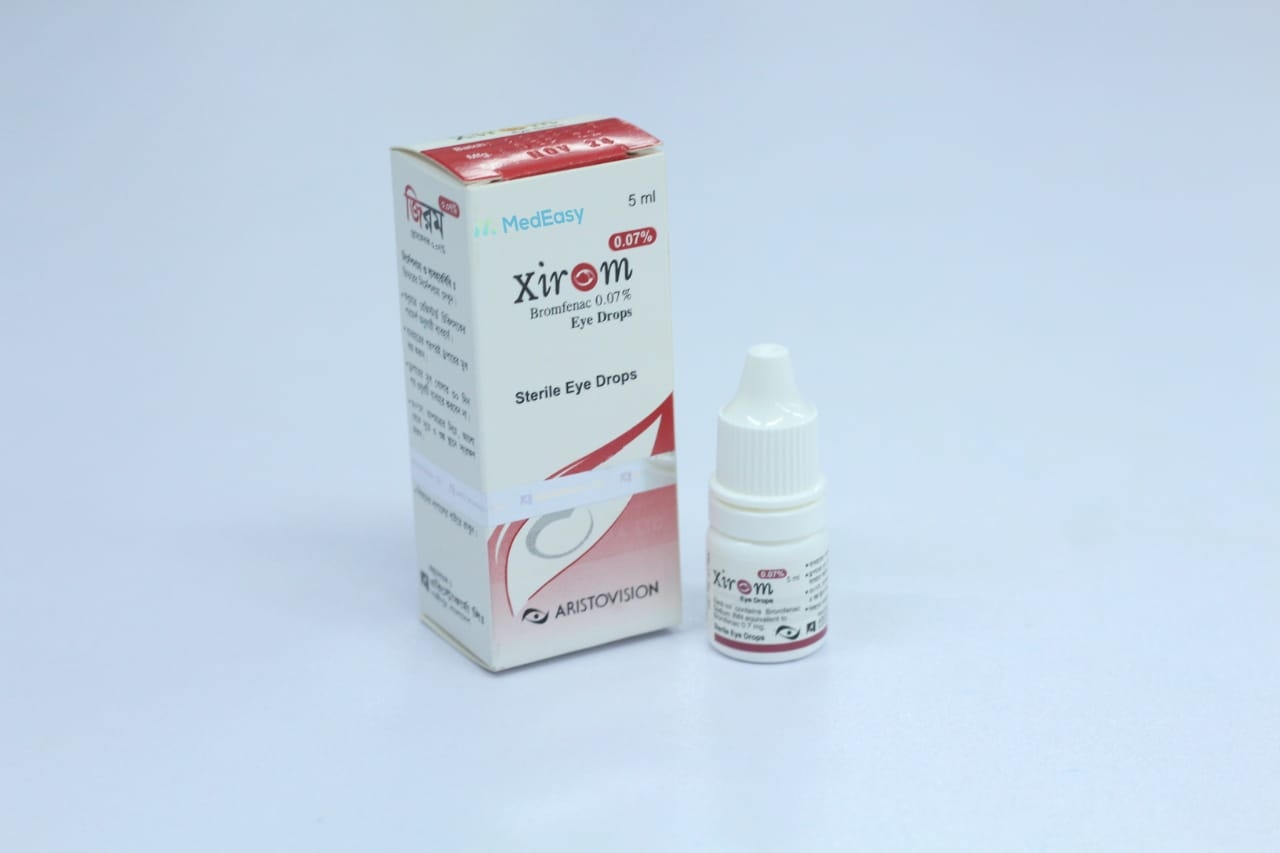
Xirom 0.07%5 ml
Aristopharma Ltd.
৳82.80
Add to cart


Xirom 0.09% 5 ml ophthalmic solution is a topical nonsteroidal anti-inflammatory drug (NSAID) formulated for use in the eye. Its evidence-based uses are as follows:
Xirom 0.09% 5 ml ophthalmic solution is for topical use in the eye only and is not intended for injection, oral, or systemic use.
Each formulation of Xirom 0.09% 5 ml ophthalmic solution contains Xirom 0.09% 5 ml as the active ingredient, at a strength (commonly 0.07% or 0.09% w/v depending on the specific branded product) determined by the prescribing physician and product availability.
Inactive ingredients typically include a preservative (e.g. benzalkonium chloride), tonicity and buffering agents (such as boric acid, sodium borate, and edetate disodium), and purified water. The exact inactive-ingredient composition may vary slightly by manufacturer/brand.
Xirom 0.09% 5 ml is a topical, nonsteroidal anti-inflammatory drug (NSAID) formulated as a sterile ophthalmic solution (eye drops). It belongs to the phenylacetic acid class of NSAIDs and is used to reduce ocular inflammation and pain, most commonly following cataract surgery.
Xirom 0.09% 5 ml ophthalmic solution works by inhibiting the cyclooxygenase (COX) enzymes involved in the production of prostaglandins — key inflammatory mediators responsible for postoperative pain, redness, and swelling in the eye.
Xirom 0.09% 5 ml ophthalmic solution is intended for use strictly in the eye and must not be injected or taken orally.
Ophthalmic Nonsteroidal Anti-Inflammatory Drug (NSAID) — Xirom 0.09% 5 ml belongs to this class of topical anti-inflammatory eye preparations.
Xirom 0.09% 5 ml is a nonsteroidal anti-inflammatory drug (NSAID) that works by non-selectively and reversibly inhibiting the cyclooxygenase (COX-1 and COX-2) enzymes, which are responsible for converting arachidonic acid into prostaglandins and other prostanoids.
By blocking prostaglandin synthesis in ocular tissue, Xirom 0.09% 5 ml ophthalmic solution reduces the inflammatory cascade that produces pain, redness, photophobia, and vascular permeability associated with intraocular surgery. Unlike corticosteroids, Xirom 0.09% 5 ml ophthalmic solution does not raise intraocular pressure and does not appear to impair wound healing to the same degree, though it can still delay healing in some patients (see Precautions and Warnings).
Following topical ocular administration, systemic absorption of Xirom 0.09% 5 ml is minimal, and plasma concentrations are generally very low or undetectable, limiting the potential for systemic NSAID-type adverse effects.
| Formulation strength | Typical regimen |
|---|---|
| 0.07% once-daily formulation | One drop in the affected eye once daily, starting 1 day before cataract surgery, continued on the day of surgery, and for the first 14 days of the postoperative period. |
| 0.09% twice-daily formulation | One drop in the affected eye twice daily, starting the day after cataract surgery and continuing through the first 2 weeks (14 days) of the postoperative period. |
The exact regimen (once vs. twice daily) depends on the specific branded formulation of Xirom 0.09% 5 ml ophthalmic solution prescribed; patients should follow the schedule indicated on their product label and by their ophthalmologist, and should not exceed the prescribed frequency or duration.
Safety and effectiveness of Xirom 0.09% 5 ml ophthalmic solution in pediatric patients have not been established (see Use in Special Populations).
No specific dosage adjustment has been established for renal or hepatic impairment, as systemic absorption of Xirom 0.09% 5 ml following topical ocular use is minimal.
One drop of Xirom 0.09% 5 ml ophthalmic solution in the affected eye once or twice daily (per the specific product's labeling), starting shortly before cataract surgery and continued for about 14 days postoperatively, unless the prescribing physician advises otherwise.
Other topical ophthalmic NSAIDs or corticosteroids: Concurrent use of Xirom 0.09% 5 ml ophthalmic solution with other topical NSAIDs may increase the risk of corneal healing problems; use of Xirom 0.09% 5 ml ophthalmic solution together with topical corticosteroids may also increase the potential for delayed healing. Such combinations should only be used under close ophthalmologist supervision.
Systemic anticoagulants and antiplatelet agents (e.g. warfarin, heparin, aspirin, clopidogrel): Xirom 0.09% 5 ml ophthalmic solution can interfere with platelet aggregation; patients on these agents, or with known bleeding tendencies, may have an increased risk of ocular bleeding (including hyphema) during ocular surgery when using Xirom 0.09% 5 ml ophthalmic solution — see Precautions and Warnings.
Because systemic absorption of Xirom 0.09% 5 ml ophthalmic solution after topical ocular use is minimal, clinically significant systemic drug interactions (e.g. with oral medications) are not expected, but patients should inform their physician of all medicines and eye drops they are using.
Xirom 0.09% 5 ml ophthalmic solution is contraindicated in patients with known hypersensitivity to Xirom 0.09% 5 ml, to other NSAIDs, or to any ingredient in the formulation.
Most adverse effects of Xirom 0.09% 5 ml ophthalmic solution are local, mild, and transient. Reported adverse reactions include:
Less common but more serious effects — corneal thinning, erosion, or perforation, and increased ocular bleeding — are discussed in detail under Precautions and Warnings, as they represent important class warnings for ophthalmic NSAIDs such as Xirom 0.09% 5 ml ophthalmic solution.
Pregnancy: There are no adequate and well-controlled studies of Xirom 0.09% 5 ml ophthalmic solution in pregnant women. As with other NSAIDs, use during the third trimester of pregnancy should generally be avoided because of the potential for premature closure of the fetal ductus arteriosus. Xirom 0.09% 5 ml ophthalmic solution should be used during pregnancy only if the potential benefit justifies the potential risk to the fetus, and only under the direct advice of a physician.
Lactation: It is not known whether Xirom 0.09% 5 ml is excreted in human breast milk following topical ocular administration. Because many drugs are excreted in human milk, caution should be exercised and a physician consulted before using Xirom 0.09% 5 ml ophthalmic solution while breastfeeding.
Use of topical NSAIDs, including Xirom 0.09% 5 ml ophthalmic solution, may cause keratitis. In some susceptible patients, continued use can lead to corneal epithelial breakdown, corneal thinning, corneal erosion, corneal ulceration, or corneal perforation. These events may be sight-threatening. Patients with evidence of corneal epithelial breakdown should discontinue Xirom 0.09% 5 ml ophthalmic solution immediately and be closely monitored.
Postmarketing experience with topical NSAIDs, including Xirom 0.09% 5 ml ophthalmic solution, suggests that patients with complicated ocular surgeries, corneal denervation, corneal epithelial defects, diabetes mellitus, ocular surface diseases (e.g. dry eye syndrome), rheumatoid arthritis, or repeat ocular surgeries within a short period of time, and those using topical NSAIDs for longer than the recommended duration or concomitantly with topical corticosteroids, may be at increased risk for corneal adverse events.
Xirom 0.09% 5 ml ophthalmic solution, like other topical NSAIDs, may interfere with platelet aggregation and cause increased bleeding of ocular tissues, including hyphema, in conjunction with ocular surgery. Caution is advised in patients with known bleeding tendencies or who are taking other medications that may prolong bleeding time.
Xirom 0.09% 5 ml ophthalmic solution, like other NSAIDs, may slow or delay healing of ocular tissue. Concomitant use of topical corticosteroids with Xirom 0.09% 5 ml ophthalmic solution may increase this risk.
Contact lenses should be removed prior to instillation of Xirom 0.09% 5 ml ophthalmic solution; the preservative in the solution may be absorbed by soft contact lenses.
Xirom 0.09% 5 ml ophthalmic solution is for topical ophthalmic use only and must not be injected into the eye or used systemically.
There is a potential for cross-sensitivity to acetylsalicylic acid, phenylacetic acid derivatives, and other NSAIDs. Caution should be used when treating patients who have previously exhibited sensitivity to these drugs.
Topical ocular overdose of Xirom 0.09% 5 ml ophthalmic solution is unlikely to cause serious systemic toxicity because systemic absorption after ophthalmic use is minimal. If excess solution is instilled, the eye may be flushed with lukewarm water.
If Xirom 0.09% 5 ml ophthalmic solution is accidentally swallowed, drink fluids to dilute and seek immediate medical attention or contact a poison control center / emergency services. Do not attempt any specific home treatment beyond this without medical guidance.
Store at room temperature (15°C to 25°C / 59°F to 77°F). Protect from light. Do not freeze. Keep the bottle tightly closed when not in use, and keep out of reach of children.
Safety and effectiveness of Xirom 0.09% 5 ml ophthalmic solution in pediatric patients have not been established.
No overall differences in safety or effectiveness of Xirom 0.09% 5 ml ophthalmic solution have been observed between elderly and younger adult patients; no dose adjustment is required based on age alone.
Specific studies in patients with renal or hepatic impairment have not been conducted; however, because systemic absorption of Xirom 0.09% 5 ml ophthalmic solution after topical ocular use is minimal, dose adjustment is not generally expected to be necessary. Physician judgment should still guide use in such patients.
Xirom 0.09% 5 ml ophthalmic solution is typically used for approximately 2 weeks (14 days) around the time of cataract surgery — beginning 1 day before surgery (for once-daily formulations) or the day after surgery (for twice-daily formulations) and continuing through the first 14 postoperative days — unless the prescribing physician directs a different duration. Treatment should not be continued beyond the period recommended by the physician, given the risk of corneal adverse effects with prolonged use.
Nonsteroidal Anti-Inflammatory Drug (NSAID) — phenylacetic acid derivative; ophthalmic anti-inflammatory / anti-inflammatory eye drop. Xirom 0.09% 5 ml belongs to this drug class.
Xirom 0.09% 5 ml exerts its effect by reversibly inhibiting the cyclooxygenase (COX-1 and COX-2) enzymes, which reduces the synthesis of prostaglandins in ocular tissue. Because prostaglandins are key mediators of inflammation, pain, vasodilation, and increased vascular permeability, this inhibition by Xirom 0.09% 5 ml ophthalmic solution reduces postoperative ocular inflammation, pain, and photophobia without the intraocular-pressure-raising effects associated with corticosteroids.
C
The safety and effectiveness of Xirom 0.09% 5 ml ophthalmic solution have not been established in pediatric patients. It should be used in children only if a physician determines that the potential benefit outweighs the potential risk, and under close medical supervision, since dedicated pediatric clinical trial data are lacking.
Q: What is Xirom 0.09% 5 ml ophthalmic solution used for?
A: Xirom 0.09% 5 ml ophthalmic solution is an eye drop used mainly to treat pain and inflammation after cataract surgery. It belongs to a class of medicines called nonsteroidal anti-inflammatory drugs (NSAIDs) and works by reducing the production of prostaglandins, substances in the eye responsible for swelling, redness, and pain.
Q: How should I use Xirom 0.09% 5 ml ophthalmic solution?
A: Wash your hands, tilt your head back, and instill one drop of Xirom 0.09% 5 ml ophthalmic solution into the affected eye as directed by your doctor — typically once or twice daily starting shortly before or after cataract surgery and continuing for about 14 days. Do not let the dropper tip touch your eye or any surface. Remove contact lenses before use.
Q: Can I wear contact lenses while using Xirom 0.09% 5 ml ophthalmic solution?
A: No. Contact lenses should be removed before instilling Xirom 0.09% 5 ml ophthalmic solution because the preservative in the solution can be absorbed by soft contact lenses. Ask your ophthalmologist when it is safe to resume wearing lenses.
Q: What are the main risks of using Xirom 0.09% 5 ml ophthalmic solution for too long?
A: Prolonged use of Xirom 0.09% 5 ml ophthalmic solution can, in susceptible patients, cause keratitis and lead to corneal thinning, erosion, or in rare cases perforation, particularly in those with pre-existing corneal problems, diabetes, dry eye, rheumatoid arthritis, or repeat eye surgeries. It may also slightly increase bleeding of ocular tissues during eye surgery and can delay healing. Use Xirom 0.09% 5 ml ophthalmic solution only for the duration your physician prescribes, and report any new eye pain, redness, or vision changes immediately.
Q: Is Xirom 0.09% 5 ml ophthalmic solution safe during pregnancy or breastfeeding?
A: Xirom 0.09% 5 ml ophthalmic solution should be used during pregnancy only if clearly needed and if the potential benefit justifies the potential risk to the fetus, particularly avoiding use in the third trimester due to the general NSAID risk of premature closure of the fetal ductus arteriosus. It is not known whether Xirom 0.09% 5 ml passes into breast milk, so breastfeeding mothers should consult their physician before use.
Q: Who should not use Xirom 0.09% 5 ml ophthalmic solution?
A: Xirom 0.09% 5 ml ophthalmic solution should not be used by anyone with a known hypersensitivity (allergy) to Xirom 0.09% 5 ml, to other NSAIDs, or to any ingredient in the formulation.
Disclaimer
The information provided is accurate to the best of our knowledge, but it does not replace professional medical advice. We cannot guarantee its completeness or accuracy, and the absence of specific information about a drug should not be taken as an endorsement. We are not responsible for any consequences arising from this information, so please consult a healthcare professional for any concerns or questions.
