
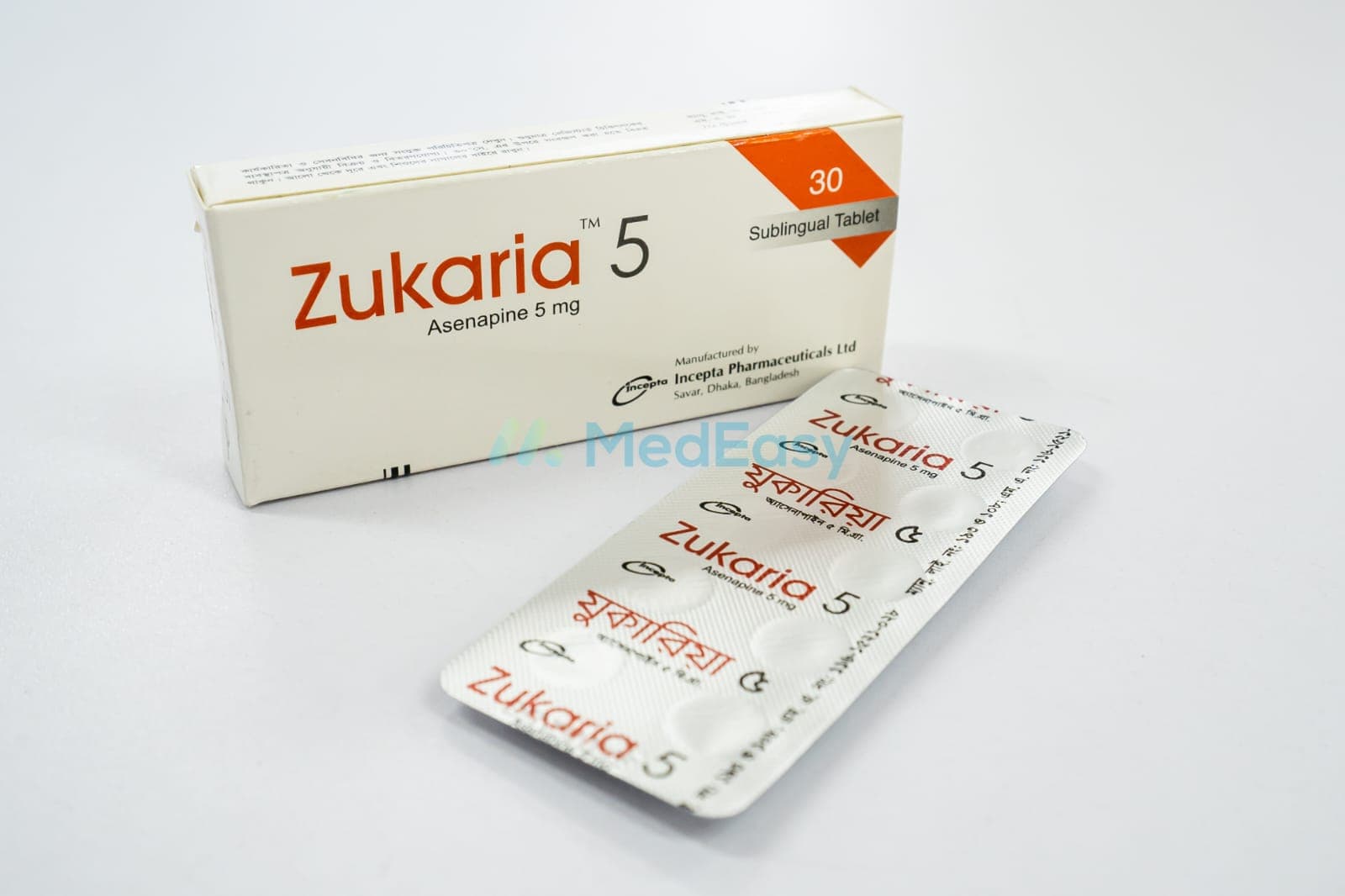

Medicine overview
Indications of Zukaria
Zukaria is an atypical (second-generation) antipsychotic indicated for:
- Schizophrenia — treatment in adults and adolescents (10-17 years); this is an FDA-approved, well-established indication.
- Bipolar I disorder, acute manic or mixed episodes — as monotherapy or as adjunct to lithium or valproate, in adults and adolescents (10-17 years); FDA-approved.
- Bipolar I disorder maintenance therapy — as monotherapy in adults, based on continuation-of-response trial data (guideline-supported/adjunct use).
Zukaria is not approved for the treatment of psychosis associated with dementia (see Precautions and Warnings, boxed warning).
Composition
Each sublingual tablet contains Asenapine Maleate as the active ingredient, equivalent to the labelled strength of asenapine base. Tablets are formulated as a fast-dissolving sublingual preparation and also contain standard excipients for sublingual delivery (e.g., gelatin, mannitol) and colorants, which vary by strength.
Description
Zukaria is an atypical antipsychotic agent belonging to the dibenzo-oxepino pyrrole class, structurally distinct from other antipsychotics. It is formulated exclusively as a fast-dissolving sublingual tablet because it undergoes extensive first-pass metabolism and has very low oral bioavailability if swallowed intact.
It is used in the management of schizophrenia and bipolar I disorder and works by modulating multiple neurotransmitter receptor systems in the brain, in particular dopamine and serotonin receptors.
Therapeutic Class
Atypical (second-generation) antipsychotic agent — Zukaria belongs to this therapeutic class.
Pharmacology
The precise mechanism of action of Asenapine Maleate in schizophrenia and bipolar I disorder is not fully understood, but is believed to be mediated through combined antagonist activity at central dopamine D2 and serotonin 5-HT2A receptors.
Asenapine Maleate also displays high affinity for several other serotonin, dopamine, alpha-adrenergic, and histamine receptors, but has negligible affinity for muscarinic cholinergic receptors. Antagonism at receptors other than dopamine and serotonin may explain some other effects of the drug, including orthostatic hypotension (alpha-1 adrenergic antagonism) and sedation (histamine H1 antagonism).
Asenapine Maleate is rapidly absorbed after sublingual administration, with peak plasma concentration reached in about 30-90 minutes. Oral bioavailability if swallowed is very low (under 2%) due to extensive first-pass glucuronidation and CYP1A2-mediated metabolism, which is why sublingual administration is essential. It is highly protein bound (~95%) and is metabolized mainly via direct glucuronidation (UGT1A4) and oxidative metabolism (CYP1A2), with a plasma elimination half-life of approximately 24 hours.
Dosage & Administration of Zukaria
Schizophrenia
| Population | Recommended Dose |
|---|---|
| Adults | Initial 5 mg sublingually twice daily; may increase to 10 mg twice daily based on efficacy and tolerability. |
| Adolescents (10-17 years) | 2.5 mg sublingually twice daily; may increase to 5 mg twice daily after at least 3 days if needed and tolerated. |
Bipolar I Disorder — Acute Manic or Mixed Episodes
| Population | Recommended Dose |
|---|---|
| Adults (monotherapy) | Initial 10 mg sublingually twice daily; may reduce to 5 mg twice daily if not tolerated. |
| Adults (adjunct to lithium or valproate) | 5 mg sublingually twice daily; may increase to 10 mg twice daily based on response. |
| Adolescents (10-17 years) | Initial 2.5 mg sublingually twice daily, may increase to 5 mg then 10 mg twice daily at intervals of at least 3 days based on response and tolerability. |
Renal Impairment
No dose adjustment of Zukaria is required in patients with any degree of renal impairment.
Hepatic Impairment
No dose adjustment is needed in mild (Child-Pugh A) or moderate (Child-Pugh B) hepatic impairment. Use in severe hepatic impairment (Child-Pugh C) is contraindicated (see Contraindications).
Administration of Zukaria
Zukaria must be administered sublingually only. Correct technique is essential for effectiveness:
- Peel back the foil packaging of the blister and gently remove the tablet — do not push the tablet through the foil, as this can damage it.
- Place the tablet under the tongue and allow it to dissolve completely; this typically occurs within seconds. Do NOT swallow, chew, or crush the tablet.
- Avoid eating or drinking for at least 10 minutes after taking the tablet, since food and liquids can reduce absorption.
Swallowing the tablet whole or crushing it significantly reduces the bioavailability of Zukaria and will make treatment less effective.
Interaction of Zukaria
- Fluvoxamine (strong CYP1A2 inhibitor): Co-administration significantly increases plasma concentrations of Zukaria; concurrent use should be approached with caution and, if used together, a lower dose of Zukaria may be needed.
- Paroxetine (CYP2D6 substrate): Zukaria is a moderate inhibitor of CYP2D6 and increases paroxetine plasma levels approximately two-fold; dose reduction of paroxetine or other CYP2D6 substrates with a narrow therapeutic index may be needed.
- Other QT-interval-prolonging drugs: Concomitant use with other drugs known to prolong the QT interval (e.g., certain antiarrhythmics, some antipsychotics, some antibiotics) should be avoided due to additive risk of QT prolongation.
- Antihypertensive agents: Zukaria may enhance the hypotensive effect of antihypertensive medications due to its alpha-adrenergic antagonism, increasing risk of orthostatic hypotension.
- CNS depressants (alcohol, benzodiazepines, opioids): Additive sedation and CNS depression may occur when used together with Zukaria.
- Dopamine agonists (e.g., levodopa): Zukaria may antagonize the effects of dopamine agonists due to its dopamine-receptor-blocking activity.
Contraindications
- Known hypersensitivity to Asenapine Maleate or any component of the formulation; severe hypersensitivity reactions including anaphylaxis have been reported.
- Severe hepatic impairment (Child-Pugh C).
Side Effects of Zukaria
Common side effects of Zukaria include:
- Somnolence (drowsiness) and sedation
- Oral hypoesthesia (numbness or reduced sensation of the mouth/tongue) — a distinctive and characteristic side effect of sublingual Zukaria, usually transient
- Akathisia (restlessness) and other extrapyramidal symptoms
- Dizziness
- Weight gain
- Increased appetite
- Fatigue
- Dysgeusia (altered taste)
Less common but serious effects include neuroleptic malignant syndrome, tardive dyskinesia, orthostatic hypotension/syncope, QT prolongation, seizures, leukopenia/neutropenia, hyperprolactinemia, and metabolic changes (dyslipidemia, hyperglycemia) — see Precautions and Warnings for details.
Pregnancy & Lactation
Pregnancy: There are no adequate and well-controlled studies of Zukaria in pregnant women. Neonates exposed to antipsychotic drugs, including Zukaria, during the third trimester are at risk for extrapyramidal and/or withdrawal symptoms following delivery. Zukaria should be used during pregnancy only if the potential benefit justifies the potential risk to the fetus; use only if clearly needed and under close medical supervision. Consult a physician before use during pregnancy.
Lactation: It is not known whether Zukaria is excreted in human breast milk. Because many drugs are excreted in breast milk and the potential for serious adverse reactions in nursing infants is unknown, a decision should be made whether to discontinue nursing or discontinue the drug, taking into account the importance of the drug to the mother. Consult a physician before use while breastfeeding.
Precautions & Warnings
Boxed Warning: Increased Mortality in Elderly Patients with Dementia-Related Psychosis
Elderly patients with dementia-related psychosis treated with atypical antipsychotic drugs, including Zukaria, are at increased risk of death compared with placebo. Zukaria is not approved for the treatment of patients with dementia-related psychosis.
Administration Technique
Correct sublingual administration is critical to efficacy. The tablet must be allowed to dissolve completely under the tongue; swallowing it whole or crushing it significantly reduces bioavailability. Patients should avoid eating or drinking for at least 10 minutes after administration (see Administration).
Hypersensitivity Reactions
Hypersensitivity reactions, including anaphylaxis and angioedema, have been reported with Zukaria. Discontinue immediately if a hypersensitivity reaction occurs.
Neuroleptic Malignant Syndrome (NMS)
NMS is a rare but potentially fatal reaction associated with antipsychotic drugs, characterized by hyperthermia, muscle rigidity, altered mental status, and autonomic instability. If signs and symptoms of NMS appear, or unexplained high fever occurs without other clinical signs of NMS, Zukaria must be discontinued immediately.
Metabolic Changes
Atypical antipsychotics, including Zukaria, have been associated with weight gain, dyslipidemia, and hyperglycemia (including rare cases of diabetic ketoacidosis). Monitor weight, fasting glucose, and lipid profile at baseline and periodically during treatment.
Tardive Dyskinesia
A syndrome of potentially irreversible, involuntary, dyskinetic movements may develop with long-term use of Zukaria. The risk increases with duration of treatment and total cumulative dose.
Orthostatic Hypotension
Zukaria may cause orthostatic hypotension and syncope, particularly during the initial dose-titration period, due to its alpha-1 adrenergic antagonist activity. Use with caution in patients with cardiovascular disease, cerebrovascular disease, or conditions predisposing to hypotension.
QT Prolongation
Use Zukaria with caution in patients with a history of QT prolongation, cardiac arrhythmias, or in combination with other QT-prolonging drugs, and in patients with relevant risk factors (e.g., electrolyte imbalance, bradycardia).
Other Precautions
Use with caution in patients with a history of seizures, in those at risk of aspiration pneumonia, and in patients with conditions affecting metabolism or hemodynamic responses. Zukaria may impair judgment, thinking, or motor skills; caution patients about operating hazardous machinery, including automobiles, until they are reasonably certain the drug does not affect them adversely.
Overdose Effects of Zukaria
Reported signs of Zukaria overdose include somnolence, agitation, and extrapyramidal symptoms. There is no specific antidote to Zukaria. In case of suspected overdose, seek immediate medical attention or contact emergency services/poison control. Management should include general supportive measures, ensuring an adequate airway, oxygenation and ventilation, and cardiovascular monitoring (including continuous ECG monitoring for possible arrhythmias) in a facility equipped to provide such care until the patient recovers.
Storage Conditions
Store at room temperature (below 30°C), away from light and moisture. Keep the tablet in the blister pack until immediately before use. Keep out of reach of children.
Use In Special Populations
Pediatric Use
Zukaria is approved for schizophrenia and for acute treatment of manic or mixed episodes of bipolar I disorder in adolescents aged 10-17 years, at reduced starting doses compared with adults (see Dosage and Administration). Safety and efficacy in children under 10 years have not been established.
Geriatric Use
Zukaria is not approved for the treatment of dementia-related psychosis due to increased risk of death in this population (see boxed warning). Use in elderly patients for approved indications should be undertaken with caution, considering the greater frequency of hepatic, renal, or cardiac impairment and concomitant disease/drug therapy in this population.
Renal Impairment
No dose adjustment of Zukaria is required.
Hepatic Impairment
No adjustment needed in mild-to-moderate impairment; contraindicated in severe hepatic impairment (see Contraindications).
Duration Of Treatment
The duration of treatment with Zukaria should be individualized based on clinical response and physician judgment. In schizophrenia and bipolar I disorder, treatment is often continued long-term for maintenance and relapse prevention; the need for continued treatment should be periodically reassessed by the prescribing physician. Do not stop or change the dose of Zukaria without consulting a physician, as abrupt discontinuation of antipsychotic medication may lead to relapse or withdrawal symptoms.
Drug Classes
Atypical antipsychotics; dibenzo-oxepino pyrroles.
Mode Of Action
Asenapine Maleate exerts its therapeutic effects primarily through antagonism of central dopamine D2 receptors and serotonin 5-HT2A receptors, a combination believed to underlie its antipsychotic and mood-stabilizing effects while reducing the risk of extrapyramidal side effects compared with typical antipsychotics. It additionally has high affinity for numerous other serotonergic (5-HT1A, 5-HT2C, 5-HT6, 5-HT7), dopaminergic (D1, D3, D4), alpha-adrenergic (alpha-1, alpha-2), and histaminergic (H1) receptors, but has negligible affinity for muscarinic cholinergic receptors, which likely explains its low incidence of anticholinergic side effects.
Pregnancy
C
Pediatric Uses
Zukaria is approved in adolescents 10-17 years of age for the treatment of schizophrenia (starting dose 2.5 mg sublingually twice daily) and for acute treatment of manic or mixed episodes associated with bipolar I disorder (starting dose 2.5 mg sublingually twice daily, titrated as needed). Safety and efficacy have not been established in children below 10 years of age. Adolescents should be monitored closely for weight gain, metabolic changes, and neuropsychiatric side effects during treatment with Zukaria.
Frequently Asked Questions
Q: What is Zukaria 5 mg Sublingual Tablet used for?
A: Zukaria 5 mg Sublingual Tablet is an atypical antipsychotic used to treat schizophrenia and acute manic or mixed episodes associated with bipolar I disorder in adults and adolescents (10-17 years).
Q: How should I take Zukaria 5 mg Sublingual Tablet?
A: Zukaria 5 mg Sublingual Tablet is taken sublingually (under the tongue) only. Place the tablet under your tongue and let it dissolve completely — do not swallow, chew, or crush it. Avoid eating or drinking for at least 10 minutes afterward, as this can reduce absorption and effectiveness.
Q: Why does my mouth feel numb after taking Zukaria 5 mg Sublingual Tablet?
A: Oral hypoesthesia, a temporary numbness or reduced sensation of the mouth or tongue, is a distinctive and well-recognized side effect of Zukaria 5 mg Sublingual Tablet. It is usually mild and transient, but tell your physician if it is bothersome or persistent.
Q: Can Zukaria 5 mg Sublingual Tablet be used in elderly patients with dementia?
A: No. Zukaria 5 mg Sublingual Tablet carries a boxed warning because elderly patients with dementia-related psychosis treated with antipsychotic drugs, including Zukaria 5 mg Sublingual Tablet, have an increased risk of death. Zukaria 5 mg Sublingual Tablet is not approved for this use.
Q: Is Zukaria 5 mg Sublingual Tablet safe during pregnancy?
A: Zukaria 5 mg Sublingual Tablet should be used during pregnancy only if the potential benefit justifies the potential risk to the fetus, as safety has not been well established. Babies exposed in the third trimester may be at risk for movement or withdrawal symptoms after birth. Always consult your physician before using Zukaria 5 mg Sublingual Tablet if you are pregnant or planning pregnancy.
Q: What should I do if I miss a dose or suspect an overdose of Zukaria 5 mg Sublingual Tablet?
A: If you miss a dose, take it as soon as you remember unless it is close to the next dose — do not double up. If you suspect an overdose of Zukaria 5 mg Sublingual Tablet, seek immediate medical attention or contact emergency services/poison control right away.
Disclaimer
The information provided is accurate to the best of our knowledge, but it does not replace professional medical advice. We cannot guarantee its completeness or accuracy, and the absence of specific information about a drug should not be taken as an endorsement. We are not responsible for any consequences arising from this information, so please consult a healthcare professional for any concerns or questions.
