
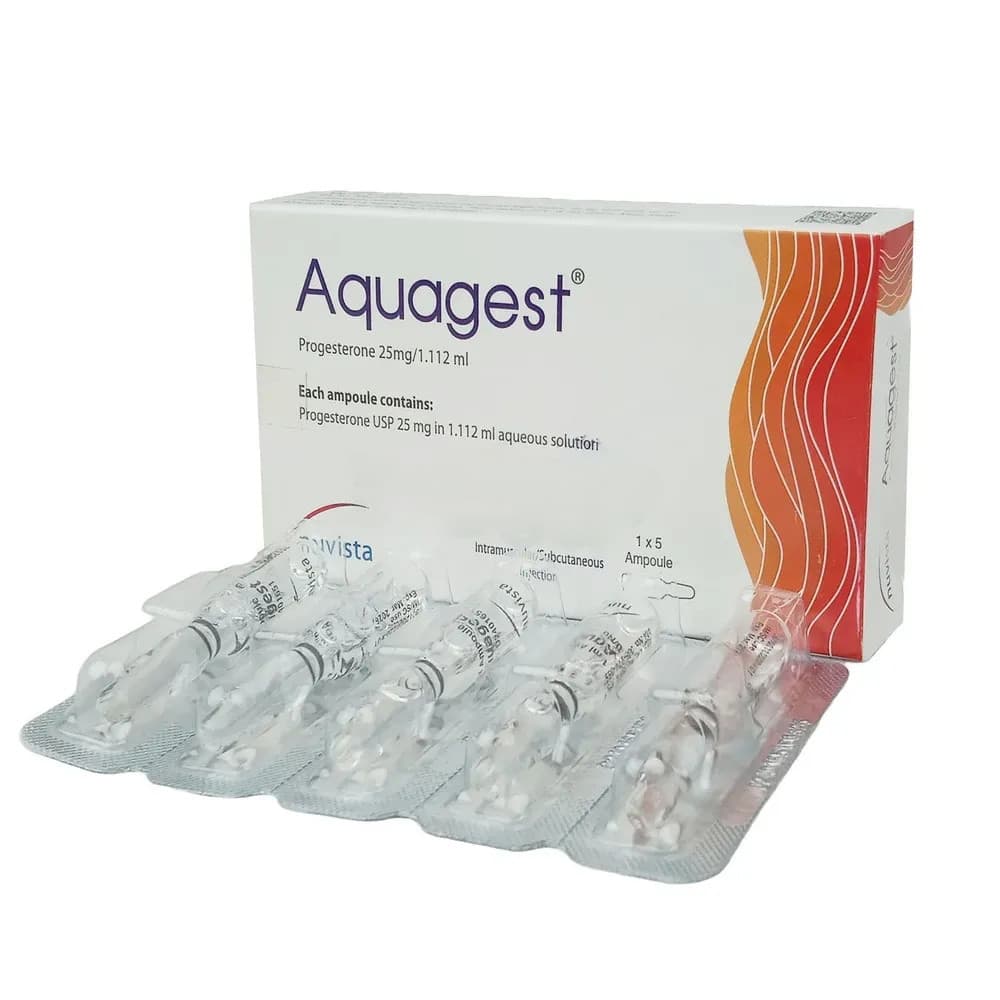

Medicine overview
Indications of Aquagest
Aquagest is a natural progestogen hormone used in several gynecological and reproductive indications. Its uses can be classified by strength of evidence as follows:
Established / approved uses
- Secondary amenorrhea: to induce a withdrawal bleed in women with adequate endogenous estrogen but absent menses.
- Prevention of endometrial hyperplasia: given cyclically with conjugated estrogen in non-hysterectomized postmenopausal women receiving estrogen replacement therapy, as part of hormone replacement therapy (HRT) in women with an intact uterus.
- Abnormal uterine bleeding due to hormonal (anovulatory) imbalance: to regulate the endometrial cycle and control bleeding.
Guideline-supported / specialist-directed uses
- Luteal phase support in assisted reproductive technology (ART): vaginal formulations of Aquagest are used to support the endometrium after in-vitro fertilization (IVF) and other ART procedures.
- Prevention of preterm birth in women with a singleton pregnancy and a history of prior spontaneous preterm birth, or with a short cervix detected on ultrasound: vaginal formulations of Aquagest are used under obstetric supervision, per professional obstetric society guidance.
Aquagest is not an antibiotic and has no role in treating infections.
Composition
Each formulation of Progesterone Micronised contains micronized progesterone (USP), a natural progestogen hormone reduced to very small particle size to improve absorption. Progesterone Micronised is available as oral soft capsules and, in some markets, as vaginal capsules/gel or inserts. Oral capsules commonly use a peanut oil vehicle to aid dissolution and absorption; patients with peanut allergy should check the specific formulation being dispensed.
Description
Aquagest is the micronized (finely reduced particle size) form of natural progesterone, a steroid hormone identical in structure to the progesterone produced by the corpus luteum and placenta. Micronization substantially improves oral bioavailability compared with non-micronized progesterone, allowing effective oral and vaginal dosing.
Aquagest acts on progesterone receptors in the endometrium, myometrium, and other target tissues to convert proliferative (estrogen-primed) endometrium into a secretory endometrium, and supports the physiological changes needed to maintain early pregnancy.
Therapeutic Class
Aquagest belongs to the therapeutic class of progestogens (progestins), specifically the sub-class of natural/bio-identical progesterone hormone preparations, as distinct from synthetic progestins (e.g., medroxyprogesterone, norethisterone).
Pharmacology
Mechanism: Progesterone Micronised binds to intracellular progesterone receptors in the endometrium, myometrium, cervix, and hypothalamus/pituitary. This binding:
- Converts proliferative endometrium into secretory endometrium, opposing unopposed estrogen stimulation and reducing the risk of endometrial hyperplasia.
- Reduces myometrial excitability and contractility, helping to maintain uterine quiescence in pregnancy.
- Provides negative feedback on the hypothalamic-pituitary axis, suppressing gonadotropin (LH/FSH) surges.
- Has mild sedative/anxiolytic central nervous system activity via neurosteroid metabolites, which is the basis for advising bedtime oral dosing.
Pharmacokinetics
Micronization increases the surface area of Progesterone Micronised particles, improving dissolution and oral absorption. It undergoes extensive first-pass hepatic metabolism to pregnanediol and other metabolites, which are excreted mainly in urine as glucuronide/sulfate conjugates. Vaginal administration of Progesterone Micronised achieves higher local endometrial concentrations with lower systemic levels than an equivalent oral dose.
Dosage & Administration of Aquagest
Dosing by indication
| Indication | Typical adult dose of Aquagest |
|---|---|
| Secondary amenorrhea (oral) | 400 mg orally once daily at bedtime for 10 days |
| Prevention of endometrial hyperplasia in HRT (oral, cyclic) | 200 mg orally once daily at bedtime for 12 days per 28-day cycle, taken with estrogen therapy |
| Luteal phase support in ART (vaginal) | 90-200 mg vaginally once or twice daily, starting around the time of oocyte retrieval/embryo transfer and continuing per fertility-specialist protocol |
| Prevention of preterm birth in high-risk pregnancy (vaginal) | 90-200 mg vaginally once daily, usually started between 16-24 weeks of gestation and continued until about 36 weeks, under obstetric supervision |
Administration: Oral capsules of Aquagest are best taken at bedtime with water, on an empty stomach, because of transient dizziness/drowsiness that can occur after dosing. Vaginal formulations of Aquagest should be inserted as directed by the prescribing physician. Do not change the dose, frequency, or duration of Aquagest without medical advice, particularly for pregnancy-related indications.
Administration of Aquagest
Oral Aquagest capsules are usually taken once daily at bedtime, with water, to minimize dizziness/drowsiness. Vaginal formulations of Aquagest (gel, capsule, or insert) are administered directly into the vagina as directed. Aquagest should not be chewed or administered by an unintended route.
Interaction of Aquagest
The following interactions with Aquagest are clinically significant and well-documented:
- CYP3A4 inducers (e.g., rifampin, carbamazepine, phenytoin, St. John's Wort): may accelerate metabolism of Aquagest, reducing its effectiveness; dose adjustment or closer monitoring may be needed.
- CYP3A4 inhibitors (e.g., ketoconazole, itraconazole, certain macrolide antibiotics, grapefruit juice): may increase blood levels of Aquagest, increasing the risk of dizziness, drowsiness, and other side effects.
- Estrogens: commonly co-administered by design in HRT, but the combination increases the risk of venous thromboembolism compared with either hormone alone (see Contraindications and Precautions).
- Central nervous system depressants (sedatives, alcohol): may add to the drowsiness caused by oral Aquagest; caution with driving or operating machinery.
Contraindications
Progesterone Micronised is contraindicated in patients with any of the following:
- Known hypersensitivity to progesterone or to any excipient of the specific formulation (including peanut oil, used as a carrier in many oral capsule formulations).
- Undiagnosed abnormal vaginal/genital bleeding.
- Known or suspected breast cancer or other hormone-sensitive malignancy.
- Active venous thromboembolism (deep vein thrombosis or pulmonary embolism) or a history of these conditions, and active arterial thromboembolic disease (e.g., stroke, myocardial infarction).
- Active liver disease or severe hepatic impairment.
- Known or suspected pregnancy, when Progesterone Micronised is being used for a non-pregnancy indication (e.g., HRT or amenorrhea) — this does not apply to formulations of Progesterone Micronised that are specifically prescribed for pregnancy-support indications under obstetric supervision.
Side Effects of Aquagest
Reported side effects of Aquagest include:
Common
- Dizziness, drowsiness, or fatigue (more common with oral dosing)
- Headache
- Breast tenderness
- Bloating and fluid retention
- Mood changes, irritability
- Nausea
- Local irritation or discharge (with vaginal formulations)
Less common but serious
- Venous thromboembolism (deep vein thrombosis, pulmonary embolism) — see Contraindications
- Allergic/hypersensitivity reactions, including reactions related to peanut oil in oral formulations
- Jaundice or signs of liver injury
Patients should seek prompt medical attention for chest pain, shortness of breath, leg swelling/pain, sudden severe headache, vision changes, or signs of jaundice while taking Aquagest.
Pregnancy & Lactation
Pregnancy: Certain vaginal formulations of Aquagest are used therapeutically in pregnancy for specific, well-defined indications (luteal phase support in ART, and prevention of preterm birth in selected high-risk pregnancies) strictly under obstetric or fertility-specialist supervision, where the potential benefit is judged to outweigh potential risk. For other indications (e.g., HRT, amenorrhea), Aquagest should not be used if pregnancy is known or suspected. In all cases, Aquagest should be used in pregnancy only if clearly needed, and only under a physician's direction — do not start, stop, or adjust Aquagest during pregnancy without consulting your doctor.
Lactation: Small amounts of progesterone are excreted in breast milk. Aquagest should be used during breastfeeding only if clearly needed and after consulting a physician, who will weigh the benefit to the mother against any potential effect on the breastfeeding infant.
Precautions & Warnings
Use Aquagest with caution and under medical supervision in the following situations:
- Drowsiness/dizziness: oral Aquagest, especially when not taken at bedtime, can cause dizziness or drowsiness; avoid driving or operating machinery until the individual response is known.
- Cardiovascular risk factors: patients with risk factors for thromboembolic disease (obesity, smoking, prior clotting disorder, immobility) should be monitored closely, particularly when Aquagest is combined with estrogen.
- Fluid retention: conditions that may be worsened by fluid retention (epilepsy, migraine, asthma, cardiac or renal dysfunction) warrant caution and monitoring.
- Mood disorders: monitor patients with a history of depression, as hormonal therapy may affect mood.
- Peanut allergy: many oral capsule formulations of Aquagest use peanut oil as a carrier; confirm the specific product's composition in patients with peanut allergy (see Contraindications).
- Hepatic impairment: use with caution in mild-to-moderate hepatic impairment; contraindicated in active liver disease (see Contraindications).
Overdose Effects of Aquagest
There is limited clinical experience with acute overdose of Aquagest. Expected symptoms of excessive dosing may include marked drowsiness, dizziness, nausea, or vomiting. There is no specific antidote. If an overdose of Aquagest is suspected, seek immediate medical attention or contact a poison control center; treatment should be supportive and managed by qualified medical personnel. Do not attempt specific home treatment beyond seeking urgent medical advice.
Storage Conditions
Store at room temperature (below 30°C), away from light and moisture. Keep out of reach of children.
Use In Special Populations
Elderly: Aquagest is not typically indicated for use in elderly patients outside of HRT-related contexts in postmenopausal women; use with attention to cardiovascular and hepatic status.
Renal impairment: limited specific data; use Aquagest with caution and monitor for fluid retention-related effects.
Hepatic impairment: Aquagest is contraindicated in active liver disease (see Contraindications); use with caution and close monitoring in mild-to-moderate impairment.
Children/adolescents: safety and efficacy of Aquagest have not been established in pediatric patients; Aquagest is not indicated for use in children.
Duration Of Treatment
Duration of Aquagest therapy depends on the indication: 10 days per cycle for secondary amenorrhea; 12 days per 28-day cycle, continued long-term, for HRT-related endometrial protection; from the time of embryo transfer until approximately 10-12 weeks of gestation (or as directed) for luteal phase/ART support; and from around 16-24 weeks until about 36 weeks of gestation for preterm birth prevention. The treating physician determines the exact duration based on response and indication.
Drug Classes
Progesterone Micronised belongs to the drug class of progestogens (progestins), specifically natural/bio-identical progesterone hormone preparations.
Mode Of Action
Progesterone Micronised acts by binding to nuclear progesterone receptors in target tissues (endometrium, myometrium, breast, hypothalamus/pituitary), inducing secretory transformation of the endometrium, reducing uterine smooth muscle excitability, and providing negative feedback that suppresses the mid-cycle LH surge. These actions underlie its use in menstrual regulation, endometrial protection during estrogen therapy, and support of early pregnancy.
Pregnancy
Category B (legacy FDA classification for certain oral micronized progesterone products)
Pediatric Uses
Safety and efficacy of Aquagest have not been established in pediatric patients. Aquagest is not indicated for use in children or adolescents outside of specialist-directed, individualized circumstances (e.g., certain adolescent gynecological disorders managed by a specialist), and should only be used in this age group under direct specialist supervision.
Frequently Asked Questions
Q: What is Aquagest 25 mg/1.119 ml SC Injection used for?
A: Aquagest 25 mg/1.119 ml SC Injection is a natural progesterone hormone used to treat secondary amenorrhea and abnormal uterine bleeding due to hormonal imbalance, to protect the uterine lining during estrogen-based hormone replacement therapy, to support the luteal phase in assisted reproduction (IVF), and, in vaginal form, to help prevent preterm birth in selected high-risk pregnancies under specialist care.
Q: Can I take Aquagest 25 mg/1.119 ml SC Injection during pregnancy?
A: Certain vaginal formulations of Aquagest 25 mg/1.119 ml SC Injection are used in pregnancy for specific indications such as luteal support after IVF or prevention of preterm birth, but only under obstetric or fertility-specialist supervision, when the benefit is judged to outweigh potential risk. For other uses (such as HRT or treating amenorrhea), Aquagest 25 mg/1.119 ml SC Injection should not be used if pregnancy is known or suspected. Always consult your physician before starting or continuing Aquagest 25 mg/1.119 ml SC Injection in pregnancy.
Q: Is Aquagest 25 mg/1.119 ml SC Injection safe while breastfeeding?
A: Small amounts of progesterone pass into breast milk. Aquagest 25 mg/1.119 ml SC Injection should only be used while breastfeeding if clearly needed, after your doctor weighs the benefit to you against any potential effect on your baby.
Q: What are the common side effects of Aquagest 25 mg/1.119 ml SC Injection?
A: Common side effects include dizziness, drowsiness (especially with oral dosing), headache, breast tenderness, bloating, and mood changes. Less commonly, Aquagest 25 mg/1.119 ml SC Injection can be associated with blood clots (venous thromboembolism), allergic reactions (including reactions related to peanut oil in some oral formulations), or liver problems, which require prompt medical attention.
Q: Who should not take Aquagest 25 mg/1.119 ml SC Injection?
A: Aquagest 25 mg/1.119 ml SC Injection should not be used by people with undiagnosed vaginal bleeding, known or suspected breast cancer or other hormone-sensitive cancer, active or past blood clots (DVT/PE) or stroke/heart attack, active liver disease, or known hypersensitivity to progesterone or to peanut oil (found in many oral capsule formulations of Aquagest 25 mg/1.119 ml SC Injection).
Q: What should I do if I miss a dose or take too much Aquagest 25 mg/1.119 ml SC Injection?
A: If you miss a dose of Aquagest 25 mg/1.119 ml SC Injection, take it as soon as you remember unless it is close to the next dose; do not double up. If you or someone else has taken more Aquagest 25 mg/1.119 ml SC Injection than prescribed, seek immediate medical attention or contact a poison control center, as excessive dosing can cause pronounced drowsiness, dizziness, or nausea.
Disclaimer
The information provided is accurate to the best of our knowledge, but it does not replace professional medical advice. We cannot guarantee its completeness or accuracy, and the absence of specific information about a drug should not be taken as an endorsement. We are not responsible for any consequences arising from this information, so please consult a healthcare professional for any concerns or questions.
