10% Off
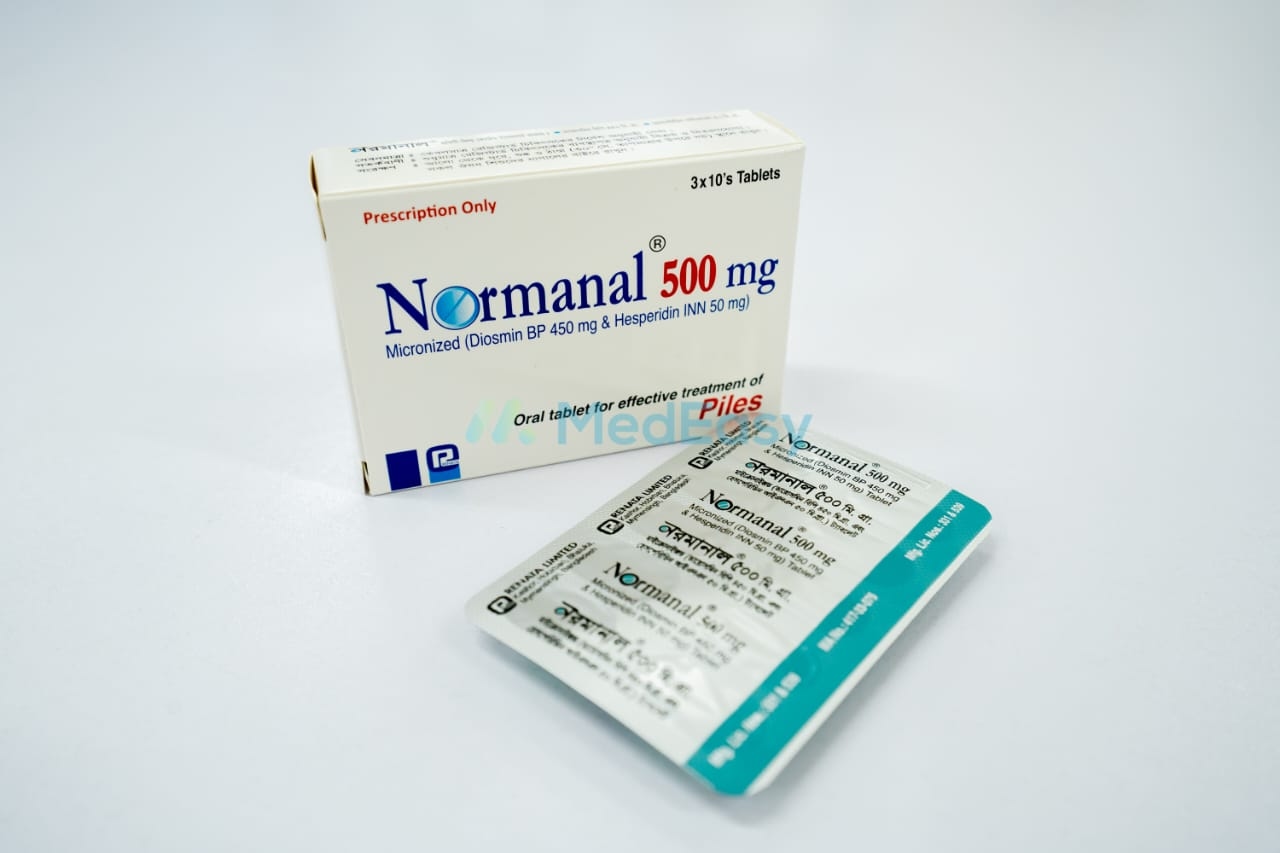
Normanal450 mg+50
Renata Limited
৳81.00
Add to cart

Ardium 450 mg+50 mg Tablet is available on MedEasy for ৳7.20 per piece, with home delivery anywhere in Bangladesh. It is manufactured by Drug International Ltd. Its generic name is Micronised Diosmin + Hesperidin.

Ardium is a venotonic (phlebotropic) flavonoid combination used in the management of venous and lymphatic disorders.
Ardium is not a treatment for the underlying structural cause of venous disease (e.g., valve incompetence) or for complicated/thrombosed hemorrhoids, which require separate medical or surgical evaluation.
Each tablet of Micronised Diosmin + Hesperidin contains a micronised purified flavonoid fraction (MPFF), typically standardised to provide diosmin and hesperidin in an approximate 9:1 ratio (commonly diosmin 450 mg and hesperidin 50 mg per 500 mg tablet). Exact strength, ratio, and inactive ingredients vary by manufacturer and formulation, so the product label should always be checked for the precise composition.
Ardium is an oral, semi-synthetic flavonoid preparation belonging to the venotonic (phlebotropic) drug class. It is manufactured using a micronisation process that reduces particle size, which is intended to improve gastrointestinal absorption compared with non-micronised flavonoid preparations.
Ardium acts on the venous and lymphatic systems by increasing venous tone, improving lymphatic drainage, and protecting the microcirculation, and it is widely used across many countries, including Bangladesh, for chronic venous insufficiency and hemorrhoidal disease.
Ardium belongs to the venotonic / vasoprotective (phlebotropic flavonoid) therapeutic class.
Pharmacodynamics: Micronised Diosmin + Hesperidin increases venous tone and vein contractility, reduces venous distensibility and capacitance, and improves venous emptying, which helps reduce venous stasis. It also improves lymphatic drainage by increasing lymphatic contractile activity and the number of functioning lymph capillaries.
At the microcirculatory level, Micronised Diosmin + Hesperidin reduces capillary hyperpermeability and increases capillary resistance. It exerts anti-inflammatory effects by reducing the synthesis and release of inflammatory mediators (such as prostaglandins and thromboxane), and by decreasing leukocyte adhesion, activation, and migration into perivascular tissue, which contributes to its benefit in both venous insufficiency and acute hemorrhoidal episodes.
Pharmacokinetics: The micronised formulation of Micronised Diosmin + Hesperidin is absorbed more rapidly and completely from the gastrointestinal tract than non-micronised flavonoid preparations. Diosmin is largely metabolised to diosmetin and other metabolites, mainly by colonic flora, and elimination occurs predominantly via the faeces, with a smaller portion excreted in urine.
Dosing of Ardium is individualised by indication. The table below reflects commonly used regimens; the prescribing physician's instructions should always be followed.
| Indication | Adult Dose | Typical Duration |
|---|---|---|
| Chronic venous insufficiency | 500 mg twice daily with meals (total 1000 mg/day) | Ongoing, as advised by physician; benefit is reassessed periodically |
| Acute hemorrhoidal attack | Higher initial dose for the first 4 days (e.g., 500 mg three times daily), reduced to 500 mg twice daily for the following 3 days, then maintenance dosing as for CVI if continued | Short course (around 7 days) for the acute episode |
Pediatric dosing of Ardium has not been established; see Use in Special Populations.
Ardium tablets should be swallowed whole with a glass of water and taken with meals to help minimise gastrointestinal discomfort. Tablets should not be crushed or chewed unless the product labeling specifically permits it. Doses should be spaced evenly through the day (e.g., morning and evening) and taken at approximately the same times each day for consistent effect.
No major, well-established clinically significant drug interactions have been identified for Ardium. It is generally considered to have a favourable interaction profile.
As a theoretical precaution, because flavonoids can have mild effects on vascular permeability and platelet/capillary function, caution and physician supervision are advised when Ardium is used together with anticoagulant or antiplatelet medicines, although no well-established, clinically significant interaction of this kind has been confirmed. Patients should inform their physician of all other medicines, supplements, and herbal products they are taking before starting Ardium.
Micronised Diosmin + Hesperidin is contraindicated in patients with known hypersensitivity to diosmin, hesperidin, other flavonoids, or any excipient of the specific product formulation.
Ardium is generally well tolerated. Reported side effects include:
Patients should seek prompt medical attention for any signs of a hypersensitivity reaction (e.g., facial swelling, difficulty breathing, widespread rash) while taking Ardium.
Data on the use of Ardium in human pregnancy are limited. As a general precaution, Ardium should be used during pregnancy only if clearly needed and if the potential benefit justifies the potential risk to the fetus; a physician should be consulted before use, especially during the first trimester.
It is not well established whether the components of Ardium pass into breast milk in clinically significant amounts. As a precaution, breastfeeding mothers should consult their physician before using Ardium, weighing the expected benefit against any potential risk to the infant.
Ardium is intended for symptomatic relief and is not a substitute for definitive evaluation or treatment of severe or complicated venous disease (e.g., venous ulcers, deep vein thrombosis) or complicated hemorrhoids (e.g., thrombosed or prolapsed hemorrhoids, significant or persistent rectal bleeding). Patients with severe, persistent, or worsening symptoms, or with rectal bleeding, should seek prompt medical evaluation rather than relying on Ardium alone.
Ardium does not replace other prescribed measures for chronic venous insufficiency, such as compression stockings, leg elevation, and lifestyle modification.
Use with caution and under medical supervision in patients on anticoagulant or antiplatelet therapy (see Interactions).
Limited data exist on Ardium overdose. Taking substantially more than the prescribed dose may increase the likelihood of gastrointestinal side effects (such as diarrhea, nausea, or abdominal discomfort). There is no specific antidote for Ardium overdose.
If an overdose of Ardium is suspected, seek immediate medical attention or contact a poison control center; treatment should be supportive and symptomatic, as directed by a physician.
Store at room temperature (below 30°C), away from light and moisture. Keep out of reach of children.
Renal impairment: Specific dose adjustment data for Ardium in renal impairment are limited; use with caution and physician oversight.
Hepatic impairment: Specific dose adjustment data for Ardium in hepatic impairment are limited; use with caution and physician oversight.
Elderly: No specific dose adjustment is generally required for Ardium in elderly patients, but they should be monitored as for any patient, particularly if other medical conditions or medicines are present.
Pregnancy and lactation: see Pregnancy and Lactation section above.
Pediatric patients: see Pediatric Uses section below.
For chronic venous insufficiency, Ardium is often used over the longer term, with the physician periodically reassessing continued need and benefit. For acute hemorrhoidal attacks, Ardium is typically used as a short course of around one week, following the higher initial dose regimen described in Dosage and Administration. Treatment duration should always follow the prescribing physician's advice.
Micronised Diosmin + Hesperidin belongs to the flavonoid / venotonic drug class, specifically classified as a micronised purified flavonoid fraction (MPFF) with vasoprotective and phlebotropic properties.
Micronised Diosmin + Hesperidin increases venous tone and reduces venous distensibility, improves lymphatic drainage, reduces capillary hyperpermeability, and decreases inflammatory mediator release and leukocyte adhesion in the microcirculation, together improving symptoms of venous insufficiency and hemorrhoidal disease.
The safety and efficacy of Ardium in children and adolescents have not been well established, and it is not generally recommended for pediatric use outside specific physician direction. Ardium should only be given to a child if specifically prescribed by a pediatrician who has weighed the potential benefits and risks.
Q: What is Ardium 450 mg+50 mg Tablet used for?
A: Ardium 450 mg+50 mg Tablet is used to relieve symptoms of chronic venous insufficiency, such as leg heaviness, pain, and swelling, and as an adjunct treatment for acute hemorrhoidal attacks.
Q: How should I take Ardium 450 mg+50 mg Tablet?
A: Ardium 450 mg+50 mg Tablet is usually taken by mouth with meals, commonly 500 mg twice daily for chronic venous insufficiency, or a short higher-dose course for acute hemorrhoidal symptoms. Always follow your physician's specific instructions.
Q: Can I take Ardium 450 mg+50 mg Tablet during pregnancy?
A: Data on Ardium 450 mg+50 mg Tablet use in pregnancy are limited. It should be used during pregnancy only if clearly needed, with the potential benefit outweighing potential risk to the fetus, and only after consulting a physician, particularly in the first trimester.
Q: What are the common side effects of Ardium 450 mg+50 mg Tablet?
A: Ardium 450 mg+50 mg Tablet is generally well tolerated. The most common side effects are mild gastrointestinal symptoms such as diarrhea, nausea, and dyspepsia, along with occasional headache or dizziness. Rash and, rarely, colitis have also been reported.
Q: Is Ardium 450 mg+50 mg Tablet a substitute for treating severe hemorrhoids or venous disease?
A: No. Ardium 450 mg+50 mg Tablet is intended for symptomatic relief and is not a substitute for medical or surgical evaluation of severe or complicated hemorrhoids (such as thrombosed or prolapsed hemorrhoids) or severe venous disease. Persistent or worsening symptoms, or rectal bleeding, should be evaluated by a physician.
Q: Does Ardium 450 mg+50 mg Tablet interact with other medicines?
A: No major clinically significant drug interactions are well established for Ardium 450 mg+50 mg Tablet. As a precaution, patients on anticoagulant or antiplatelet medicines should use Ardium 450 mg+50 mg Tablet under medical supervision and inform their physician of all medicines they are taking.
Disclaimer
The information provided is accurate to the best of our knowledge, but it does not replace professional medical advice. We cannot guarantee its completeness or accuracy, and the absence of specific information about a drug should not be taken as an endorsement. We are not responsible for any consequences arising from this information, so please consult a healthcare professional for any concerns or questions.