8% Off
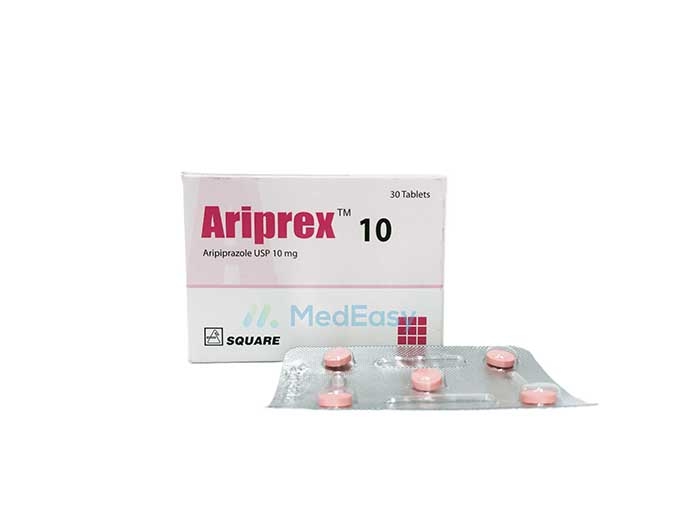
Ariprex10 mg
Square Pharmaceuticals PLC.
৳4.60
Add to cart
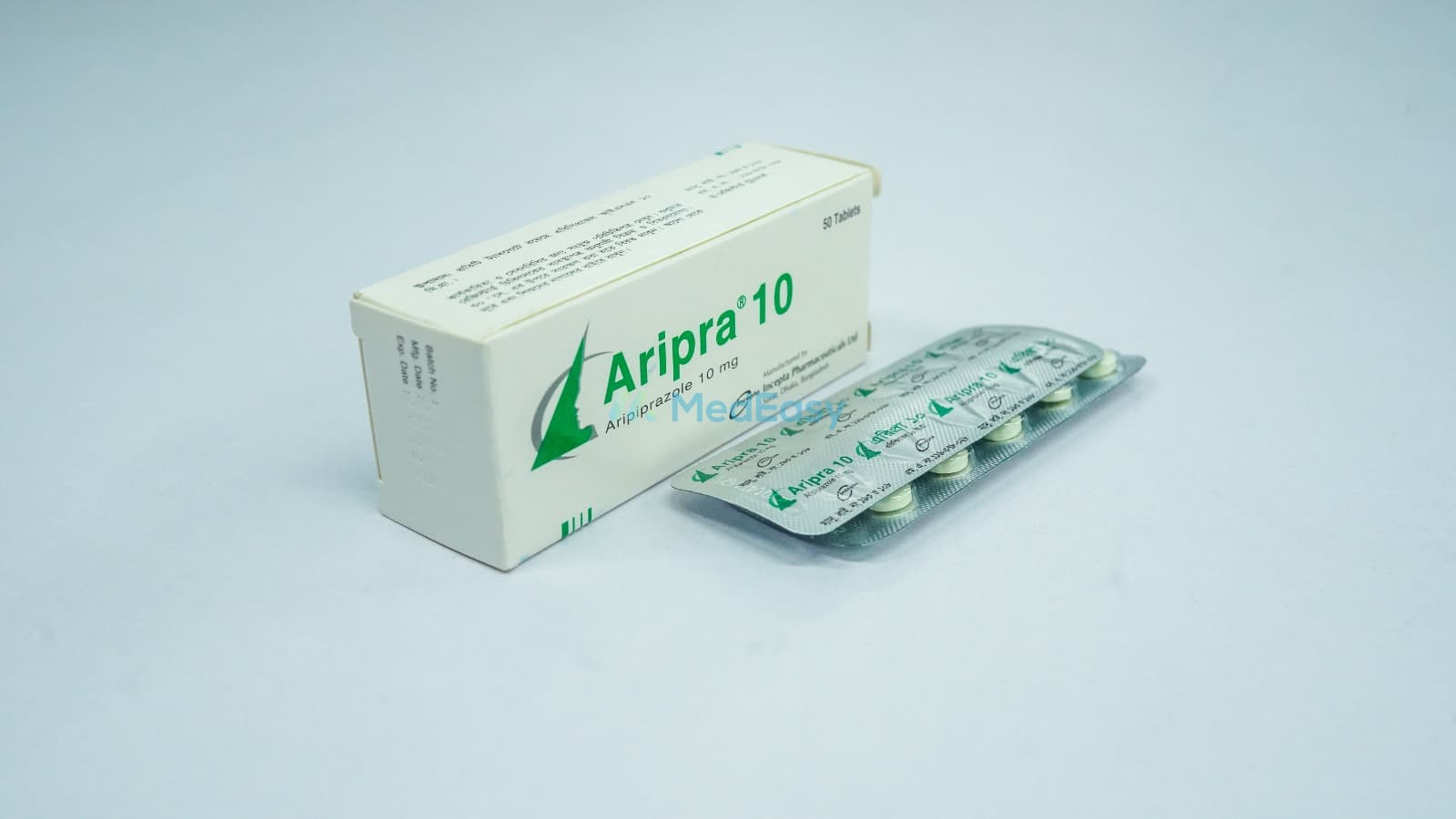
Aripra 10 mg Tablet is available on MedEasy for ৳45.00 per 10's Strip, with home delivery anywhere in Bangladesh. It is manufactured by Incepta Pharmaceuticals Ltd. Its generic name is Aripiprazole.

Aripra is an atypical antipsychotic (a dopamine partial agonist) with the following evidence-based indications:
Aripra is not approved for the treatment of dementia-related psychosis in elderly patients; see Precautions and Warnings for the associated mortality risk in this population.
Each tablet/capsule of Aripiprazole typically contains Aripiprazole as the active pharmaceutical ingredient, commonly available in strengths of 2 mg, 5 mg, 10 mg, 15 mg, 20 mg, and 30 mg (oral tablets and orally disintegrating tablets), as an oral solution (1 mg/mL), and as a short-acting intramuscular injection (9.75 mg/1.3 mL). Strength and formulation available depend on the specific brand and manufacturer.
Aripra is a psychotropic medicine belonging to the atypical (second-generation) antipsychotic class. Unlike older antipsychotics that mainly block dopamine receptors, Aripra acts as a partial agonist at dopamine D2 and D3 receptors and serotonin 5-HT1A receptors, and as an antagonist at serotonin 5-HT2A receptors. This unique receptor profile allows it to stabilize dopamine and serotonin activity rather than simply blocking it, which is thought to give it a comparatively lower risk of some side effects seen with older antipsychotics, though it carries its own distinct safety profile including akathisia and impulse-control disorders.
Aripra is used mainly in psychiatry for the management of schizophrenia, bipolar I disorder, as an add-on for depression that has not responded fully to standard antidepressants, and for specific pediatric conditions including irritability in autistic disorder and tics in Tourette's disorder.
Atypical (Second-Generation) Antipsychotic - Dopamine Partial Agonist (Aripra)
Mechanism of action: Aripiprazole is believed to exert its therapeutic effects through partial agonism at dopamine D2 and D3 receptors and serotonin 5-HT1A receptors, combined with antagonism at serotonin 5-HT2A receptors. This "dopamine system stabilizer" activity functionally dampens dopamine activity in pathways that are overactive (reducing psychotic symptoms) while providing some agonist activity in pathways that are underactive, which may account for its comparatively lower propensity for certain movement side effects at typical doses.
Dosing of Aripra is individualized by indication and titrated based on clinical response and tolerability. It may be taken with or without food.
| Indication | Adult Dose | Pediatric Dose |
|---|---|---|
| Schizophrenia | Initial 10-15 mg once daily; target 10-15 mg/day; maximum 30 mg/day | Ages 13-17: start 2 mg/day, titrate to 10 mg/day over about 2 weeks; max 30 mg/day |
| Bipolar I disorder (acute manic/mixed episode) | Monotherapy: start 15 mg once daily; Adjunct to lithium/valproate: 10-15 mg once daily; max 30 mg/day | Ages 10-17: start 2 mg/day, titrate to a target of 10 mg/day; max 30 mg/day |
| Adjunct to antidepressants for MDD | Start 2-5 mg once daily; target range 5-10 mg/day; max 15 mg/day | Not established |
| Irritability associated with autistic disorder | Not an adult indication | Ages 6-17: start 2 mg/day, may increase to 5 mg/day after 1 week, then in increments of 5 mg/day; usual target 5-15 mg/day |
| Tourette's disorder (tic suppression) | Not an adult indication | Ages 6-18: start 2 mg/day for 2 days, then 5 mg/day; may titrate further; max 10 mg/day if <50 kg, 20 mg/day if ≥50 kg |
| Acute agitation (schizophrenia/bipolar mania) | IM injection 9.75 mg (range 5.25-15 mg); may repeat after 2 hours; max 30 mg/day | Not established |
Always take Aripra exactly as prescribed by your physician; do not change the dose or stop treatment abruptly without medical advice.
Aripra tablets can be taken with or without food, at approximately the same time each day to maintain consistent blood levels. Orally disintegrating tablets should be placed on the tongue and allowed to dissolve without chewing or splitting; they can be taken with or without liquid. The oral solution should be measured using the calibrated dosing device provided. The short-acting intramuscular injection is administered by a healthcare professional only, for acute agitation, and is not for intravenous or subcutaneous use.
Aripra has several clinically significant drug interactions:
Inform your physician of all medicines, supplements, and herbal products you are taking before starting Aripra.
Aripiprazole is contraindicated in patients with a known hypersensitivity to Aripiprazole or to any component of the formulation. Serious hypersensitivity reactions, including anaphylaxis and angioedema, have been reported.
Side effects of Aripra vary by indication, dose, and patient age. Common and serious effects include:
Pregnancy: Aripra should be used during pregnancy only if the potential benefit clearly justifies the potential risk to the fetus, and only under close physician supervision. Neonates exposed to antipsychotic drugs, including Aripra, during the third trimester are at risk of extrapyramidal and/or withdrawal symptoms after delivery, such as agitation, abnormal muscle tone, tremor, drowsiness, and feeding difficulty; these symptoms have varied in severity and may require extended hospital monitoring of the newborn. Do not stop or start Aripra during pregnancy without consulting your physician, as untreated psychiatric illness also carries risk.
Lactation: Aripra is excreted in human breast milk. Breastfeeding is generally not recommended during Aripra therapy unless the treating physician determines that the benefits to the mother clearly outweigh the potential risks to the infant, with close monitoring of the infant for sedation, feeding difficulties, and abnormal movements.
Symptoms of Aripra overdose may include drowsiness, vomiting, tremor, agitation or aggression, tachycardia, hypotension, confusion, and in severe cases, seizures or loss of consciousness. There is no specific antidote for Aripra overdose.
If an overdose of Aripra is suspected, seek immediate medical attention or contact emergency services/poison control right away. Treatment is supportive and may include cardiac and vital sign monitoring, maintaining an open airway and adequate oxygenation, and symptomatic management in a hospital setting. Do not attempt to manage a suspected overdose at home.
Store at room temperature (below 30°C), away from light and moisture. Keep out of reach of children.
Aripra is approved for specific pediatric indications with defined age ranges: schizophrenia (13-17 years), bipolar I disorder manic/mixed episodes (10-17 years), irritability associated with autistic disorder (6-17 years), and Tourette's disorder (6-18 years). Safety and efficacy for other indications, or in children younger than the approved age ranges, have not been established. Dosing in children should always start low and be titrated slowly under specialist supervision.
Aripra is not approved for treating dementia-related psychosis in elderly patients due to increased risk of death (see Precautions and Warnings). Elderly patients, particularly those with dementia, should be monitored closely if Aripra is used for an approved indication, with attention to orthostatic hypotension and sedation.
No dose adjustment is generally required in patients with renal impairment; clinical experience in severe renal impairment is limited.
No dose adjustment is generally required in mild-to-moderate hepatic impairment. Use with caution and closer monitoring in severe hepatic impairment.
Duration of Aripra therapy depends on the condition being treated and individual response, and is determined by the prescribing physician. Acute psychotic or manic episodes are typically treated for several weeks before assessing response, while schizophrenia and bipolar disorder often require long-term maintenance therapy to prevent relapse. Do not stop Aripra abruptly without consulting your physician, as this can lead to symptom recurrence or discontinuation effects; any changes in duration or dose should be physician-guided.
Atypical Antipsychotics; Dopamine Partial Agonists (Aripiprazole is a member of this class)
Aripiprazole acts as a partial agonist at dopamine D2 and D3 receptors and at serotonin 5-HT1A receptors, and as an antagonist at serotonin 5-HT2A receptors. By partially stimulating rather than fully blocking or fully activating dopamine receptors, Aripiprazole is thought to stabilize dopaminergic neurotransmission - reducing excess dopamine activity associated with positive psychotic symptoms while providing enough baseline activity to limit effects on pathways responsible for movement and prolactin regulation. This distinctive mechanism differentiates Aripiprazole from both first-generation (typical) antipsychotics and most other second-generation antipsychotics, which act primarily as dopamine receptor antagonists.
C
Aripra has specific pediatric approvals: schizophrenia in adolescents 13-17 years, bipolar I disorder manic/mixed episodes in children and adolescents 10-17 years, irritability associated with autistic disorder in children 6-17 years, and Tourette's disorder in children 6-18 years. Dosing always begins low and is titrated gradually based on response and tolerability under specialist supervision. Safety and efficacy of Aripra have not been established for indications or age groups outside these approved uses. Children and adolescents taking Aripra, particularly for depression-related conditions, must be monitored closely for emergence or worsening of suicidal thoughts, unusual behavior changes, or impulse-control problems.
Q: What is Aripra 10 mg Tablet used for?
A: Aripra 10 mg Tablet is an atypical antipsychotic medicine used to treat schizophrenia, bipolar I disorder (manic and mixed episodes), and as an add-on treatment for major depressive disorder that has not fully responded to standard antidepressants. In children, it is also used for irritability associated with autistic disorder and for tic suppression in Tourette's disorder.
Q: How long does it take for Aripra 10 mg Tablet to start working?
A: Some improvement in agitation or sleep may be noticed within the first 1-2 weeks, but the full antipsychotic or mood-stabilizing effect of Aripra 10 mg Tablet can take several weeks of regular use. Do not stop taking Aripra 10 mg Tablet early just because you do not feel a full effect immediately - discuss any concerns with your physician.
Q: Can Aripra 10 mg Tablet be taken during pregnancy or breastfeeding?
A: Aripra 10 mg Tablet should be used during pregnancy only if the potential benefit clearly justifies the potential risk to the fetus, since babies exposed in the third trimester can develop temporary movement or withdrawal symptoms after birth. Aripra 10 mg Tablet also passes into breast milk, so breastfeeding is generally not recommended during treatment unless your physician determines the benefits outweigh the risks. Always consult your physician before starting, stopping, or continuing Aripra 10 mg Tablet during pregnancy or breastfeeding.
Q: What are the most common side effects of Aripra 10 mg Tablet?
A: The most common side effects of Aripra 10 mg Tablet include akathisia (restlessness and an inability to sit still), headache, nausea, insomnia or drowsiness, constipation, and some weight gain. Most side effects are manageable, but you should report severe restlessness, uncontrollable movements, high fever with muscle stiffness, or new compulsive urges (such as gambling or overeating) to your physician right away.
Q: Who should not take Aripra 10 mg Tablet?
A: Aripra 10 mg Tablet should not be used by anyone with a known hypersensitivity (allergic reaction) to Aripra 10 mg Tablet. It also carries a boxed warning against use for dementia-related psychosis in elderly patients due to an increased risk of death, and it is not approved for that use. Always share your full medical history with your physician before starting Aripra 10 mg Tablet.
Q: What should I do if I miss a dose or take too much Aripra 10 mg Tablet?
A: If you miss a dose of Aripra 10 mg Tablet, take it as soon as you remember unless it is almost time for your next dose - do not double up. If you or someone else has taken more Aripra 10 mg Tablet than prescribed, seek immediate medical attention or contact emergency services/poison control right away, as overdose can cause serious drowsiness, rapid heartbeat, or other complications requiring hospital care.
Disclaimer
The information provided is accurate to the best of our knowledge, but it does not replace professional medical advice. We cannot guarantee its completeness or accuracy, and the absence of specific information about a drug should not be taken as an endorsement. We are not responsible for any consequences arising from this information, so please consult a healthcare professional for any concerns or questions.