10% Off
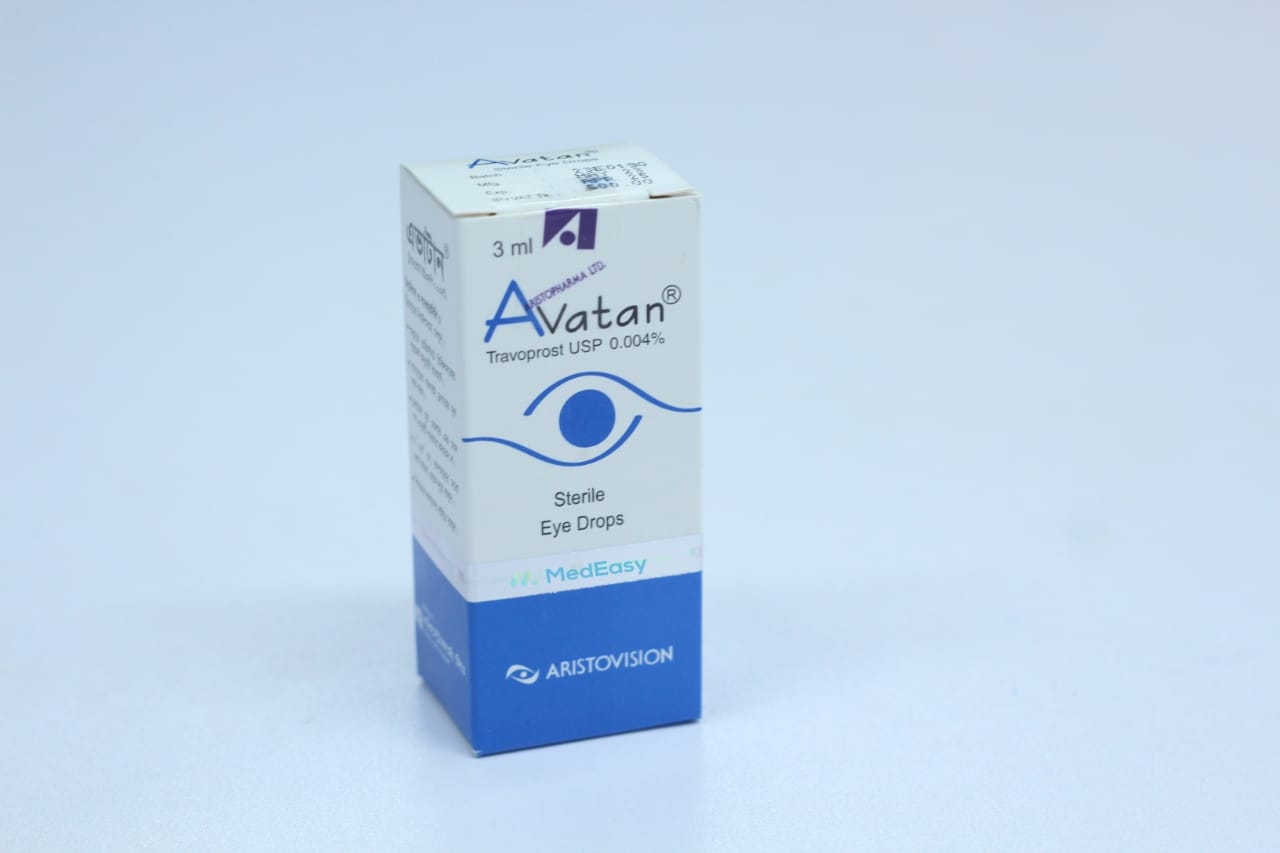
Avatan0.004%
Aristopharma Ltd.
৳540.00
Add to cart

Avro 0.004% Ophthalmic Solution is available on MedEasy for ৳406.26 per 3 ml drop, with home delivery anywhere in Bangladesh. It is manufactured by Drug International Ltd. Its generic name is Travoprost.

Avro ophthalmic solution is indicated for the reduction of elevated intraocular pressure (IOP) in patients with open-angle glaucoma or ocular hypertension.
Avro is not approved for and should not be used to treat angle-closure glaucoma, congenital glaucoma, or other acute causes of raised intraocular pressure that require different management.
Each mL of ophthalmic solution contains Travoprost 0.004% (40 micrograms/mL) as the active ingredient, formulated as a sterile, isotonic, buffered aqueous solution for topical ocular use.
Inactive ingredients typically include a preservative (such as benzalkonium chloride or an alternative ionic-buffered preservative system), tonicity agents, and pH-adjusting agents; exact excipients vary by manufacturer/brand.
Avro is a synthetic prostaglandin F2-alpha analogue used in ophthalmology to lower intraocular pressure. It is formulated as a topical ophthalmic solution and is administered as eye drops.
Avro is a prodrug: after instillation, corneal esterases hydrolyze it to its biologically active free acid, which acts as a selective agonist at the FP (prostaglandin F) receptor to increase outflow of aqueous humor from the eye, thereby lowering intraocular pressure.
Prostaglandin analogue — ophthalmic anti-glaucoma / ocular hypotensive agent
Travoprost is a prodrug that is hydrolyzed by corneal esterases to its active acid form. This active metabolite is a selective agonist of the FP prostanoid receptor.
Activation of FP receptors in the ciliary muscle and sclera increases the uveoscleral (and to a lesser degree trabecular) outflow of aqueous humor, without significantly affecting aqueous humor production. The net effect is a sustained reduction in intraocular pressure.
Systemic absorption after ocular administration of Travoprost is minimal. Peak IOP-lowering effect occurs within approximately 12 hours of dosing, with a duration of action that supports once-daily dosing. The active acid is further metabolized (beta-oxidation, glucuronide conjugation) and excreted primarily in urine.
| Indication | Population | Dose |
|---|---|---|
| Open-angle glaucoma / ocular hypertension | Adults | One drop of Avro 0.004% in the affected eye(s) once daily, in the evening |
| Open-angle glaucoma / ocular hypertension | Pediatric patients | Safety and efficacy not established (see Use in Special Populations) |
Avro is for topical ophthalmic (eye drop) use only and must not be injected or taken orally. Wash hands before use, tilt the head back, pull down the lower eyelid to form a small pocket, and instill one drop without letting the dropper touch the eye. Close the eye gently for 1–2 minutes and apply light pressure over the tear duct to reduce systemic absorption. Full instillation technique and spacing from other eye drops are detailed in Dosage and Administration.
Because ocular absorption of Avro into the systemic circulation is minimal, clinically significant systemic drug interactions are unlikely.
Travoprost is contraindicated in patients with known hypersensitivity to Travoprost or to any component of the formulation (including the preservative, such as benzalkonium chloride, in preserved formulations).
| Effect | Notes |
|---|---|
| Ocular hyperemia (eye redness) | Very common; a typical, characteristic effect of Avro and other prostaglandin analogues |
| Eyelash changes | Increased length, thickness, number, and pigmentation of eyelashes with continued use |
| Iris pigmentation changes | Increased brown pigmentation of the iris, which is usually permanent; more likely in patients with mixed-colour irides (e.g., blue-brown, green-brown) |
| Periorbital/eyelid skin darkening | Darkening of the skin around the eye, which may be reversible in some patients on discontinuation |
| Ocular pruritus, dryness, irritation or pain | Common, generally mild |
| Blurred vision, foreign body sensation | Usually transient after instillation |
Less commonly, Avro has been associated with intraocular inflammation (iritis/uveitis) and macular edema (including cystoid macular edema) in susceptible patients — see Precautions and Warnings.
Pregnancy: There are no adequate and well-controlled studies of Avro in pregnant women. Avro should be used during pregnancy only if clearly needed and if the potential benefit to the mother justifies the potential risk to the fetus. A physician should always be consulted before use in pregnancy.
Lactation: It is not known whether Avro or its metabolites are excreted in human breast milk. Because many drugs are excreted in breast milk, caution should be exercised and a physician consulted before using Avro while breastfeeding; the decision should weigh the benefit of treatment against the potential risk to the infant.
Ocular overdose of Avro is unlikely to cause significant systemic toxicity due to minimal systemic absorption; excessive dosing may increase local irritation, redness, or discomfort. If Avro is accidentally ingested, systemic effects are not well characterized but supportive/symptomatic treatment should be given. In case of accidental over-instillation, eye(s) may be flushed with lukewarm water. Any suspected overdose or ingestion, especially in a child, warrants prompt contact with a physician, emergency services, or a poison control centre for guidance; do not attempt unsupervised home treatment beyond basic eye flushing.
Store unopened Avro ophthalmic solution as directed on the pack (typically at controlled room temperature, or refrigerated at 2–8°C per some manufacturers, prior to opening). Once opened, store at room temperature (below 30°C), protect from light, and discard any remaining solution after the period stated on the label (commonly 4–6 weeks after first opening) even if some solution remains. Keep out of reach of children.
The safety and efficacy of Avro in pediatric patients have not been established; its use in children and adolescents is generally not recommended outside specialist supervision.
No overall differences in safety or effectiveness have been observed between elderly and younger adult patients; no dose adjustment is required based on age alone.
Specific dose adjustment has not been established as necessary in renal or hepatic impairment, since systemic absorption of Avro after ocular administration is minimal.
See Pregnancy and Lactation section above for detailed guidance.
Glaucoma and ocular hypertension are chronic conditions; Avro is generally used as a long-term, continuous once-daily therapy to control intraocular pressure, not as a short course. The duration of treatment should be determined by the prescribing ophthalmologist based on regular monitoring of intraocular pressure, optic nerve status, and visual fields, and treatment is typically continued indefinitely unless side effects, lack of efficacy, or a change in the treatment plan warrant discontinuation.
Prostaglandin F2-alpha analogues; ophthalmic anti-glaucoma / ocular hypotensive agents
Travoprost is a prodrug that is hydrolyzed by corneal esterases into its active free acid. This active form acts as a selective agonist at the FP (prostaglandin F) receptor, increasing uveoscleral outflow of aqueous humor from the eye. Because it enhances drainage rather than reducing production of aqueous humor, Travoprost produces a sustained, once-daily-dosing-compatible reduction in intraocular pressure.
C
The safety and efficacy of Avro in pediatric patients have not been formally established in well-controlled studies. Because data are limited, Avro is generally not recommended for use in infants, children, or adolescents unless specifically directed by a pediatric ophthalmologist who has weighed the potential benefits against the unknown risks in this population.
Q: What is Avro 0.004% Ophthalmic Solution used for?
A: Avro 0.004% Ophthalmic Solution is an eye drop used to lower elevated intraocular pressure (pressure inside the eye) in people with open-angle glaucoma or ocular hypertension, helping to protect the optic nerve and preserve vision over the long term.
Q: How should I use Avro 0.004% Ophthalmic Solution eye drops?
A: Instill one drop of Avro 0.004% Ophthalmic Solution into the affected eye(s) once daily, in the evening. Do not use it more often than prescribed, as using it more frequently can actually make it less effective at lowering eye pressure.
Q: Will Avro 0.004% Ophthalmic Solution change the colour of my eyes?
A: Avro 0.004% Ophthalmic Solution can gradually increase brown pigmentation in the iris, especially in people with mixed-colour eyes (such as blue-brown or green-brown). This colour change is usually permanent and may be more visible if only one eye is treated. It can also make eyelashes longer, thicker, and darker, and may darken the skin around the eyes. Your doctor should discuss these possible changes with you before you start treatment.
Q: Can I use Avro 0.004% Ophthalmic Solution while wearing contact lenses?
A: Remove contact lenses before instilling Avro 0.004% Ophthalmic Solution, since the preservative in the drops can be absorbed by soft lenses. You can reinsert your lenses about 15 minutes after using the drops.
Q: Is Avro 0.004% Ophthalmic Solution safe to use during pregnancy or breastfeeding?
A: Safety in pregnancy and breastfeeding has not been fully established. Avro 0.004% Ophthalmic Solution should be used in these situations only if your physician judges that the benefit clearly outweighs the potential risk, so always consult your doctor before using Avro 0.004% Ophthalmic Solution if you are pregnant, planning pregnancy, or breastfeeding.
Q: What should I do if I miss a dose or use too much Avro 0.004% Ophthalmic Solution?
A: If you miss a dose, simply continue with your normal once-daily schedule the next evening — do not double up. If you or a child accidentally swallows Avro 0.004% Ophthalmic Solution or uses excessive amounts, flush the eye with lukewarm water if it was over-instilled, and contact your physician, emergency services, or a poison control centre promptly for further advice.
Disclaimer
The information provided is accurate to the best of our knowledge, but it does not replace professional medical advice. We cannot guarantee its completeness or accuracy, and the absence of specific information about a drug should not be taken as an endorsement. We are not responsible for any consequences arising from this information, so please consult a healthcare professional for any concerns or questions.