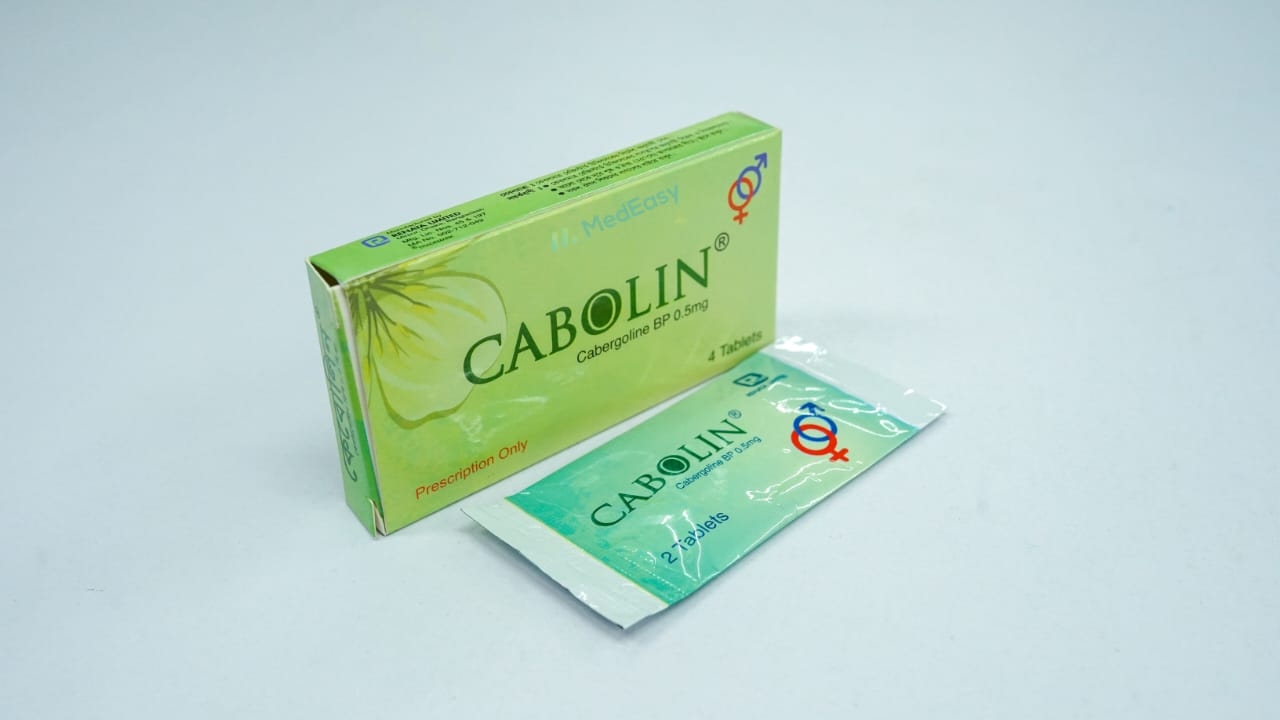
It is indicated for the treatment of hyperprolactinemic disorders, either idiopathic or due to pituitary adenomas. It is used to stop breast milk production (lactation) soon after childbirth, stillbirth, abortion or miscarriage. It can also be used to treat other conditions caused by hormonal disturbance ... Read moreIt is indicated for the treatment of hyperprolactinemic disorders, either idiopathic or due to pituitary adenomas. It is used to stop breast milk production (lactation) soon after childbirth, stillbirth, abortion or miscarriage. It can also be used to treat other conditions caused by hormonal disturbance which can result in high levels of prolactin being produced. This includes high levels of prolactin caused by tumours of the pituitary gland in both men and women.
Theropeutic Class
Antiparkinsonian Drug
Pharmacology
Cabolac 0.5 mg is a long-acting dopamine receptor agonist with a high affinity for D2 receptors. It works by reducing the amount of prolactin that is released from pituitary gland. Results of in vitro studies demonstrate that Cabolac 0.5 mg exerts a direct inhibitory effect on the secretion of prolactin.
Dosage & Administration of Cabolac 0.5 mg
The recommended dosage of Cabolac 0.5 mg Tablet for initiation of therapy is 0.25 mg twice a week. Dosage may be increased by 0.25 mg twice weekly up to a dosage of 1 mg twice a week according to the patient’s serum prolactin level. Before initiating treatment, cardiovascular evaluation should be performed and echocardiography should be considered to assess for valvular disease.Dosage increases should not occur more rapidly than every 4 weeks. If the patient does not respond adequately, and no additional benefit is observed with higher doses, the lowest dose that achieved maximal response should be used and other therapeutic approaches considered. Patients receiving long term treatment with Cabolac 0.5 mg should undergo periodic assessment of their cardiac status and echocardiography should be considered.After a normal serum prolactin level has been maintained for 6 months, Cabolac 0.5 mg may be discontinued, with periodic monitoring of the serum prolactin level to determine whether or when treatment with Cabolac 0.5 mg should be reinstituted.To prevent milk production (lactation): 1 mg (two 0.5 mg tablets) on the first day after delivery. To stop lactation once after start of breastfeeding: 0.25 mg (one half of Cabolac 0.5 mg 0.5 mg table) every 12 hours for two days. To reduce prolactin levels in other conditions: Initially, 0.25 mg twice a week. Dose may be increased up to maximum dose of 4.5 mg or until have responded fully to treatment.
Dosage of Cabolac 0.5 mg
The recommended dosage of Cabolac 0.5 mg Tablet for initiation of therapy is 0.25 mg twice a week. Dosage may be increased by 0.25 mg twice weekly up to a dosage of 1 mg twice a week according to the patient’s serum prolactin level. Before initiating treatment, cardiovascular evaluation should be performed and echocardiography should be considered to assess for valvular disease.Dosage increases should not occur more rapidly than every 4 weeks. If the patient does not respond adequately, and no additional benefit is observed with higher doses, the lowest dose that achieved maximal response should be used and other therapeutic approaches considered. Patients receiving long term treatment with Cabolac 0.5 mg should undergo periodic assessment of their cardiac status and echocardiography should be considered.After a normal serum prolactin level has been maintained for 6 months, Cabolac 0.5 mg may be discontinued, with periodic monitoring of the serum prolactin level to determine whether or when treatment with Cabolac 0.5 mg should be reinstituted.To prevent milk production (lactation): 1 mg (two 0.5 mg tablets) on the first day after delivery. To stop lactation once after start of breastfeeding: 0.25 mg (one half of Cabolac 0.5 mg 0.5 mg table) every 12 hours for two days. To reduce prolactin levels in other conditions: Initially, 0.25 mg twice a week. Dose may be increased up to maximum dose of 4.5 mg or until have responded fully to treatment.
Interaction of Cabolac 0.5 mg
Cabolac 0.5 mg should not be administered concurrently with D2-antagonists, such as Phenothiazines, Butyrophenones, Thioxanthenes, or Metoclopramide, Chlorpromazine, Domperidone, and medicines to lower blood pressure.
Contraindications
Cabolac 0.5 mg tablet is contraindicated in patients with:
Uncontrolled hypertension or known hypersensitivity
History of cardiac valvular disorders demonstration of valve leaflet thickening
High blood pressure in pregnancy associated with swelling and protein in urine
History of pulmonary, pericardial, or retroperitoneal fibrotic disorders & serious mental disease.
Side Effects of Cabolac 0.5 mg
Pathological gambling, increased libido, and hypersexuality have been reported in patients treated with dopamine agonists including Cabolac 0.5 mg. This has been generally reversible upon reduction of the dose or treatment discontinuation.
Pregnancy & Lactation
Pregnancy category B. It is not known whether this drug is excreted in human milk.
Precautions & Warnings
Initial doses higher than 1.0 mg may produce orthostatic hypotension. Care should be exercised when administering Cabolac 0.5 mg with other medications known to lower blood pressure, hypersensitivity, severe liver disease & mental illness.
Overdose Effects of Cabolac 0.5 mg
Over dosage might be expected to produce nasal congestion, syncope, or hallucinations. Measures to support blood pressure should be taken if necessary.
Storage Conditions
Store below 25° C. Keep away from light, moisture & out of reach of children.
Use In Special Populations
Pediatric Use: Safety and effectiveness of Cabolac 0.5 mg in pediatric patients have not been established.Geriatric Use: In general, dose selection for an elderly patient should be cautious, usually starting at the low end of the dosing range, reflecting the greater frequency of decreased hepatic, renal, or cardiac function, and of concomitant disease or other drug therapy.Use in patients with hepatic impairment: Since Cabolac 0.5 mg is extensively metabolized by the liver, caution should be used, and careful monitoring exercised, when administering Cabolac 0.5 mg to patients with hepatic impairment.
Drug Classes
Antiparkinson drugs
Mode Of Action
Cabolac 0.5 mg is a long-acting dopamine receptor agonist with a high affinity for D2 receptors. It works by reducing the amount of prolactin that is released from pituitary gland. Results of in vitro studies demonstrate that Cabolac 0.5 mg exerts a direct inhibitory effect on the secretion of prolactin.
Pregnancy
Pregnancy category B. It is not known whether this drug is excreted in human milk.
Pediatric Uses
Pediatric Use: Safety and effectiveness of Cabolac 0.5 mg in pediatric patients have not been established.Geriatric Use: In general, dose selection for an elderly patient should be cautious, usually starting at the low end of the dosing range, reflecting the greater frequency of decreased hepatic, renal, or cardiac function, and of concomitant disease or other drug therapy.Use in patients with hepatic impairment: Since Cabolac 0.5 mg is extensively metabolized by the liver, caution should be used, and careful monitoring exercised, when administering Cabolac 0.5 mg to patients with hepatic impairment.
Frequently Asked Questions
What is Cabolac 0.5 mg used for?
It is indicated for the treatment of hyperprolactinemic disorders, either idiopathic or due to pituitary adenomas. It is used to stop breast milk production (lactation) soon after childbirth, stillbirth, abortion or miscarriage. It can also be used to treat other conditions caused by hormonal disturbance ... Read moreIt is indicated for the treatment of hyperprolactinemic disorders, either idiopat…
What is the dosage of Cabolac 0.5 mg?
The recommended dosage of Cabolac 0.5 mg Tablet for initiation of therapy is 0.25 mg twice a week. Dosage may be increased by 0.25 mg twice weekly up to a dosage of 1 mg twice a week according to the patient’s serum prolactin level. Before initiating treatment, cardiovascular evaluation should be performed and echocardiography should be considered to assess for valvular disease.Dosage increases sh…
What are the side effects of Cabolac 0.5 mg?
Pathological gambling, increased libido, and hypersexuality have been reported in patients treated with dopamine agonists including Cabolac 0.5 mg. This has been generally reversible upon reduction of the dose or treatment discontinuation.
Who should not take Cabolac 0.5 mg?
Cabolac 0.5 mg tablet is contraindicated in patients with: Uncontrolled hypertension or known hypersensitivity History of cardiac valvular disorders demonstration of valve leaflet thickening High blood pressure in pregnancy associated with swelling and protein in urine History of pulmonary, pericardial, or retroperitoneal fibrotic disorders & serious mental disease.
What precautions should be taken with Cabolac 0.5 mg?
Initial doses higher than 1.0 mg may produce orthostatic hypotension. Care should be exercised when administering Cabolac 0.5 mg with other medications known to lower blood pressure, hypersensitivity, severe liver disease & mental illness.
Is Cabolac 0.5 mg safe during pregnancy and breastfeeding?
Pregnancy category B. It is not known whether this drug is excreted in human milk.
Disclaimer
The information provided is accurate to our best practices, but it does not replace professional medical advice. We cannot guarantee its completeness or accuracy. The absence of specific information about a drug should not be seen as an endorsement. We are not responsible for any consequences resulting from this information, so consult a healthcare professional for any concerns or questions.