8% Off
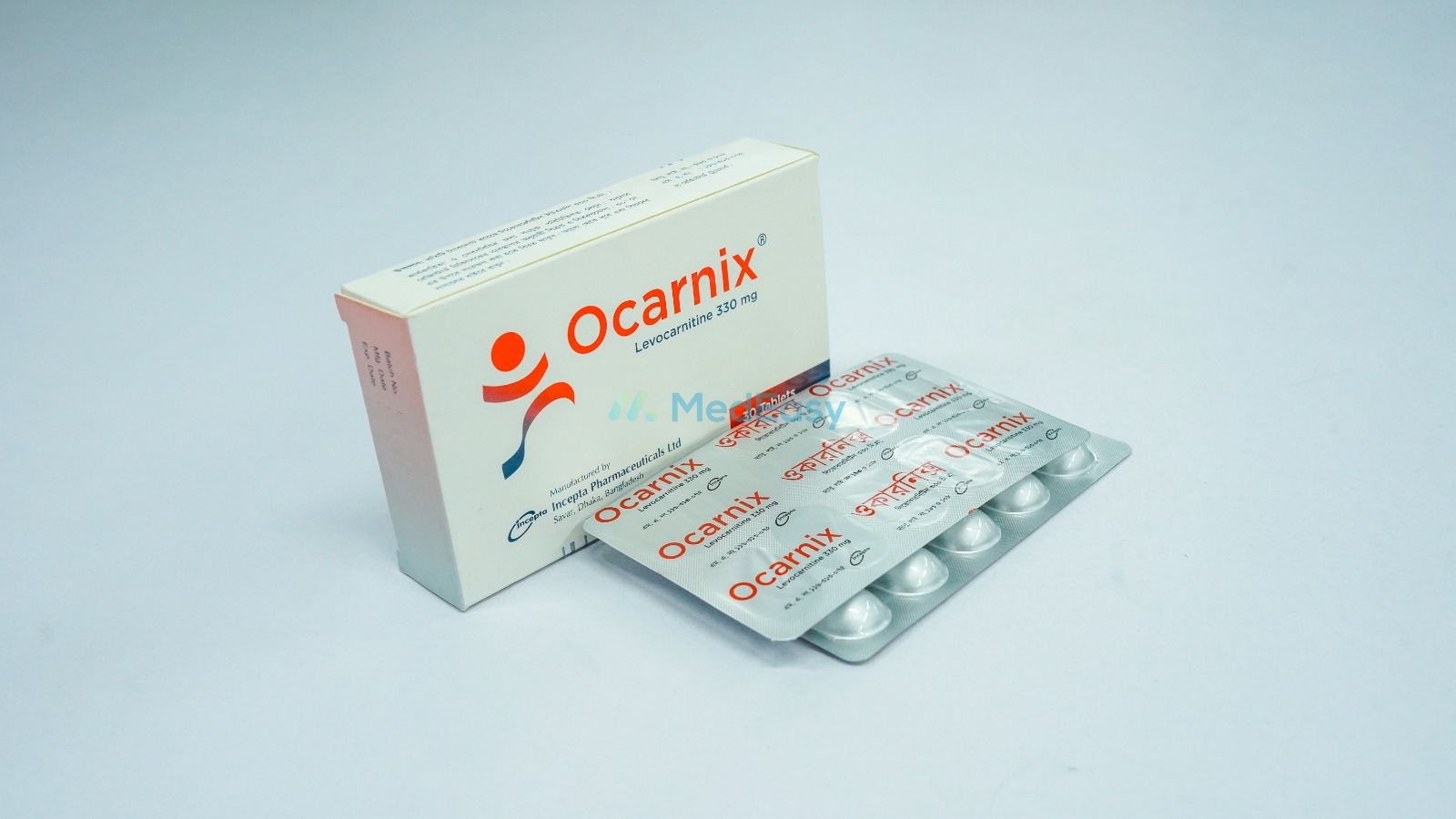
Ocarnix330 mg
Incepta Pharmaceuticals Ltd.
৳46.00
Add to cart
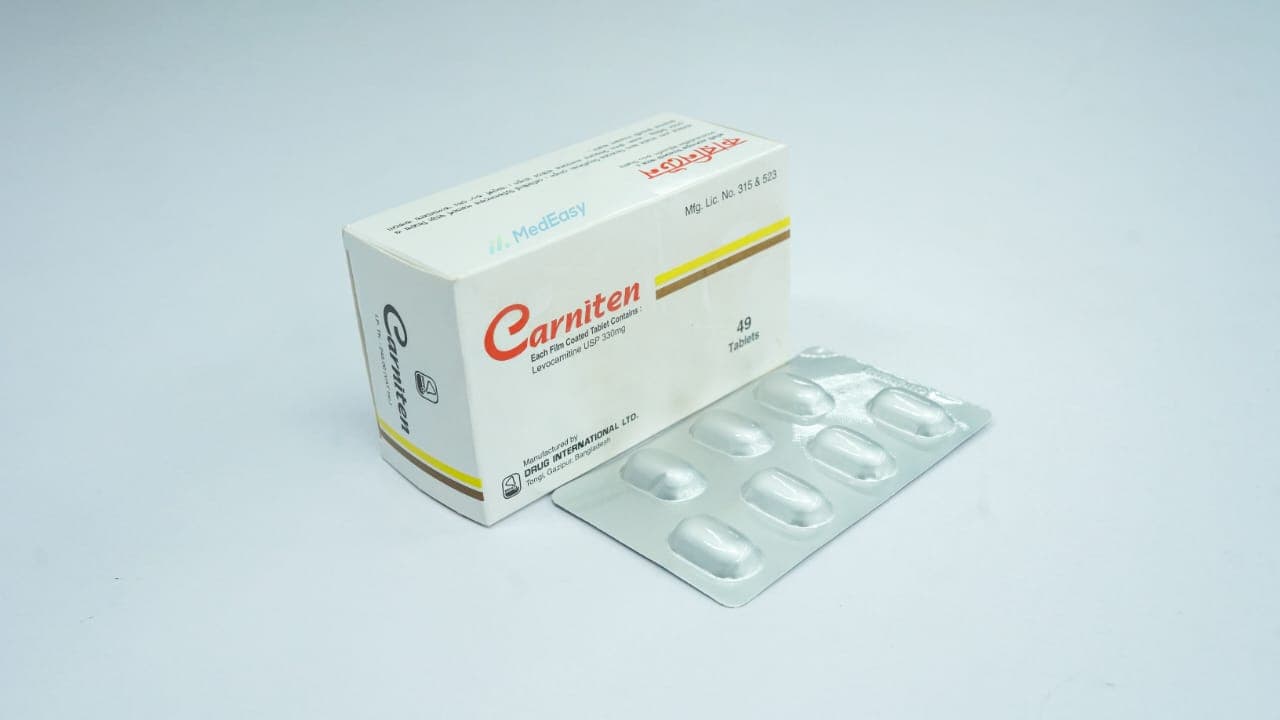

Carniten is indicated for conditions related to carnitine deficiency. Its uses are classified below by strength of evidence.
Carniten should be used for these adjunct or off-label purposes only under a physician's guidance, as evidence is more limited than for the approved indications.
Each formulation of Levocarnitine contains Levocarnitine as the sole active pharmaceutical ingredient. Levocarnitine is available as oral tablets, oral solution, and as a sterile solution for intravenous injection, with strength varying by product and manufacturer.
Carniten is the biologically active form of carnitine, a naturally occurring amino acid derivative that is essential for normal fatty acid metabolism. The body normally synthesizes Carniten from the amino acids lysine and methionine, and also obtains it from dietary sources such as red meat and dairy products.
Carniten is used as a medicine to replace or supplement carnitine in patients who have primary carnitine deficiency, or secondary deficiency caused by certain metabolic disorders or by dialysis, so that normal energy metabolism from fatty acids can be restored.
Carniten belongs to the therapeutic class of amino-acid derivative / metabolic agents, and is specifically classified as a carnitine-replacement agent used to treat carnitine deficiency syndromes.
Levocarnitine plays an essential role in energy production by facilitating the transport of long-chain fatty acids across the inner mitochondrial membrane, where they undergo beta-oxidation to generate adenosine triphosphate (ATP). Levocarnitine also facilitates removal of excess short-chain and medium-chain fatty acyl groups from cells, helping to prevent their toxic accumulation.
In patients with primary or secondary carnitine deficiency, supplementation with Levocarnitine restores plasma and tissue carnitine concentrations, correcting the metabolic disturbances caused by impaired fatty-acid oxidation.
Dosage of Carniten is individualized according to the indication, patient age, body weight, and clinical response. General guidance is summarized below; a physician's specific prescription should always be followed.
| Indication | Typical Adult Dose | Typical Pediatric Dose |
|---|---|---|
| Primary carnitine deficiency (oral) | 990 mg to 3 g of Carniten per day, in 2-3 divided doses | 50-100 mg/kg/day of Carniten in divided doses, up to a maximum of 3 g/day |
| Acute metabolic crisis (IV) | Loading dose of about 50 mg/kg of Carniten by slow IV infusion, followed by 50 mg/kg/day of Carniten in divided doses | Similar weight-based dosing under specialist supervision |
| Carnitine deficiency in dialysis patients (IV) | 10-20 mg/kg of Carniten (based on dry body weight) given intravenously after each haemodialysis session | Not routinely established; individualized by nephrologist |
Oral Carniten may be taken with or without food; taking it with food may reduce a fishy body odor some patients notice. Intravenous Carniten must be administered by slow infusion as directed by a healthcare professional; do not administer by rapid IV push.
Oral Carniten tablets or solution should be swallowed with a glass of water, and may be taken with meals to improve tolerability and reduce body odor. Doses should be spaced evenly through the day as directed.
Intravenous Carniten should be administered only by or under the supervision of a healthcare professional, given as a slow intravenous injection or infusion; it should not be mixed in the same syringe or infusion line with other medicines unless compatibility is confirmed.
Carniten has a limited but clinically relevant interaction profile:
Levocarnitine is contraindicated only in patients with known hypersensitivity to Levocarnitine or to any excipient in the specific formulation used. There are no other well-established absolute contraindications to Levocarnitine.
Carniten is generally well tolerated. Reported side effects include:
Carniten is a naturally occurring nutrient normally present in the body, including during pregnancy and lactation; however, data on supplemental Carniten use in pregnant or breastfeeding women are limited. As a general precaution, Carniten should be used during pregnancy only if clearly needed and if the potential benefit justifies the potential risk to the fetus. Carniten passes into breast milk in small amounts; a nursing mother should use Carniten only after consulting her physician, who will weigh the benefits and risks for her specific situation.
The following precautions apply to the use of Carniten:
Reported effects of Carniten overdose are generally limited to an exaggeration of common side effects, such as diarrhea, nausea, vomiting, abdominal cramps, and a stronger fishy body odor. There is no specific antidote for Carniten overdose. If an overdose of Carniten is suspected, seek immediate medical attention or contact a poison control center/emergency services; treatment is supportive and symptomatic under medical supervision. Do not attempt home treatment for a suspected overdose.
Store at room temperature (below 30°C), away from light and moisture. Keep out of reach of children. Do not use beyond the expiry date printed on the pack.
Renal impairment / dialysis: Intravenous Carniten dosing is specifically established for dialysis-dependent patients (see Dosage and Administration); dosing should be individualized based on dry body weight and clinical response.
Hepatic impairment: Limited data are available; use Carniten cautiously with physician monitoring.
Elderly patients: No specific dose adjustment is established for elderly patients, but they should be monitored as for any patient with reduced renal reserve.
Pediatric and geriatric use: see Pediatric Uses for details on children; general population safety in the elderly is comparable to adults when renal function is accounted for.
For primary or secondary carnitine deficiency, Carniten is typically used long-term/chronically, as deficiency states usually persist for life or for the duration of the underlying metabolic condition. For dialysis-related carnitine deficiency, Carniten is generally continued for as long as the patient remains on maintenance dialysis. Duration should be reviewed periodically by the treating physician based on carnitine levels and clinical response.
Amino acid derivative / Metabolic agent (Carnitine replacement therapy)
Levocarnitine acts as an essential cofactor in the transport of long-chain fatty acids from the cytoplasm into mitochondria via the carnitine palmitoyltransferase (CPT-I/CPT-II) shuttle system, where beta-oxidation of these fatty acids generates ATP for cellular energy. Levocarnitine also binds and helps to eliminate potentially toxic acyl-CoA groups that accumulate in certain metabolic disorders, converting them to acylcarnitines that are excreted in the urine, thereby restoring the free coenzyme-A pool needed for normal intermediary metabolism.
B
Carniten is an approved treatment for primary carnitine deficiency and for secondary carnitine deficiency due to inborn errors of metabolism in pediatric patients, including infants, using weight-based oral dosing (typically 50-100 mg/kg/day of Carniten in divided doses). Intravenous Carniten is used under specialist supervision for pediatric patients in acute metabolic crisis. For indications other than carnitine deficiency (e.g., adjunct uses), safety and efficacy of Carniten in children have not been established, and use should only occur under the direct guidance of a pediatric metabolic specialist.
Q: What is Carniten 330 mg Tablet used for?
A: Carniten 330 mg Tablet is used to treat primary carnitine deficiency, secondary carnitine deficiency caused by certain metabolic disorders, and carnitine deficiency in patients on long-term dialysis. It is sometimes used as an adjunct in other conditions under specialist guidance.
Q: Can I take Carniten 330 mg Tablet without a doctor's prescription?
A: No. Although Carniten 330 mg Tablet is a naturally occurring nutrient, the medicinal doses used to treat deficiency states should only be taken under a physician's supervision, since the correct dose and duration depend on your specific diagnosis.
Q: Why does Carniten 330 mg Tablet cause a fishy body odor?
A: A fishy body odor is a known, generally harmless side effect of Carniten 330 mg Tablet caused by a metabolite called trimethylamine. Taking Carniten 330 mg Tablet with food may help reduce this effect.
Q: Is Carniten 330 mg Tablet safe during pregnancy or breastfeeding?
A: Carniten 330 mg Tablet should be used during pregnancy only if clearly needed and if the expected benefit outweighs any potential risk to the baby, and only small amounts pass into breast milk; a nursing mother should consult her physician before using Carniten 330 mg Tablet.
Q: Who should not take Carniten 330 mg Tablet?
A: Carniten 330 mg Tablet should not be used by anyone with a known hypersensitivity (allergy) to Carniten 330 mg Tablet or to any ingredient in the specific product. There are no other well-established absolute contraindications.
Q: What should I do if I miss a dose or take too much Carniten 330 mg Tablet?
A: If you miss a dose, take it as soon as you remember unless it is close to your next dose; do not double the dose. If you suspect you have taken too much Carniten 330 mg Tablet, seek immediate medical attention or contact a poison control center, especially if you notice severe diarrhea or other unusual symptoms.
Disclaimer
The information provided is accurate to the best of our knowledge, but it does not replace professional medical advice. We cannot guarantee its completeness or accuracy, and the absence of specific information about a drug should not be taken as an endorsement. We are not responsible for any consequences arising from this information, so please consult a healthcare professional for any concerns or questions.