
8% Off
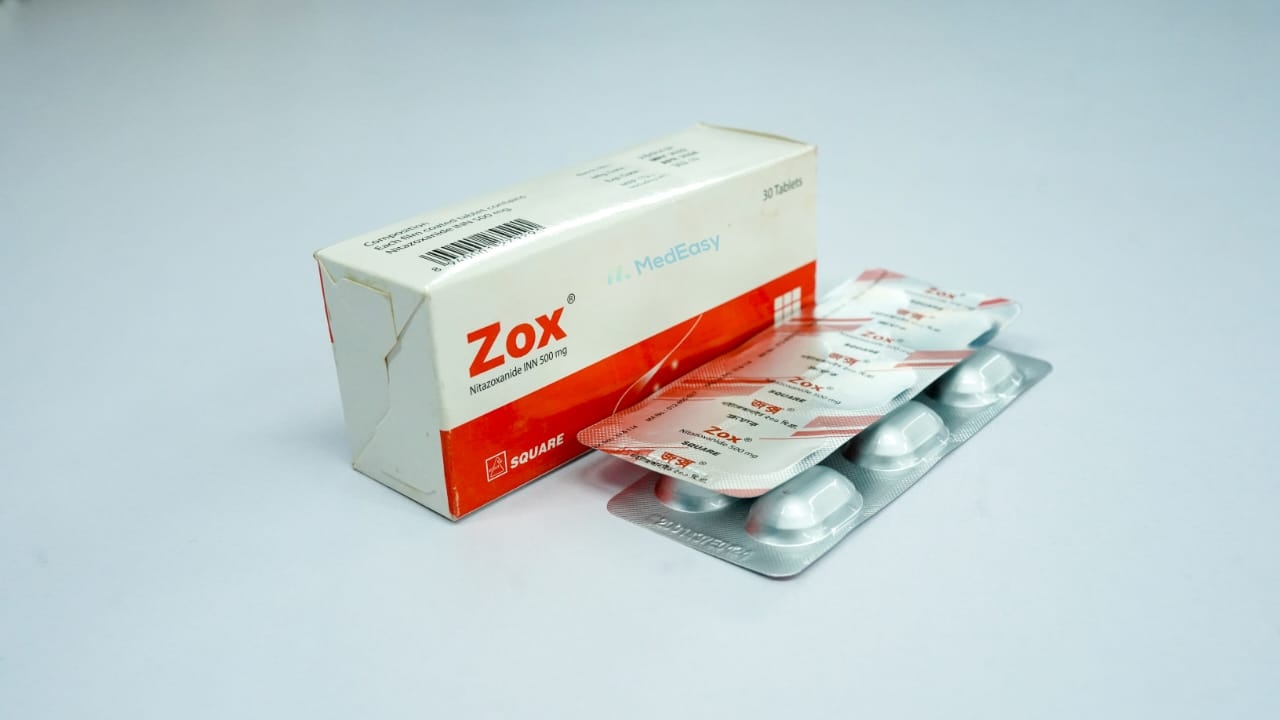
Zox500 mg
Square Pharmaceuticals PLC.
৳55.59
Add to cart


Diar is an antiprotozoal medicine used to treat certain parasitic causes of diarrhea.
Diar has also been studied off-label for other intestinal parasitic infections and, during the COVID-19 pandemic, was investigated as a possible antiviral against certain viral gastroenteritis and respiratory viruses; evidence for these uses is limited and inconsistent, and such use should only occur under a physician's guidance.
Each tablet or reconstituted oral suspension of Nitazoxanide contains nitazoxanide as the active pharmaceutical ingredient.
Inactive ingredients vary by manufacturer/brand; refer to the specific product package insert for excipient details.
Diar is a synthetic thiazolide antiparasitic (antiprotozoal) agent. It is used orally to treat intestinal infections caused by susceptible protozoan parasites, most notably Giardia lamblia and Cryptosporidium parvum.
Diar is available as film-coated tablets and as a powder for oral suspension, and is typically given as a short 3-day course with food.
Diar belongs to the thiazolide antiprotozoal / antiparasitic class of medicines. It is not an antibiotic in the classical antibacterial sense, but it is an antimicrobial agent active against certain protozoa.
Nitazoxanide and its active circulating metabolite, tizoxanide, interfere with the anaerobic energy metabolism of susceptible protozoa by inhibiting the pyruvate:ferredoxin oxidoreductase (PFOR) enzyme-dependent electron transfer reaction, which is essential for anaerobic energy metabolism in these organisms.
After oral administration, Nitazoxanide is rapidly hydrolyzed to tizoxanide, which is further conjugated to tizoxanide glucuronide. Tizoxanide is highly (>99.9%) bound to plasma proteins. Absorption is enhanced when Nitazoxanide is taken with food. Tizoxanide is excreted in urine, bile, and feces, and tizoxanide glucuronide is excreted primarily in urine and bile.
Diar is taken by mouth with food, usually as a 3-day course, with the dose depending on age as shown below.
| Age group | Dose | Form | Duration |
|---|---|---|---|
| 1–3 years | 100 mg every 12 hours | Oral suspension (5 mL) | 3 days |
| 4–11 years | 200 mg every 12 hours | Oral suspension (10 mL) | 3 days |
| 12 years and older (including adults) | 500 mg every 12 hours | Tablet or oral suspension (25 mL) | 3 days |
Take Diar exactly as prescribed by your physician; do not stop, extend, skip doses, or share this medicine with others without medical advice, as incomplete or inappropriate use of antiparasitic therapy can reduce effectiveness and contribute to reduced susceptibility over time.
Safety and efficacy in children younger than 1 year have not been established.
The active metabolite of Diar (tizoxanide) is highly bound to plasma protein (>99.9%). Caution is advised when Diar is given together with other highly plasma-protein-bound drugs with a narrow therapeutic index, such as warfarin, because of the theoretical potential for displacement interactions; monitor for changes in anticoagulant effect (e.g., INR) if co-administered.
Diar is not expected to significantly inhibit or induce major cytochrome P450 enzymes based on available data, so clinically significant CYP-mediated drug interactions are not well established. Always inform your physician or pharmacist of all other medications, including over-the-counter drugs and supplements, before starting Diar.
Nitazoxanide is contraindicated in patients with known hypersensitivity to nitazoxanide, tizoxanide, or any excipient in the specific formulation.
Most adverse effects associated with Diar are mild and gastrointestinal in nature.
Seek medical attention promptly for signs of an allergic reaction (rash, itching, swelling, severe dizziness, trouble breathing) or for persistent, severe, or bloody diarrhea, high fever, or signs of dehydration while taking Diar, as these may indicate a different or more serious underlying condition.
Pregnancy: Animal reproduction studies with Diar at doses higher than the human dose have not shown evidence of fetal harm, but there are no adequate and well-controlled studies in pregnant women. Diar should be used during pregnancy only if clearly needed and if the potential benefit justifies the potential risk to the fetus; consult a physician before use.
Lactation: It is not known whether Diar or its metabolites are excreted in human breast milk. Caution should be exercised, and a physician should be consulted, before using Diar while breastfeeding.
Limited data are available on overdose with Diar; single doses up to 4000 mg have been given to healthy volunteers without serious adverse effects in clinical studies, but this does not mean higher doses are safe for all patients.
If an overdose of Diar is suspected, seek immediate medical attention or contact a poison control center / emergency services. Treatment of overdose is supportive and symptomatic; there is no specific antidote.
Store tablets at room temperature (below 30°C), away from light and moisture. For the oral suspension, once Diar powder has been reconstituted with water, store the suspension at room temperature (do not freeze) and discard any unused portion after 7 days. Keep out of reach of children.
The pharmacokinetics of Diar in patients with renal impairment have not been studied; use with caution and monitor closely.
The pharmacokinetics of Diar in patients with hepatic impairment have not been studied; use with caution and monitor closely.
Clinical studies of Diar did not include sufficient numbers of patients aged 65 and over to determine whether they respond differently from younger patients; dose selection should be cautious.
Efficacy of Diar for cryptosporidiosis has not been established in HIV-positive or other immunocompromised patients.
See Pregnancy and Lactation section above.
The standard course of Diar for approved indications (giardiasis and cryptosporidiosis) is 3 days, taken twice daily with food. Your physician may adjust the duration based on clinical response; do not extend or shorten the course without medical advice.
To reconstitute the oral suspension of Diar: tap the bottle to loosen the powder, then add the amount of water indicated on the label in two portions, shaking well after each addition, to make a final volume that provides 100 mg of Diar per 5 mL. Shake well before each use. Store the reconstituted suspension at room temperature, do not freeze, and discard any unused portion after 7 days.
Nitazoxanide is classified as a thiazolide antiprotozoal agent (nitrothiazolyl-salicylamide derivative), a class of synthetic antimicrobials active against certain anaerobic protozoa and, to a lesser extent, some anaerobic bacteria and helminths.
Nitazoxanide and its active metabolite tizoxanide inhibit the pyruvate:ferredoxin oxidoreductase (PFOR) enzyme-dependent electron transfer reaction that is essential for anaerobic energy metabolism in susceptible protozoa such as Giardia lamblia and Cryptosporidium parvum. Interference with this energy-generating pathway leads to parasite death. See Pharmacology for additional detail.
B
Diar oral suspension is approved for use in children 1 year of age and older for the treatment of diarrhea due to Giardia lamblia or Cryptosporidium parvum. Tablets are approved for patients 12 years and older.
| Age | Dose |
|---|---|
| 1–3 years | 100 mg every 12 hours for 3 days |
| 4–11 years | 200 mg every 12 hours for 3 days |
The safety and efficacy of Diar in children younger than 1 year of age have not been established.
Q: What is Diar 500 mg Tablet used for?
A: Diar 500 mg Tablet is used to treat diarrhea caused by the parasites Giardia lamblia and Cryptosporidium parvum, and in some regional labels, Entamoeba histolytica. It is usually given as a 3-day course.
Q: How should I take Diar 500 mg Tablet?
A: Take Diar 500 mg Tablet by mouth with food, exactly as prescribed, usually every 12 hours for 3 days. Shake the oral suspension well before each dose and complete the full course even if you feel better sooner.
Q: Can Diar 500 mg Tablet be used in pregnancy?
A: Diar 500 mg Tablet should be used during pregnancy only if clearly needed and if the potential benefit justifies the potential risk to the fetus, because adequate human safety data are lacking; consult a physician before use.
Q: What are the common side effects of Diar 500 mg Tablet?
A: The most common side effects of Diar 500 mg Tablet are mild gastrointestinal symptoms such as abdominal pain, diarrhea, nausea, and headache. Contact your physician if you develop severe, bloody diarrhea, high fever, or signs of an allergic reaction.
Q: Is Diar 500 mg Tablet an antibiotic?
A: No, Diar 500 mg Tablet is an antiprotozoal (antiparasitic) agent, not a bactericidal antibiotic, although it is broadly classed as an antimicrobial. It works by interfering with the parasite's energy metabolism.
Q: What should I do if I miss a dose or think I've taken too much Diar 500 mg Tablet?
A: If you miss a dose of Diar 500 mg Tablet, take it as soon as you remember unless it is almost time for the next dose. If you suspect an overdose, seek immediate medical attention or contact a poison control center; do not attempt home treatment.
Disclaimer
The information provided is accurate to the best of our knowledge, but it does not replace professional medical advice. We cannot guarantee its completeness or accuracy, and the absence of specific information about a drug should not be taken as an endorsement. We are not responsible for any consequences arising from this information, so please consult a healthcare professional for any concerns or questions.

