10% Off
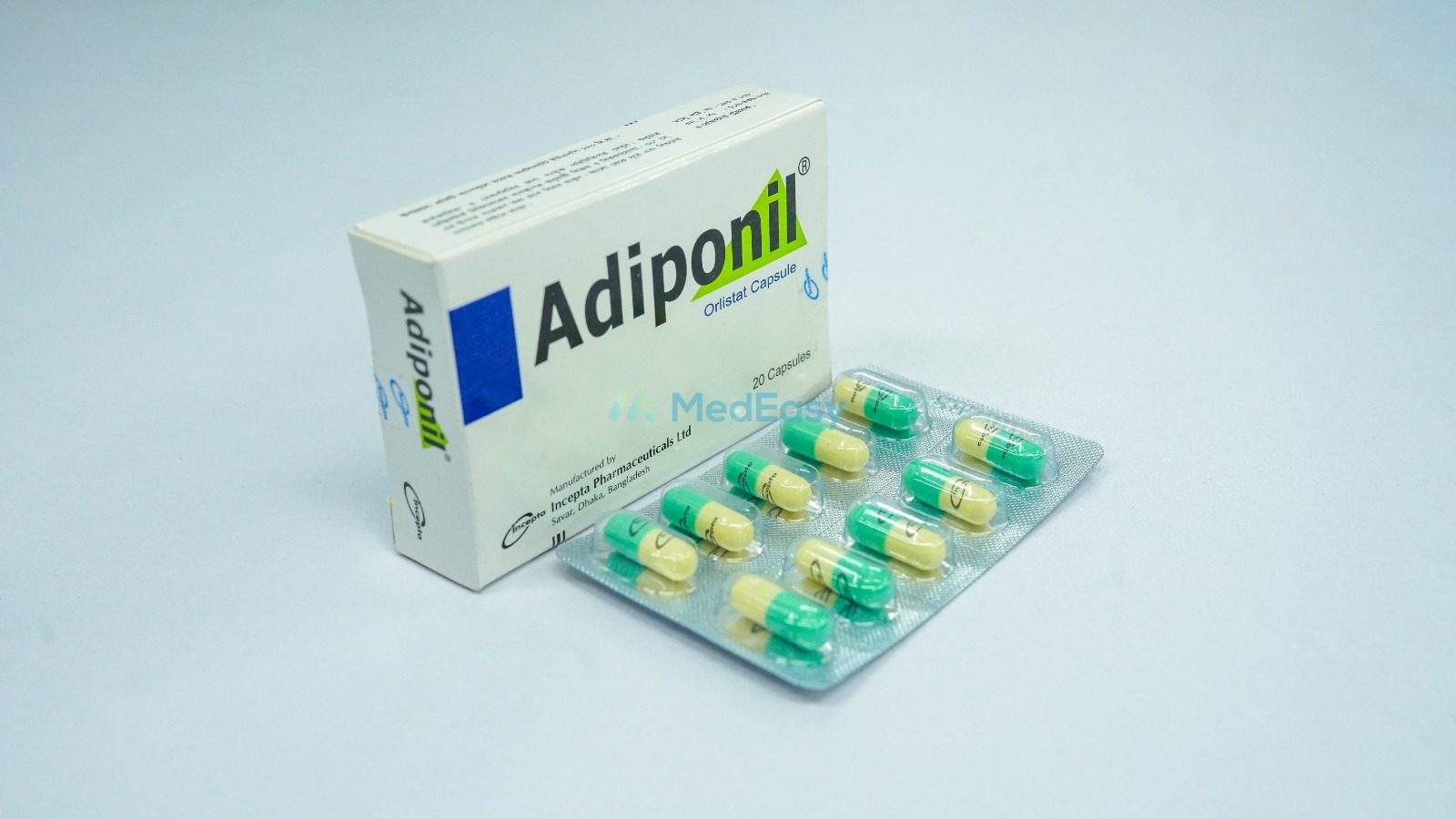
Adiponil120 mg
Incepta Pharmaceuticals Ltd.
৳360.00
Add to cart


Dietil is a lipase inhibitor indicated for the management of obesity as follows:
Dietil does not treat the underlying cause of obesity; organic causes of obesity (e.g. hypothyroidism) should be excluded before starting therapy.
Each capsule contains Orlistat as the active pharmaceutical ingredient, available in strengths of 120 mg and 60 mg. Inactive ingredients typically include microcrystalline cellulose, sodium starch glycolate, povidone, sodium lauryl sulfate, and talc, with a gelatin capsule shell — exact excipients vary by manufacturer/brand.
Dietil is a reversible inhibitor of gastric and pancreatic lipase enzymes, used as an anti-obesity agent. Unlike centrally-acting appetite suppressants, Dietil acts locally within the gastrointestinal tract to reduce the absorption of dietary fat, and is not systemically absorbed to a clinically significant degree.
Dietil is available as an oral capsule in 120 mg (prescription strength) and 60 mg strengths, and is used as part of a comprehensive weight-management plan that includes a reduced-calorie, reduced-fat diet.
Dietil belongs to the therapeutic class of anti-obesity agents, and pharmacologically is classified as a gastrointestinal lipase inhibitor.
Orlistat acts by forming a covalent bond with the active serine residue site of gastric and pancreatic lipases, inactivating these enzymes. The inactivated enzymes are then unable to hydrolyze dietary fat (triglycerides) into absorbable free fatty acids and monoglycerides. Because the undigested triglycerides are not absorbed, the resulting caloric deficit contributes to weight loss.
| Indication | Dose |
|---|---|
| Obesity management (weight loss/maintenance), BMI ≥30, or ≥27 with risk factors | One 120 mg capsule three times daily with each main fat-containing meal, taken during the meal or up to 1 hour after eating |
| Milder weight management (lower-strength product) | One 60 mg capsule up to three times daily with fat-containing meals, per product labeling |
Adolescents aged 12–16 years: 120 mg three times daily with main meals, together with a nutritionally balanced, reduced-calorie diet and under medical supervision. Use in children under 12 years is not recommended — safety and efficacy have not been established.
No dedicated pharmacokinetic studies have been conducted in patients with renal or hepatic impairment; use with caution and under medical supervision in these populations, and monitor for hepatic adverse effects (see Precautions and Warnings).
Dietil is administered orally with water, taken during or up to one hour after a fat-containing meal. If a meal is skipped or contains no fat, that dose may be skipped. Do not exceed three doses (120 mg each) in 24 hours. Take a fat-soluble multivitamin at a separate time from Dietil, such as at bedtime.
The following clinically significant interactions have been established with Dietil:
Orlistat is contraindicated in patients with:
Adverse effects of Dietil are predominantly gastrointestinal, related to its mechanism of blocking fat absorption, and tend to occur more frequently with higher dietary fat intake. Counseling patients on adherence to a low-fat diet reduces the frequency of these effects.
Pregnancy: Dietil is contraindicated during pregnancy, because weight loss offers no anticipated benefit during pregnancy and may cause fetal harm. Dietil should be discontinued if pregnancy occurs or is planned; use only if a physician determines it is clearly needed and potential benefit justifies potential risk — in general this drug should be avoided during pregnancy.
Lactation: It is not known whether Dietil passes into human breast milk. Caution should be exercised, and a physician should be consulted before use of Dietil in a nursing mother, weighing the benefits of breastfeeding against any theoretical risk.
Studies of single doses up to 800 mg and repeated doses up to 400 mg three times daily have not shown significant adverse effects beyond the expected gastrointestinal effects of Dietil, and effects are expected to be reversible given its local, non-systemic mechanism of action. Nevertheless, in cases of suspected overdose, seek immediate medical attention or contact a poison control center/emergency services. Patients should be observed for at least 24 hours; management is supportive and symptomatic, since no specific antidote is known.
Store at room temperature (below 30°C), away from light and moisture. Keep out of reach of children.
Dietil 120 mg is approved for use in adolescents aged 12–16 years for obesity management, combined with a reduced-calorie diet and medical supervision. Safety and efficacy in children under 12 years have not been established, and use in this age group is not recommended.
Clinical studies of Dietil did not include a sufficient number of subjects aged 65 years and over to determine whether they respond differently from younger patients. Use with appropriate caution, considering the greater frequency of comorbidities and concomitant medication in this population.
No dedicated studies have been conducted in patients with renal impairment. Use with caution, and monitor renal function, particularly in patients at risk of oxalate nephropathy (see Precautions and Warnings).
No dedicated studies have been conducted in patients with hepatic impairment. Because rare severe hepatic injury has been reported with Dietil, use with caution and monitor liver function in patients with pre-existing liver disease.
Dietil is generally used for weight management over an extended period as part of a comprehensive lifestyle programme. If a clinically meaningful amount of weight loss (e.g., approximately 5% of initial body weight) has not been achieved after about 12 weeks of therapy combined with diet and lifestyle changes, the prescriber should reassess treatment, since further benefit is unlikely without additional intervention. Long-term use should be periodically reviewed by the prescribing physician, weighing ongoing benefit against tolerability and the need for continued dietary adherence.
Orlistat is classified as an anti-obesity agent, specifically a pancreatic and gastric lipase inhibitor.
Orlistat works by covalently binding to and inhibiting gastric and pancreatic lipase enzymes within the gastrointestinal lumen. This prevents the breakdown of dietary triglycerides into absorbable fatty acids and monoglycerides, so roughly 25–30% of ingested fat passes through the gut unabsorbed and is excreted in the feces, producing a caloric deficit that supports weight loss when combined with dietary changes.
X
Dietil 120 mg is indicated for the management of obesity in adolescents aged 12 to 16 years, used together with a nutritionally balanced, reduced-calorie diet, and under close medical and, where possible, family/dietary supervision. Adolescent patients should also take a daily multivitamin supplement containing fat-soluble vitamins, dosed apart from Dietil (see Interactions). Safety and efficacy of Dietil in children under 12 years of age have not been established, and use in this age group is not recommended.
Q: What is Dietil 120 mg Capsule used for?
A: Dietil 120 mg Capsule is used for weight loss and weight maintenance in overweight or obese adults, together with a reduced-calorie, low-fat diet, and to help reduce the risk of regaining weight after prior weight loss. It works by blocking the absorption of some of the fat you eat.
Q: How should I take Dietil 120 mg Capsule?
A: Take one capsule (120 mg, or 60 mg for lower-strength products) by mouth up to three times daily, with each main meal that contains fat — during the meal or within 1 hour after eating. If a meal contains no fat or is skipped, that dose can be skipped. Dietil 120 mg Capsule only works if you also follow a reduced-calorie, low-fat diet.
Q: What are the most common side effects of Dietil 120 mg Capsule?
A: The most common side effects are gastrointestinal and related to unabsorbed fat passing through the bowel — oily spotting, gas with oily discharge, urgent or more frequent bowel movements, oily or fatty stools, and occasionally difficulty controlling bowel movements. These effects are usually mild, improve within a few weeks, and are reduced by keeping dietary fat low. Rarely, serious liver problems have been reported — seek medical attention immediately if you notice yellowing of the skin/eyes, dark urine, loss of appetite, or pain in the upper right abdomen.
Q: Can I take Dietil 120 mg Capsule during pregnancy or while breastfeeding?
A: No. Dietil 120 mg Capsule is contraindicated during pregnancy because weight loss is not appropriate in pregnancy and may harm the fetus; it should be stopped if you become pregnant or are planning pregnancy. It is not known whether Dietil 120 mg Capsule passes into breast milk, so it should be used during breastfeeding only if a physician determines it is clearly needed, and with caution.
Q: Do I need to take vitamins with Dietil 120 mg Capsule?
A: Yes. Because Dietil 120 mg Capsule reduces absorption of fat-soluble vitamins (A, D, E, K) and beta-carotene, you should take a daily multivitamin supplement, timed at least 2 hours before or after Dietil 120 mg Capsule (for example, at bedtime), to help prevent vitamin deficiency.
Q: Who should not take Dietil 120 mg Capsule?
A: Dietil 120 mg Capsule should not be used by anyone with a known hypersensitivity/allergy to Dietil 120 mg Capsule or its ingredients, chronic malabsorption syndrome, cholestasis (bile flow blockage), or during pregnancy. Discuss your full medical history, including any liver, kidney, or gallbladder problems and all medicines you take, with your physician before starting Dietil 120 mg Capsule.
Disclaimer
The information provided is accurate to the best of our knowledge, but it does not replace professional medical advice. We cannot guarantee its completeness or accuracy, and the absence of specific information about a drug should not be taken as an endorsement. We are not responsible for any consequences arising from this information, so please consult a healthcare professional for any concerns or questions.