
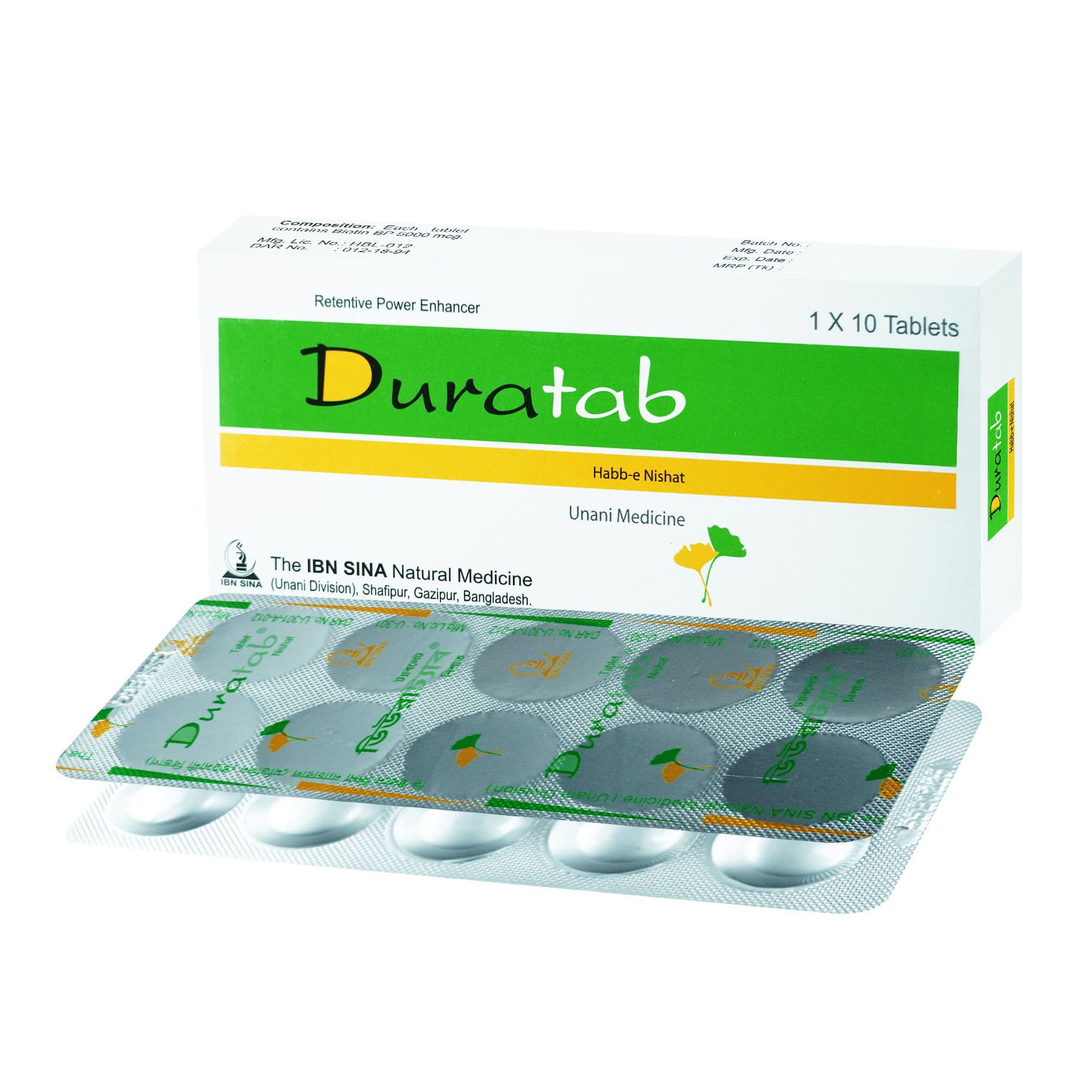

Medicine overview
Indications of Duratab
Duratab is a traditional Unani polyherbal formulation used as a general tonic in Unani medicine to support mood, vigor, and overall wellness. Its use is based on traditional Unani medical practice and historical formulary categorization rather than robust modern clinical trial evidence.
- Traditional/anecdotal use: As a general restorative and mood-supporting tonic within Unani medicine.
- Traditional/anecdotal use: As a supportive remedy for low vigor or general debility, as used by Unani practitioners (hakims).
These uses are not supported by robust modern clinical trials and should not replace evaluation and treatment by a qualified conventional or Unani medical practitioner for any underlying health condition.
Composition
Habb-e-Nishat is a polyherbal Unani formulation prepared according to classical Unani formulary methods. The precise composition and standardized proportions of ingredients vary by manufacturer, as it is compounded according to traditional Unani pharmacopoeial references rather than a single standardized modern pharmaceutical formula.
Patients and caregivers should always check the manufacturer's product label/packaging for the specific list of ingredients contained in a particular batch of Habb-e-Nishat, as composition has not been independently verified beyond general Unani formulary categorization.
Description
Duratab is a traditional Unani medicine preparation. In Unani terminology, "Habb" refers to a pill or tablet dosage form, and "Nishat" relates to concepts of joy, freshness, and vigor. Duratab is therefore traditionally formulated and used within the Unani system of medicine as a tonic intended to support mood, freshness, and vigor.
Duratab is a traditional/complementary medicine product; its formulation, quality standards, and evidence base differ from those required for conventional pharmaceutical drugs.
Therapeutic Class
Duratab belongs to the category of traditional Unani polyherbal tonics/restoratives. It is classified within Unani medicine formularies as a general tonic intended to support mood and vigor, rather than under any modern pharmacological drug class.
Pharmacology
The pharmacology of Habb-e-Nishat has not been characterized through modern pharmacokinetic or pharmacodynamic studies. As a polyherbal Unani formulation, its proposed effects are described in traditional Unani medical theory rather than in terms of a defined mechanism of action, absorption, distribution, metabolism, or excretion profile.
No controlled clinical trial data establishing the pharmacological activity of Habb-e-Nishat in humans are available from authoritative modern regulatory sources.
Dosage & Administration of Duratab
There is no standardized, regulator-approved dosing schedule for Duratab established through modern clinical trials. Dosing of Duratab should be determined only by a qualified Unani physician (hakim) or medical practitioner, based on the specific product label and the individual's condition.
General Guidance
- Do not exceed the dose recommended on the product packaging or by a qualified Unani physician (hakim) or medical practitioner.
- Duratab is typically taken orally as tablets/pills, usually with water, as directed on the label.
- Do not use Duratab as a substitute for evaluation and treatment of persistent mood, sleep, or general health concerns by a conventional medical practitioner.
Administration of Duratab
Duratab is administered orally, typically swallowed with water. It should be taken as directed on the manufacturer's label or as advised by a qualified Unani physician (hakim).
Interaction of Duratab
Formal drug-interaction studies for Duratab have not been conducted. Because it is a polyherbal product, it may theoretically interact with other herbal products, dietary supplements, or prescription/over-the-counter medicines, particularly those affecting the central nervous system, blood pressure, or blood clotting.
Patients should inform their physician or pharmacist about all medicines and supplements they are taking before starting Duratab, to avoid potential interactions.
Contraindications
Habb-e-Nishat is contraindicated in individuals with known hypersensitivity to Habb-e-Nishat or to any of its herbal components.
Side Effects of Duratab
Well-characterized modern clinical data on the side effects of Duratab are not available. As with other polyherbal products, possible but uncommon effects may include gastrointestinal discomfort or allergic/hypersensitivity reactions (e.g., skin rash, itching) in sensitive individuals.
Anyone experiencing signs of an allergic reaction (such as rash, swelling, or difficulty breathing) after taking Duratab should stop use and seek medical attention promptly.
Pregnancy & Lactation
The safety of Duratab in pregnancy and breastfeeding has not been established through controlled studies. Duratab should be avoided during pregnancy and breastfeeding unless specifically advised and supervised by a qualified Unani physician (hakim) or medical practitioner, since potential risks to the fetus or infant cannot be ruled out.
Precautions & Warnings
Duratab should be used only under the guidance of a qualified Unani physician (hakim) or medical practitioner, as its standardized composition and dosing vary by manufacturer and have not been independently verified beyond general Unani formulary categorization.
- Avoid use in children without professional guidance (see Use in Special Populations).
- Avoid use during pregnancy and breastfeeding without professional guidance (see Pregnancy and Lactation).
- Discontinue Duratab and seek medical advice if hypersensitivity reactions occur (see Contraindications).
- Persistent mood, sleep, or general health concerns should be evaluated by a conventional medical practitioner rather than managed with Duratab alone.
Overdose Effects of Duratab
No specific antidote or well-documented overdose profile exists for Duratab. If an overdose of Duratab is suspected, seek immediate medical attention or contact a poison control center/emergency services rather than attempting home treatment.
Storage Conditions
Store at room temperature (below 30°C), away from light and moisture. Keep out of reach of children.
Use In Special Populations
Duratab has not been formally studied in special populations.
- Children: Avoid use of Duratab in children without the guidance of a qualified Unani physician (hakim) or pediatric medical practitioner, as safety in this population has not been established.
- Elderly: Use with caution and under professional guidance, particularly in those with underlying chronic conditions or taking multiple medications.
- Pregnancy/breastfeeding: See Pregnancy and Lactation section.
- Renal/hepatic impairment: No specific dosing data available; use only under medical supervision.
Duration Of Treatment
The appropriate duration of use of Duratab should be determined by a qualified Unani physician (hakim) or medical practitioner based on individual response. Duratab is not intended for indefinite self-directed use; if symptoms persist or worsen after a reasonable trial period, discontinue and seek conventional medical evaluation.
Drug Classes
Habb-e-Nishat is classified as a traditional Unani polyherbal tonic/restorative formulation, not within a modern pharmacological drug class.
Mode Of Action
The mode of action of Habb-e-Nishat is described in traditional Unani medical theory in terms of balancing bodily humors and supporting vigor and mood, rather than through an established modern pharmacological mechanism. No validated mechanism of action has been demonstrated for Habb-e-Nishat in controlled scientific studies.
Pediatric Uses
Safety and efficacy of Duratab in children have not been established. Duratab should generally be avoided in children unless specifically recommended and supervised by a qualified Unani physician (hakim) or pediatric medical practitioner.
Frequently Asked Questions
Q: What is Duratab Tablet used for?
A: Duratab Tablet is a traditional Unani polyherbal tonic used to support mood, vigor, and general wellness. This use is based on traditional Unani practice and has not been confirmed by robust modern clinical trials, so persistent health concerns should be evaluated by a qualified medical practitioner.
Q: Is Duratab Tablet safe to take without a doctor's advice?
A: Duratab Tablet should only be used under the guidance of a qualified Unani physician (hakim) or medical practitioner, because its composition and dosing vary by manufacturer and have not been independently verified beyond general Unani formulary categorization.
Q: Can children take Duratab Tablet?
A: Duratab Tablet should generally be avoided in children, as its safety and efficacy in this population have not been established; use only if specifically advised and supervised by a qualified Unani physician (hakim) or pediatric practitioner.
Q: Can Duratab Tablet be taken during pregnancy or breastfeeding?
A: Duratab Tablet should be avoided during pregnancy and breastfeeding unless specifically advised and supervised by a qualified Unani physician (hakim) or medical practitioner, as its safety in these situations has not been established and potential risks to the fetus or infant cannot be ruled out.
Q: What should I do if I miss a dose or take too much Duratab Tablet?
A: If you suspect you have taken too much Duratab Tablet, seek immediate medical attention or contact a poison control center/emergency services, since no specific antidote or well-documented overdose profile exists. For missed doses, follow the schedule advised by your Unani physician (hakim) or medical practitioner without doubling the next dose.
Q: Who should not take Duratab Tablet?
A: Anyone with known hypersensitivity to Duratab Tablet or any of its herbal ingredients should not take it. If a hypersensitivity reaction such as rash, swelling, or difficulty breathing occurs, stop use immediately and seek medical attention.
Disclaimer
The information provided is accurate to the best of our knowledge, but it does not replace professional medical advice. We cannot guarantee its completeness or accuracy, and the absence of specific information about a drug should not be taken as an endorsement. We are not responsible for any consequences arising from this information, so please consult a healthcare professional for any concerns or questions.
