
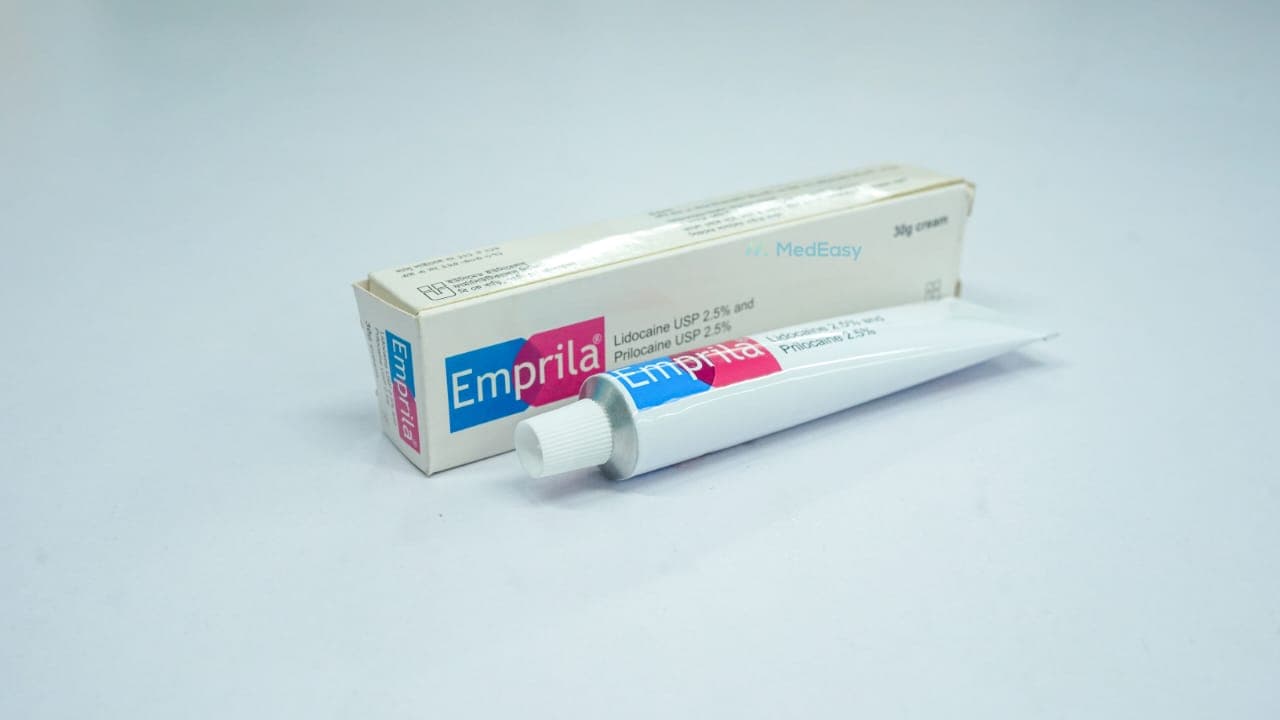

Medicine overview
Indications of Emprila
Emprila cream is a topical eutectic mixture of two amide-type local anesthetics used to produce local numbness (dermal analgesia) of intact skin and, in some labeled formulations, certain mucous membranes before minor procedures.
Established / approved uses
- Topical anesthesia of normal intact skin before needle procedures such as venipuncture, intravenous cannulation, and injections
- Topical anesthesia of intact skin before minor dermatologic procedures such as shave biopsy, curettage, or laser hair removal
- Anesthesia of adult male and female genital mucous membranes before minor procedures (e.g., prior to local infiltration anesthesia), in formulations labeled for this use
Adjunct use
- Used as pretreatment to reduce the pain of subsequent needle-based infiltration anesthesia
Emprila is not indicated for application to the eyes, middle ear, open wounds, mucous membranes beyond the labeled formulation and area, or for use as an injectable anesthetic.
Composition
Lidocaine + Prilocaine cream is typically formulated as a eutectic mixture containing Lidocaine 2.5% w/w and Prilocaine 2.5% w/w (25 mg/g of each), supplied as an oil-in-water emulsion cream for topical application. Exact strength and pack size may vary by manufacturer; refer to the specific product label for the formulation dispensed.
Description
Emprila is a fixed-dose topical combination of two amide-type local anesthetics formulated together as a "eutectic mixture" (a combination with a lower melting point than either component alone), which allows a high concentration of both anesthetic bases to penetrate intact skin. When applied under an occlusive dressing for a sufficient period, it produces reversible local numbness of the skin (or labeled mucous membrane), reducing the pain of needle procedures and certain minor superficial procedures.
Therapeutic Class
Emprila belongs to the therapeutic class of topical local anesthetics (amide type), formulated as a eutectic mixture for dermal and mucosal surface anesthesia.
Pharmacology
Lidocaine + Prilocaine combines two amide-type local anesthetics with a similar mechanism of action:
- Both lidocaine and prilocaine stabilize neuronal cell membranes by blocking voltage-gated sodium channels, inhibiting the ionic fluxes required for the initiation and conduction of nerve impulses, which produces reversible local anesthesia of the treated area.
- Combining the two bases in a eutectic mixture lowers the melting point of the combination compared with either drug alone, allowing both anesthetics to exist as a liquid oil at room temperature at high concentration, which improves penetration through the stratum corneum of intact skin.
Onset of measurable dermal analgesia with Lidocaine + Prilocaine typically begins around 1 hour after application under an occlusive dressing, with maximal effect around 2-3 hours; effect on genital mucous membranes has a faster onset (as little as 5-10 minutes) but shorter recommended application time.
Dosage & Administration of Emprila
The amount and duration of application of Emprila depends on the procedure, the site, and the patient's age. Use the smallest area and shortest duration consistent with effective anesthesia, especially in infants and young children.
| Use | Typical application |
|---|---|
| Intact skin before venipuncture/IV cannulation (adults and children) | Apply a thick layer of cream to intact skin, cover with an occlusive dressing, and leave in place for at least 1 hour (up to a labeled maximum, commonly around 4-5 hours) before the procedure |
| Intact skin before minor dermatologic procedures | Apply thick layer under occlusion for 1-2 hours depending on the procedure, per product labeling |
| Adult genital mucous membranes (labeled formulations only) | Apply a thicker layer without occlusion for approximately 5-10 minutes before superficial procedures, or per product-specific instructions for minor infiltration pretreatment |
Maximum application area/amount and maximum duration are age- and weight-dependent, and are notably restricted in infants and young children to reduce the risk of methemoglobinemia and systemic absorption (see Use in Special Populations and Pediatric Uses). The treated area should not exceed the labeled maximum, and the dressing/cream should be removed promptly at the end of the recommended application time.
Administration of Emprila
Emprila is for topical use on intact skin (or labeled mucous membranes) only. It must not be injected, swallowed, or applied to the eyes, ears, or open wounds unless specifically labeled for that use.
- Apply a thick layer of cream to the intended area only; do not rub in.
- For skin application, cover with the supplied occlusive dressing (or plastic film) for the recommended time, then remove the dressing and wipe off the cream before the procedure.
- Wash hands after application (unless the hands are the treated area) and avoid contact with the eyes.
- Do not apply to broken or irritated skin, or over a larger area or for longer than recommended.
Interaction of Emprila
Emprila has the following clinically significant interactions:
- Other methemoglobinemia-inducing agents (e.g., sulfonamides, dapsone, nitrates/nitrites, certain antimalarials, phenytoin, acetaminophen in overdose): concurrent use with Emprila increases the risk of clinically significant methemoglobinemia, particularly in infants and young children.
- Class I antiarrhythmic drugs (e.g., mexiletine, tocainide): concurrent systemic use with Emprila may have additive systemic toxicity, since the lidocaine component is chemically related; use with caution if systemic absorption is expected to be significant.
- Other local anesthetics used concurrently (e.g., for adjacent or overlapping procedures): may increase the total systemic dose of amide-type local anesthetic and the risk of systemic toxicity.
Inform the treating clinician or pharmacist of all current medicines before using Emprila, especially if any of the above agents are being taken.
Contraindications
Lidocaine + Prilocaine is contraindicated in:
- Known hypersensitivity to lidocaine, prilocaine, any other amide-type local anesthetic, or any excipient of the cream.
- Patients with congenital or idiopathic methemoglobinemia.
Side Effects of Emprila
Side effects of Emprila are usually local and mild, but systemic effects can occur, particularly with use over larger areas, for longer than recommended, or on broken skin.
Local effects (common)
- Transient paleness (blanching), redness, swelling, or altered temperature sensation at the application site
- Mild itching or a warm/burning sensation on removal of the dressing
Less common / systemic effects
- Contact dermatitis or allergic skin reaction at the application site
- Dizziness, drowsiness, or perioral numbness with excessive systemic absorption
- Methemoglobinemia (see Precautions and Warnings), presenting as bluish discoloration of the skin/lips (cyanosis), fatigue, or shortness of breath — requires prompt medical attention
Pregnancy & Lactation
Emprila should be used during pregnancy only if clearly needed and if the potential benefit justifies the potential risk to the fetus; a physician should be consulted before use, as systemic absorption from topical use, though generally low, is not zero.
Lidocaine and prilocaine pass into breast milk in small amounts. Emprila should be used in breastfeeding women only under medical advice, and application to or near the breast/nipple area should be avoided so the infant is not exposed during feeding.
Precautions & Warnings
Emprila should be used with the following precautions:
- Methemoglobinemia: the prilocaine component is metabolized to a metabolite that can cause methemoglobinemia; the risk increases with excessive application area/dose, use in young infants, or concurrent use of other methemoglobinemia-inducing drugs (see Interaction). Discontinue use and seek prompt medical attention if signs such as cyanosis (bluish skin/lips) or unusual fatigue occur.
- Site of application: avoid application to broken skin, large surface areas, mucous membranes beyond the labeled use, or near the eyes, as this increases systemic absorption and the risk of irritation (corneal irritation can occur with accidental eye contact).
- Duration/area of application: do not exceed the recommended application area or duration, especially in infants and young children, due to increased risk of systemic absorption and methemoglobinemia.
- Hepatic impairment: patients with severe hepatic disease may be at greater risk of systemic toxicity due to reduced metabolism of the amide anesthetics; use the minimum effective area/duration.
- G6PD deficiency or other conditions predisposing to methemoglobinemia: use with added caution and closer monitoring.
Overdose Effects of Emprila
Excessive application (larger area, longer duration, or on broken skin) of Emprila can lead to significant systemic absorption, causing signs of local anesthetic systemic toxicity (dizziness, drowsiness, perioral numbness, visual disturbance, progressing to seizures, hypotension, or cardiac arrhythmia in severe cases) and/or methemoglobinemia (cyanosis, fatigue, shortness of breath, headache).
Accidental ingestion or suspected overdose is a medical emergency. Remove the cream from the skin immediately, and seek immediate medical attention or contact emergency services/poison control. Methemoglobinemia may require specific medical treatment (such as methylene blue) administered by trained healthcare personnel; do not attempt home treatment.
Storage Conditions
Store at room temperature (below 30°C), away from light and moisture. Keep out of reach of children. Do not freeze. Keep the tube tightly closed after use.
Use In Special Populations
- Infants and young children: use the smallest effective application area and shortest duration; see Pediatric Uses for age-specific restrictions and methemoglobinemia risk.
- Elderly: generally well tolerated with standard application; no specific dose adjustment established, but the smallest effective area/duration should still be used.
- Hepatic impairment: reduced metabolism of the amide anesthetic components may increase the risk of systemic toxicity with extensive or prolonged application; use cautiously and minimize application area/duration.
- Renal impairment: no specific dose adjustment is established for topical use, but caution is advised with extensive application.
- G6PD deficiency or other predisposition to methemoglobinemia: use with added caution (see Precautions and Warnings).
Duration Of Treatment
Emprila is intended for short-term, procedure-related application only (typically a single application per procedure, occluded for the labeled duration), not for chronic or repeated daily use over the same or overlapping areas without medical advice.
Drug Classes
Lidocaine + Prilocaine is classified as a topical local anesthetic (amide type), formulated as a eutectic mixture of two amide anesthetics.
Mode Of Action
Both components of Lidocaine + Prilocaine act by diffusing through intact skin (or mucosa) in their base form and blocking voltage-gated sodium channels on sensory nerve membranes. This stabilizes the neuronal membrane and inhibits the ionic fluxes needed to initiate and conduct nerve impulses, producing reversible local anesthesia of the treated skin or mucous membrane without affecting consciousness.
Pregnancy
B
Pediatric Uses
Emprila may be used in infants and children for topical anesthesia before needle procedures, with the application area and duration restricted according to the child's age and body weight per product labeling; use is generally not recommended in neonates born before 37 weeks gestational age without specific medical guidance. Emprila is less reliably effective for anesthesia below the age of about 7 years for certain procedures and should be used with particular caution in infants under 12 months of age, in whom the risk of clinically significant methemoglobinemia is higher, especially with concurrent use of other methemoglobinemia-inducing drugs. Safety and efficacy for use on mucous membranes have not been established in children.
Frequently Asked Questions
Q: What is Emprila 30 gm Cream cream used for?
A: Emprila 30 gm Cream is a topical anesthetic cream applied to intact skin to numb the area before procedures such as blood draws, IV line placement, injections, or minor skin procedures. Some formulations are also labeled for numbing genital skin before minor procedures.
Q: How long before a procedure should Emprila 30 gm Cream be applied?
A: Emprila 30 gm Cream is usually applied as a thick layer under an occlusive dressing at least 1 hour before a skin procedure, with the exact time (and any maximum limit) depending on the procedure and the product label. Follow your healthcare provider's or the package instructions exactly, and do not leave it on longer than recommended.
Q: Is Emprila 30 gm Cream safe for babies and young children?
A: Emprila 30 gm Cream can be used in infants and children for procedures such as vaccinations or blood draws, but the area treated and the time it is left on must be smaller/shorter than in adults, because young infants are more likely to develop a condition called methemoglobinemia. Always follow your pediatrician's specific instructions and never use it on premature or very young infants without medical advice.
Q: What are the signs of a serious reaction to Emprila 30 gm Cream?
A: Watch for bluish discoloration of the skin or lips, unusual tiredness, or shortness of breath after using Emprila 30 gm Cream, as these can be signs of methemoglobinemia, a rare but serious blood disorder linked to the prilocaine component. Seek medical attention immediately if these occur.
Q: Can Emprila 30 gm Cream be used during pregnancy or breastfeeding?
A: Emprila 30 gm Cream should be used during pregnancy or while breastfeeding only if clearly needed, after consulting a physician, since a small amount can be absorbed into the bloodstream and into breast milk. Avoid applying it to or near the breast area if you are breastfeeding.
Q: Can Emprila 30 gm Cream be applied to broken skin, wounds, or near the eyes?
A: No. Emprila 30 gm Cream is intended for intact (unbroken) skin, or for mucous membranes only where specifically labeled. Applying it to broken skin, open wounds, or near the eyes increases absorption and the risk of side effects, including eye irritation if accidental contact occurs.
Disclaimer
The information provided is accurate to the best of our knowledge, but it does not replace professional medical advice. We cannot guarantee its completeness or accuracy, and the absence of specific information about a drug should not be taken as an endorsement. We are not responsible for any consequences arising from this information, so please consult a healthcare professional for any concerns or questions.
