
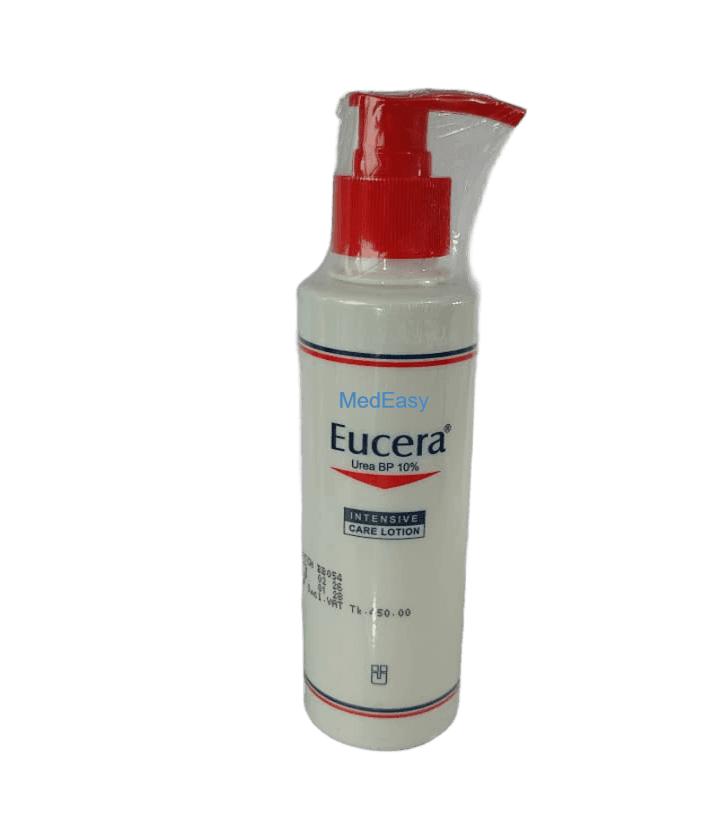

Medicine overview
Indications of Eucera
Eucera is a topical keratolytic and moisturizing (humectant) agent used in dermatology, formulated in various concentrations (typically 10% to 50%) for the management of dry, scaling, and thickened skin conditions.
Established Uses (Lower Concentrations, approx. 10-20%)
- Moisturizing and softening of dry, rough, scaling skin (xerosis)
- Ichthyosis vulgaris and other hereditary or acquired scaling skin disorders
- Keratosis pilaris
- Dry, cracked skin on elbows, heels, and hands
Established Uses (Higher Concentrations, approx. 30-50%)
- Debridement and softening of hyperkeratotic tissue, including calluses and corns
- Chemical avulsion (softening/removal) of dystrophic nails, including as an adjunct prior to topical or oral antifungal therapy for onychomycosis (fungal nail infection)
Adjunct / Off-label Uses
- Adjunct softening agent to improve penetration of other co-applied topical medications on thickened skin
- Care of dry or fissured diabetic foot skin under medical supervision
Composition
Products containing Urea supply Urea (carbamide) as the active ingredient, formulated as a cream, lotion, ointment, or gel in strengths commonly ranging from 10% to 50% w/w, combined with emollient and humectant excipients.
Description
Eucera (carbamide) is a small, naturally occurring molecule and a normal component of the skin's natural moisturizing factor. As a topical agent, Eucera is used across a range of concentrations - lower strengths for everyday moisturizing of dry, scaling skin, and higher strengths for medically supervised softening and removal of thickened skin or nails.
Therapeutic Class
Eucera belongs to the therapeutic class of topical keratolytics and emollients/humectants used in dermatological skin care.
Pharmacology
Urea is a component of the skin's natural moisturizing factor. At lower concentrations it acts as a humectant, binding water within the stratum corneum to increase skin hydration and pliability. At higher concentrations, Urea disrupts hydrogen bonding within keratin, denaturing and solubilizing intercellular proteins; this softens and facilitates removal (desquamation) of thickened, hyperkeratotic skin and nail tissue.
Dosage & Administration of Eucera
Dosage and application of Eucera depend on the concentration of the product and the condition being treated.
| Concentration | Indication | Typical Application |
|---|---|---|
| 10-20% | Dry skin, xerosis, ichthyosis, keratosis pilaris | Apply a thin layer to the affected skin 1-2 times daily, gently massaging until absorbed |
| 30-40% | Calluses, corns, thickened/hyperkeratotic skin | Apply to the affected area once or twice daily; may be used under occlusion (e.g., a bandage) as directed by a physician to enhance softening |
| 40-50% | Nail debridement/chemical avulsion (adjunct in onychomycosis) | Apply thickly to the nail plate only (protecting surrounding skin with petroleum jelly or tape), cover with an occlusive dressing, and leave as directed (commonly 7-14 days) under medical supervision before mechanical or chemical debridement |
For external use on the skin/nails only. Wash hands after application unless the hands are the area being treated.
Administration of Eucera
Eucera is for topical (external) use only. Clean and dry the affected area before application. Apply a thin layer (for moisturizing) or a thick layer under occlusion (for debridement, as directed by a physician). Avoid contact with the eyes, mouth, and mucous membranes, and avoid spreading higher-concentration products onto normal surrounding skin. Wash hands after use unless treating the hands.
Interaction of Eucera
No clinically significant systemic drug interactions have been established for topical Eucera, as systemic absorption from intact skin is minimal.
- Concurrent use with other topical keratolytic or irritant agents (e.g., salicylic acid, retinoids, alpha-hydroxy acids) on the same area may increase local irritation.
- Eucera may enhance the penetration of other co-applied topical medications (e.g., topical corticosteroids, antifungals) by softening the skin barrier; this is sometimes used therapeutically but should be supervised by a physician.
Contraindications
Urea is contraindicated in patients with known hypersensitivity to Urea or to any component of the formulation.
Side Effects of Eucera
Topical Eucera is generally well tolerated. Reported side effects include:
- Transient stinging, burning, or tingling sensation on application, especially on broken, fissured, or irritated skin, or with higher concentrations
- Mild redness or itching at the application site
- Contact dermatitis (uncommon)
- Dryness or irritation of surrounding healthy skin if higher-concentration products are applied beyond the intended area
Pregnancy & Lactation
There are no well-controlled human studies of topical Eucera in pregnancy or lactation. Because systemic absorption from intact skin is minimal, topical Eucera is generally considered low-risk; however, it should be used only if clearly needed and the potential benefit justifies any potential risk, on the advice of a physician, applied to a limited area, and avoiding the breast area during breastfeeding to reduce infant exposure. Consult a physician before use during pregnancy or while breastfeeding.
Precautions & Warnings
Eucera is for external use only; avoid contact with the eyes, lips, and mucous membranes. Do not apply to open wounds, actively infected skin, or severely inflamed/broken skin unless directed by a physician. Higher-concentration formulations intended for callus or nail debridement should be applied precisely to the affected area only, protecting surrounding healthy skin (e.g., with petroleum jelly or tape), to avoid unnecessary irritation. Discontinue use and consult a physician if excessive irritation, redness, or signs of infection develop. Clearly distinguish between low-concentration products intended for daily moisturizing and high-concentration products intended for medically supervised debridement, as their application technique and irritation potential differ substantially.
Overdose Effects of Eucera
Topical overuse of Eucera is unlikely to cause systemic toxicity because absorption through intact skin is minimal. Excessive or prolonged application, particularly of high-concentration products, may cause significant local irritation, burning, or skin breakdown. If accidental ingestion occurs, or if a severe local reaction develops, seek immediate medical attention or contact a poison control center.
Storage Conditions
Store at room temperature (below 30°C), away from light and moisture. Keep out of reach of children.
Use In Special Populations
Renal/Hepatic Impairment: No dose adjustment is required for topical Eucera, as systemic absorption is minimal.
Elderly: No specific precautions beyond standard use; elderly patients often have more fragile, dry skin and may benefit from lower-concentration formulations.
Pediatric: See Pediatric Uses.
Pregnancy/Lactation: See Pregnancy and Lactation.
Duration Of Treatment
Duration of Eucera therapy depends on the indication. For daily moisturizing of dry or scaling skin, use may continue long-term as needed. For callus/corn softening or nail debridement, treatment is typically limited to the course directed by a physician (commonly 1-2 weeks for nail-softening protocols), followed by reassessment.
Drug Classes
Topical Keratolytic; Emollient/Humectant
Mode Of Action
Urea is a naturally occurring component of the skin's natural moisturizing factor. At lower concentrations, it acts as a humectant, binding water within the stratum corneum to increase skin hydration. At higher concentrations, it disrupts hydrogen bonding within keratin, denaturing and solubilizing intercellular proteins, which softens and facilitates removal (desquamation) of thickened, hyperkeratotic skin and nail tissue.
Pediatric Uses
Use of Eucera in pediatric patients should be guided by a physician. Low-concentration formulations (10-20%) are commonly used for pediatric dry skin conditions such as ichthyosis and keratosis pilaris; however, formal safety and efficacy data in young children, particularly infants, are limited, so use should be conservative, limited to smaller body-surface areas, and supervised by a physician - especially for higher-concentration or occlusive nail-debridement use, which is generally reserved for older children and adults.
Frequently Asked Questions
Q: What is Eucera 10% w/v Lotion cream used for?
A: Eucera 10% w/v Lotion is a topical keratolytic and moisturizing agent. Lower-concentration formulations (about 10-20%) are used to moisturize and soften dry, rough, or scaling skin conditions such as xerosis and ichthyosis, while higher-concentration formulations (about 30-50%) are used to soften and remove thickened skin (calluses, corns) and to help soften nails affected by fungal infection before antifungal treatment.
Q: Can I use Eucera 10% w/v Lotion cream on my face?
A: Lower-concentration Eucera 10% w/v Lotion products are sometimes used on facial skin for dryness, but must be kept away from the eyes, lips, and mucous membranes. Higher-concentration debriding formulations are generally not intended for facial use. Always follow your physician's or the product label's specific instructions.
Q: Is Eucera 10% w/v Lotion safe to use during pregnancy or breastfeeding?
A: There are no well-controlled human studies of topical Eucera 10% w/v Lotion during pregnancy or breastfeeding. Because very little is absorbed through intact skin, it is generally considered low-risk, but Eucera 10% w/v Lotion should be used only if clearly needed, in a limited area, and after consulting a physician; avoid applying it to the breast area while breastfeeding.
Q: How long does it take for Eucera 10% w/v Lotion to soften a callus or nail?
A: For calluses and corns, improvement is usually seen within days to a couple of weeks of regular use of Eucera 10% w/v Lotion. For nail debridement (chemical avulsion) prior to antifungal treatment, higher-concentration Eucera 10% w/v Lotion is typically applied under occlusion for about 7-14 days as directed by a physician before the softened nail tissue is removed.
Q: Can children use Eucera 10% w/v Lotion cream?
A: Low-concentration Eucera 10% w/v Lotion products are commonly used for children's dry skin conditions under a physician's guidance, but safety and efficacy data in very young children, particularly infants, are limited. Higher-concentration or occlusive nail-debridement use of Eucera 10% w/v Lotion is generally reserved for older children and adults, and should always be supervised by a physician.
Q: What should I do if Eucera 10% w/v Lotion causes burning or irritation?
A: Mild, transient stinging with Eucera 10% w/v Lotion is common, especially on broken skin or with higher concentrations. If irritation is significant, persistent, or accompanied by redness, swelling, or signs of infection, stop using the product and consult a physician.
Disclaimer
The information provided is accurate to the best of our knowledge, but it does not replace professional medical advice. We cannot guarantee its completeness or accuracy, and the absence of specific information about a drug should not be taken as an endorsement. We are not responsible for any consequences arising from this information, so please consult a healthcare professional for any concerns or questions.
