
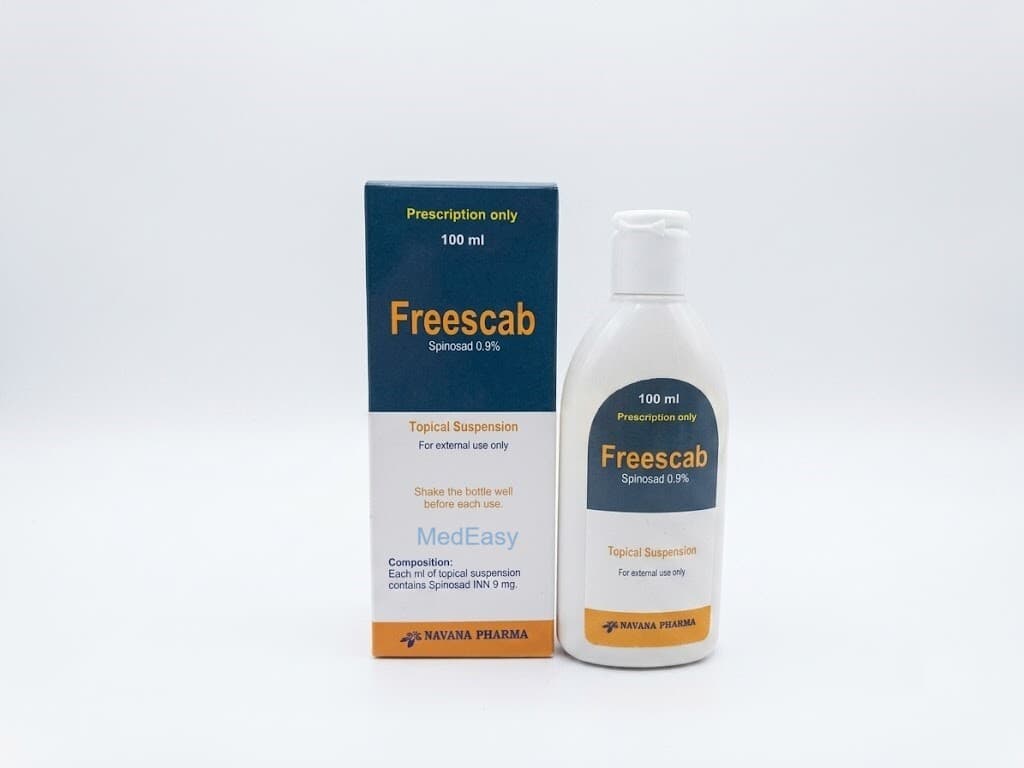

Medicine overview
Indications of Freescab
Freescab is a topical ectoparasiticide used as part of an overall lice or scabies management program (which also includes environmental measures such as laundering clothing, bedding, and personal items).
FDA-approved indications
- Head lice infestation (Pediculosis capitis): Topical treatment of head lice in patients 6 months of age and older.
- Scabies: Topical treatment of scabies infestation in patients 4 years of age and older.
Freescab is not indicated for use on eyebrows, eyelashes, or for infestations of body or pubic lice unless specifically directed by a physician.
Composition
Each container of topical suspension contains Spinosad 0.9% w/w (9 mg per gram) as the active ingredient, in a vehicle containing benzyl alcohol and other inactive suspending and stabilizing agents suitable for external application to the scalp, hair, or skin.
Description
Freescab is a naturally derived pediculicide and scabicide obtained from the fermentation of the soil bacterium Saccharopolyspora spinosa. It is formulated as a 0.9% topical suspension intended for application to the scalp and hair (for head lice) or to the skin (for scabies).
Freescab belongs to the spinosyn class of insecticidal compounds and works by disrupting the nervous system of lice and mites, leading to their paralysis and death, while showing minimal systemic absorption when applied to intact human skin.
Therapeutic Class
Freescab belongs to the topical pediculicide and scabicide (ectoparasiticide) class, specifically the spinosyn group of naturally derived insecticidal agents.
Pharmacology
Mechanism of Action
Spinosad acts on the nervous system of insects and mites. It causes activation of nicotinic acetylcholine receptors and also affects gamma-aminobutyric acid (GABA)-gated chloride channels, producing involuntary muscle contractions, tremors, and prolonged neuronal hyperexcitation. This leads to paralysis and death of lice and mites.
Pharmacokinetics
Following topical application to intact scalp or skin, Spinosad shows no clinically relevant systemic absorption in humans, which limits the potential for systemic adverse effects.
Dosage & Administration of Freescab
| Indication | Age Group | Dosing Instructions |
|---|---|---|
| Head lice (Pediculosis capitis) | Adults and children 6 months and older | Apply a sufficient amount of Freescab suspension to cover the dry scalp and hair completely. Leave in place for 10 minutes, then rinse thoroughly with warm water. A single application is often sufficient; repeat treatment only if live lice are observed 7 days after the first application. |
| Scabies | Adults and children 4 years and older | Apply Freescab suspension over the entire body from the neck down to the soles of the feet, ensuring complete coverage including skin folds and under nails. Allow 10 minutes for initial absorption, then leave on the skin for a minimum of 6 hours (or as directed by the physician) before bathing or washing off. |
Freescab should be used as directed by a physician or pharmacist; do not exceed the recommended contact time or frequency of application.
Administration of Freescab
Freescab is for external (topical) use only. Apply directly to dry hair/scalp (for head lice) or dry skin (for scabies) using the amount recommended by the label or physician. Avoid contact with the eyes, mouth, and mucous membranes during application; if accidental contact occurs, rinse immediately with water. Wash hands thoroughly after application. Application in young children should be supervised by an adult to prevent accidental ingestion or eye contact.
Interaction of Freescab
No clinically significant drug-drug interactions have been established for Freescab, largely because it is not meaningfully absorbed into the systemic circulation after topical use. As a precaution, avoid applying other topical scalp or skin products (e.g., other pediculicides, strong irritants, or occlusive agents) at the same time as Freescab unless directed by a physician, as this may increase local irritation or alter absorption.
Contraindications
Spinosad is contraindicated in patients with known hypersensitivity to Spinosad or to any component of the formulation.
Side Effects of Freescab
Head lice treatment
- Application site redness (erythema) - reported in approximately 3% of patients
- Eye redness (ocular erythema) - reported in approximately 2% of patients
Scabies treatment
- Application site irritation, including pain or burning sensation - reported in approximately 3% of patients
- Dry skin - reported in approximately 2% of patients
Most reactions associated with Freescab are mild, local, and self-limiting. Discontinue use and consult a physician if severe irritation, rash, or signs of an allergic reaction occur.
Pregnancy & Lactation
Pregnancy: Freescab is not absorbed systemically to a clinically relevant extent following topical application, and maternal use is not expected to result in meaningful fetal exposure. However, as with any medicine, Freescab should be used during pregnancy only if clearly needed and the potential benefit justifies the potential risk; consult a physician before use.
Lactation: There is no data on the presence of Freescab in human milk. If applying Freescab to or near the chest area, remove the product thoroughly with soap and water before breastfeeding to prevent inadvertent ingestion by the infant. Consult a physician before use while breastfeeding.
Precautions & Warnings
- Freescab is for external/topical use only; it is not intended for oral, ophthalmic, vaginal, or rectal use.
- Avoid contact with the eyes and mucous membranes; if contact occurs, rinse thoroughly with water.
- Freescab contains benzyl alcohol and is not approved for use in neonates or infants below 6 months of age, due to the risk of increased systemic absorption and serious adverse effects (including "gasping syndrome") associated with benzyl alcohol in this age group.
- Use only as directed; avoid unnecessary repeated or prolonged application beyond what is recommended, as this does not improve efficacy and may increase the risk of local irritation.
- As part of an effective lice or scabies management program, identify and treat close contacts and household members as needed, and wash bedding, clothing, combs, and other personal items to prevent reinfestation or spread.
- Application in infants, young children, and dependent adults should be supervised by a caregiver.
Overdose Effects of Freescab
Freescab is intended for external use only. If the product is accidentally ingested, or if excessive application leads to signs of toxicity (such as marked skin irritation, vomiting, or unusual drowsiness), seek immediate medical attention or contact a poison control center/emergency services without delay. There is no specific antidote for Freescab; management of overdose or accidental ingestion should be supportive and directed by a physician. Do not attempt home treatment for suspected ingestion beyond following emergency guidance.
Storage Conditions
Store at room temperature (below 30°C), away from light and moisture. Keep out of reach of children.
Use In Special Populations
- Renal impairment: No dose adjustment is expected to be necessary, as Freescab is not significantly absorbed systemically after topical application; however, use should still be guided by a physician.
- Hepatic impairment: No specific dose adjustment is established; given minimal systemic absorption, clinically significant effects are not anticipated, but caution and physician guidance are advised.
- Elderly patients: No specific dosage adjustment is required; general precautions for topical application apply.
- Immunocompromised patients: May require closer monitoring and physician supervision, as scabies infestations can be more extensive or resistant to treatment in this population.
See Pediatric Uses for age-specific information on Freescab.
Duration Of Treatment
For head lice, a single application of Freescab is often sufficient; retreatment is recommended only if live lice are observed 7 days after the initial application. For scabies, a single whole-body application left on the skin for the recommended contact time is typically used; a physician may advise a repeat application if signs of infestation persist, since post-scabetic itching can continue for several weeks even after successful treatment. Do not use Freescab for longer or more frequently than directed.
Drug Classes
Spinosad is classified as a topical pediculicide and scabicide, belonging to the spinosyn class of naturally derived insecticidal/ectoparasiticidal agents.
Mode Of Action
Spinosad works by activating nicotinic acetylcholine receptors and affecting GABA-gated chloride channels in the nervous system of lice and mites, causing sustained neuronal excitation, involuntary muscle activity, paralysis, and eventual death of the parasites. See Pharmacology for further detail.
Pediatric Uses
- Head lice: Freescab is approved for use in patients 6 months of age and older.
- Scabies: Freescab is approved for use in patients 4 years of age and older.
- Freescab is not approved for use in neonates or infants below 6 months of age due to the benzyl alcohol content of the formulation and the associated risk of serious adverse effects from increased systemic absorption in this age group; safety and efficacy below this age have not been established.
- Application in children should be performed or directly supervised by an adult to avoid accidental ingestion or contact with the eyes.
Frequently Asked Questions
Q: What is Freescab 100 ml Topical Suspension used for?
A: Freescab 100 ml Topical Suspension is a topical medicine used to treat head lice infestation in patients 6 months and older, and scabies in patients 4 years and older. It works by paralyzing and killing the lice or mites.
Q: How long should I leave Freescab 100 ml Topical Suspension on before rinsing or washing it off?
A: For head lice, apply Freescab 100 ml Topical Suspension to dry hair and scalp, leave it on for 10 minutes, then rinse with warm water. For scabies, apply over the whole body from the neck down, leave on for at least 6 hours (after an initial 10-minute absorption period), then wash off, unless your physician directs otherwise.
Q: Do I need to repeat treatment with Freescab 100 ml Topical Suspension?
A: For head lice, a single application is often enough. Repeat treatment only if you still see live lice 7 days after the first application. For scabies, your physician may recommend a repeat application if signs of infestation continue, since itching can persist for weeks even after successful treatment.
Q: Can Freescab 100 ml Topical Suspension be used during pregnancy or breastfeeding?
A: Freescab 100 ml Topical Suspension is not significantly absorbed into the bloodstream after topical use, so meaningful exposure to a fetus or infant is not expected. Still, it should be used during pregnancy only if clearly needed, and breastfeeding mothers should wash the product off the chest area with soap and water before nursing. Always consult your physician first.
Q: Is Freescab 100 ml Topical Suspension safe for infants?
A: No. Freescab 100 ml Topical Suspension is not approved for infants under 6 months of age because the formulation contains benzyl alcohol, which can cause serious adverse effects if absorbed in larger amounts in very young infants.
Q: What should I do if Freescab 100 ml Topical Suspension is accidentally swallowed?
A: Seek immediate medical attention or contact a poison control center/emergency services right away. Do not attempt home treatment; Freescab 100 ml Topical Suspension is intended for external use only and has no specific antidote.
Disclaimer
The information provided is accurate to the best of our knowledge, but it does not replace professional medical advice. We cannot guarantee its completeness or accuracy, and the absence of specific information about a drug should not be taken as an endorsement. We are not responsible for any consequences arising from this information, so please consult a healthcare professional for any concerns or questions.
