
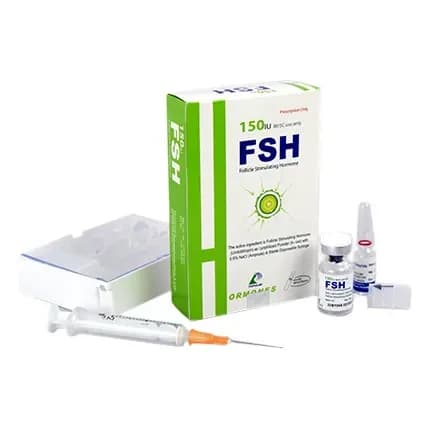

Medicine overview
Indications of FSH
FSH is a gonadotropin preparation used in the management of infertility. Its approved and guideline-supported uses include:
- Female anovulatory infertility (established use): Induction of ovulation in women with anovulation (e.g., WHO Group I/II anovulation) who have not responded to, or are not candidates for, first-line agents such as clomiphene citrate.
- Controlled ovarian stimulation for Assisted Reproductive Technology (established use, combination therapy): Development of multiple follicles as part of an assisted reproductive technology (ART) program such as in vitro fertilization (IVF), used together with a GnRH agonist/antagonist and, subsequently, human chorionic gonadotropin (hCG) as the ovulation trigger.
- Male infertility due to hypogonadotropic hypogonadism (established use, adjunct/combination therapy): Used together with hCG (which provides LH-like activity) to stimulate spermatogenesis in men with hypogonadotropic hypogonadism.
Treatment with FSH must be initiated and supervised by a physician experienced in the management of fertility disorders, with facilities for hormonal and ultrasound monitoring.
Composition
Each vial/pre-filled pen of Follicle Stimulating Hormone contains purified or recombinant follicle-stimulating hormone as the active ingredient, supplied as a lyophilized powder for reconstitution or as a ready-to-use injectable solution, depending on the brand and formulation.
Description
FSH is a gonadotropin hormone preparation (available as a highly purified urinary-derived product or as a recombinant DNA-derived product) used to stimulate the ovaries in women and the testes in men. It replicates the action of the naturally occurring pituitary hormone that regulates follicular development and spermatogenesis.
It is administered exclusively by injection (subcutaneous or intramuscular) under medical supervision and is not available as an oral formulation.
Therapeutic Class
FSH belongs to the therapeutic class of gonadotropins / reproductive hormones, used specifically as an ovulation-stimulating and spermatogenesis-stimulating agent.
Pharmacology
Mechanism
Follicle Stimulating Hormone binds to FSH receptors located on ovarian granulosa cells in women and on testicular Sertoli cells in men.
- In women: it stimulates the growth and maturation of ovarian follicles and promotes granulosa cell production of estradiol, leading to follicular development suitable for ovulation induction or oocyte retrieval.
- In men: it acts on Sertoli cells to support spermatogenesis; when combined with hCG (which supplies LH-like activity to Leydig cells), it promotes testosterone-dependent spermatogenic function in men with hypogonadotropic hypogonadism.
Pharmacokinetics
Following subcutaneous or intramuscular injection, Follicle Stimulating Hormone is absorbed with a bioavailability of roughly 70-80%, reaches peak serum concentration within 12-24 hours, and has an elimination half-life of approximately 24-40 hours, allowing once-daily dosing during a treatment cycle.
Dosage & Administration of FSH
General Principles
The dose of FSH must be individualized based on the indication and the patient's ovarian/testicular response, monitored by serum estradiol levels and transvaginal ultrasound (in women) or clinical/semen parameters (in men).
| Indication | Typical Regimen |
|---|---|
| Anovulatory infertility (women) | Starting dose commonly 75-150 IU subcutaneously/intramuscularly once daily; adjusted in small increments (e.g., every 7-14 days) according to ovarian response; hCG given once adequate follicular development is confirmed. |
| Controlled ovarian stimulation for ART (women) | Starting dose commonly 150-225 IU daily, often combined with a GnRH agonist/antagonist protocol; dose adjusted based on monitoring; hCG or a GnRH agonist trigger given when follicles reach maturity. |
| Male hypogonadotropic hypogonadism | Commonly 75-150 IU given 2-3 times weekly by injection, in combination with hCG; treatment is prolonged, often continued for a minimum of 3-4 months and up to 18 months to assess response on semen analysis. |
See Dosage and Administration sub-fields for further detail. See Precautions and Warnings for ovarian hyperstimulation syndrome (OHSS) monitoring requirements.
Administration of FSH
FSH is given by subcutaneous or intramuscular injection only, never orally. Powder formulations must be reconstituted with the accompanying diluent immediately before use (see Reconstitution). Patients or caregivers may be trained by a healthcare professional to self-administer subcutaneous injections at home, using a fresh injection site each time to reduce local reactions. Pre-filled pen formulations should be used strictly according to the device instructions.
Interaction of FSH
No clinically significant drug-metabolism-based interactions have been well established for FSH, as it is a peptide hormone that is not metabolized via cytochrome P450 pathways.
- Intentional combination therapy: FSH is commonly and deliberately co-administered with clomiphene citrate, human chorionic gonadotropin (hCG), and GnRH agonists/antagonists as part of a structured fertility treatment protocol; this is expected combination use, not an adverse interaction.
- Other fertility medicines: concurrent use of other ovulation-inducing agents outside a physician-directed protocol may increase the risk of ovarian hyperstimulation syndrome (OHSS) and multiple follicular development; see Precautions and Warnings.
Contraindications
Follicle Stimulating Hormone is contraindicated in patients with:
- Known hypersensitivity to Follicle Stimulating Hormone or any excipient in the formulation.
- Primary ovarian failure (elevated baseline FSH indicating the ovaries cannot respond).
- Uncontrolled thyroid or adrenal gland dysfunction.
- Tumors of the ovary, breast, uterus, testis, pituitary gland, or hypothalamus.
- Pregnancy (not indicated for use once pregnancy is established).
- Undiagnosed abnormal vaginal/uterine bleeding.
Side Effects of FSH
Common and important adverse effects reported with FSH include:
- Ovarian hyperstimulation syndrome (OHSS): a potentially serious complication in women involving ovarian enlargement, abdominal pain/distension, nausea, and in severe cases fluid shifts, ascites, and thromboembolic risk; see Precautions and Warnings.
- Injection site reactions (pain, redness, bruising, swelling).
- Headache, fatigue, mood changes.
- Abdominal pain, bloating, nausea, vomiting.
- Ovarian cyst formation.
- Multiple pregnancy (twins or more) due to multi-follicular development.
- In men: gynecomastia, acne, and injection site reactions.
- Rare: thromboembolic events, ectopic pregnancy (related to underlying tubal disease in the treated population), and hypersensitivity reactions.
Pregnancy & Lactation
FSH is not indicated for use during an established pregnancy and should be discontinued once pregnancy is confirmed; it has no therapeutic role after conception and continued use should only occur under direct specialist guidance if ever considered. If pregnancy occurs during a treatment cycle, the treating physician must be informed immediately.
There is limited data on the presence of FSH in human breast milk. As a large peptide hormone it is unlikely to be clinically significant if present, but it should be used during breastfeeding only if clearly needed and if the potential benefit justifies the potential risk, and only under medical supervision, since it is not typically indicated in the postpartum/lactation period outside specific fertility contexts.
Precautions & Warnings
Ovarian Hyperstimulation Syndrome (OHSS)
Treatment with FSH carries a risk of OHSS, which can be serious or life-threatening. Regular monitoring with transvaginal ultrasound and serum estradiol levels is required throughout treatment, and the hCG trigger dose should be withheld if excessive ovarian response is detected.
Multiple Pregnancy
Because FSH can stimulate development of multiple follicles, the risk of multiple gestation (twins or more) is increased compared with natural conception; this carries added maternal and perinatal risk.
Specialist Monitoring
Treatment with FSH must only be carried out by, or under the close supervision of, a physician experienced in fertility treatment, with access to appropriate hormonal assay and ultrasound monitoring facilities.
Thromboembolism
Gonadotropin therapy, including FSH, has been associated rarely with thromboembolic events, particularly in women with additional risk factors.
Pulmonary and Vascular Complications
Rare reports of pulmonary complications and torsion of the ovary have occurred in association with gonadotropin therapy including FSH; sudden severe abdominal pain during treatment should be evaluated promptly.
Overdose Effects of FSH
Overdose of FSH may increase the risk of ovarian hyperstimulation syndrome (OHSS) in women. There is no specific antidote. In the event of a suspected overdose, patients should seek immediate medical attention or contact emergency services / a poison control center; treatment is supportive and directed at managing OHSS or other symptoms under specialist care.
Storage Conditions
Store in a refrigerator (2°C-8°C); do not freeze. Protect from light. Once reconstituted, use only within the time period specified on the product label and discard any unused solution. Keep out of reach of children. If a room-temperature-stable formulation is dispensed, follow the specific storage instructions provided with that product.
Use In Special Populations
Pediatric use: FSH is not indicated for use in children; safety and efficacy in the pediatric population have not been established.
Elderly: FSH is used in reproductive-age adults; it is not indicated in elderly patients as it falls outside the approved population for fertility treatment.
Renal or hepatic impairment: Specific dose adjustment data are not well established; use with caution and under close specialist supervision if used at all in patients with significant renal or hepatic impairment.
Duration Of Treatment
The duration of a single stimulation cycle with FSH for ovulation induction or controlled ovarian stimulation is typically 7-14 days, ending once follicles reach the target size and the hCG trigger is given. For male hypogonadotropic hypogonadism, treatment with FSH combined with hCG is generally continued for a minimum of 3-4 months, and may be extended up to 12-18 months, before spermatogenic response can be fully assessed. The total number of treatment cycles/duration should be determined by the treating fertility specialist.
Reconstitution
Lyophilized (powder) formulations of FSH must be reconstituted immediately before use with the diluent (typically sterile water for injection) supplied in the pack. Gently swirl (do not shake vigorously) until the powder is fully dissolved into a clear solution. Use the reconstituted solution immediately and discard any unused portion unless the product labeling specifically states an extended in-use storage period. Pre-filled liquid pen formulations of FSH do not require reconstitution.
Drug Classes
Follicle Stimulating Hormone is classified under: Gonadotropins; Reproductive/fertility hormones; Follicle-stimulating hormone (FSH) preparations.
Mode Of Action
Follicle Stimulating Hormone acts by binding to FSH receptors on ovarian granulosa cells (in women) and testicular Sertoli cells (in men), stimulating intracellular signaling that drives follicular growth, granulosa cell estradiol synthesis, and oocyte maturation in women, and supports Sertoli cell function necessary for spermatogenesis in men, particularly when combined with hCG-driven Leydig cell testosterone production.
Pregnancy
X (legacy FDA pregnancy category: contraindicated in pregnancy - not indicated for use once pregnancy is confirmed)
Pediatric Uses
FSH is not approved for use in the pediatric population. Safety and efficacy of FSH in children have not been established, and it should not be used in this age group outside of specialist investigational settings.
Frequently Asked Questions
Q: What is FSH 150 IU/vial IM/SC Injection used for?
A: FSH 150 IU/vial IM/SC Injection is used to treat infertility. In women, it is used to induce ovulation or to stimulate the development of multiple follicles as part of assisted reproductive technology (ART) such as IVF. In men, it is used together with hCG to stimulate sperm production in hypogonadotropic hypogonadism.
Q: How is FSH 150 IU/vial IM/SC Injection given?
A: FSH 150 IU/vial IM/SC Injection is given only by injection, either subcutaneously or intramuscularly, under the guidance of a fertility specialist. It is not available as a tablet or oral medicine.
Q: What is the most serious risk of FSH 150 IU/vial IM/SC Injection treatment?
A: The most serious risk is ovarian hyperstimulation syndrome (OHSS), which can cause enlarged ovaries, abdominal pain, fluid accumulation, and in severe cases can be life-threatening; regular monitoring with ultrasound and blood hormone tests is required during treatment with FSH 150 IU/vial IM/SC Injection to reduce this risk.
Q: Can FSH 150 IU/vial IM/SC Injection be used during pregnancy?
A: No. FSH 150 IU/vial IM/SC Injection is not indicated once pregnancy is confirmed and should be stopped; it has no role in maintaining an existing pregnancy. Use only if clearly needed under fertility specialist guidance prior to conception, and inform your doctor immediately if pregnancy occurs during treatment.
Q: Does FSH 150 IU/vial IM/SC Injection increase the chance of twins?
A: Yes. Because FSH 150 IU/vial IM/SC Injection can stimulate multiple follicles to develop at once, the chance of a multiple pregnancy (twins or more) is higher than with natural conception.
Q: What should I do if I miss a dose of FSH 150 IU/vial IM/SC Injection or suspect an overdose?
A: Contact your fertility specialist promptly if you miss a dose, as timing is important for treatment success. If an overdose is suspected, seek immediate medical attention or contact emergency services, since FSH 150 IU/vial IM/SC Injection overdose can increase the risk of ovarian hyperstimulation syndrome.
Disclaimer
The information provided is accurate to the best of our knowledge, but it does not replace professional medical advice. We cannot guarantee its completeness or accuracy, and the absence of specific information about a drug should not be taken as an endorsement. We are not responsible for any consequences arising from this information, so please consult a healthcare professional for any concerns or questions.
