
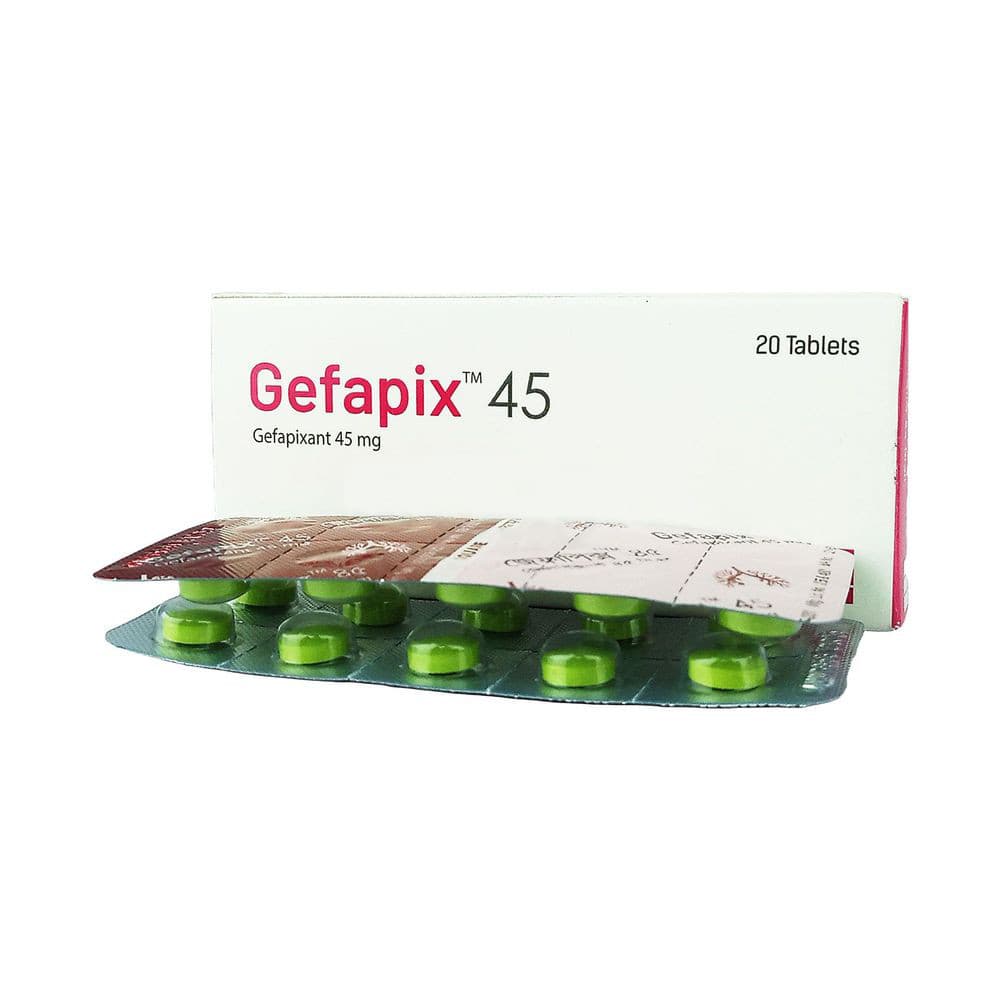

Medicine overview
Indications of Gefapix
Gefapix is indicated for the treatment of refractory or unexplained chronic cough in adults. This includes:
- Refractory chronic cough: Chronic cough (lasting more than 8 weeks) that persists despite guideline-based treatment of an identifiable underlying condition (e.g. asthma, gastro-oesophageal reflux disease, upper airway cough syndrome).
- Unexplained chronic cough: Chronic cough for which no underlying cause can be identified despite a thorough diagnostic work-up.
Gefapix is an established, guideline-supported treatment option specifically for this indication and is not intended for acute cough due to common cold, other short-term respiratory infections, or cough with a treatable identified cause that has not yet been adequately managed. It is not an antibiotic and has no role in treating infections.
Composition
Each film-coated tablet contains Gefapixant Citrate equivalent to 45 mg of gefapixant base, along with pharmaceutically acceptable excipients that ensure tablet stability and controlled release. Strength and formulation may vary by manufacturer; always check the product label for exact composition.
Description
Gefapix is an orally administered, non-narcotic, non-opioid medicine belonging to a novel class of cough therapeutics called P2X3 receptor antagonists. It was specifically developed to address chronic cough that does not respond to treatment of an underlying cause, or for which no cause can be found, filling an important treatment gap since most traditional antitussives are not effective or approved for this population.
Gefapix works by selectively blocking overactive signalling in the airway sensory nerves that drive the persistent urge to cough, rather than by suppressing the central cough reflex or by any anti-inflammatory or antimicrobial mechanism.
Therapeutic Class
Gefapix belongs to the therapeutic class of antitussives (cough suppressants), specifically P2X3 receptor antagonists — a distinct pharmacological category from opioid-based, antihistamine-based, or mucolytic cough medicines.
Pharmacology
Mechanism of Action
Gefapixant Citrate is a selective antagonist of the P2X3 receptor, an ATP-gated ion channel expressed on vagal sensory (C-fibre) nerve endings in the airways. In chronic cough, these nerves become hypersensitised, and ATP released from airway tissue activates P2X3 receptors, triggering excessive and inappropriate cough signals to the brain. By blocking ATP-mediated activation of these P2X3 receptors, Gefapixant Citrate reduces this hypersensitivity and decreases cough frequency and severity without depressing the central nervous system or respiratory drive.
Pharmacokinetics
Gefapixant Citrate is well absorbed after oral administration, undergoes minor hepatic metabolism, and is eliminated primarily via renal excretion, largely as unchanged drug. Because hepatic metabolism is a minor elimination pathway, hepatic impairment has limited effect on drug exposure, whereas renal function significantly affects clearance.
Dosage & Administration of Gefapix
| Indication | Population | Recommended Dose |
|---|---|---|
| Refractory or unexplained chronic cough | Adults (normal or mild-to-moderate renal function) | 45 mg orally twice daily |
| Refractory or unexplained chronic cough | Adults with severe renal impairment (eGFR <30 mL/min/1.73m²) | 45 mg orally once daily |
| Refractory or unexplained chronic cough | Pediatric (under 18 years) | Not established — see Pediatric Use |
Gefapix tablets may be taken with or without food, swallowed whole with water. No dose adjustment is required for mild-to-moderate renal impairment or for any degree of hepatic impairment, as hepatic clearance is a minor route of elimination. Treatment duration and continued need for therapy should be periodically reassessed by the prescribing physician. Always take Gefapix exactly as directed by your doctor; do not adjust the dose on your own.
Administration of Gefapix
Gefapix tablets should be swallowed whole with a glass of water, with or without food, at approximately the same times each day to maintain consistent blood levels. Do not crush, chew, or split the tablet unless specifically advised by a physician or pharmacist. If a dose is missed, take it as soon as remembered unless it is close to the next scheduled dose, in which case the missed dose should be skipped — do not double the dose.
Interaction of Gefapix
Formal drug-interaction studies with Gefapix have not identified any clinically meaningful pharmacokinetic interactions, as hepatic metabolism via cytochrome P450 and UGT enzymes is a minor elimination pathway and transporter-mediated interactions observed in vitro have not translated into clinically significant effects in vivo.
As a precaution, patients should inform their physician of all prescription medicines, over-the-counter products, and herbal supplements they are taking, particularly other drugs affecting renal clearance, before starting Gefapix, so that the physician can assess the overall clinical picture.
Contraindications
Gefapixant Citrate is contraindicated in patients with known hypersensitivity to gefapixant or to any of the excipients of the specific product formulation. There is no other well-established absolute contraindication for Gefapixant Citrate.
Side Effects of Gefapix
The most common adverse effect of Gefapix is taste disturbance (dysgeusia), reported very commonly and described by patients as a bitter, metallic, or salty taste; related complaints of reduced taste (hypogeusia) or complete loss of taste (ageusia) also occur. Taste disturbance is the leading reason patients discontinue treatment and typically resolves within about 5 days of stopping the medicine, although rare cases of prolonged taste changes lasting beyond a year have been reported.
Very Common (may affect more than 1 in 10 people)
- Dysgeusia, hypogeusia, ageusia (taste disturbance/loss)
Common (may affect up to 1 in 10 people)
- Nausea
- Dry mouth
- Diarrhoea, upper abdominal pain, dyspepsia (indigestion)
- Headache and dizziness
- Insomnia
- Cough exacerbation, oropharyngeal (throat) pain
- Upper respiratory tract infection
- Decreased appetite
Uncommon
- Urinary tract, kidney, or bladder calculi (stones)
Patients should contact their physician if side effects are severe, persistent, or bothersome, particularly if taste disturbance affects appetite, nutrition, or quality of life.
Pregnancy & Lactation
Pregnancy: Data on the use of Gefapix in pregnant women are limited. As a precaution, it is preferable to avoid Gefapix during pregnancy and in women of childbearing potential who are not using effective contraception. Gefapix should be used during pregnancy only if clearly needed and if the potential benefit to the mother justifies the potential risk to the fetus; a physician should always be consulted before use in pregnancy.
Lactation: Available data indicate that gefapixant is excreted into milk in animal studies, and a risk to the breastfeeding infant cannot be excluded. A decision should be made, in consultation with a physician, whether to discontinue breastfeeding or discontinue Gefapix therapy, taking into account the benefit of breastfeeding for the child and the benefit of therapy for the mother.
Precautions & Warnings
- Taste disturbance: Very commonly reported; see Side Effects for details. Patients should be counselled about this possibility before starting treatment.
- Obstructive sleep apnoea (OSA): Higher doses of Gefapix have been associated with reduced oxygen saturation during sleep in some patients. Suspected or diagnosed OSA should be appropriately managed before and during Gefapix therapy.
- Sulfonamide sensitivity: Gefapix contains a sulfonamide-like chemical structure; although cross-reactivity has not been established, it should be used with caution in patients with a history of sulfonamide allergy, with clinical judgement applied.
- Acute lower respiratory tract infection: Cough due to an acute lower respiratory infection should be evaluated and treated appropriately; use of Gefapix in this setting should be individualised.
- Renal impairment: Dose adjustment is required in severe renal impairment (see Dosage and Administration); data are insufficient in end-stage renal disease on dialysis.
- Gefapix does not treat the underlying cause of cough and should be used only after appropriate diagnostic evaluation, under medical supervision.
Overdose Effects of Gefapix
In cases of known or suspected overdose with Gefapix, seek immediate medical attention or contact a poison control centre / emergency services without delay. In clinical studies, doses substantially higher than the recommended dose were associated with crystalluria (crystals in urine) without evidence of kidney injury; no other serious adverse events have been reported with overdose. Management of overdose should be supportive and symptomatic, and gefapixant is partially removed by haemodialysis. Do not attempt to manage a suspected overdose at home without professional medical guidance.
Storage Conditions
Store at room temperature (below 30°C), away from light and moisture. Keep out of reach of children.
Use In Special Populations
Elderly
No overall differences in safety or efficacy have been identified between elderly and younger adult patients; no dose adjustment is required based on age alone, though renal function should be assessed as it commonly declines with age.
Renal Impairment
No dose adjustment is needed for mild-to-moderate renal impairment. In severe renal impairment, the dose of Gefapix should be reduced to once daily. Data are insufficient to recommend use in end-stage renal disease requiring dialysis.
Hepatic Impairment
No dose adjustment of Gefapix is required in patients with hepatic impairment of any severity, as hepatic metabolism is a minor route of elimination.
Pediatric Population
The safety and efficacy of Gefapix in children and adolescents below 18 years of age have not been established; see Pediatric Use.
Duration Of Treatment
The duration of treatment with Gefapix should be determined by the prescribing physician based on clinical response and tolerability. Chronic cough is typically a long-term condition, and treatment may be continued as long as it remains effective and well tolerated; the physician should periodically reassess the ongoing need for therapy. Patients should not stop or continue treatment on their own without medical advice.
Drug Classes
Antitussive; P2X3 receptor antagonist.
Mode Of Action
Gefapixant Citrate selectively blocks the P2X3 receptor, an ATP-gated ion channel on airway sensory nerve fibres, thereby reducing ATP-mediated activation of the hypersensitive cough reflex pathway that underlies chronic refractory or unexplained cough.
Pediatric Uses
The safety and efficacy of Gefapix in pediatric patients under 18 years of age have not been established, and there is currently no relevant approved use of Gefapix in this population. Gefapix should not be used in children or adolescents outside of a clinical trial setting unless specifically directed by a specialist physician.
Frequently Asked Questions
Q: What is Gefapix 45 mg Tablet used for?
A: Gefapix 45 mg Tablet is used to treat refractory or unexplained chronic cough in adults — that is, a long-lasting cough that has not improved despite treatment of an underlying cause, or a cough for which no cause can be identified after thorough medical evaluation.
Q: Why does Gefapix 45 mg Tablet cause a strange taste in my mouth?
A: Taste disturbance (dysgeusia) is the most common side effect of Gefapix 45 mg Tablet, affecting the taste receptors that share some pathway similarities with the cough-signalling receptors it targets. It is usually described as a bitter, metallic, or salty taste and typically improves within about 5 days of stopping the medicine, though it is a common reason people choose to discontinue treatment. Discuss any bothersome taste changes with your physician.
Q: Can I take Gefapix 45 mg Tablet if I am pregnant or breastfeeding?
A: Gefapix 45 mg Tablet should be avoided during pregnancy and in women of childbearing potential not using effective contraception unless clearly needed, as data in humans are limited; it should be used in pregnancy only if the potential benefit justifies the potential risk to the fetus. During breastfeeding, a decision should be made with your physician about whether to continue breastfeeding or Gefapix 45 mg Tablet therapy, as the drug passes into milk in animal studies.
Q: Is Gefapix 45 mg Tablet safe for children?
A: No. The safety and efficacy of Gefapix 45 mg Tablet in children and adolescents under 18 years have not been established, so it is not recommended for use in this age group outside specialist clinical settings.
Q: Do I need a lower dose of Gefapix 45 mg Tablet if I have kidney problems?
A: Patients with mild-to-moderate renal impairment do not need a dose change, but those with severe renal impairment should have their dose reduced from twice daily to once daily. There is not enough information to recommend a dose for patients on dialysis. Always follow your doctor's specific dosing instructions.
Q: What should I do if I take too much Gefapix 45 mg Tablet?
A: If an overdose of Gefapix 45 mg Tablet is suspected, seek immediate medical attention or contact emergency services/poison control right away. Do not try to manage it at home.
Disclaimer
The information provided is accurate to the best of our knowledge, but it does not replace professional medical advice. We cannot guarantee its completeness or accuracy, and the absence of specific information about a drug should not be taken as an endorsement. We are not responsible for any consequences arising from this information, so please consult a healthcare professional for any concerns or questions.
