
Key facts
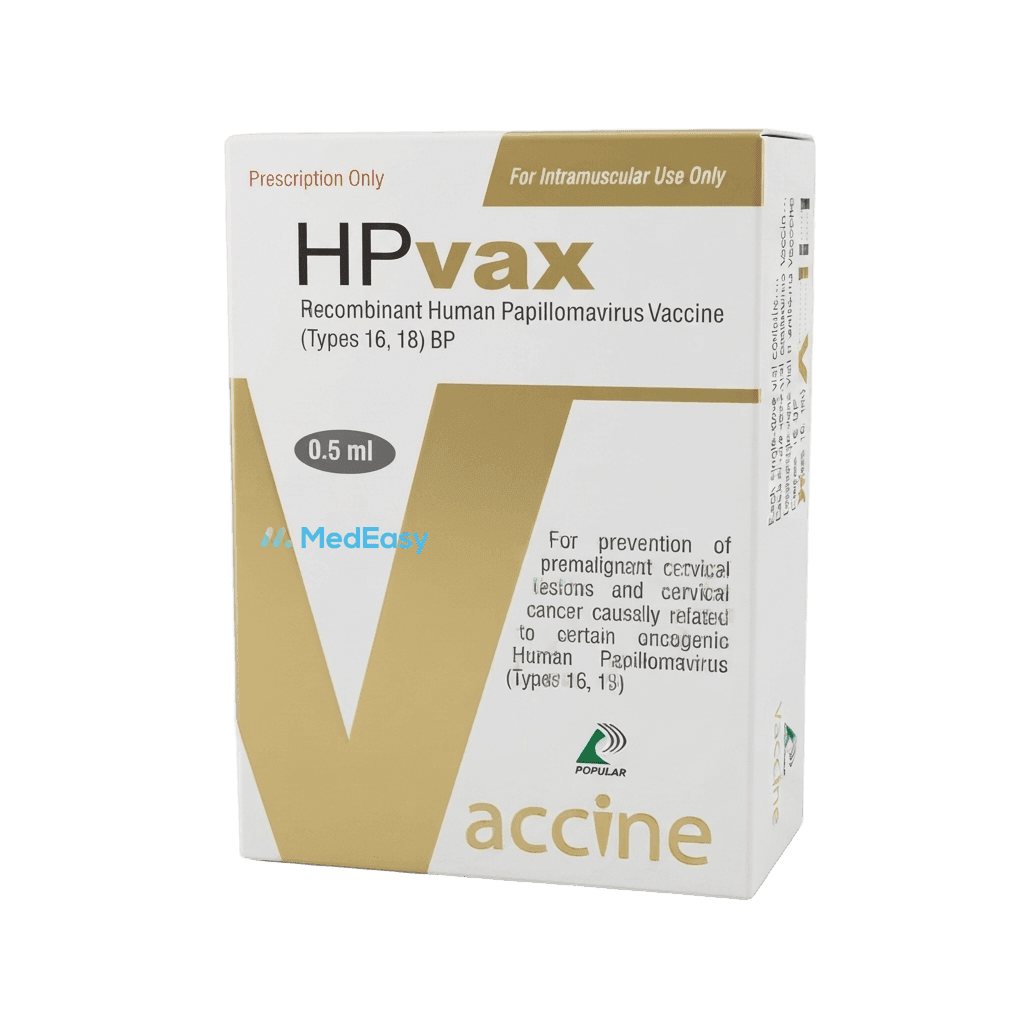
HPvax 0.5 ml/dose IM Injection is available on MedEasy for ৳2375.00 per 0.5 ml vial, with home delivery anywhere in Bangladesh. It is manufactured by Popular Pharmaceuticals Ltd. Its generic name is Human Papillomavirus Bivalent.
- Pack sizes
- 0.5 ml vial
- Prescription
- Required. Upload a valid doctor's prescription at checkout; a MedEasy pharmacist verifies it before dispatch.
- Delivery
- Home delivery across Bangladesh. Same-day delivery in Dhaka, Chattogram, Sylhet and Bogura city areas; 2-3 days elsewhere.
- Payment
- Cash on delivery, bKash, cards and mobile banking.
- Brand
- HPvax
- Generic name
- Human Papillomavirus Bivalent
- Manufacturer
- Popular Pharmaceuticals Ltd.
- Form & strength
- IM Injection 0.5 ml/dose
- Availability
- In stock
- Authenticity
- Sourced from licensed suppliers and the manufacturer's authorised distributors in Bangladesh.

Medicine overview
Indications of HPvax
The HPvax vaccine is indicated for active immunization to prevent the following diseases caused by Human Papillomavirus (HPV) types 16 and 18:
- Established/FDA-approved use: Cervical cancer caused by HPV types 16 and 18.
- Established/FDA-approved use: Cervical intraepithelial neoplasia (CIN) grade 2 or worse and adenocarcinoma in situ caused by HPV types 16 and 18.
- Established/FDA-approved use: Cervical intraepithelial neoplasia (CIN) grade 1 caused by HPV types 16 and 18.
- Guideline-supported use: Routine immunization of adolescent girls per WHO and national immunization program recommendations, typically administered before the onset of sexual activity.
HPvax is a prophylactic (preventive) vaccine only. It is not indicated, and has no demonstrated benefit, for treatment of existing HPV infection, existing cervical lesions, or cervical cancer. It also does not protect against HPV types other than 16 and 18, so routine cervical cancer screening should continue as recommended by local guidelines even after vaccination.
Composition
Each 0.5 mL dose of Human Papillomavirus Bivalent vaccine contains purified virus-like particles (VLPs) of the major capsid L1 protein of:
- Human Papillomavirus type 16 - 20 micrograms
- Human Papillomavirus type 18 - 20 micrograms
The VLPs are produced using recombinant DNA technology and adjuvanted with AS04 (a combination of aluminium hydroxide and 3-O-desacyl-4'-monophosphoryl lipid A) to enhance the immune response. The vaccine also contains sodium chloride and sodium dihydrogen phosphate dihydrate as excipients, in water for injection.
Description
HPvax is a non-infectious, recombinant, adjuvanted vaccine used to prevent cervical cancer and precancerous cervical lesions caused by Human Papillomavirus (HPV) types 16 and 18, which together are responsible for the majority of cervical cancer cases worldwide. The vaccine works by stimulating the body's immune system to produce protective antibodies against these two high-risk HPV types before natural exposure occurs.
HPvax is supplied as a sterile suspension for intramuscular injection, given as a multi-dose series in the deltoid region of the upper arm.
Therapeutic Class
HPvax belongs to the therapeutic class of prophylactic viral vaccines, specifically a recombinant, adjuvanted, non-live human papillomavirus vaccine.
Pharmacology
Human Papillomavirus Bivalent contains virus-like particles (VLPs) formed from the L1 capsid protein of HPV types 16 and 18. These VLPs do not contain viral DNA, so they cannot infect cells, replicate, or cause disease, but they closely resemble the natural virus surface and are highly immunogenic.
Following intramuscular administration, the AS04-adjuvanted VLPs stimulate a strong humoral and cell-mediated immune response, leading to production of high titers of neutralizing antibodies against HPV 16 and 18. These antibodies transude to the cervical mucosa and are believed to prevent infection by blocking viral entry into epithelial cells, thereby preventing the persistent infection that can progress to cervical intraepithelial neoplasia and cervical cancer.
Dosage & Administration of HPvax
HPvax is administered only by intramuscular injection, preferably into the deltoid region of the upper arm, by a trained healthcare professional. It must never be given intravenously, subcutaneously, or intradermally.
| Population | Recommended Schedule |
|---|---|
| Adolescents and adults aged 15-25 years | 3 doses of 0.5 mL each, given at 0, 1, and 6 months |
| Girls aged 9-14 years (per WHO and many national immunization programs) | 2 doses of 0.5 mL each, given at 0 and 6 months; a single-dose schedule is also endorsed by WHO in eligible national programs |
If flexibility in the schedule is required, the second dose may be given between 1 and 2.5 months after the first, and the third dose between 5 and 12 months after the first. The same vaccine product should be used to complete the full series whenever possible. The vaccine (prefilled syringe or vial) should be shaken well before use to ensure a uniform, slightly opalescent white suspension, and inspected visually for particulate matter or discoloration before administration.
Administration of HPvax
HPvax must be given by intramuscular injection only, preferably in the deltoid muscle of the upper arm. Do not inject into the gluteal region or into an area with a tattoo, scar, or skin lesion. As with any injectable vaccine, appropriate medical treatment and supervision must be readily available in case of a rare anaphylactic reaction following administration.
Interaction of HPvax
HPvax may be co-administered with other age-appropriate vaccines (e.g., combined diphtheria-tetanus-pertussis, hepatitis B, or COVID-19 vaccines) using separate syringes and separate injection sites, based on available clinical data and local immunization schedules.
Immunosuppressive therapy (e.g., corticosteroids, chemotherapy, biologic agents): Concomitant use may reduce the immune response to HPvax, potentially resulting in a lower or less durable antibody response. Vaccination may still be considered in immunocompromised individuals, but an adequate protective response cannot be guaranteed.
Other vaccines/immunoglobulins given at different sites: No significant interaction is expected, but administration at separate anatomical sites is recommended.
Contraindications
Human Papillomavirus Bivalent is contraindicated in individuals with:
- A history of severe allergic reaction (e.g., anaphylaxis) to any component of the vaccine.
- A history of a severe allergic reaction after a previous dose of Human Papillomavirus Bivalent.
Vaccination should be deferred (not permanently withheld) in individuals with moderate or severe acute illness, with or without fever, until the condition has resolved.
Side Effects of HPvax
The most commonly reported side effects of HPvax are generally mild to moderate and self-limiting.
- Very common: Pain, redness, and swelling at the injection site; headache; myalgia (muscle pain); fatigue.
- Common: Gastrointestinal symptoms (nausea, vomiting, diarrhea, abdominal pain); fever; dizziness; itching or rash at the injection site.
- Uncommon: Upper respiratory tract infection; urticaria (hives).
- Rare but serious: Syncope (fainting), sometimes accompanied by jerking movements, can occur after any injection, particularly in adolescents - see Precautions and Warnings. Severe allergic reactions, including anaphylaxis, have also been reported rarely.
Pregnancy & Lactation
Pregnancy: HPvax is not recommended for use during pregnancy. If a person is found to be pregnant after starting the vaccination series, remaining doses should be postponed until after delivery. Inadvertent administration during pregnancy is not, by itself, a reason for concern or termination of pregnancy, as available data have not shown an increased risk of adverse pregnancy outcomes, though experience remains limited. Vaccination should be completed after delivery. Consult a physician before receiving this vaccine if pregnancy is suspected or confirmed.
Lactation: HPvax may be given to breastfeeding individuals. Available data do not suggest a risk to the breastfed infant, but a physician should be consulted before vaccination during breastfeeding.
Precautions & Warnings
Syncope: Fainting (sometimes with jerking movements) can occur after, or even before, injection of HPvax, especially in adolescents. Vaccine recipients should be observed for approximately 15 minutes after administration, and procedures should be in place to prevent injury from falling.
Not a treatment: HPvax does not treat existing HPV infection, cervical dysplasia, or cervical cancer, and has no therapeutic effect once such conditions are established.
Incomplete protection: HPvax protects only against disease caused by HPV types 16 and 18 (with some cross-protection against related types); it does not protect against all HPV types that can cause cervical cancer. Routine cervical cancer screening (e.g., Pap smear/HPV testing) should be continued according to local guidelines regardless of vaccination status.
Bleeding disorders: Administer with caution in individuals with thrombocytopenia or any coagulation disorder, as bleeding may occur following an intramuscular injection.
Immunocompromised individuals: May have a diminished immune response - see Interactions.
Latex: Some presentations (e.g., pre-filled syringe tip caps) may contain natural rubber latex; caution is advised in individuals with latex allergy.
Overdose Effects of HPvax
There is no clinical experience with overdose of HPvax. In the event a dose exceeding the recommended amount is administered, or if doses are given closer together than recommended, seek immediate medical attention or contact a poison control center. Management should be symptomatic and supportive, with monitoring for injection-site reactions and hypersensitivity.
Storage Conditions
Store HPvax in a refrigerator at 2°C to 8°C (36°F to 46°F). Do not freeze; discard the vaccine if it has been frozen. Store in the original carton to protect from light. Once removed from vial or syringe packaging, use promptly as directed by a healthcare professional. Keep out of reach of children.
Use In Special Populations
Elderly: HPvax is not indicated for use in elderly populations; it is intended for use before or during early exposure risk to HPV, generally in adolescence and young adulthood.
Renal/hepatic impairment: No specific dose adjustment data are available; use per standard vaccination recommendations under medical supervision.
Immunocompromised patients: May be vaccinated, but an adequate immune response may not be achieved - see Interactions and Precautions.
HIV-positive individuals: Vaccination is not contraindicated, though antibody response may be reduced.
Duration Of Treatment
HPvax is given as a complete primary immunization series (2 or 3 doses depending on age at first dose, as above) rather than a continuous treatment course. Studies have demonstrated sustained protective antibody levels for many years after completion of the series, and no booster dose is currently recommended.
Drug Classes
Human Papillomavirus Bivalent belongs to the drug class of viral vaccines, specifically prophylactic, recombinant, AS04-adjuvanted human papillomavirus vaccines.
Mode Of Action
Human Papillomavirus Bivalent works by presenting the immune system with non-infectious virus-like particles (VLPs) that mimic the outer surface of HPV types 16 and 18. The AS04 adjuvant enhances recognition of these VLPs by antigen-presenting cells, producing a robust and durable antibody response. On natural exposure to HPV 16 or 18, these circulating and mucosal antibodies neutralize the virus before it can infect cervical epithelial cells, preventing the persistent infection that would otherwise be required to cause cervical intraepithelial neoplasia and cervical cancer.
Pediatric Uses
HPvax is approved for use in girls and young women from 9 years of age. Safety and efficacy in children younger than 9 years have not been established, and the vaccine is not indicated in this age group.
In girls aged 9-14 years, a 2-dose schedule (0 and 6 months) is used per WHO and many national immunization program recommendations; a single-dose option is also endorsed by WHO where locally adopted. From age 15 years onward, the standard 3-dose schedule (0, 1, and 6 months) applies. HPvax is most effective when given before the onset of sexual activity and potential exposure to HPV.
Frequently Asked Questions
Q: What is HPvax 0.5 ml/dose IM Injection used for?
A: HPvax 0.5 ml/dose IM Injection is a vaccine used to prevent cervical cancer and precancerous cervical lesions caused by HPV types 16 and 18. It is a preventive vaccine and does not treat existing HPV infection or cervical cancer.
Q: At what age should HPvax 0.5 ml/dose IM Injection be given?
A: HPvax 0.5 ml/dose IM Injection is approved from 9 years of age, and it works best when given before the start of sexual activity. Girls aged 9-14 years typically receive 2 doses (0 and 6 months), while those aged 15-25 years receive 3 doses (0, 1, and 6 months).
Q: Is HPvax 0.5 ml/dose IM Injection safe during pregnancy?
A: HPvax 0.5 ml/dose IM Injection is not recommended during pregnancy. If pregnancy occurs during the vaccination series, remaining doses should be postponed until after delivery; accidental vaccination during early pregnancy is not considered a reason for concern or termination, but a physician should always be consulted.
Q: What are the common side effects of HPvax 0.5 ml/dose IM Injection?
A: The most common side effects of HPvax 0.5 ml/dose IM Injection are pain, redness, and swelling at the injection site, along with headache, muscle pain, and fatigue. Fainting can occasionally occur after injection, so patients are usually observed for about 15 minutes afterward.
Q: Does HPvax 0.5 ml/dose IM Injection replace cervical cancer screening?
A: No. HPvax 0.5 ml/dose IM Injection only protects against HPV types 16 and 18, not all cancer-causing HPV types, so routine cervical cancer screening (such as Pap smear or HPV testing) should continue as recommended by a physician even after vaccination.
Q: Who should not receive HPvax 0.5 ml/dose IM Injection?
A: HPvax 0.5 ml/dose IM Injection should not be given to anyone with a history of a severe allergic reaction (anaphylaxis) to any component of the vaccine or after a previous dose. Vaccination should be postponed in anyone with moderate or severe acute illness until they have recovered.
Disclaimer
The information provided is accurate to the best of our knowledge, but it does not replace professional medical advice. We cannot guarantee its completeness or accuracy, and the absence of specific information about a drug should not be taken as an endorsement. We are not responsible for any consequences arising from this information, so please consult a healthcare professional for any concerns or questions.