

5% Off
Ketaride50 mg/ml
Incepta Pharmaceuticals Ltd.
৳109.25
Add to cart
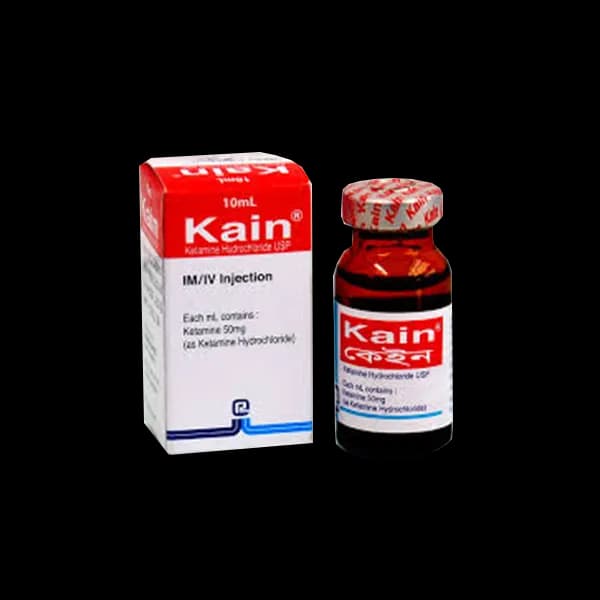

Kain is indicated as the sole anesthetic agent for diagnostic and surgical procedures that do not require skeletal muscle relaxation, and as an induction agent prior to administration of other general anesthetics. It is also used to supplement low-potency agents such as nitrous oxide.
Kain is used off-label, at very low sub-anesthetic ("sub-dissociative") doses and only under specialist supervision, for:
Kain is a controlled substance with recognized potential for misuse and must never be self-administered outside a supervised medical setting.
Each mL of injectable solution contains Ketamine hydrochloride equivalent to Ketamine base, commonly available in strengths of 50 mg/mL (also formulated as 10 mg/mL and 100 mg/mL in some markets), supplied as a clear, colourless, multi-dose injectable solution for intravenous or intramuscular use.
Kain is a rapid-acting, non-barbiturate general anesthetic that produces a unique state known as "dissociative anesthesia," characterised by profound analgesia, normal or slightly enhanced skeletal muscle tone, cardiovascular and respiratory stimulation, and occasionally a transient and minimal respiratory depression.
It is chemically classified as an arylcyclohexylamine and acts primarily through non-competitive antagonism of the NMDA (N-methyl-D-aspartate) glutamate receptor. Kain is administered by intravenous or intramuscular injection only in monitored clinical settings by personnel trained in airway management and general anesthesia.
General (dissociative) anesthetic agent; NMDA-receptor antagonist.
Ketamine is a non-competitive antagonist at the NMDA receptor-ion channel complex, which blocks glutamate-mediated excitatory neurotransmission and produces dissociation between the cortical and limbic systems, resulting in a cataleptic, amnesic, and analgesic state distinct from other general anesthetics. It also interacts, to a lesser degree, with opioid, monoaminergic, muscarinic and other receptor systems, contributing to its analgesic and sympathomimetic effects.
Ketamine characteristically increases heart rate, blood pressure and cardiac output (sympathomimetic stimulation), which distinguishes it from most other anesthetic agents that are cardiodepressant.
Dosing of Kain is individualised by indication, route, patient age, and concurrent medications, and must only be given by, or under the direct supervision of, personnel trained in general anesthesia/airway management with continuous cardiorespiratory monitoring available. See Dosage for indication-specific regimens and Administration for route-specific technique.
Kain is given by slow intravenous injection (over approximately 60 seconds) or by intramuscular injection, and by continuous IV infusion for maintenance of anesthesia/sedation. It must be administered only in a setting equipped for continuous monitoring of heart rate, blood pressure, oxygen saturation, and airway/respiratory status, by personnel trained in resuscitation and airway management. Kain is not intended for unsupervised self-administration under any circumstance.
Ketamine is contraindicated in:
| System | Effects |
|---|---|
| Cardiovascular | Elevated blood pressure and heart rate (most common); hypotension, bradycardia, arrhythmias |
| Respiratory | Respiratory stimulation is typical; transient respiratory depression or apnea can occur with rapid high-dose IV administration; laryngospasm (uncommon) |
| Psychiatric/Neurological (emergence reactions) | Vivid dreams, hallucinations, confusion, irrational behaviour and disorientation during recovery, reported in roughly 1 in 8 adult patients; enhanced skeletal muscle tone with tonic-clonic (seizure-like) movements |
| Ocular | Diplopia, nystagmus, mild elevation of intraocular pressure |
| Gastrointestinal | Nausea, vomiting, anorexia |
| Other | Injection-site pain/erythema, rare anaphylactoid reactions |
Co-administration of a benzodiazepine and use of a quiet recovery environment can reduce the frequency and severity of emergence reactions associated with Kain.
Pregnancy: Safe use of Kain in human pregnancy, including obstetric use, has not been established, and such use is generally not recommended. Kain should be used in pregnancy only if clearly needed and if the potential benefit justifies the potential risk to the fetus; always consult a physician before use in pregnancy.
Lactation: Data on excretion of Kain into human breast milk are limited. Because of potential effects on the infant, a decision should be made whether to discontinue breastfeeding or avoid Kain, taking into account the importance of the drug to the mother, in consultation with a physician.
Overdosage or excessively rapid administration of Kain can cause profound respiratory depression or apnea, severe cardiovascular instability, and prolonged unresponsiveness. If overdose of Kain is suspected, seek immediate medical attention or contact emergency services/poison control without delay. Management is supportive, with priority given to securing the airway and providing ventilatory support; mechanical ventilatory assistance is generally preferred over the use of analeptic (respiratory-stimulant) drugs. Complete recovery is typical with prompt supportive care, even after unintentionally large doses.
Store at controlled room temperature, 20-25°C (68-77°F); protect from light. Keep out of reach of children, and store under locked, controlled-substance conditions in accordance with local regulations, as Kain has recognized potential for misuse.
Original labeling states that safety and efficacy of Kain in patients below 16 years of age have not been formally established. Nonetheless, weight-based dosing of Kain is widely used off-label for pediatric anesthesia and procedural sedation under the supervision of specialists experienced in pediatric airway management, following current specialty guidance.
Use with caution in elderly patients, particularly those with cardiovascular disease, as they may be more sensitive to the hemodynamic (blood pressure/heart rate) effects of Kain; consider lower doses with close monitoring.
No formal dose-adjustment guidelines exist. Because Kain is cleared hepatically, use with caution and titrate carefully in patients with significant hepatic impairment.
See Pregnancy and Lactation above.
Kain is typically used for the duration of a single anesthetic, sedation, or analgesic episode (minutes to a few hours), determined by the procedure and the clinician's judgment, with additional maintenance doses given as needed. It is not intended for ongoing self-administration. Off-label use for depression or chronic pain follows structured, time-limited infusion protocols under specialist supervision, with duration determined by the treating specialist based on response and safety monitoring.
Dissociative (general) anesthetic; NMDA-receptor antagonist; controlled substance (recognized potential for misuse/dependence).
Non-competitive antagonism of the NMDA (N-methyl-D-aspartate) glutamate receptor-ion channel complex in the central nervous system, producing dissociation between the thalamocortical and limbic systems that manifests as profound analgesia, amnesia, and catalepsy ("dissociative anesthesia"), with additional minor interactions at opioid, monoaminergic and muscarinic receptor sites.
Formal labeling states that safety and effectiveness of Kain in children under 16 years of age have not been established. In current clinical practice, however, Kain is widely and routinely used off-label, at weight-based doses, for pediatric procedural sedation and general anesthesia, based on extensive published experience and specialty-society guidance, provided it is given by clinicians experienced in pediatric airway management with full monitoring available. Parents/guardians should discuss the specific risks and benefits for their child with the treating specialist.
Q: What is Kain 50 mg/ml IM/IV Injection used for?
A: Kain 50 mg/ml IM/IV Injection is mainly used as a general anesthetic for short surgical or diagnostic procedures that do not require muscle relaxation, and to induce anesthesia before other anesthetic agents are given. At much lower doses it is also used for procedural sedation, pain control, and, off-label under specialist supervision, for treatment-resistant depression.
Q: Is Kain 50 mg/ml IM/IV Injection safe to use during pregnancy?
A: Safe use of Kain 50 mg/ml IM/IV Injection in pregnancy has not been established, and it is generally not recommended. It should be used in pregnancy only if a physician determines the potential benefit clearly outweighs the potential risk to the fetus, so always consult your doctor first.
Q: Can Kain 50 mg/ml IM/IV Injection be given at home or without supervision?
A: No. Kain 50 mg/ml IM/IV Injection must only be given by trained medical personnel in a setting with continuous monitoring of heart rate, blood pressure, and breathing, because of its effects on the cardiovascular system and airway, and its recognized potential for misuse. It is never appropriate for self-administration.
Q: What are the most common side effects of Kain 50 mg/ml IM/IV Injection?
A: The most common effects of Kain 50 mg/ml IM/IV Injection are a rise in blood pressure and heart rate, and "emergence reactions" during recovery, such as vivid dreams, hallucinations, or confusion, which occur in roughly 1 in 8 patients. These can often be reduced by giving a benzodiazepine and allowing recovery in a calm, quiet space.
Q: What should be done if someone receives too much Kain 50 mg/ml IM/IV Injection?
A: An overdose of Kain 50 mg/ml IM/IV Injection can cause severe breathing difficulty, dangerously low or unstable blood pressure, or prolonged unresponsiveness. This is a medical emergency — seek immediate medical attention or contact emergency services/poison control right away. Treatment mainly involves supporting breathing and circulation in a hospital setting.
Q: Is Kain 50 mg/ml IM/IV Injection approved for use in children?
A: Formal prescribing information states that safety and effectiveness in children under 16 have not been officially established. In practice, Kain 50 mg/ml IM/IV Injection is commonly used off-label in children for anesthesia and sedation by specialists experienced in pediatric care, using weight-based dosing and full monitoring.
Disclaimer
The information provided is accurate to the best of our knowledge, but it does not replace professional medical advice. We cannot guarantee its completeness or accuracy, and the absence of specific information about a drug should not be taken as an endorsement. We are not responsible for any consequences arising from this information, so please consult a healthcare professional for any concerns or questions.
