
5% Off
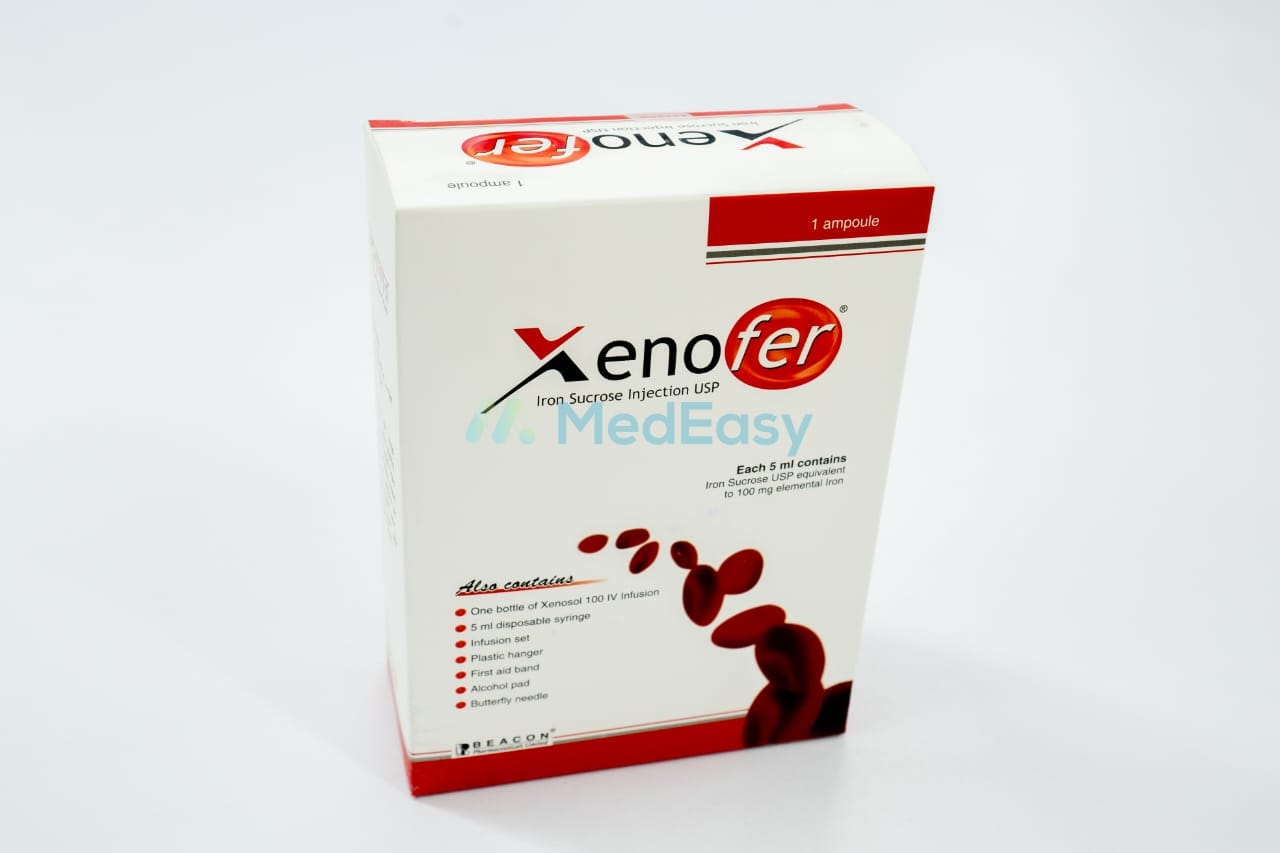
Xenofer100 mg/5 m
Beacon Pharmaceuticals PLC
৳332.50
Add to cart


Kidifer is a parenteral (intravenous) iron replacement product used to treat iron-deficiency anemia in patients for whom oral iron is inadequate, not tolerated, or clinically inappropriate.
Kidifer is not indicated for anemias not caused by iron deficiency (e.g. hemolytic anemia, anemia of chronic disease without proven iron deficiency).
Each mL of Iron Sucrose Injection [Elemental Iron] contains iron in the form of iron sucrose complex equivalent to 20 mg of elemental iron (commonly supplied as ampoules/vials providing 100 mg elemental iron per 5 mL). The exact strength and pack size should be confirmed on the product label.
Kidifer is a sterile, brown, colloidal solution of polynuclear iron (III)-hydroxide in complex with sucrose, given by slow intravenous injection or infusion. It is used to replenish iron stores and correct iron-deficiency anemia when oral iron therapy is insufficient, poorly tolerated, or clinically unsuitable, most commonly in patients with chronic kidney disease.
As a parenteral iron product, Kidifer is a prescription-only medicine that must be administered by a qualified healthcare professional in a clinical setting equipped to monitor for and manage hypersensitivity reactions.
Hematinic agent — parenteral (intravenous) iron replacement therapy. Kidifer belongs to the iron-carbohydrate complex class of injectable iron preparations.
Iron Sucrose Injection [Elemental Iron] supplies iron in a form that closely resembles physiological ferritin, allowing it to be released to iron-binding and iron-transport proteins in the body. Following intravenous administration, the iron-sucrose complex is taken up predominantly by the reticuloendothelial system (liver, spleen, bone marrow), where iron is cleaved from the sucrose carrier.
The released iron is either stored as ferritin or transported by transferrin to erythroid precursor cells in the bone marrow, where it is incorporated into hemoglobin, correcting iron-deficiency anemia and replenishing depleted iron stores. The sucrose component is eliminated primarily via the kidneys.
Kidifer is dosed according to the calculated iron deficit and clinical indication, and is administered only by intravenous injection or infusion by a trained healthcare professional. It must never be given intramuscularly or self-administered by the patient at home.
| Population | Typical Dose | Notes |
|---|---|---|
| Hemodialysis-dependent CKD | 100 mg by slow IV injection or infusion | Given repeatedly per dialysis session, per individualized treatment course |
| Non-dialysis-dependent CKD | 200 mg by slow IV injection or infusion | Given on 5 occasions within a 14-day period per treatment course |
| Peritoneal dialysis-dependent CKD | 300 mg then 400 mg by infusion, then 400 mg | Administered over a 28-day treatment course |
Local prescribing practice in Bangladesh commonly describes adult dosing as 100–200 mg elemental iron, given one to three times weekly depending on hemoglobin level and calculated iron deficit, up to a maximum of 200 mg per single injection — this should be individualized by the treating physician based on the calculated total iron deficit.
In children 2 years of age and older with CKD-associated iron-deficiency anemia, the recommended dose is 0.5 mg/kg by slow IV injection or infusion, repeated as needed, not to exceed 100 mg per dose. Safety and efficacy in children under 2 years have not been established.
No specific dose adjustment beyond the indication-based dosing above is well established for renal or hepatic impairment; Kidifer is in fact the treatment for iron deficiency that commonly accompanies chronic kidney disease, and dosing already accounts for renal status per the schedules above. Use with caution in significant hepatic impairment, with close monitoring for iron overload.
Total cumulative dose should be calculated individually (e.g. using a body-weight/hemoglobin-deficit formula) and should not be exceeded, to avoid iron overload. See Contraindications and Precautions and Warnings.
Kidifer must be administered only by a healthcare professional in a facility equipped with resuscitation equipment and trained staff, because of the risk of serious hypersensitivity reactions.
Oral iron preparations: Kidifer may reduce the absorption of concomitantly administered oral iron supplements. Oral iron therapy should generally not be started until at least several days after the last dose of Kidifer, or as directed by the prescribing physician.
Other parenteral iron products: Concurrent use with other IV iron formulations is not recommended due to the risk of cumulative iron overload.
No other well-established, clinically significant drug-drug interactions have been identified for Kidifer. Inform the physician of all other medicines being used, including erythropoiesis-stimulating agents, which are often co-prescribed rather than interacting adversely.
Iron Sucrose Injection [Elemental Iron] is contraindicated in patients with:
Conditions such as active infection or a history of drug allergies are important cautions requiring careful clinical judgment, but are not absolute contraindications — see Precautions and Warnings.
Adverse effects associated with Kidifer range from common, mild infusion-related symptoms to rare but serious hypersensitivity reactions.
Patients should seek immediate medical attention for symptoms such as difficulty breathing, swelling of the face/throat, rash, or fainting.
Pregnancy: Data on the use of Kidifer during pregnancy, particularly in the first trimester, are limited. Kidifer should be used during pregnancy only if the potential benefit justifies the potential risk to the fetus, and generally only after the first trimester when treatment of iron-deficiency anemia is clearly needed and oral iron is inadequate or not tolerated. Use should be under direct physician supervision.
Lactation: Small amounts of iron from Kidifer may pass into breast milk; available data have not shown adverse effects in breastfed infants, but a nursing mother should use Kidifer only on the advice of her physician, who will weigh the clinical need for maternal iron therapy against any potential infant exposure.
Kidifer can cause serious, potentially life-threatening hypersensitivity reactions, including anaphylaxis. It must only be administered in settings where personnel and resuscitation equipment (including oxygen and epinephrine) are immediately available. Patients should be monitored closely during each administration and for at least 30 minutes afterward for signs and symptoms of a reaction (e.g. rash, itching, wheezing, hypotension, dizziness).
Rapid administration may cause hypotension. Administer slowly, at the recommended rate, and monitor vital signs.
Excessive or inappropriate use of Kidifer can lead to iron overload, with accumulation in the liver and other organs. Dosing must be based on the individually calculated total iron deficit; periodic monitoring of iron parameters (e.g. serum ferritin, transferrin saturation) is recommended, particularly with repeated courses.
Iron may theoretically worsen certain bacterial or fungal infections by supporting pathogen growth. Use Kidifer with caution in patients with active systemic infection; treatment should generally be deferred until the infection resolves unless the clinical need for iron repletion is urgent, as judged by the treating physician.
Kidifer is a prescription-only, hospital/clinic-administered intravenous therapy. It is not intended for home or self-administration by patients.
Excessive dosing or infusion rate of Kidifer may cause acute toxicity, including hypotension, and can lead to iron overload with accumulation in the liver, heart, and other organs (hemosiderosis) if administered in doses exceeding what is required to correct the iron deficit.
There is no specific antidote routinely used at the bedside; management is supportive. If overdosage or a severe reaction is suspected, seek immediate medical attention or contact emergency services / a poison control center right away. Iron chelation therapy may be considered by treating physicians in cases of significant iron overload, based on clinical and laboratory assessment.
Store at room temperature (below 30°C), away from light and moisture. Do not freeze. Each vial/ampoule is for single use only; discard any unused portion. Keep out of reach of children.
Renal impairment: Kidifer is specifically indicated for iron-deficiency anemia associated with chronic kidney disease, including hemodialysis- and peritoneal dialysis-dependent patients; dosing is stratified by dialysis status (see Dosage and Administration).
Hepatic impairment: Use with caution; monitor closely for iron overload, as data on dosing adjustment in significant hepatic disease are limited.
Elderly: No overall differences in safety or efficacy have been established compared with younger adults; dose selection should still consider the individually calculated iron deficit and any comorbid renal/hepatic disease.
Active infection: Use with caution — see Precautions and Warnings.
Pediatric and pregnant/lactating patients: See Pediatric Uses and Pregnancy and Lactation sections.
Duration of treatment with Kidifer is individualized and based on the total calculated iron deficit, the indication being treated, and the patient's hemoglobin and iron-parameter response. Courses are typically given as a defined series of doses over one to several weeks (e.g. up to 14 days for non-dialysis CKD, or a 28-day course for peritoneal dialysis patients); a hemodialysis patient may receive maintenance doses over an extended period as clinically required. The prescribing physician determines when the calculated iron deficit has been corrected and further doses are no longer needed.
Parenteral (intravenous) iron replacement agents; hematinics; iron-carbohydrate (iron-sucrose) complexes.
Iron Sucrose Injection [Elemental Iron] is a complex of polynuclear iron (III)-hydroxide with sucrose that mimics the structure of natural ferritin. After intravenous administration, it is taken up by cells of the reticuloendothelial system, where iron is released from the sucrose carrier, bound to transferrin, and delivered to the bone marrow for incorporation into hemoglobin during erythropoiesis, or stored as ferritin in tissue iron stores.
Kidifer is approved for use in children 2 years of age and older for iron-deficiency anemia associated with chronic kidney disease, at a dose of 0.5 mg/kg by slow IV injection or infusion, not to exceed 100 mg per dose, with dosing individualized to the calculated iron deficit.
Safety and efficacy of Kidifer in children younger than 2 years of age have not been established. Use in this age group should only occur under specialist supervision when no suitable alternative exists and the potential benefit is judged to outweigh the risk.
Q: What is Kidifer 100 mg/5 ml IV Injection used for?
A: Kidifer 100 mg/5 ml IV Injection is an intravenous iron replacement medicine used to treat iron-deficiency anemia, most commonly in patients with chronic kidney disease who cannot take or do not adequately respond to oral iron. It may also be used for iron deficiency related to inflammatory bowel disease or other conditions where oral iron is not suitable, as determined by your physician.
Q: Can I give myself Kidifer 100 mg/5 ml IV Injection at home?
A: No. Kidifer 100 mg/5 ml IV Injection must only be given by a healthcare professional in a hospital or clinic setting equipped to manage allergic reactions, because of the risk of serious hypersensitivity reactions including anaphylaxis. It is not a self-administered, take-home injection.
Q: What are the most serious risks of Kidifer 100 mg/5 ml IV Injection?
A: The most serious risk is a hypersensitivity reaction, including rare but potentially life-threatening anaphylaxis, which is why Kidifer 100 mg/5 ml IV Injection is given only where resuscitation facilities and trained staff are available, with monitoring during the infusion and for at least 30 minutes afterward. Other risks include a drop in blood pressure (hypotension) during or after the infusion, and iron overload if doses exceed what your body needs — your physician calculates your dose carefully to avoid this.
Q: Is Kidifer 100 mg/5 ml IV Injection safe during pregnancy or breastfeeding?
A: Kidifer 100 mg/5 ml IV Injection should be used during pregnancy only if clearly needed and if the potential benefit justifies the potential risk to the baby, generally avoided in the first trimester unless essential, and only under a physician's direct supervision. Small amounts may pass into breast milk; breastfeeding mothers should use Kidifer 100 mg/5 ml IV Injection only on their doctor's advice.
Q: Can children receive Kidifer 100 mg/5 ml IV Injection?
A: Kidifer 100 mg/5 ml IV Injection is approved for children 2 years of age and older with chronic kidney disease-associated iron-deficiency anemia, dosed by body weight (0.5 mg/kg, maximum 100 mg per dose). Safety and efficacy in children younger than 2 years have not been established.
Q: What should I tell my doctor before receiving Kidifer 100 mg/5 ml IV Injection?
A: Tell your doctor about any known allergies (especially to iron products), any history of severe allergic reactions, whether you have an active infection, liver disease, or existing iron overload, and whether you are pregnant, planning pregnancy, or breastfeeding, as these affect whether and how Kidifer 100 mg/5 ml IV Injection should be used.
Disclaimer
The information provided is accurate to the best of our knowledge, but it does not replace professional medical advice. We cannot guarantee its completeness or accuracy, and the absence of specific information about a drug should not be taken as an endorsement. We are not responsible for any consequences arising from this information, so please consult a healthcare professional for any concerns or questions.

