
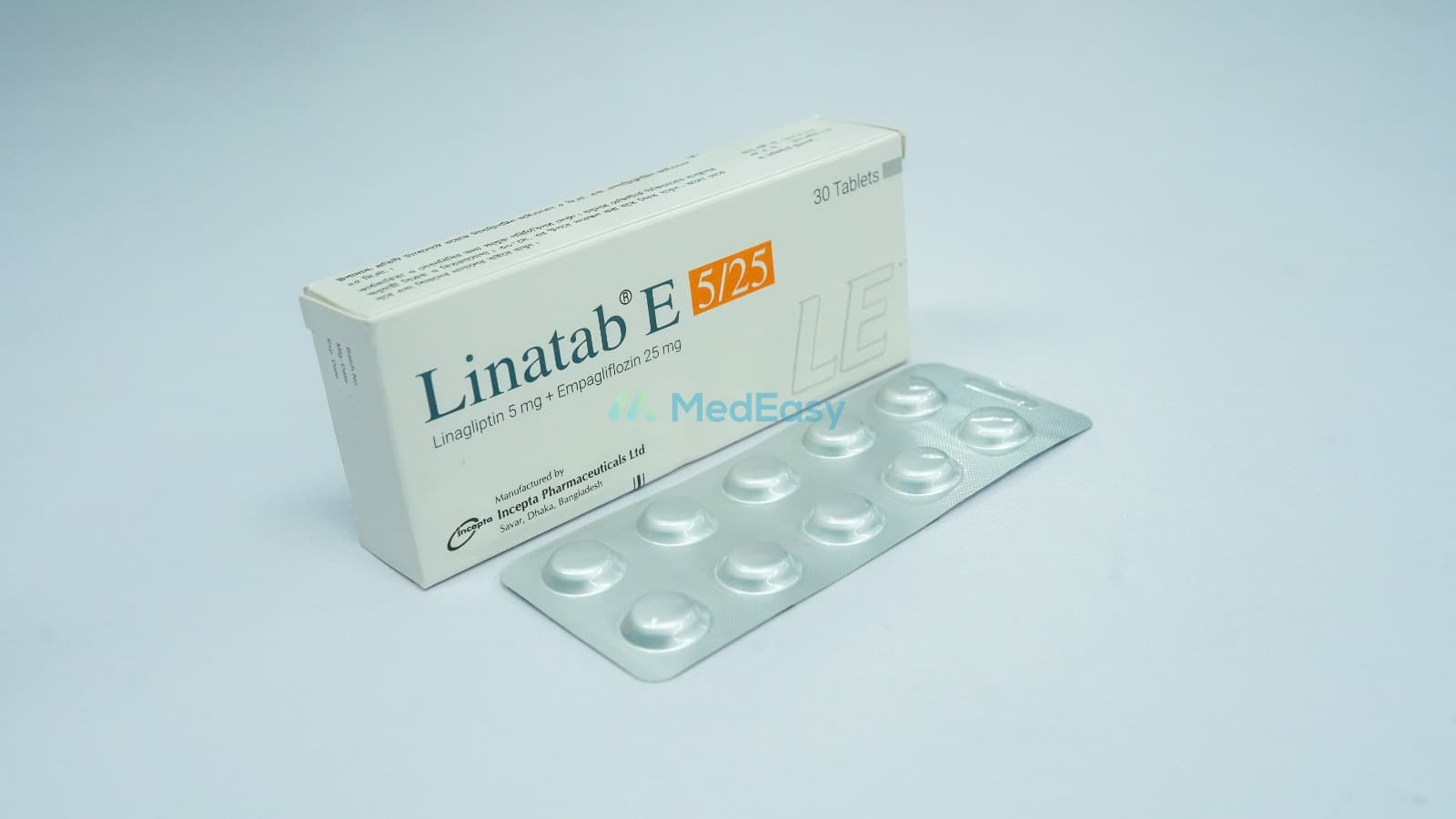

Medicine overview
Indications of Linatab E
Linatab E is a fixed-dose combination oral antidiabetic medicine used in the management of type 2 diabetes mellitus in adults. Its use should be guided by a physician after assessing kidney function and overall diabetes treatment needs.
- Established/FDA-approved use: Linatab E is indicated as an adjunct to diet and exercise to improve glycemic control in adults with type 2 diabetes mellitus.
- Combination-dependent use: Linatab E may be used together with other antidiabetic agents such as metformin, a sulfonylurea, or insulin when glycemic control is inadequate on those therapies alone, under physician supervision.
- Not indicated for: Linatab E is not indicated for treatment of type 1 diabetes mellitus or diabetic ketoacidosis (see Contraindications and Precautions and Warnings).
Linatab E does not replace diet, exercise, and lifestyle modification, which remain the foundation of type 2 diabetes management.
Composition
Each tablet of Empagliflozin+ Linagliptin combines two active ingredients:
- Empagliflozin - commonly available as 10 mg or 25 mg per tablet
- Linagliptin - commonly 5 mg per tablet
Empagliflozin+ Linagliptin is typically supplied as film-coated tablets in strengths such as 10 mg/5 mg and 25 mg/5 mg (empagliflozin/linagliptin). Exact strengths, colors, and pack sizes can vary by manufacturer; always check the product label/pack insert actually dispensed.
Description
Linatab E is an oral fixed-dose combination of two antidiabetic agents that lower blood glucose through complementary, independent mechanisms in adults with type 2 diabetes mellitus. Empagliflozin is a sodium-glucose co-transporter-2 (SGLT2) inhibitor that reduces renal reabsorption of glucose, while linagliptin is a dipeptidyl peptidase-4 (DPP-4) inhibitor that raises incretin hormone levels to enhance glucose-dependent insulin release.
Linatab E is taken orally, once daily, and is used together with a physician-directed diet and exercise program as part of comprehensive type 2 diabetes management. Linatab E is not used to treat type 1 diabetes or diabetic ketoacidosis.
Therapeutic Class
Linatab E belongs to the therapeutic class of combination oral antidiabetic agents, combining a sodium-glucose co-transporter-2 (SGLT2) inhibitor (empagliflozin) with a dipeptidyl peptidase-4 (DPP-4) inhibitor (linagliptin).
Pharmacology
Empagliflozin+ Linagliptin combines two antidiabetic agents that act through distinct, complementary mechanisms:
- Empagliflozin inhibits SGLT2 in the renal proximal tubule, reducing reabsorption of filtered glucose and increasing urinary glucose excretion, which lowers plasma glucose independent of insulin secretion or insulin action.
- Linagliptin inhibits the DPP-4 enzyme, slowing breakdown of the incretin hormones GLP-1 and GIP. This increases glucose-dependent insulin secretion from pancreatic beta cells and reduces glucagon secretion from alpha cells, lowering blood glucose primarily after meals.
Pharmacokinetics (overview): Empagliflozin reaches peak plasma concentration within about 1.5 hours of an oral dose, has an elimination half-life of approximately 12 hours, and is eliminated largely unchanged in urine and feces. Linagliptin is absorbed orally, binds extensively to DPP-4 in tissues, has a long effective half-life that supports once-daily dosing, and is eliminated predominantly through the bile/enterohepatic route largely unchanged, with only minor renal excretion. Because the glucose-lowering effect of the empagliflozin component depends on renal function, the efficacy of Empagliflozin+ Linagliptin is reduced and its use is limited in patients with significant renal impairment (see Use in Special Populations).
Dosage & Administration of Linatab E
The dose of Linatab E must be individualized by a treating physician based on glycemic response, tolerability, and renal function.
| Clinical scenario | Typical Linatab E regimen |
|---|---|
| Initial therapy in adults not adequately controlled on diet/exercise, metformin, or another antidiabetic agent | Empagliflozin 10 mg/Linagliptin 5 mg once daily in the morning |
| Inadequate glycemic response to the 10 mg/5 mg dose, with adequate renal function | May be increased to Empagliflozin 25 mg/Linagliptin 5 mg once daily |
| Estimated GFR 30 to less than 45 mL/min/1.73 m2 | Linatab E is generally not recommended, as the empagliflozin component has reduced efficacy and increased risk in this range |
| Estimated GFR less than 30 mL/min/1.73 m2, end-stage renal disease, or dialysis | Linatab E is contraindicated (see Contraindications) |
| Concurrent use with insulin or a sulfonylurea | A lower dose of the insulin or sulfonylurea may be needed to reduce hypoglycemia risk, per physician judgment |
Renal function should be assessed before starting Linatab E and monitored periodically during treatment. Any dose change or discontinuation should only be made under physician guidance.
Administration of Linatab E
Linatab E is taken orally, once daily in the morning, with or without food. Tablets should be swallowed whole with water and should not be split or crushed unless a physician or pharmacist specifically advises otherwise. Linatab E should be taken at approximately the same time each day, together with a physician-recommended diet and exercise program, to achieve the best glycemic control.
Interaction of Linatab E
Linatab E has several clinically significant drug interactions:
- Insulin and insulin secretagogues (e.g., sulfonylureas): Combining these with Linatab E increases the risk of hypoglycemia; a lower dose of the insulin or secretagogue may be needed.
- Diuretics: Concurrent use, particularly with loop diuretics, can add to the volume-depleting effect of the empagliflozin component, increasing the risk of hypotension and dehydration.
- Strong UGT/CYP3A4 enzyme inducers (e.g., rifampicin, carbamazepine, phenytoin, phenobarbital): May reduce plasma concentrations of linagliptin, potentially reducing its glucose-lowering effect; closer monitoring of glycemic control is advised if such agents are co-administered with Linatab E.
- ACE inhibitors, angiotensin receptor blockers, and other antihypertensives: May add to the blood-pressure-lowering and volume-depleting effects of Linatab E, increasing the risk of symptomatic hypotension, particularly in elderly patients or those with reduced intravascular volume.
- Urine glucose test interference: Because the empagliflozin component increases urinary glucose excretion, Linatab E will cause positive urine glucose test results; alternative methods should be used to monitor glycemic control.
Contraindications
Empagliflozin+ Linagliptin is contraindicated in the following situations:
- Known hypersensitivity to empagliflozin, linagliptin, or any component of the formulation, including a history of serious hypersensitivity reactions (e.g., anaphylaxis, angioedema) to either component.
- Severe renal impairment (estimated GFR less than 30 mL/min/1.73 m2), end-stage renal disease, or patients on dialysis, because the glucose-lowering effect of the empagliflozin component depends on adequate renal function.
Side Effects of Linatab E
Most patients tolerate Linatab E reasonably well. Reported adverse effects include:
- Common: Urinary tract infection, genital mycotic infections (vulvovaginal candidiasis in women, balanitis in men), nasopharyngitis, increased urination, increased thirst, and headache.
- Less common: Nausea, back pain, arthralgia (joint pain, a recognized DPP-4 inhibitor class effect), and hypoglycemia (mainly when Linatab E is combined with insulin or a sulfonylurea).
- Serious but uncommon: Diabetic ketoacidosis (which can occur with only mildly elevated or near-normal blood glucose), volume depletion/hypotension, acute kidney injury, urosepsis and pyelonephritis, necrotizing fasciitis of the perineum (Fournier's gangrene), acute pancreatitis, severe hypersensitivity reactions (anaphylaxis, angioedema), and bullous pemphigoid (see Precautions and Warnings).
Patients should seek prompt medical attention for unusual tiredness with nausea/vomiting and abdominal pain (possible ketoacidosis), signs of dehydration or fainting, severe genital or perineal pain/swelling with fever, or persistent severe abdominal pain while taking Linatab E.
Pregnancy & Lactation
Pregnancy: Data on the use of Linatab E in pregnant women are limited, and SGLT2 inhibitors such as the empagliflozin component are generally not recommended in pregnancy, particularly during the second and third trimesters, based on effects on fetal and neonatal kidney development observed in animal studies. Linatab E should be used in pregnancy only if clearly needed and if the potential benefit justifies the potential risk to the fetus, and only under close physician supervision; alternative antidiabetic therapy is usually preferred once pregnancy is identified.
Lactation: It is not known whether empagliflozin or linagliptin passes into human breast milk. Because of potential effects on the developing kidney observed in juvenile animal studies with the empagliflozin component, breastfeeding is generally not recommended during treatment with Linatab E. A decision should be made, in consultation with a physician, whether to discontinue breastfeeding or discontinue Linatab E, taking into account the importance of the medicine to the mother.
Precautions & Warnings
The following precautions apply when using Linatab E:
- Diabetic ketoacidosis (DKA): Cases of ketoacidosis, sometimes with near-normal blood glucose (euglycemic DKA), have been reported with SGLT2 inhibitors such as the empagliflozin component of Linatab E, including during periods of acute illness, reduced food/fluid intake, surgery, or excessive alcohol intake. Linatab E should be temporarily stopped before scheduled surgery and during serious illness, and patients should seek immediate medical attention for symptoms such as nausea, vomiting, abdominal pain, tiredness, or difficulty breathing.
- Volume depletion and hypotension: Linatab E can cause intravascular volume contraction; symptomatic hypotension may occur, particularly in the elderly, patients with impaired renal function, low systolic blood pressure, or those taking diuretics or antihypertensives. Volume status should be assessed and corrected before starting Linatab E in at-risk patients.
- Genital mycotic infections and urinary tract infections: Linatab E increases the risk of genital yeast infections and urinary tract infections, including serious cases of urosepsis and pyelonephritis.
- Necrotizing fasciitis of the perineum (Fournier's gangrene): A rare but life-threatening infection of the tissue surrounding the genitals and perineum has been reported with SGLT2 inhibitors, including the empagliflozin component. Patients should seek immediate medical attention for severe perineal or genital pain, tenderness, swelling, redness, or fever.
- Acute pancreatitis: Cases of acute pancreatitis have been reported with DPP-4 inhibitors, including the linagliptin component. Linatab E should be discontinued promptly if pancreatitis is suspected (persistent severe abdominal pain, with or without vomiting).
- Hypoglycemia: The risk of hypoglycemia is increased when Linatab E is combined with insulin or an insulin secretagogue (e.g., a sulfonylurea); a lower dose of the concomitant agent may be needed.
- Hypersensitivity reactions and bullous pemphigoid: Serious hypersensitivity reactions and, rarely, bullous pemphigoid (a blistering skin condition, a recognized DPP-4 inhibitor class effect) have been reported; Linatab E should be discontinued and appropriate treatment given if these occur.
- Not for type 1 diabetes or diabetic ketoacidosis: Linatab E is not indicated for these conditions (see Contraindications).
- Renal function monitoring: Renal function should be assessed before starting Linatab E and monitored periodically thereafter, given the empagliflozin component's dependence on kidney function for efficacy and its contraindication in severe renal impairment.
Overdose Effects of Linatab E
There is limited clinical experience with overdose of Linatab E. In the event of a suspected overdose, seek immediate medical attention or contact a poison control center/emergency services. Management is supportive and may include monitoring of blood glucose, electrolytes, renal function, and volume status, along with appropriate corrective measures for hypoglycemia, dehydration, or ketoacidosis if present. There is no specific antidote. Do not attempt to manage a suspected overdose of Linatab E at home without professional medical guidance.
Storage Conditions
Store at room temperature (below 30°C), away from light and moisture. Keep out of reach of children.
Use In Special Populations
- Renal impairment: Linatab E is generally not recommended with an estimated GFR of 30 to less than 45 mL/min/1.73 m2, and is contraindicated with an estimated GFR below 30 mL/min/1.73 m2, end-stage renal disease, or dialysis, because the empagliflozin component's efficacy declines and risk increases as kidney function worsens.
- Hepatic impairment: No dose adjustment is generally required in mild-to-moderate hepatic impairment; Linatab E has not been well studied in severe hepatic impairment and should be used cautiously under physician supervision in that setting.
- Elderly patients: Elderly patients are at greater risk of volume depletion, hypotension, and renal function decline with Linatab E; renal function should be monitored more closely in this group.
- Pediatric patients: See Pediatric Uses.
- Pregnancy and lactation: See Pregnancy and Lactation.
Duration Of Treatment
Linatab E is generally used long-term as part of ongoing management of type 2 diabetes mellitus, for as long as it remains effective, well tolerated, and clinically appropriate. Glycemic control (e.g., HbA1c), renal function, and overall tolerability should be reassessed periodically by a physician, who may adjust the dose, add other therapies, or discontinue Linatab E based on the individual's response and any emerging safety concerns. Treatment should not be stopped or changed without medical advice.
Drug Classes
Empagliflozin+ Linagliptin belongs to the drug class of combination oral antidiabetic agents, specifically combining a sodium-glucose co-transporter-2 (SGLT2) inhibitor (empagliflozin) with a dipeptidyl peptidase-4 (DPP-4) inhibitor (linagliptin).
Mode Of Action
Empagliflozin+ Linagliptin works through two complementary mechanisms: the empagliflozin component inhibits SGLT2 in the kidney's proximal tubule, reducing glucose reabsorption and increasing urinary glucose excretion; the linagliptin component inhibits the DPP-4 enzyme, raising levels of the incretin hormones GLP-1 and GIP, which increases glucose-dependent insulin secretion and reduces glucagon secretion. Together, these actions lower blood glucose in adults with type 2 diabetes mellitus through insulin-independent and insulin-dependent pathways.
Pediatric Uses
The safety and efficacy of Linatab E in pediatric patients under 18 years of age have not been established. Linatab E is not recommended for use in children or adolescents outside of specialist-directed clinical care, and should only be considered if a pediatric endocrinologist judges the potential benefit to outweigh the uncertainties of use in this age group.
Frequently Asked Questions
Q: What is Linatab E 25 mg+5 mg Tablet used for?
A: Linatab E 25 mg+5 mg Tablet is a combination antidiabetic medicine used, together with diet and exercise, to improve blood glucose control in adults with type 2 diabetes mellitus. It combines empagliflozin (an SGLT2 inhibitor) and linagliptin (a DPP-4 inhibitor), each working differently to lower blood sugar.
Q: Can Linatab E 25 mg+5 mg Tablet be used for type 1 diabetes?
A: No. Linatab E 25 mg+5 mg Tablet is not indicated for type 1 diabetes mellitus or for diabetic ketoacidosis; it is intended only for adults with type 2 diabetes mellitus.
Q: What are the most common side effects of Linatab E 25 mg+5 mg Tablet?
A: The most commonly reported side effects of Linatab E 25 mg+5 mg Tablet include urinary tract infections, genital yeast infections, increased urination and thirst, nasopharyngitis (cold-like symptoms), and headache. Hypoglycemia can occur if Linatab E 25 mg+5 mg Tablet is combined with insulin or a sulfonylurea.
Q: What warning signs should make me stop Linatab E 25 mg+5 mg Tablet and seek medical help?
A: Seek immediate medical attention if you develop nausea, vomiting, abdominal pain, and unusual tiredness (possible ketoacidosis, which can occur even with near-normal blood sugar), or severe pain, swelling, redness, or fever in the genital/perineal area (a rare but serious infection called Fournier's gangrene). Persistent severe abdominal pain could indicate pancreatitis and also needs prompt evaluation.
Q: Is Linatab E 25 mg+5 mg Tablet safe during pregnancy or breastfeeding?
A: Linatab E 25 mg+5 mg Tablet is generally not recommended during pregnancy, especially in the second and third trimesters, or during breastfeeding, because of potential effects on the developing baby's kidneys. If you are pregnant, planning pregnancy, or breastfeeding, talk to your doctor, who will likely recommend an alternative antidiabetic treatment.
Q: Can Linatab E 25 mg+5 mg Tablet affect my kidney function?
A: Yes. Linatab E 25 mg+5 mg Tablet depends on adequate kidney function to work effectively, and its use is generally not recommended or is contraindicated once kidney function drops below certain levels. Your doctor will check your kidney function before starting Linatab E 25 mg+5 mg Tablet and periodically during treatment.
Disclaimer
The information provided is accurate to the best of our knowledge, but it does not replace professional medical advice. We cannot guarantee its completeness or accuracy, and the absence of specific information about a drug should not be taken as an endorsement. We are not responsible for any consequences arising from this information, so please consult a healthcare professional for any concerns or questions.
