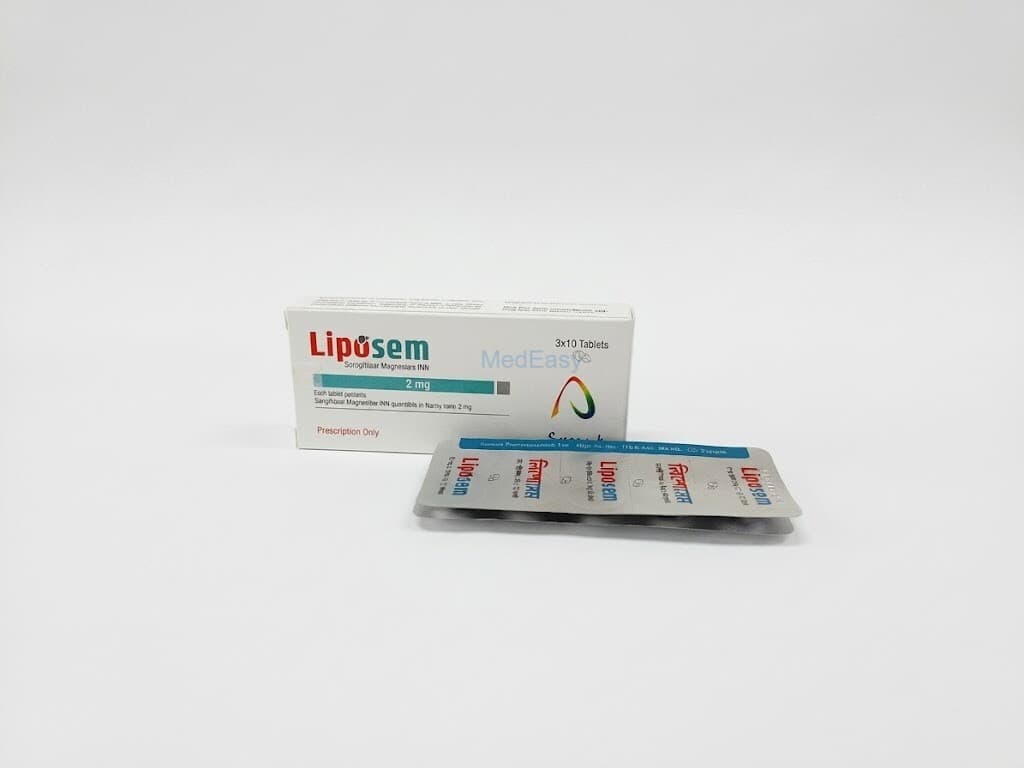
Liposem

Liposem2 mg

Tablet


By
MRP 700.0010 % Off
Best PriceTk /
1
Section

Medicine overview

Indications of Liposem 2 mg

including statins Helps reduce severe hypertriglyceridemiaLiposem 2 mg has demonstrated favorable effects on glycemic parameters

Pharmacology

Liposem 2 mg is a dual peroxisome proliferator-activated receptor (PPAR) agonist , with predominant PPAR- activity and moderate PPAR- activity.

Absorption

Mechanism of Action: PPAR Activation PPARs are nuclear receptor transcription factors activated by lipids.

Distribution

Reduction of Triglyceride Availability Promotes diversion of fatty acids from peripheral tissues (muscle and adipose tissue) to the liver Decreases triglyceride production and circulating lipid burden c.

Metabolism

It plays a significant role in regulating lipid metabolism, glucose homeostasis, and inflammatory processes, making it useful in managing diabetic dyslipidemia and hypertriglyceridemia. They regulate genes involved in: Lipid and lipoprotein metabolism Glucose homeostasis Inflammatory pathways Saroglitazar exerts its pharmacological effects primarily through: Strong PPAR- agonism Moderate PPAR- agonism This dual action results in both lipid-lowering and glucose-modulating effects. PPAR- Mediated Lipid Regulation Activation of PPAR- by Liposem 2 mg leads to multiple beneficial effects on lipid metabolism: a. Enhanced Fatty Acid Oxidation Increases hepatic oxidation of fatty acids Reduces triglyceride synthesis and secretion from the liver b. Reduction of Triglyceride Availability Promotes diversion of fatty acids from peripheral tissues (muscle and adipose tissue) to the liver Decreases triglyceride production and circulating lipid burden c. PPAR- Mediated Glucose Regulation Although less potent than its PPAR- activity, Saroglitazars PPAR- activation contributes to metabolic control: a. Regulation of Glucose Homeostasis Reduces hepatic glucose output Improves post-absorptive insulin-mediated suppression of glucose production c. Gene Expression Effects Upregulates genes involved in carbohydrate and lipid metabolism, including: Adiponectin Fatty acid binding protein (aP2) Lipoprotein lipase (LPL) Fatty acid transport protein (FATP) CD36 (fatty acid translocase) 4. Metabolic and Clinical Effects Through combined PPAR- and PPAR- activation, Liposem 2 mg provides: Reduction in fasting and postprandial free fatty acids Decreased metabolic stress on liver and skeletal muscle Improved insulin sensitivity Better glycemic control in Type 2 diabetes mellitus Reduction in cardiovascular risk factors associated with dyslipidemia 5. Preclinical and Clinical Evidence (Summary Insight) Demonstrated robust anti-dyslipidemic effects in lipid metabolism studies Showed significant anti-diabetic and insulin-sensitizing activity in preclinical models Clinical studies support its role in improving both lipid and glycemic parameters Overall Pharmacological Summary Liposem 2 mg works through: PPAR- activation lipid lowering, triglyceride reduction, HDL improvement PPAR- activation improved insulin sensitivity and glucose control Combined effect comprehensive cardiometabolic risk reduction.

Excretion

Improved Triglyceride Clearance Activates lipoprotein lipase (LPL) enhances breakdown of triglyceride-rich particles Reduces apolipoprotein C-III , an inhibitor of LPL further enhances TG clearance d.

Dosage & Administration of Liposem 2 mg

Proper dosing and administration of Liposem 2 mg is important to achieve optimal control of diabetic dyslipidemia and hypertriglyceridemia while ensuring patient safety.

Recommended Adult Dosage

  • The recommended dose is 2 tablets of 2 mg once daily
  • Should be taken orally, once a day, preferably at the same time each day for consistent therapeutic effect
  • Can be taken with or without food, as directed by the physician

Administration Guidelines

  • Swallow tablets whole with a sufficient amount of water
  • Do not crush or chew the tablets
  • Use as part of a comprehensive management plan including:
    • Dietary modification
    • Physical activity
    • Glycemic and lipid monitoring

Pediatric Use

  • Safety and effectiveness in children and adolescents below 18 years have not been established
  • Use is not recommended in the pediatric population unless specifically advised by a specialist

Geriatric Use

  • Elderly patients may have multiple comorbidities and concurrent medications
  • Liposem 2 mg should be used with caution in geriatric patients
  • Dose adjustment is generally not required, but careful clinical monitoring is recommended

Clinical Monitoring Recommendations (Expanded Guidance)

During therapy, periodic monitoring may include:

  • Lipid profile (TG, LDL, HDL, VLDL, non-HDL cholesterol)
  • Glycemic parameters (Fasting plasma glucose, HbA1c)
  • Liver function tests, if clinically indicated

Interaction of Liposem 2 mg

Liposem 2 mg has been evaluated for its potential to interact with commonly involved drug-metabolizing enzymes, particularly the cytochrome P450 (CYP) system. Overall, available data suggest a low potential for clinically significant drug–drug interactions .
1. Cytochrome P450 (CYP) Enzyme Profile
In vitro studies using recombinant human CYP isozymes indicate that Liposem 2 mg:
Does not significantly inhibit the following CYP enzymes at tested concentrations:
Does not induce CYP3A4 activity in cell-based reporter assays (HepG2 models)
These findings suggest that Liposem 2 mg is unlikely to interfere with major hepatic drug metabolism pathways .
2. Drug–Drug Interaction Potential
Although formal clinical interaction studies are limited , in vitro data demonstrate minimal interaction potential.
The tested concentrations in studies were higher than the expected therapeutic plasma levels , supporting a low likelihood of clinically relevant interactions.
Based on current evidence, Liposem 2 mg is considered unlikely to cause significant CYP-mediated drug interactions .
3. Concomitant Use with Other Medications
Liposem 2 mg is commonly used in patients with Type 2 diabetes mellitus who are already receiving multiple therapies, such as:
Antidiabetic agents (e.g., metformin, insulin, sulfonylureas)
Lipid-lowering drugs (e.g., statins)
Antihypertensive medications
No clinically significant interaction patterns have been established with these drug classes, but routine clinical monitoring is advised.
4. Clinical Considerations (Safety Monitoring)
Monitor lipid and glucose parameters when used with other metabolic drugs
Observe for additive effects when combined with other lipid-lowering therapies
Use caution in patients receiving multiple long-term medications, especially in polypharmacy settings
Overall Interaction Summary
Minimal inhibition or induction of major CYP enzymes
Low likelihood of clinically significant drug interactions
Suitable for use in combination therapy for cardiometabolic disorders under medical supervision

Contraindications

Liposem 2 mg is generally well tolerated; however, its use is contraindicated in specific situations to ensure patient safety.

Primary Contraindication

  • Known hypersensitivity to Liposem 2 mg or any of its excipients

Patients who have previously experienced allergic reactions to the active substance or formulation components should avoid its use due to the risk of hypersensitivity reactions.

Clinical Considerations (Expanded Safety Context)

Although not additional formal contraindications, caution is advised in the following situations:

  • History of drug-induced allergic reactions to lipid-lowering or antidiabetic agents
  • Patients with unexplained hypersensitivity reactions after starting new medications
  • Use in complex polypharmacy cases where causality of adverse reactions may be difficult to identify

Side Effects of Liposem 2 mg

Liposem 2 mg is generally well tolerated in clinical use. In controlled clinical studies, most adverse effects were mild to moderate in intensity and rarely led to discontinuation of therapy.

Overall Tolerability Profile

Across phase III clinical trials (12–24 weeks duration), Liposem 2 mg demonstrated a favorable safety profile, with most patients completing therapy without significant adverse events.

Common Side Effects (≥ 2%)

The most frequently reported adverse events include:

  • Gastritis (gastric discomfort or inflammation)
  • Asthenia (generalized weakness or fatigue)
  • Pyrexia (fever)

These effects were generally mild to moderate and transient in nature.

Severity and Treatment Continuation

  • Most adverse events did not require discontinuation of treatment
  • Symptoms were typically self-limiting or manageable with supportive care
  • No major safety signals were identified in controlled clinical studies

Clinical Trial Context

  • Adverse event rates observed in clinical trials may vary depending on study design, population, and duration
  • Direct comparison with other medications should be interpreted cautiously
  • Real-world incidence may differ from controlled study settings

Pregnancy & Lactation

The safety of Liposem 2 mg during pregnancy and breastfeeding has not been fully established in well-controlled clinical studies. Therefore, its use in these populations requires careful risk–benefit assessment.

Pregnancy

  • Classified as Pregnancy Category C
  • Adequate and well-controlled studies in pregnant women are not available
  • Animal or clinical data are insufficient to confirm safety in human pregnancy

Clinical considerations:

  • Liposem 2 mg should be used during pregnancy only if clearly needed
  • The potential benefit must outweigh the potential risk to the fetus
  • Women who become pregnant while taking this medication should consult a physician immediately

Lactation (Breastfeeding)

  • It is currently unknown whether Liposem 2 mg is excreted in human breast milk
  • Due to lack of safety data, use is not recommended during breastfeeding

Clinical recommendation:

  • Nursing mothers should generally avoid using Liposem 2 mg
  • Alternative therapies with established safety profiles may be preferred during lactation

Clinical Summary

  • Insufficient evidence to confirm safety in pregnancy
  • Use only when absolutely necessary under strict medical supervision
  • Not recommended during breastfeeding due to unknown excretion profile

Precautions & Warnings

Liposem 2 mg should be used with appropriate caution in certain patient populations, particularly those with underlying hepatic, renal, muscular, or cardiovascular conditions.

1. Liver and Renal Function Impairment

  • Treatment should be initiated with caution in patients with:
    • Abnormal liver function tests
    • Impaired renal function

Clinical considerations:

  • Periodic monitoring of liver and kidney function may be required
  • Dose adjustment may be considered based on clinical status and physician evaluation

2. History of Myopathy or Muscle Disorders

  • Caution is advised in patients with a history of:
    • Myopathies
    • Muscle-related disorders

Clinical considerations:

  • Patients should be monitored for:
    • Muscle pain
    • Weakness
    • Elevated muscle enzyme levels (if clinically indicated)

3. Cardiovascular Disease and Heart Failure Risk

  • Use with caution in patients with Type 2 diabetes mellitus and underlying cardiac disease, especially those with:
    • History of congestive heart failure (CHF)
    • Episodic or unstable heart failure

Monitoring requirements:

  • Patients should be closely observed for:
    • Shortness of breath
    • Edema
    • Signs and symptoms of worsening heart failure

4. Fluid Retention and Weight Gain

  • Rapid weight gain may indicate fluid retention or volume overload
  • Patients should be evaluated for:
    • Peripheral edema
    • Fluid accumulation
    • Signs of congestive heart failure

Clinical action:

  • Appropriate medical evaluation and intervention should be initiated if fluid retention is suspected

Overall Safety Summary

  • Use cautiously in patients with hepatic, renal, muscular, or cardiac comorbidities
  • Regular clinical monitoring is recommended in high-risk patients
  • Early detection of fluid retention or heart failure symptoms is essential

Overdose Effects of Liposem 2 mg

Clinical experience with Liposem 2 mg indicates that overdose cases are rare, and no confirmed instances of clinically significant overdose have been reported in controlled studies.

Overall Safety in Overdose

  • No documented cases of intentional or accidental overdose have been reported in clinical trials
  • The available safety data suggest a favorable tolerability profile even at higher exposure levels
  • Specific toxic dose thresholds have not been clearly established

Potential Clinical Manifestations (Theoretical Considerations)

Although not observed in studies, in the event of excessive intake, possible effects may include:

  • Gastrointestinal discomfort (e.g., nausea, gastric irritation)
  • General weakness or fatigue
  • Metabolic imbalance related to lipid or glucose regulation (theoretical)

Management of Suspected Overdose

In case of suspected overdose, management should be supportive and symptomatic, including:

  • Monitoring of vital signs (blood pressure, heart rate, respiratory status)
  • Clinical observation for any emerging symptoms
  • Supportive care based on patient condition

Storage Conditions

Store below 25°C and dry place, away from light and moisture. Keep out of the reach of children.

Frequently Asked Questions

What is Liposem 2 mg used for?

Saroglitazar Magnesium is a dual PPAR (Peroxisome Proliferator-Activated Receptor) agonist indicated primarily for the management of diabetic dyslipidemia and hypertriglyceridemia , especially in patients with Type 2 diabetes mellitus who are not adequately controlled with statin therapy. 1. Diabetic Dyslipidemia Saroglitazar Magnesium is indicated for the treatment of lipid abnormalities associat…

What is the dosage of Liposem 2 mg?

Proper dosing and administration of Saroglitazar Magnesium is important to achieve optimal control of diabetic dyslipidemia and hypertriglyceridemia while ensuring patient safety. Recommended Adult Dosage The recommended dose is 2 tablets of 2 mg once daily Should be taken orally, once a day , preferably at the same time each day for consistent therapeutic effect Can be taken with or without food …

What are the side effects of Liposem 2 mg?

Saroglitazar Magnesium is generally well tolerated in clinical use. In controlled clinical studies, most adverse effects were mild to moderate in intensity and rarely led to discontinuation of therapy. Overall Tolerability Profile Across phase III clinical trials (12–24 weeks duration), Saroglitazar Magnesium demonstrated a favorable safety profile, with most patients completing therapy without si…

Who should not take Liposem 2 mg?

Saroglitazar Magnesium is generally well tolerated; however, its use is contraindicated in specific situations to ensure patient safety. Primary Contraindication Known hypersensitivity to Saroglitazar Magnesium or any of its excipients Patients who have previously experienced allergic reactions to the active substance or formulation components should avoid its use due to the risk of hypersensitivi…

What precautions should be taken with Liposem 2 mg?

Saroglitazar Magnesium should be used with appropriate caution in certain patient populations, particularly those with underlying hepatic, renal, muscular, or cardiovascular conditions. 1. Liver and Renal Function Impairment Treatment should be initiated with caution in patients with: Abnormal liver function tests Impaired renal function Clinical considerations: Periodic monitoring of liver and ki…

Is Liposem 2 mg safe during pregnancy and breastfeeding?

The safety of Saroglitazar Magnesium during pregnancy and breastfeeding has not been fully established in well-controlled clinical studies. Therefore, its use in these populations requires careful risk–benefit assessment. Pregnancy Classified as Pregnancy Category C Adequate and well-controlled studies in pregnant women are not available Animal or clinical data are insufficient to confirm safety i…

Disclaimer

The information provided is accurate to our best practices, but it does not replace professional medical advice. We cannot guarantee its completeness or accuracy. The absence of specific information about a drug should not be seen as an endorsement. We are not responsible for any consequences resulting from this information, so consult a healthcare professional for any concerns or questions.