
10% Off
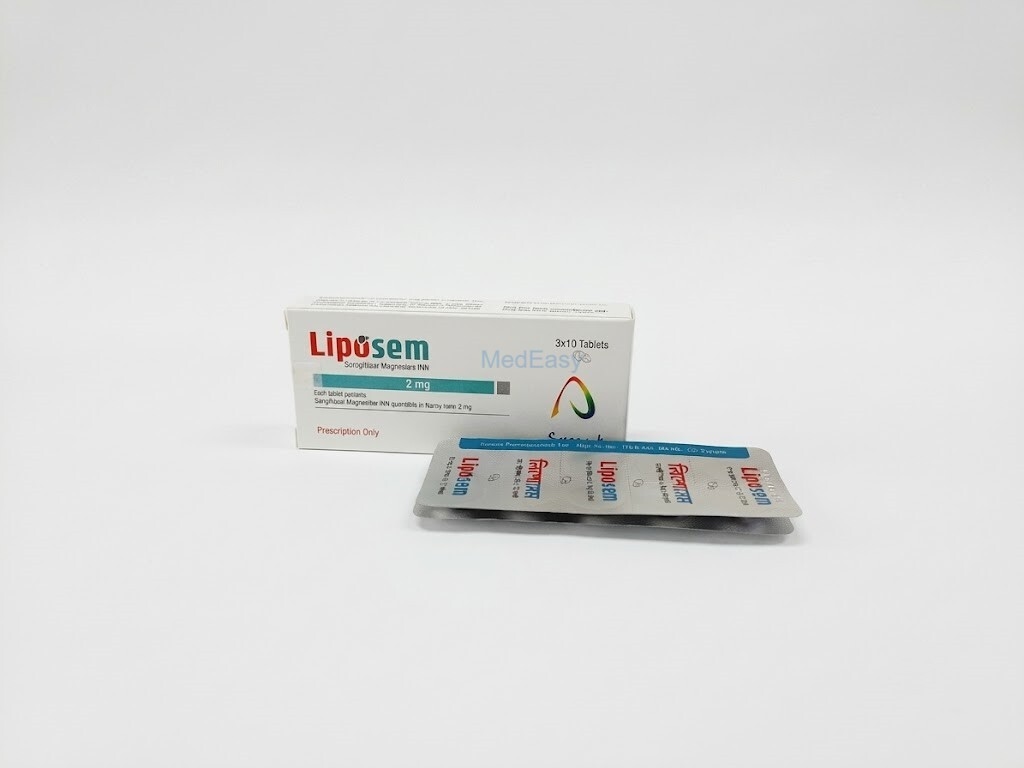
Liposem2 mg
Everest Pharmaceuticals Ltd.
৳630.00
Add to cart
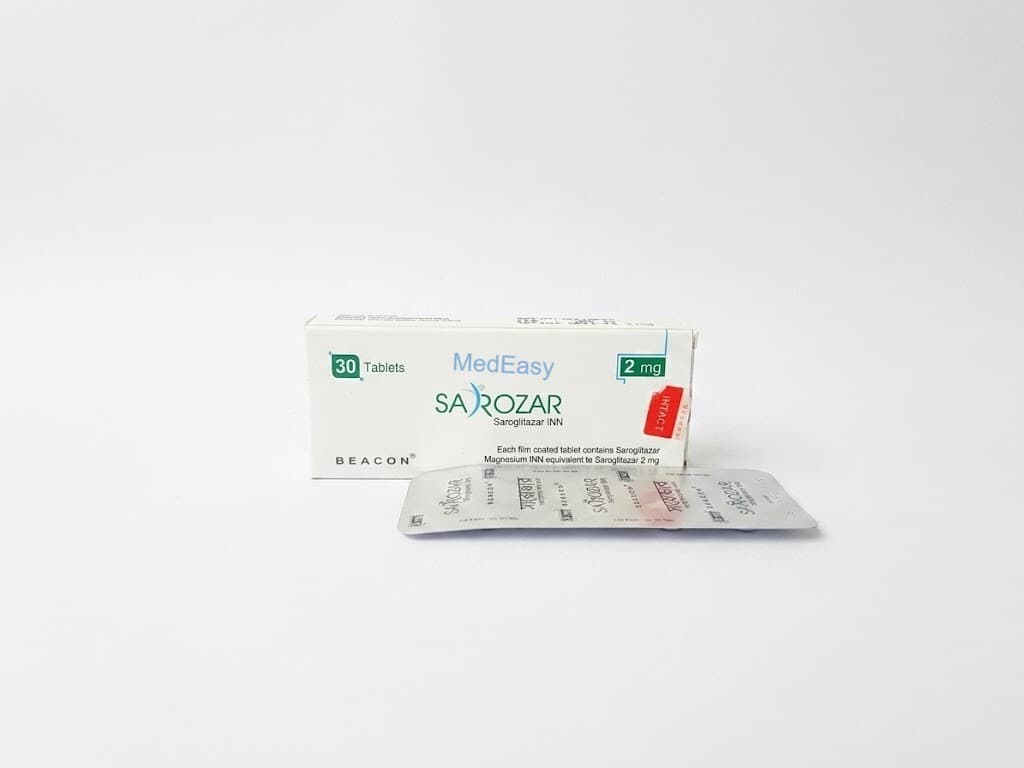

Sarozar is a dual PPAR-alpha/gamma agonist indicated for the following uses:
Sarozar is a relatively newer, regionally-approved agent; it should be used within its approved indications and under physician supervision.
Each film-coated tablet contains Saroglitazar Magnesium equivalent to 2 mg or 4 mg of saroglitazar, along with pharmaceutically approved excipients.
Sarozar is a novel dual peroxisome proliferator-activated receptor (PPAR) agonist, predominantly acting on PPAR-alpha with moderate PPAR-gamma agonistic activity. It was developed to address diabetic dyslipidemia, a combination of high triglycerides and insulin resistance commonly seen in type 2 diabetes. Sarozar is approved and marketed in select markets, including the Indian subcontinent, and is available in Bangladesh as an oral tablet.
Saroglitazar Magnesium acts as a dual agonist of peroxisome proliferator-activated receptors (PPAR):
In vitro studies indicate Saroglitazar Magnesium does not significantly inhibit or induce major cytochrome P450 enzymes, suggesting a relatively low potential for clinically significant drug-drug interactions via this pathway.
| Indication | Recommended Dose |
|---|---|
| Diabetic dyslipidemia / hypertriglyceridemia with type 2 diabetes (add-on to statin) | 4 mg once daily (as two 2 mg tablets or one 4 mg tablet), taken orally with or without food |
| NAFLD/NASH (in markets where approved) | 4 mg once daily, per treating physician's assessment and local approved labeling |
Tablets should be swallowed whole with water. Dose should not be adjusted or increased without physician advice. Periodic monitoring of lipid profile, blood glucose, and liver function is recommended during treatment. See Precautions and Warnings for renal/hepatic impairment considerations.
Sarozar tablets are taken orally, once daily, with or without food, swallowed whole with a glass of water. Do not crush or chew unless directed by a physician.
In vitro data suggest Sarozar has a low potential for cytochrome P450-mediated drug interactions. However, clinically relevant considerations include:
Inform the treating physician of all other medicines being taken before starting Sarozar.
Saroglitazar Magnesium is contraindicated in patients with known hypersensitivity to Saroglitazar Magnesium or to any excipient in the formulation.
The most commonly reported adverse effects of Sarozar (occurring in more than 2% of patients) include:
Other reported effects include mild elevations in liver enzymes, myalgia, and increases in serum creatinine. Most adverse events have been mild to moderate and generally did not require discontinuation. See Precautions and Warnings for fluid retention/edema and hepatic monitoring guidance.
Sarozar is classified under pregnancy category C. Adequate and well-controlled studies in pregnant women are not available. Sarozar should be used during pregnancy only if clearly needed and the potential benefit justifies the potential risk to the fetus; consult a physician before use.
It is not known whether Sarozar is excreted in human breast milk. Because many drugs are excreted in breast milk, caution should be exercised and a physician consulted before use of Sarozar in breastfeeding mothers; if necessary, an alternative feeding method or discontinuation of the drug should be considered based on medical advice.
Use Sarozar with caution in the following situations:
No cases of overdose with Sarozar have been reported in clinical use. In the event of a suspected overdose, seek immediate medical attention or contact emergency services/poison control. Management should consist of general supportive care, including monitoring of vital signs and symptomatic treatment as directed by a physician.
Store below 25°C in a dry place, protected from light and moisture. Keep out of reach of children.
Hepatic impairment: Use Sarozar with caution; periodic liver function monitoring is advised (see Precautions and Warnings).
Renal impairment: Use Sarozar with caution and monitor renal function; dose adjustment recommendations are not well established for severe renal impairment, so specific product labeling should be verified.
Elderly: Use Sarozar with caution in elderly patients, considering the likelihood of comorbidities such as cardiac or hepatic/renal disease.
Pediatric patients: Safety and efficacy of Sarozar have not been established in patients under 18 years of age; use in this group is not recommended.
The duration of treatment with Sarozar is individualized by the treating physician based on lipid profile, glycemic control, and liver-related parameters (where relevant), with periodic reassessment. Do not stop or extend treatment without medical advice.
Saroglitazar Magnesium belongs to the glitazar class - a dual PPAR-alpha/gamma (peroxisome proliferator-activated receptor) agonist.
Saroglitazar Magnesium acts as a dual PPAR-alpha/PPAR-gamma agonist: PPAR-alpha activation lowers triglycerides and improves the overall lipid profile, while PPAR-gamma activation improves insulin sensitivity and glycemic control.
C
Safety and efficacy of Sarozar have not been established in pediatric patients (under 18 years of age). Its use is therefore not recommended in this age group.
Q: What is Sarozar 2 mg Tablet used for?
A: Sarozar 2 mg Tablet is used to treat diabetic dyslipidemia and hypertriglyceridemia in people with type 2 diabetes whose lipid levels are not adequately controlled by statin therapy alone. In some markets it is also used for non-alcoholic fatty liver disease (NAFLD) and non-alcoholic steatohepatitis (NASH).
Q: How should I take Sarozar 2 mg Tablet?
A: Sarozar 2 mg Tablet is usually taken as a 4 mg dose once daily by mouth, with or without food, swallowed whole with water. Always follow your physician's specific instructions and do not change the dose on your own.
Q: Can Sarozar 2 mg Tablet be taken during pregnancy or while breastfeeding?
A: Sarozar 2 mg Tablet falls under pregnancy category C and should be used in pregnancy only if clearly needed and the benefit outweighs the potential risk to the fetus. It is not known whether Sarozar 2 mg Tablet passes into breast milk, so breastfeeding mothers should consult their physician before using it.
Q: What are the common side effects of Sarozar 2 mg Tablet?
A: The most commonly reported side effects of Sarozar 2 mg Tablet include gastritis, weakness (asthenia), and fever (pyrexia). Some patients may experience mild liver enzyme elevation, muscle aches, or increased serum creatinine. Most side effects are mild to moderate.
Q: Who should not take Sarozar 2 mg Tablet?
A: Sarozar 2 mg Tablet should not be used by anyone with a known hypersensitivity (allergy) to Sarozar 2 mg Tablet or to any of its excipients.
Q: What should I do if I miss a dose or take too much Sarozar 2 mg Tablet?
A: If you miss a dose, take it as soon as you remember unless it is close to the next dose - do not double the dose. If an overdose is suspected, seek immediate medical attention or contact emergency services/poison control right away.
Disclaimer
The information provided is accurate to the best of our knowledge, but it does not replace professional medical advice. We cannot guarantee its completeness or accuracy, and the absence of specific information about a drug should not be taken as an endorsement. We are not responsible for any consequences arising from this information, so please consult a healthcare professional for any concerns or questions.
