
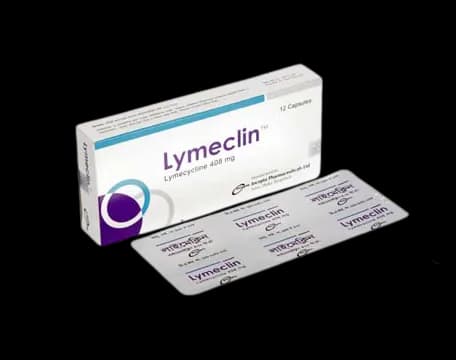

Medicine overview
Indications of Lymeclin
Lymeclin is a tetracycline-class antibiotic used for the following indications:
Established / Approved Uses
- Moderate to severe acne vulgaris, particularly inflammatory acne, as part of a comprehensive skin-care regimen.
- Treatment of susceptible bacterial infections, including:
- Respiratory tract infections (e.g., bronchitis, sinusitis)
- Urinary tract infections caused by susceptible organisms
- Skin and soft tissue infections
- Infections caused by atypical organisms such as Chlamydia, Mycoplasma, and Rickettsia species
Adjunct / Off-label Uses
- Rosacea (used off-label in some regions for its anti-inflammatory and antibacterial effects).
Lymeclin should only be used for infections confirmed or strongly suspected to be caused by susceptible bacteria; it is not effective against viral infections.
Composition
Each capsule of Lymecycline contains Lymecycline (INN) 408 mg, equivalent to approximately 300 mg of tetracycline base.
Description
Lymeclin is a semisynthetic, highly water-soluble tetracycline-class antibiotic (a lysine conjugate of tetracycline). Its high solubility allows it to be absorbed via an active carrier-mediated transport mechanism in the intestine, similar to that used for amino acids, giving it more predictable absorption than some older tetracyclines. Lymeclin is used both as an antibacterial agent and, at standard doses, in the long-term management of inflammatory acne.
Therapeutic Class
Tetracycline-class antibiotic (Tetracyclines), ATC code J01AA04.
Pharmacology
Lymecycline is a bacteriostatic antibiotic. It works by reversibly binding to the 30S ribosomal subunit of susceptible bacteria, blocking the attachment of aminoacyl-tRNA to the mRNA-ribosome complex and thereby inhibiting bacterial protein synthesis.
Lymecycline has activity against a broad range of gram-positive and gram-negative bacteria, as well as atypical organisms such as Chlamydia, Mycoplasma, and Rickettsia species. In acne, Lymecycline also reduces inflammation by inhibiting bacterial lipases produced by Cutibacterium acnes and by direct anti-inflammatory effects, independent of its antibacterial action.
Pharmacokinetics
- Absorption: Rapidly and almost completely absorbed from the gastrointestinal tract via an active transport mechanism; less affected by food than some other tetracyclines, though co-administration with divalent/trivalent cations still markedly reduces absorption.
- Distribution: Widely distributed into body tissues and fluids; crosses the placenta and is present in breast milk.
- Elimination: Excreted mainly unchanged via the kidneys and, to a lesser extent, in the bile/faeces.
Dosage & Administration of Lymeclin
Acne Vulgaris (Adults and Children over 12 years)
408 mg (one capsule) of Lymeclin once daily, usually in the morning, for a minimum of 8 weeks. If there is no improvement, treatment should be reassessed by 3 months.
Susceptible Bacterial Infections (Adults)
| Infection severity | Dose |
|---|---|
| Mild to moderate infections | 408 mg once daily |
| Severe infections | Up to 408 mg twice daily, as directed by a physician |
Children (12 years and older)
Same dose as adults; Lymeclin is not recommended for children under 12 years of age (contraindicated under 8 years - see Contraindications).
Renal/Hepatic Impairment
Use with caution in patients with renal or hepatic impairment; tetracyclines may aggravate renal impairment and can accumulate with reduced clearance. Dose adjustment or avoidance may be required - consult a physician.
How to Take
- Swallow the capsule whole with a full glass of water; do not lie down immediately after taking a dose, to reduce the risk of esophageal irritation.
- May be taken with or without food; taking with food may reduce nausea.
- Avoid taking at the same time as antacids, dairy products, or supplements containing calcium, iron, magnesium, zinc, bismuth, or aluminium - separate dosing by at least 2-3 hours, as these reduce absorption of Lymeclin.
Take Lymeclin exactly as prescribed by your physician; do not stop, extend, skip doses, or share this medicine with others without medical advice.
Administration of Lymeclin
Lymeclin capsules should be swallowed whole with a full glass of water, taken at roughly the same time each day, and not taken immediately before lying down. It can be taken with or without food; separate dosing from antacids, dairy, and mineral supplements by 2-3 hours.
Interaction of Lymeclin
| Interacting agent | Effect |
|---|---|
| Antacids and mineral supplements (calcium, iron, magnesium, zinc, bismuth, aluminium) and dairy products | Significantly reduce absorption of Lymeclin; separate dosing by 2-3 hours. |
| Oral retinoids (isotretinoin, acitretin) | Increased risk of pseudotumor cerebri (benign intracranial hypertension) when combined with Lymeclin; avoid concurrent use. |
| Warfarin and other oral anticoagulants | Lymeclin may potentiate anticoagulant effect; monitor INR/coagulation status closely. |
| Oral contraceptives | A theoretical, debated reduction in contraceptive efficacy has been reported with tetracyclines; advise additional (barrier) contraception during and shortly after treatment with Lymeclin. |
| Penicillin-class antibiotics | Lymeclin, being bacteriostatic, may antagonize the bactericidal action of penicillins; avoid concurrent use where possible. |
| Lithium, methotrexate, digoxin | Lymeclin may increase serum levels/toxicity of these drugs; monitor accordingly. |
Contraindications
- Known hypersensitivity to Lymecycline or any other tetracycline-class antibiotic.
- Pregnancy - Lymecycline can cause permanent tooth discoloration and inhibit bone growth in the developing fetus.
- Breastfeeding - Lymecycline passes into breast milk and may affect the infant's developing teeth and bones.
- Children under 8 years of age - due to the risk of permanent tooth discoloration and inhibition of bone growth.
Side Effects of Lymeclin
Common
- Nausea, vomiting, diarrhea, abdominal pain
- Headache
- Photosensitivity (increased skin sensitivity to sunlight)
Less Common / Rare
- Rash, dermatitis, hypersensitivity reactions
- Esophageal irritation/esophagitis (see Precautions for prevention)
- Hepatotoxicity (elevated liver enzymes, jaundice - dark urine, yellowing of skin/eyes)
- Pseudotumor cerebri / benign intracranial hypertension (headache, visual disturbances) - rare, more common with concurrent retinoid use
- Visual disturbances
- Superinfection, including oral or vaginal candidiasis, with prolonged use
Seek immediate medical attention for signs of a severe allergic reaction (swelling of face/lips/throat, difficulty breathing, severe rash) or symptoms of liver problems while taking Lymeclin.
Pregnancy & Lactation
Lymeclin is contraindicated during pregnancy, as tetracyclines cross the placenta and can cause permanent discoloration of the child's teeth and inhibit bone growth if used during the second and third trimesters. Lymeclin should not be used during pregnancy; if pregnancy occurs or is suspected during treatment, a physician should be consulted immediately to switch to an alternative antibiotic.
Lymeclin passes into breast milk and is generally not recommended during breastfeeding. If use during breastfeeding is considered unavoidable by a physician, it should be limited to short courses, with the infant monitored for feeding problems, diarrhea, rash, or oral thrush; consult a physician before use.
Precautions & Warnings
- Photosensitivity: Lymeclin may increase sensitivity to sunlight and UV light; avoid excessive sun exposure and use sun protection during treatment.
- Esophageal irritation: take with adequate water and remain upright (avoid lying down) for at least 30 minutes after dosing.
- Pseudotumor cerebri: rare; discontinue and seek medical advice promptly if severe headache or visual disturbances occur, especially if taken with oral retinoids.
- Reduced oral contraceptive efficacy: a debated, theoretical interaction; advise backup contraception during treatment.
- Absorption interference: avoid concurrent antacids, dairy products, or iron/mineral supplements - see Interactions.
- Renal/hepatic impairment: use with caution; see Use in Special Populations.
- Superinfection: prolonged use may result in overgrowth of non-susceptible organisms, including Clostridioides difficile-associated diarrhea.
- Autoimmune conditions: use with caution in patients with systemic lupus erythematosus or myasthenia gravis, as tetracyclines may worsen these conditions.
- Antibiotic stewardship: Take Lymeclin exactly as prescribed by your physician; do not stop, extend, skip doses, or share this medicine with others without medical advice.
Overdose Effects of Lymeclin
Symptoms of Lymeclin overdose may include nausea, vomiting, diarrhea, and abdominal discomfort. There is no specific antidote. In case of a suspected overdose, seek immediate medical attention or contact a poison control center; do not attempt home treatment. Supportive care and monitoring will be provided by medical professionals as needed.
Storage Conditions
Store at room temperature (below 30°C), away from light and moisture. Keep out of reach of children. Do not use beyond the expiry date printed on the pack.
Use In Special Populations
- Pregnancy: Contraindicated - see Pregnancy and Lactation.
- Breastfeeding: Not recommended - see Pregnancy and Lactation.
- Children under 8 years: Contraindicated due to effects on teeth and bone development.
- Children 8-12 years: Not generally recommended; use only if a physician determines benefits outweigh risks.
- Elderly: No specific dose adjustment is generally required, but renal function should be considered.
- Renal impairment: Use with caution; may require dose adjustment or avoidance in severe impairment.
- Hepatic impairment: Use with caution; monitor liver function during prolonged treatment.
Duration Of Treatment
For acne vulgaris, Lymeclin is typically used for a minimum of 8 weeks, with reassessment of response by 12 weeks (3 months); if no improvement is seen, an alternative treatment should be considered. For bacterial infections, the duration of Lymeclin treatment is generally 7-14 days depending on the type and severity of infection, as directed by a physician. The full course should always be completed even if symptoms improve early.
Drug Classes
Tetracyclines; Antibacterials for systemic use (ATC classification: J01AA04).
Mode Of Action
Lymecycline inhibits bacterial protein synthesis by reversibly binding to the 30S ribosomal subunit, preventing attachment of aminoacyl-tRNA to the mRNA-ribosome complex. This bacteriostatic action, combined with anti-inflammatory effects on sebaceous gland activity and Cutibacterium acnes-related inflammation, underlies its efficacy in both bacterial infections and acne.
Pediatric Uses
Lymeclin is contraindicated in children under 8 years of age due to the risk of permanent tooth discoloration and inhibition of bone growth. It is generally not recommended for children under 12 years of age. In adolescents 12 years and older, Lymeclin may be used at the standard adult dose for approved indications such as acne vulgaris and susceptible infections, under medical supervision. Safety and efficacy in children under 8 years have not been established and use is contraindicated in this age group.
Frequently Asked Questions
Q: What is Lymeclin 408 mg Capsule used for?
A: Lymeclin 408 mg Capsule is a tetracycline-class antibiotic used to treat moderate to severe acne vulgaris and susceptible bacterial infections such as respiratory tract, urinary tract, and skin infections.
Q: How should I take Lymeclin 408 mg Capsule?
A: Lymeclin 408 mg Capsule should be swallowed whole with a full glass of water, at around the same time each day, and not taken immediately before lying down. Avoid taking it at the same time as antacids, dairy products, or iron/mineral supplements, as these reduce its absorption.
Q: Can I take Lymeclin 408 mg Capsule during pregnancy or while breastfeeding?
A: No. Lymeclin 408 mg Capsule is contraindicated during pregnancy because it can cause permanent tooth discoloration and affect bone growth in the developing baby. It is also not recommended during breastfeeding, as it passes into breast milk. Always consult your physician before use if you are pregnant, trying to conceive, or breastfeeding.
Q: Can children take Lymeclin 408 mg Capsule?
A: Lymeclin 408 mg Capsule is contraindicated in children under 8 years of age and is generally not recommended under 12 years, because it can cause permanent tooth discoloration and affect bone growth. It may be used in adolescents 12 years and older under medical supervision.
Q: What should I do if I miss a dose of Lymeclin 408 mg Capsule?
A: Take the missed dose of Lymeclin 408 mg Capsule as soon as you remember, unless it is almost time for your next dose - in that case, skip the missed dose and continue your regular schedule. Do not take a double dose to make up for a missed one.
Q: What are the common side effects of Lymeclin 408 mg Capsule?
A: Common side effects of Lymeclin 408 mg Capsule include nausea, diarrhea, abdominal pain, headache, and increased sensitivity to sunlight. Seek medical attention promptly if you develop a severe rash, difficulty breathing, yellowing of the skin or eyes, or severe headache with visual changes.
Disclaimer
The information provided is accurate to the best of our knowledge, but it does not replace professional medical advice. We cannot guarantee its completeness or accuracy, and the absence of specific information about a drug should not be taken as an endorsement. We are not responsible for any consequences arising from this information, so please consult a healthcare professional for any concerns or questions.
