
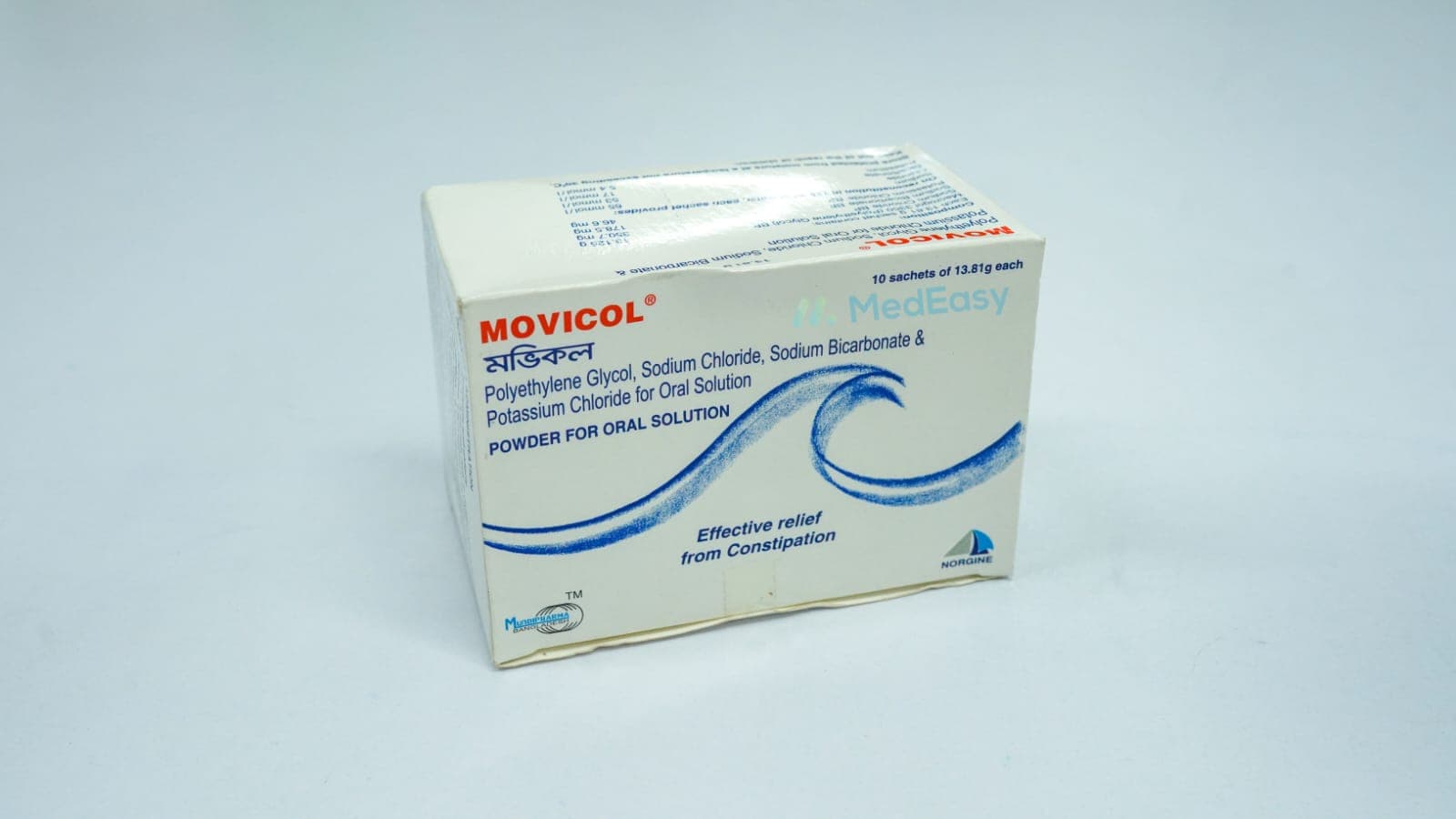

Medicine overview
Indications of Movicol
Established / Guideline-Supported Uses
- Chronic constipation in adults and adolescents, including constipation associated with irritable bowel syndrome, for the long-term relief of symptoms. Movicol is used as maintenance therapy taken daily, dissolved in water.
- Faecal (faecal) impaction — a short course of Movicol at a higher, disimpaction dose is used to clear an impacted bowel before switching to a lower maintenance dose.
- Bowel cleansing / bowel preparation prior to colonoscopy, barium enema, or abdominal/colorectal surgery, where a large-volume, higher-concentration formulation of Movicol is used to empty the colon completely so the bowel wall can be examined or operated on safely.
Adjunct / Combination Use
- Movicol bowel-cleansing regimens are sometimes combined with a stimulant laxative (e.g., bisacodyl) or a split-dose schedule to improve the quality of colon cleansing before endoscopy, as directed by the endoscopist.
Movicol is not indicated for the treatment of the underlying cause of constipation, and should not be used for weight loss or as a substitute for dietary/lifestyle measures without medical advice.
Composition
Macrogol + Electrolytes is a combined osmotic laxative preparation supplied as a powder for oral solution (sachet form). Each sachet typically contains:
- Macrogol (polyethylene glycol, PEG 3350 or PEG 4000) — the high-molecular-weight osmotic agent, in variable strength depending on the specific product (e.g., maintenance-strength or high-volume bowel-preparation strength).
- Sodium chloride
- Sodium bicarbonate (or sodium sulfate, in some bowel-preparation formulations)
- Potassium chloride
The exact quantities of macrogol and each electrolyte vary between the low-dose (maintenance) sachet and the high-volume (bowel-cleansing) sachet of Macrogol + Electrolytes; the electrolyte content is specifically balanced to minimise net absorption or loss of sodium, potassium, and water from the body when large volumes are ingested.
Description
Movicol is an osmotic laxative combination consisting of macrogol (polyethylene glycol, a large, inert polymer) together with a balanced electrolyte mixture (sodium chloride, sodium bicarbonate, and potassium chloride). It is supplied as a powder that is dissolved in water before drinking.
Movicol works by retaining water within the bowel lumen through an osmotic effect, which softens the stool, increases stool bulk, and stimulates the natural urge to defecate, without being significantly absorbed into the bloodstream or metabolised by the body. The accompanying electrolytes are included so that, even when patients drink large volumes for bowel cleansing, there is minimal net gain or loss of body sodium, potassium, or water.
Movicol is used both as a once- or twice-daily maintenance treatment for chronic constipation and, in a different (higher-volume) formulation and dose, as a same-day or split-dose bowel-cleansing preparation before colonoscopy or bowel surgery.
Therapeutic Class
Movicol belongs to the osmotic laxative class of medicines, and its high-volume formulation is additionally classified as a bowel evacuant / bowel-cleansing preparation used for pre-procedure gut preparation.
Pharmacology
Mechanism of Action
The macrogol (polyethylene glycol) component of Macrogol + Electrolytes is a long-chain polymer that is neither absorbed from, nor metabolised in, the gastrointestinal tract. It forms hydrogen bonds with water molecules, holding water within the bowel lumen and preventing its absorption across the gut wall. This osmotic retention of water increases the volume and softness of the stool and mechanically stimulates colonic motility (peristalsis), producing a bowel movement typically within 24–48 hours for the constipation indication, or rapid, repeated watery evacuation within 1–2 hours at the high doses used for bowel cleansing.
Role of the Electrolytes
The added sodium chloride, sodium bicarbonate, and potassium chloride in Macrogol + Electrolytes create an iso-osmotic (electrolyte-balanced) solution. This balance is specifically designed so that, when the solution passes through the gut, there is no significant net movement of the body's own sodium, potassium, or water into or out of the bloodstream — an important safety feature, particularly for the large volumes used in bowel-preparation regimens.
Pharmacokinetics
Macrogol + Electrolytes acts locally within the gastrointestinal tract. The macrogol component is essentially not absorbed systemically and is excreted unchanged in the faeces; only a very small fraction of the electrolyte load is absorbed under normal use.
Dosage & Administration of Movicol
Chronic Constipation (Maintenance Dose) — Adults and Adolescents
The usual starting dose of Movicol (maintenance-strength sachet) is 1–3 sachets per day, each dissolved in the volume of water stated on the product label, taken as a single dose or in divided doses through the day. The dose is adjusted according to individual response, then reduced to the lowest effective maintenance dose.
Faecal Impaction (Short-Term, Higher Dose)
For disimpaction, a higher number of sachets of Movicol (as advised by the prescriber, often up to 8 sachets/day) dissolved in water is taken over a short course, usually not exceeding 3 days, and is normally used under medical supervision, especially in frail or elderly patients.
Bowel Preparation Before Colonoscopy / Surgery
| Regimen | Typical Dose |
|---|---|
| Single-dose (evening before procedure) | Full course of the high-volume Movicol solution (commonly 2–4 litres total), taken over 2–4 hours the evening before the procedure. |
| Split-dose (preferred where recommended by the endoscopist) | Roughly half the volume taken the evening before, and the remaining half taken 4–6 hours before the procedure, completing intake at least 2 hours before the procedure starts. |
The exact volume, sachet number, and timing must follow the specific product instructions and the endoscopist's/surgeon's written bowel-preparation instructions, as strengths of Movicol vary by brand.
Renal/Hepatic Impairment
No specific dose reduction is established for mild-to-moderate renal or hepatic impairment for the maintenance indication, but Movicol should be used with caution and under closer monitoring in patients with significant renal impairment because of the electrolyte and fluid load (see Precautions and Warnings).
Administration of Movicol
Each sachet of Movicol should be emptied into the exact volume of drinking water stated on the pack (this varies between the maintenance-strength and bowel-preparation-strength sachets) and stirred until fully dissolved before drinking. The reconstituted solution should generally be consumed promptly, and any prepared solution not used within the time stated on the label (commonly within a few hours) should be discarded and freshly prepared. Movicol may be taken with or without food for the constipation indication; for bowel preparation, follow the specific fasting/fluid instructions given by the treating physician or endoscopy unit. Doses of other oral medicines should ideally be separated in time from Movicol intake (see Drug Interactions).
Interaction of Movicol
Because Movicol produces rapid transit of fluid through the gut and increases stool water content, it can reduce the absorption of other orally administered medicines if taken at the same time; other oral drugs should generally be taken at least 1–2 hours before or after Movicol, particularly for drugs with a narrow therapeutic index.
Because Movicol carries a sodium, potassium, and fluid load, caution and closer monitoring are advised when it is used together with medicines that also affect fluid or electrolyte balance, such as diuretics, ACE inhibitors, or angiotensin receptor blockers, as the combination may increase the risk of electrolyte disturbance, particularly in patients with renal or cardiac impairment.
Contraindications
Macrogol + Electrolytes is contraindicated in patients with:
- Known hypersensitivity to macrogol/polyethylene glycol or to any of the electrolyte components of Macrogol + Electrolytes.
- Bowel perforation or a known risk of gastrointestinal perforation.
- Bowel obstruction, or symptoms suggestive of obstruction (e.g., ileus).
- Severe inflammatory bowel disease, such as toxic megacolon or severe/fulminant ulcerative colitis or Crohn's disease.
- Gastric retention or severe disorders of gastric emptying (relevant to the high-volume bowel-preparation formulation of Macrogol + Electrolytes).
- Severe, uncorrected dehydration.
Side Effects of Movicol
Common
- Abdominal bloating and distension
- Abdominal pain or cramping
- Nausea
- Flatulence
Less Common
- Vomiting
- Diarrhoea (usually a sign that the dose of Movicol needs to be reduced)
- Perianal soreness or irritation with prolonged use
Rare
- Hypersensitivity reactions, including skin rash, urticaria, angioedema, and, very rarely, anaphylaxis
- Fluid or electrolyte disturbances (e.g., hyponatraemia, hypokalaemia) with excessive intake, prolonged use, or in at-risk patients
Pregnancy & Lactation
Pregnancy: Movicol is minimally absorbed from the gut, and available data have not shown it to be teratogenic; however, it should be used during pregnancy only if clearly needed and if the potential benefit justifies the potential risk, and only under medical advice, particularly for the high-volume bowel-preparation regimen.
Lactation: Because systemic absorption of the macrogol component of Movicol is minimal, it is generally considered compatible with breastfeeding when used at usual doses for constipation; nevertheless, a physician or pharmacist should be consulted before use during breastfeeding, especially for the bowel-preparation regimen.
Precautions & Warnings
- Cardiac impairment: Use Movicol with caution in patients with significant cardiac disease (e.g., heart failure), as the fluid and electrolyte shifts produced by large-volume regimens may precipitate cardiac arrhythmia or pulmonary oedema.
- Renal impairment: Use with caution and consider closer monitoring of fluid and electrolyte status in patients with impaired renal function, who are less able to correct any electrolyte disturbance caused by Movicol.
- Sodium-restricted diet: Patients on a sodium-restricted diet should be counselled that Movicol contains sodium, and its use should be discussed with a physician.
- Elderly and debilitated patients: Use Movicol with additional caution, and under supervision, in frail, elderly, or bedridden patients, and in those with impaired swallowing or a reduced gag reflex, because of the risk of regurgitation or aspiration with large-volume regimens.
- Unexplained abdominal pain: Movicol should not be started until serious organic disease (including bowel obstruction and perforation — see Contraindications) has been excluded in a patient with undiagnosed abdominal pain.
- Prolonged use: Long-term, unsupervised use of Movicol should be avoided; persistent constipation despite treatment should prompt medical review of the underlying cause.
Overdose Effects of Movicol
Overdose with Movicol is most likely to present as severe diarrhoea and vomiting, which can lead to significant fluid loss and electrolyte disturbance (particularly of sodium and potassium), especially in young children, the elderly, or patients with pre-existing renal or cardiac disease. There is no specific antidote. In case of a suspected overdose, stop further doses and seek immediate medical attention or contact the nearest hospital emergency department or a poison-control service; treatment is generally supportive, with correction of fluid and electrolyte imbalance under medical supervision.
Storage Conditions
Store at room temperature (below 30°C), away from light and moisture. Keep out of reach of children.
Use In Special Populations
Renal Impairment
Use Movicol with caution and consider more frequent monitoring of fluid and electrolyte status in patients with significant renal impairment (see Precautions and Warnings).
Hepatic Impairment
No specific dose adjustment is established; general caution is advised as with any patient receiving a large fluid/electrolyte load.
Elderly
Movicol can be used in elderly patients, but with additional caution in those who are frail, immobile, or have swallowing difficulty, given the higher risk of fluid/electrolyte disturbance and aspiration (see Precautions and Warnings).
Children
See Paediatric Uses below; only specific age-appropriate formulations and doses of Movicol are established for children, and use in young children should always be supervised by a physician.
Duration Of Treatment
For chronic constipation, Movicol is typically continued at the lowest effective maintenance dose for as long as needed to keep stools soft and regular, with periodic medical review, particularly if used beyond a few weeks. For faecal impaction, the higher disimpaction dose of Movicol is normally used for a short course (commonly up to 3 days) before returning to a maintenance dose. For bowel preparation before colonoscopy or surgery, Movicol is used as a single, one-off course completed shortly before the scheduled procedure, exactly as instructed by the endoscopist or surgeon.
Reconstitution
Movicol is supplied as a powder that must be reconstituted before use. Empty the contents of one sachet into the exact volume of drinking water specified on the product label (the volume differs between the low-dose maintenance sachet and the high-volume bowel-preparation sachet) and stir well until completely dissolved. The resulting solution may have a faint characteristic taste; it may be chilled or flavoured with a small amount of sugar-free squash if permitted by the product labelling, to improve palatability for large-volume bowel-preparation regimens. Any reconstituted solution of Movicol that is not consumed within the time stated on the pack (commonly within about 6 hours) should be discarded and a fresh solution prepared.
Drug Classes
Macrogol + Electrolytes is classified as an osmotic laxative; its high-volume, high-strength formulation is further classified as a bowel evacuant / gastrointestinal lavage (bowel-cleansing) preparation.
Mode Of Action
Macrogol + Electrolytes works purely osmotically within the bowel: the macrogol component binds water molecules and holds them in the intestinal lumen, softening and bulking the stool and mechanically triggering peristalsis, while the accompanying electrolytes are balanced so that fluid and salts are neither significantly absorbed into, nor lost from, the body during treatment.
Pediatric Uses
Use of Movicol in children should always be under the guidance of a paediatrician. Specific paediatric-strength sachets/doses of macrogol-electrolyte products are established for the treatment of constipation and faecal impaction in children from around 2 years of age and older, with the dose calculated by age and adjusted to clinical response; treatment in very young children (under 2 years) should only be undertaken with direct medical supervision, as safety and efficacy in this age group are less well established. The high-volume bowel-preparation formulation of Movicol used before colonoscopy is generally reserved for older children/adolescents under direct medical/endoscopy-unit supervision, with the dose and volume individualised by the treating team; safety and efficacy of the bowel-preparation regimen have not been formally established in very young children.
Frequently Asked Questions
Q: What is Movicol Oral Powder used for?
A: Movicol Oral Powder is an osmotic laxative used to relieve chronic constipation and faecal impaction, and (in a higher-strength form) to completely empty the bowel before a colonoscopy or bowel surgery.
Q: How quickly does Movicol Oral Powder work?
A: For everyday constipation, Movicol Oral Powder usually produces a bowel movement within 24 to 48 hours of starting the maintenance dose. When used at the higher volume for bowel cleansing before a procedure, it usually causes repeated watery bowel movements within 1 to 2 hours.
Q: Can Movicol Oral Powder be taken every day for a long time?
A: Movicol Oral Powder can be used long-term for chronic constipation at the lowest dose that keeps stools comfortable, but it should be reviewed periodically by a physician; it should not be used continuously without medical supervision, and if constipation persists despite treatment, the underlying cause should be investigated.
Q: Who should not take Movicol Oral Powder?
A: Movicol Oral Powder should not be used by anyone with a known allergy to macrogol/polyethylene glycol or to its electrolyte ingredients, or by patients with bowel obstruction, bowel perforation, severe inflammatory bowel disease such as toxic megacolon, gastric retention, or severe uncorrected dehydration. It should also not be started in someone with undiagnosed abdominal pain until a doctor has excluded a serious cause.
Q: Is Movicol Oral Powder safe in pregnancy and breastfeeding?
A: Because very little of Movicol Oral Powder is absorbed into the bloodstream, it is generally considered to carry low risk in pregnancy and breastfeeding, but it should still only be used if clearly needed, and a physician should be consulted first, especially for the high-volume bowel-preparation regimen.
Q: What should I do if I take too much Movicol Oral Powder?
A: Taking too much Movicol Oral Powder can cause severe diarrhoea and vomiting with loss of fluid and body salts. Stop taking further doses and seek immediate medical attention or contact the nearest hospital or a poison-control service, particularly if the person affected is a young child, elderly, or has kidney or heart disease.
Disclaimer
The information provided is accurate to the best of our knowledge, but it does not replace professional medical advice. We cannot guarantee its completeness or accuracy, and the absence of specific information about a drug should not be taken as an endorsement. We are not responsible for any consequences arising from this information, so please consult a healthcare professional for any concerns or questions.
