
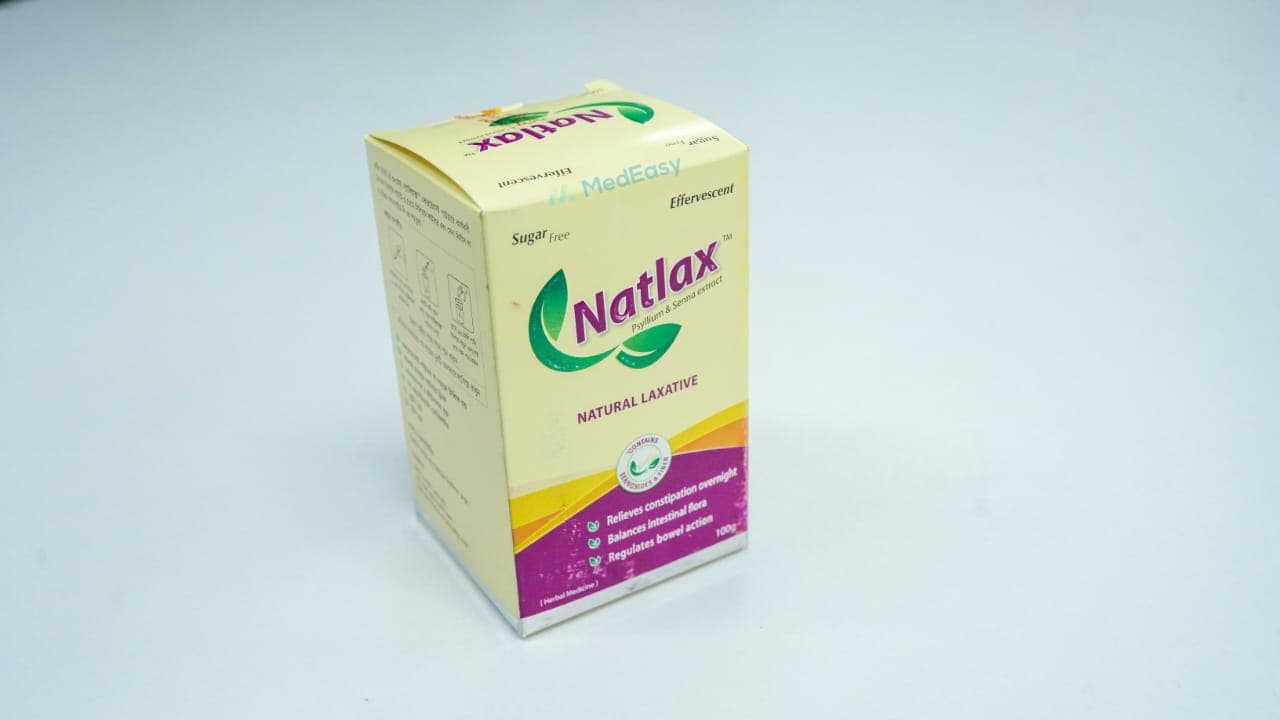

Medicine overview
Indications of Natlax
Natlax is indicated for the short-term relief of occasional constipation in adults and adolescents. It combines a bulk-forming fiber laxative with a stimulant laxative for use when dietary fiber alone has been insufficient to restore regular bowel movements.
- Established/OTC-monograph use: Occasional (short-term) constipation - Natlax promotes softer, bulkier stool and stimulates colonic motility to produce a bowel movement, generally within 6-12 hours.
- Adjunct use: As an adjunct to dietary and lifestyle measures (increased fluid intake, physical activity) for constipation that has not responded adequately to fiber supplementation alone.
- Not indicated for chronic, long-term management of constipation without medical supervision, and not indicated for weight loss.
Composition
Each dose of Psyllium Fiber + Senna Extract contains a combination of:
- Psyllium Husk Fiber - a natural, bulk-forming soluble fiber derived from the seed husk of Plantago ovata.
- Senna Extract - a standardized extract of Senna alexandrina (Cassia senna) leaf/pod, standardized to its sennoside (anthraquinone glycoside) content.
Strength and exact ratio of psyllium to senna vary by brand and product formulation; refer to the specific product label for the exact quantity per dose.
Description
Natlax is a combination over-the-counter laxative product that pairs a bulk-forming fiber agent with a stimulant laxative to relieve occasional constipation. It is typically available as a granule, powder for oral suspension, or chewable/tablet dosage form.
Natlax works through two complementary mechanisms: the psyllium fiber component absorbs water in the intestine to form a soft, bulky gel that promotes normal bowel function, while the senna extract component directly stimulates the nerves of the colon wall to increase peristaltic movement. This dual action is intended to produce more reliable relief than either agent alone when fiber alone has not been effective.
Therapeutic Class
Natlax belongs to the class of laxatives, specifically a fixed combination of a bulk-forming laxative (psyllium) and a stimulant laxative (senna/anthraquinone glycosides).
Pharmacology
Psyllium Fiber + Senna Extract exerts its laxative effect through two distinct, complementary mechanisms:
Psyllium Fiber (Bulk-forming component)
Psyllium husk is a hydrophilic mucilloid that is not significantly absorbed or metabolized in the gastrointestinal tract. On contact with water, it swells and forms a viscous gel, increasing the volume and water content of the stool. This softens the stool and mechanically stimulates peristalsis, typically producing a bowel movement within 12-72 hours.
Senna Extract (Stimulant component)
Senna contains sennosides (anthraquinone glycosides) that are minimally absorbed in the small intestine and are converted by colonic bacteria into active metabolites (rhein anthrone). These metabolites directly stimulate the myenteric plexus, increasing colonic motility and peristalsis, and also increase net water and electrolyte secretion into the colon. Onset of action is typically 6-12 hours.
The combination in Psyllium Fiber + Senna Extract is designed to provide faster onset (from the senna component) with the physiologic, stool-softening benefit of fiber (from the psyllium component).
Dosage & Administration of Natlax
Dosing of Natlax should follow the specific product label, as concentrations vary by brand. General OTC dosing guidance is summarized below.
| Population | Typical Dose | Frequency |
|---|---|---|
| Adults and children 12 years and older | 1 dose (as directed on product label, typically 1 rounded teaspoon/packet/tablet equivalent) mixed with a full glass (approx. 240 mL) of water or other fluid | 1-2 times daily, usually at bedtime and/or before breakfast, up to the maximum stated on the label |
| Children 6-11 years | One-half the adult dose | Only under adult supervision and guidance of a physician |
| Children under 6 years | Not recommended | Consult a physician |
Natlax should not be used for more than 1 week continuously without consulting a physician, as prolonged use of the stimulant (senna) component can lead to dependence and electrolyte disturbance.
Administration of Natlax
Natlax powder/granule formulations should be mixed thoroughly with at least one full glass (240 mL) of water or other liquid immediately before drinking, and taken with additional fluid to reduce the risk of choking or intestinal obstruction. Chewable or tablet forms of Natlax should be taken with a full glass of water. Doses are commonly taken at bedtime or before the first meal of the day.
Interaction of Natlax
Because it contains a bulk-forming agent, Natlax can reduce the absorption of certain oral medications if taken at the same time. Clinically significant interactions include:
- Oral drugs in general (e.g., digoxin, warfarin, lithium, carbamazepine): Psyllium fiber can physically bind or delay gastrointestinal absorption of many oral drugs, reducing their bioavailability. Natlax should be taken at least 2 hours apart from other oral medications.
- Digoxin and other cardiac glycosides: Chronic use of the senna component, if leading to electrolyte imbalance (particularly hypokalemia), can increase the risk of digoxin toxicity.
- Diuretics and corticosteroids: Concurrent use with the senna component of Natlax may increase the risk of electrolyte disturbances (especially potassium loss) when used long-term or in excess.
Contraindications
Psyllium Fiber + Senna Extract is contraindicated in patients with:
- Known hypersensitivity to psyllium, senna, or any other component of Psyllium Fiber + Senna Extract.
- Bowel obstruction, intestinal stricture, or fecal impaction.
- Undiagnosed abdominal pain, nausea, or vomiting, or other symptoms suggestive of appendicitis or an acute surgical abdomen.
- Difficulty swallowing or known esophageal narrowing/stricture (due to risk of esophageal obstruction with the psyllium component).
Side Effects of Natlax
Most side effects of Natlax are gastrointestinal and mild, but can be more pronounced with the stimulant (senna) component. Reported effects include:
- Common: Abdominal cramping, bloating, flatulence, and nausea.
- Less common: Diarrhea (especially with excess dosing), mild abdominal discomfort.
- Uncommon but important: Electrolyte imbalance (with excessive or prolonged use), rectal bleeding or persistent abdominal pain (should prompt discontinuation and medical review), and allergic reactions (rash, itching, swelling, difficulty breathing) in patients hypersensitive to psyllium or senna.
- Rare: Esophageal or intestinal obstruction if Natlax is taken without adequate fluid.
Harmless discoloration of urine (yellow-brown or pink-red) can occur with senna-containing products such as Natlax and is not a cause for concern.
Pregnancy & Lactation
Pregnancy: Bulk-forming fiber agents such as the psyllium component of Natlax are generally considered a preferred first-line option for constipation during pregnancy. The senna (stimulant) component of Natlax is used cautiously in pregnancy and should be used only for short-term relief if fiber and lifestyle measures alone are insufficient, and only if clearly needed. As with any medicine in pregnancy, Natlax should be used only if the potential benefit justifies the potential risk to the fetus; consult a physician before use.
Lactation: Psyllium fiber is not significantly absorbed systemically and is generally considered compatible with breastfeeding. Small amounts of senna metabolites may pass into breast milk; occasional short-term use of Natlax is generally considered acceptable, but a physician should be consulted, particularly with repeated or prolonged use, and the breastfed infant should be observed for loose stools.
Precautions & Warnings
Natlax should be used with the following precautions:
- Adequate fluid intake: Natlax must always be taken with a full glass (at least 240 mL) of water or other fluid. Taking the psyllium component without sufficient fluid can cause it to swell in the throat or esophagus, leading to choking or esophageal/bowel obstruction.
- Not for prolonged use: Natlax is intended for short-term (up to about 1 week) use. Regular, prolonged use of the stimulant (senna) component may lead to laxative dependence, reduced normal bowel function, and electrolyte imbalance (particularly low potassium).
- Abdominal cramping: Cramping, more commonly associated with the senna component, may occur, especially at higher doses; if severe or persistent, discontinue and consult a physician.
- Seek medical advice if constipation persists beyond 1 week of use, if rectal bleeding occurs, or if there is no bowel movement after use (may indicate a more serious condition).
- Electrolyte disturbance: Excessive or prolonged use of Natlax can cause fluid and electrolyte imbalance, particularly in elderly or debilitated patients.
Overdose Effects of Natlax
Overdose or excessive use of Natlax may cause severe abdominal cramping, diarrhea, dehydration, and electrolyte imbalance (particularly low potassium), which can in turn lead to muscle weakness and irregular heartbeat. If an overdose of Natlax is suspected, seek immediate medical attention or contact a poison control center; do not attempt specific home treatment beyond general supportive measures such as maintaining fluid intake while awaiting medical advice.
Storage Conditions
Store at room temperature (below 30°C), away from light and moisture. Keep out of reach of children.
Use In Special Populations
Elderly: Elderly patients, particularly those who are debilitated or have reduced mobility, are at higher risk of electrolyte imbalance and dehydration with laxative use, including Natlax; use the lowest effective dose and ensure adequate fluid intake.
Renal impairment: Use Natlax with caution in patients with significant renal impairment, as electrolyte disturbances from the senna component may be less well tolerated; consult a physician.
Hepatic impairment: No specific dose adjustment is established; use with general caution and physician guidance.
Diabetic patients: Some formulations of Natlax may contain sugar or sweeteners; patients with diabetes should check the specific product label.
See Pediatric Uses and Pregnancy and Lactation for those specific populations.
Duration Of Treatment
Natlax is intended for short-term, as-needed use for occasional constipation, generally not exceeding 1 week of continuous use. If constipation persists beyond 1 week, or recurs frequently, a physician should be consulted to evaluate for an underlying cause rather than continuing self-treatment with Natlax.
Drug Classes
Bulk-forming laxative + Stimulant (anthraquinone) laxative combination
Mode Of Action
Psyllium Fiber + Senna Extract acts through two mechanisms: the psyllium fiber component absorbs water to form a bulky gel that mechanically stimulates the bowel and softens stool, while the senna extract component is converted by colonic bacteria into active anthrone metabolites that directly stimulate colonic nerve endings, increasing peristaltic contractions and reducing water/electrolyte absorption in the colon.
Pediatric Uses
The safety and efficacy of Natlax in children under 6 years of age have not been established, and use in this age group is not recommended. For children 6 to 11 years of age, Natlax may be used only under adult supervision and on the advice of a physician, typically at half the adult dose. Use in adolescents 12 years and older generally follows adult dosing. A pediatrician should always be consulted before giving Natlax to a child, as chronic constipation in children may require a different, medically supervised approach.
Frequently Asked Questions
Q: What is Natlax 100 gm Effervescent Powder used for?
A: Natlax 100 gm Effervescent Powder is used for the short-term relief of occasional constipation. It combines a bulk-forming fiber (psyllium) with a stimulant laxative (senna) to help produce a bowel movement, typically within 6-12 hours.
Q: How should I take Natlax 100 gm Effervescent Powder?
A: Natlax 100 gm Effervescent Powder should be mixed with or taken with a full glass (at least 240 mL) of water or other liquid, usually once or twice daily as directed on the product label, most commonly at bedtime or before breakfast. Always ensure adequate fluid intake when taking Natlax 100 gm Effervescent Powder to reduce the risk of choking or bowel obstruction.
Q: Can I take Natlax 100 gm Effervescent Powder every day for a long time?
A: No. Natlax 100 gm Effervescent Powder is intended for short-term use, generally no more than about 1 week. Regular, prolonged use of the senna component in Natlax 100 gm Effervescent Powder can lead to laxative dependence and electrolyte imbalance. If your constipation continues beyond a week, consult a physician instead of continuing to use Natlax 100 gm Effervescent Powder.
Q: Who should not take Natlax 100 gm Effervescent Powder?
A: Natlax 100 gm Effervescent Powder should not be used by anyone with a known bowel obstruction, fecal impaction, undiagnosed abdominal pain (such as possible appendicitis), difficulty swallowing, or a known allergy to psyllium, senna, or other ingredients in Natlax 100 gm Effervescent Powder.
Q: Is Natlax 100 gm Effervescent Powder safe during pregnancy or breastfeeding?
A: The fiber component of Natlax 100 gm Effervescent Powder is generally preferred as a first-line option in pregnancy, while the senna component should be used cautiously and only short-term if truly needed. Natlax 100 gm Effervescent Powder should be used in pregnancy or while breastfeeding only if clearly needed and after consulting a physician.
Q: What side effects can Natlax 100 gm Effervescent Powder cause?
A: The most common side effects of Natlax 100 gm Effervescent Powder are abdominal cramping, bloating, flatulence, and nausea. Harmless discoloration of urine can occur with the senna component. Seek medical attention if you experience severe cramping, rectal bleeding, or no bowel movement after taking Natlax 100 gm Effervescent Powder.
Disclaimer
The information provided is accurate to the best of our knowledge, but it does not replace professional medical advice. We cannot guarantee its completeness or accuracy, and the absence of specific information about a drug should not be taken as an endorsement. We are not responsible for any consequences arising from this information, so please consult a healthcare professional for any concerns or questions.
