
8% Off
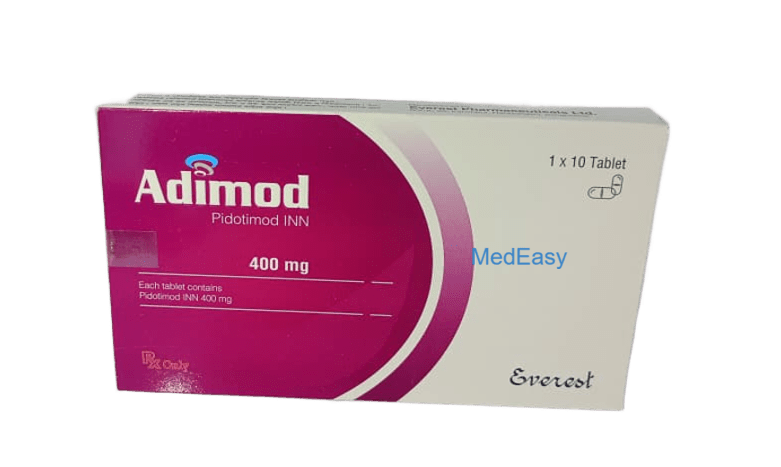
Adimod400 mg
Everest Pharmaceuticals Ltd.
৳460.00
Add to cart


Pidonex is a synthetic immunostimulant (immunomodulator) used as follows:
Note: The evidence base for Pidonex is stronger and use is more established in some countries (e.g., parts of Europe and Asia) than in others; Pidonex is not approved by the US FDA and is not a substitute for vaccination, antibiotics when indicated, or other standard-of-care infection treatment/prevention measures.
Each dose of Pidotimod contains Pidotimod as the active pharmaceutical ingredient. Pidotimod is available in oral formulations such as:
Exact strengths and pack sizes vary by manufacturer and country; refer to the specific product label.
Pidonex is a synthetic dipeptide-like immunostimulant molecule that acts on both innate and adaptive immune responses. It is used mainly to reduce the frequency and severity of recurrent respiratory tract infections, particularly in children who experience frequent colds, tonsillitis, otitis media, or bronchitis.
Pidonex is not an antibiotic and does not directly kill or inhibit pathogens; instead, it modulates the patient's own immune system to help the body respond more effectively to, and recover more quickly from, respiratory infections, and to reduce how often they recur. It is typically given as a preventive/adjunctive course rather than as treatment for an acute infection in progress.
Immunostimulant / Immunomodulator — Pidonex is classified as a synthetic immune-response modifier used in the prevention of recurrent respiratory infections.
Pidotimod acts on multiple components of the innate and adaptive immune system rather than on the infecting organism directly. Proposed and demonstrated effects include:
Pidotimod is absorbed after oral administration, with peak plasma concentrations typically reached within a few hours; it undergoes limited metabolism and is eliminated predominantly via the kidneys. It does not have direct antimicrobial or antiviral activity.
| Population | Typical dose | Regimen |
|---|---|---|
| Children (approx. 3 years and older, per local labeling) | 400 mg once or twice daily (oral solution/sachet) | Commonly given as a cyclic course, e.g., daily for 15 days, repeated for 2–3 monthly cycles, or per physician's regimen |
| Adults and adolescents | 400–800 mg once or twice daily (sachet/tablet) | Cyclic or continuous courses as directed by the prescriber, often for several weeks |
Exact dose, formulation, and course length should follow the prescribing physician's instructions and the approved local product label, as regimens vary by country and product.
Pidonex is intended as a preventive/adjunctive course and is not a substitute for treating an acute infection with appropriate standard therapy (e.g., antibiotics when bacterial infection is diagnosed).
Pidonex is given by mouth. Oral solution/sachet formulations can be taken directly or mixed with a small amount of water; tablets should be swallowed with water. Pidonex may be taken with or without food, according to product labeling. Doses should be spaced evenly if given more than once daily, and courses should be completed as prescribed even if symptoms are not currently present, since it is often used preventively.
No extensively documented, clinically significant pharmacokinetic drug-drug interactions have been well established for Pidonex. Because Pidonex works by modulating immune function, caution and physician guidance are advised when it is used together with:
Always inform the prescribing physician of all other medicines, supplements, and vaccines being used.
Pidotimod is contraindicated in:
Pidonex is generally well tolerated. Reported adverse effects include:
Patients should seek medical attention if signs of an allergic reaction (swelling, difficulty breathing, severe rash) occur.
Data on the use of Pidonex during pregnancy and breastfeeding are limited. As a precaution, Pidonex should be used during pregnancy only if clearly needed and if the potential benefit justifies the potential risk to the fetus, and only under medical supervision. Similarly, use during breastfeeding should be avoided unless a physician determines it is necessary, since it is not established whether Pidonex passes into breast milk. Pregnant or breastfeeding individuals should consult a physician before use.
Pidonex should be used with the following precautions:
Reports of Pidonex overdose are limited, and significant toxicity has not been well characterized. In case of a suspected overdose of Pidonex, seek immediate medical attention or contact a poison control center/emergency services. Management would generally involve supportive and symptomatic care, as directed by a healthcare professional; no specific antidote is established.
Store at room temperature (below 30°C), away from light and moisture. Keep out of reach of children.
Specific dose-adjustment data for Pidonex in renal or hepatic impairment are limited; use with caution and under medical supervision in these populations, as Pidonex is renally eliminated.
Limited specific data exist for elderly patients; Pidonex is used at standard adult doses under medical supervision, with attention to any comorbid conditions.
See Pediatric Uses.
See Pregnancy and Lactation.
Pidonex is typically given in cyclic courses rather than continuously — for example, a course of about 15 days of daily dosing, repeated over 2–3 monthly cycles, or an extended course of several weeks, depending on the product and the treating physician's protocol. The exact duration should be individualized by the prescriber based on the frequency and severity of the patient's recurrent infections and response to therapy; Pidonex should not be continued indefinitely without medical review.
Immunostimulants; Immunomodulatory agents
Pidotimod enhances both innate and adaptive immune responses: it promotes dendritic cell maturation and antigen presentation, increases phagocytic activity of neutrophils and macrophages, boosts natural killer (NK) cell cytotoxicity, favors a balanced Th1-oriented cytokine profile, and supports mucosal defenses including secretory IgA. Through these combined effects, Pidotimod helps the immune system respond more effectively to respiratory pathogens and reduces the frequency of recurrent infections, without acting as a direct antimicrobial agent.
Pidonex is used primarily in children with a history of recurrent respiratory tract infections (e.g., frequent colds, tonsillitis, otitis media, bronchitis), typically from around 3 years of age and older, according to most local product labels, given as oral solution or sachet at a dose of 400 mg once or twice daily in cyclic courses (see Dosage and Administration).
Safety and efficacy in infants and very young children (below the labeled minimum age) have not been well established, and Pidonex should only be used in this age group under direct physician guidance. As with adults, Pidonex in children is adjunctive/preventive and does not replace vaccination or standard treatment of an active infection.
Q: What is Pidonex 400 mg Tablet used for?
A: Pidonex 400 mg Tablet is a synthetic immunostimulant used mainly to reduce the frequency, duration, and severity of recurrent respiratory tract infections (such as frequent colds, tonsillitis, otitis media, or bronchitis), particularly in children. It is used as a preventive/adjunctive measure, not as a treatment for an active infection by itself.
Q: Can Pidonex 400 mg Tablet replace antibiotics or vaccines?
A: No. Pidonex 400 mg Tablet is not an antibiotic and does not have direct antimicrobial activity, and it does not replace routine vaccination. It should be used alongside, not instead of, standard-of-care treatment (such as antibiotics when a bacterial infection is diagnosed) and recommended immunizations.
Q: What is the usual dose of Pidonex 400 mg Tablet?
A: The usual dose of Pidonex 400 mg Tablet is 400 mg once or twice daily by mouth, often given in cyclic courses (for example, daily for about 15 days, repeated over 2–3 months). The exact dose, formulation, and duration should be determined by a physician based on age and clinical need.
Q: Is Pidonex 400 mg Tablet safe during pregnancy or breastfeeding?
A: Data on Pidonex 400 mg Tablet use during pregnancy and breastfeeding are limited. It should be used in these situations only if a physician determines the potential benefit justifies the potential risk, and only under medical supervision — pregnant or breastfeeding individuals should consult their doctor before taking Pidonex 400 mg Tablet.
Q: What are the common side effects of Pidonex 400 mg Tablet?
A: Pidonex 400 mg Tablet is generally well tolerated. The most common side effects are mild gastrointestinal symptoms such as nausea, vomiting, diarrhea, or abdominal discomfort. Less commonly, skin rash, itching, or hypersensitivity reactions can occur. Seek medical attention if signs of a serious allergic reaction develop.
Q: Who should not take Pidonex 400 mg Tablet?
A: Pidonex 400 mg Tablet should not be used by anyone with a known hypersensitivity (allergy) to Pidonex 400 mg Tablet or to any ingredient in the specific product formulation. Patients with autoimmune conditions or those on immunosuppressive therapy should use Pidonex 400 mg Tablet only under medical supervision.
Disclaimer
The information provided is accurate to the best of our knowledge, but it does not replace professional medical advice. We cannot guarantee its completeness or accuracy, and the absence of specific information about a drug should not be taken as an endorsement. We are not responsible for any consequences arising from this information, so please consult a healthcare professional for any concerns or questions.
