10% Off
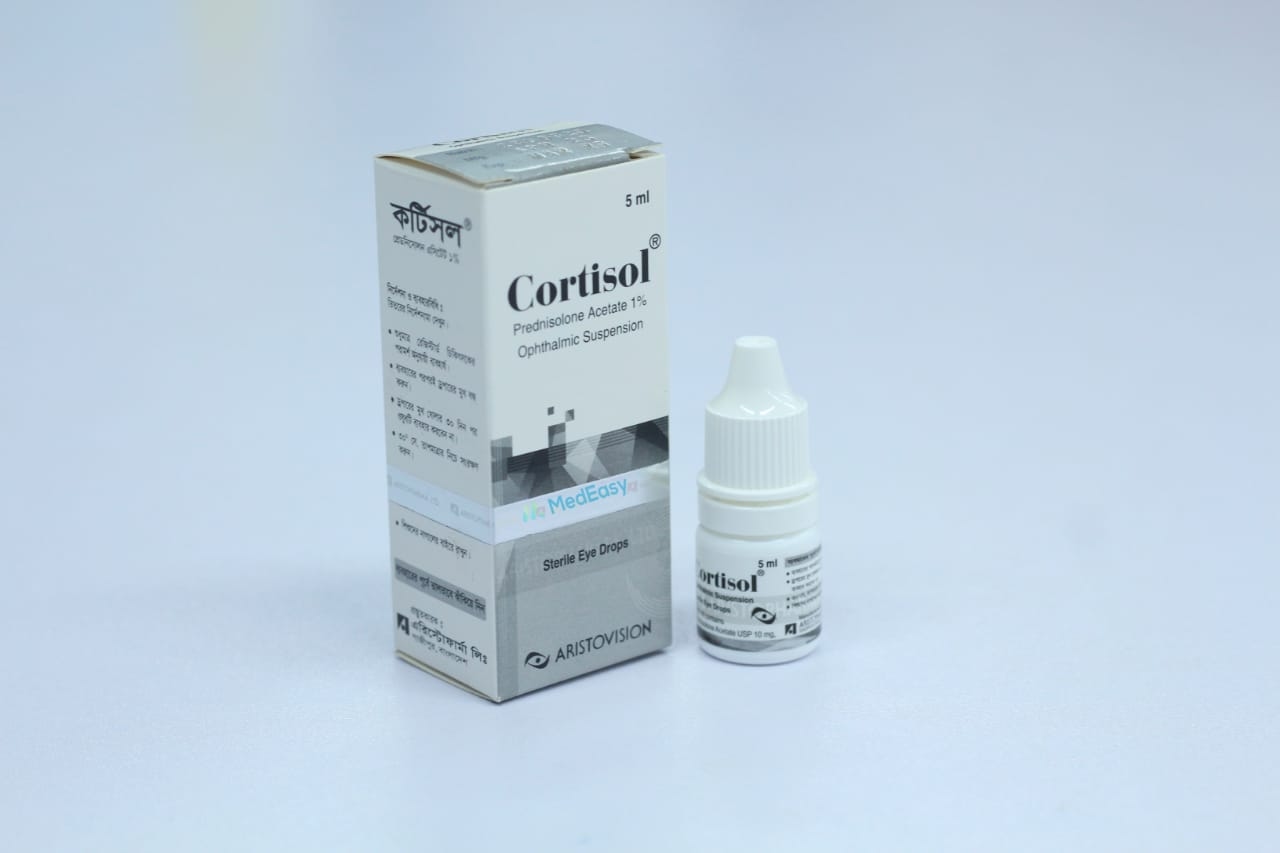
Cortisol1%
Aristopharma Ltd.
৳90.00
Add to cart

Predflam 1% Ophthalmic Suspension is available on MedEasy for ৳90.00 per 5 ml drop, with home delivery anywhere in Bangladesh. It is manufactured by General Pharmaceuticals Ltd. Its generic name is Prednisolone Acetate.

Predflam ophthalmic suspension is a corticosteroid indicated for the treatment of steroid-responsive inflammatory conditions of the eye. Its established and guideline-supported uses include:
Predflam is not indicated for use in undiagnosed "red eye" without prior ophthalmologic evaluation, since it may mask or worsen an underlying infection.
Each mL of Prednisolone Acetate ophthalmic suspension contains Prednisolone Acetate equivalent to 10 mg prednisolone acetate (1% w/v), along with ophthalmic-grade suspending agents, preservative (typically benzalkonium chloride), and buffering agents in a sterile aqueous vehicle.
Predflam is a synthetic glucocorticoid, formulated as the acetate ester of prednisolone to improve corneal penetration and prolong ocular tissue contact time in a sterile ophthalmic suspension. It is used topically in the eye to suppress inflammation, cellular infiltration, and vascular permeability associated with a variety of ocular inflammatory disorders.
In Bangladesh, Predflam is marketed exclusively as a 1% ophthalmic suspension in 5 mL dropper bottles. In some other markets, related prednisolone formulations are also available as oral tablets or injections for systemic anti-inflammatory and immunosuppressive use, but the acetate ester form is used almost exclusively as an ophthalmic preparation.
Corticosteroid — Ophthalmic anti-inflammatory agent (glucocorticoid); Predflam belongs to the topical ocular steroid class.
Prednisolone Acetate is a glucocorticoid that suppresses the inflammatory response to a variety of inciting agents. It acts by inducing phospholipase A2 inhibitory proteins (lipocortins), which control the biosynthesis of potent inflammatory mediators such as prostaglandins and leukotrienes by inhibiting the release of their common precursor, arachidonic acid, from membrane phospholipids.
By this mechanism, Prednisolone Acetate reduces capillary dilation, edema, fibrin deposition, leukocyte migration, capillary proliferation, fibroblast proliferation, deposition of collagen, and scar formation associated with inflammation. The acetate ester form is relatively insoluble, which allows it to penetrate the intact corneal epithelium more effectively than phosphate salt formulations, producing higher intraocular drug concentrations. Systemic absorption after topical ocular administration is minimal under normal use.
| Indication / Severity | Recommended Dosage of Predflam |
|---|---|
| Mild to moderate ocular inflammation | Instill 1–2 drops into the conjunctival sac 2 to 4 times daily. |
| Severe ocular inflammation (initial 24–48 hours) | Instill 1–2 drops every 1 to 2 hours while awake, then reduce frequency gradually as inflammation subsides. |
| Post-operative inflammation | As directed by the ophthalmologist, typically 2 to 4 times daily, tapered over 1–2 weeks. |
Shake the bottle well before each use, as Predflam is a suspension. Treatment should not be discontinued prematurely; the dose should be tapered gradually under medical supervision, as abrupt discontinuation may cause rebound inflammation.
If used together with an anti-infective agent for infective conjunctivitis, both medicines should be used exactly as prescribed. See Precautions and Warnings for monitoring requirements during prolonged use.
For ophthalmic (eye) use only — not for injection or oral use.
Predflam ophthalmic suspension has minimal systemic absorption with normal use, so clinically significant systemic drug interactions are uncommon. However, the following should be noted:
Prednisolone Acetate ophthalmic suspension is contraindicated in:
Side effects associated with Predflam ophthalmic suspension are usually local to the eye and include:
Patients should promptly report eye pain, significant vision changes, or persistent redness to their physician.
Predflam should be used during pregnancy only if clearly needed and if the potential benefit justifies the potential risk to the fetus. Although systemic absorption after ophthalmic administration is minimal, adequate and well-controlled studies in pregnant women are lacking, and corticosteroids in general have been associated with fetal effects in animal studies at high systemic exposure. A physician should be consulted before use during pregnancy.
It is not known whether topically applied Predflam is excreted in human milk in clinically significant amounts. Because many systemically absorbed corticosteroids are excreted in breast milk, caution should be exercised and a physician consulted when Predflam is used by a nursing mother.
Prolonged use of Predflam can result in elevated intraocular pressure and/or glaucoma, with damage to the optic nerve, defects in visual acuity, and visual field loss; intraocular pressure should be monitored regularly if use extends beyond 10 days.
Predflam should not be used to treat undiagnosed "red eye," as corticosteroids may mask infection or exacerbate an existing untreated ocular infection. Use in the presence of thinning of the cornea or sclera may lead to perforation. Prolonged use may also suppress the host immune response, increasing the risk of secondary ocular infections; the possibility of fungal infection should be considered in any persistent corneal ulceration where a corticosteroid has been used.
Use with caution in patients with a history of herpes simplex keratitis, as corticosteroids may prolong the course and exacerbate the severity of the infection. Employ the lowest effective dose for the shortest duration necessary, and taper gradually rather than stopping abruptly. Reassess the patient if there is no improvement after 2 days of therapy.
Ophthalmic overdose of Predflam is unlikely to cause acute systemic toxicity, but excessive or prolonged use increases the risk of elevated intraocular pressure, glaucoma, and cataract formation. If a large amount is accidentally ingested or instilled excessively, or if the eye is exposed to a non-ophthalmic concentrated form, flush the eye gently with clean water and seek immediate medical attention or contact a poison control center. Do not attempt to manage a suspected overdose with home remedies; professional medical evaluation is advised in all cases of suspected overdose or accidental ingestion.
Store Predflam ophthalmic suspension at room temperature (below 30°C), away from light and moisture. Keep the bottle tightly closed, shake well before each use, and keep out of reach of children. Discard any unused portion 4 weeks after opening, or as directed on the label.
Pediatric patients: Safety and efficacy of Predflam in pediatric patients have not been extensively established through controlled trials; when used in children, close monitoring for elevated intraocular pressure is recommended, as children may be more sensitive to steroid-induced ocular hypertension with long-term use.
Elderly patients: No overall differences in safety or effectiveness have been reported between elderly and younger adult patients; standard adult dosing generally applies with routine monitoring.
Renal/hepatic impairment: No dose adjustment of ophthalmic Predflam is established as necessary in renal or hepatic impairment, given minimal systemic absorption; however, caution is still advised and a physician should be consulted.
The duration of treatment with Predflam depends on the severity of the inflammatory condition and clinical response, and should be determined by the prescribing physician. Treatment is typically continued for 1 to 2 weeks for mild conditions, and may extend to several weeks for more severe or post-surgical inflammation, with the dose tapered gradually rather than stopped abruptly. Use beyond 10 days requires monitoring of intraocular pressure. If no improvement is seen within 2 days, the patient should be reassessed by a physician.
Corticosteroids; Glucocorticoids; Topical ophthalmic anti-inflammatory agents — Prednisolone Acetate is classified within this group.
Prednisolone Acetate exerts its anti-inflammatory effect by inducing lipocortin (phospholipase A2 inhibitory protein) synthesis, which blocks the release of arachidonic acid from membrane phospholipids. This reduces downstream production of prostaglandins and leukotrienes, the key mediators of inflammation, thereby decreasing capillary dilation, vascular permeability, leukocyte migration, and fibroblast and collagen deposition in ocular tissue.
C
The safety and efficacy of Predflam ophthalmic suspension in pediatric patients have not been established through extensive controlled clinical trials. When prescribed for a child, it should be used at the lowest effective dose for the shortest duration necessary, under close physician supervision, with regular monitoring of intraocular pressure, since prolonged corticosteroid use may carry a higher risk of ocular hypertension and growth-related effects in children. Predflam should only be used in children when a physician determines the potential benefit outweighs the risk.
Q: What is Predflam 1% Ophthalmic Suspension eye drop used for?
A: Predflam 1% Ophthalmic Suspension ophthalmic suspension is used to treat steroid-responsive inflammation of the eye, such as allergic conjunctivitis, iritis, cyclitis, and inflammation following eye surgery or injury. It should only be used under a physician's or ophthalmologist's guidance.
Q: How should I use Predflam 1% Ophthalmic Suspension eye drops correctly?
A: Shake the bottle well, wash your hands, tilt your head back, and instill the prescribed number of drops of Predflam 1% Ophthalmic Suspension into the lower eyelid pocket without touching the dropper tip to your eye. Close your eyes gently for 1–2 minutes afterward. Use exactly as prescribed, usually 2 to 4 times daily.
Q: Can Predflam 1% Ophthalmic Suspension be used for a red or infected eye without seeing a doctor?
A: No. Predflam 1% Ophthalmic Suspension should not be used for undiagnosed red eye, because corticosteroids can mask or worsen an underlying bacterial, viral, or fungal eye infection. Always have a red or painful eye evaluated by a physician before starting Predflam 1% Ophthalmic Suspension.
Q: What are the main risks of using Predflam 1% Ophthalmic Suspension for a long time?
A: Prolonged use of Predflam 1% Ophthalmic Suspension can raise intraocular pressure and lead to glaucoma, cause cataracts, delay wound healing, and increase the risk of secondary eye infections. Regular eye pressure checks are recommended if treatment continues beyond 10 days.
Q: Is Predflam 1% Ophthalmic Suspension safe to use during pregnancy or breastfeeding?
A: Predflam 1% Ophthalmic Suspension should be used during pregnancy or breastfeeding only if clearly needed and if a physician determines the benefit outweighs any potential risk. Please consult your doctor before using Predflam 1% Ophthalmic Suspension if you are pregnant, planning pregnancy, or breastfeeding.
Q: What should I do if I accidentally use too much Predflam 1% Ophthalmic Suspension?
A: If you instill more Predflam 1% Ophthalmic Suspension than prescribed or a large amount is accidentally ingested, rinse the eye with clean water if applicable and seek immediate medical attention or contact a poison control center rather than trying to manage it at home.
Disclaimer
The information provided is accurate to the best of our knowledge, but it does not replace professional medical advice. We cannot guarantee its completeness or accuracy, and the absence of specific information about a drug should not be taken as an endorsement. We are not responsible for any consequences arising from this information, so please consult a healthcare professional for any concerns or questions.