
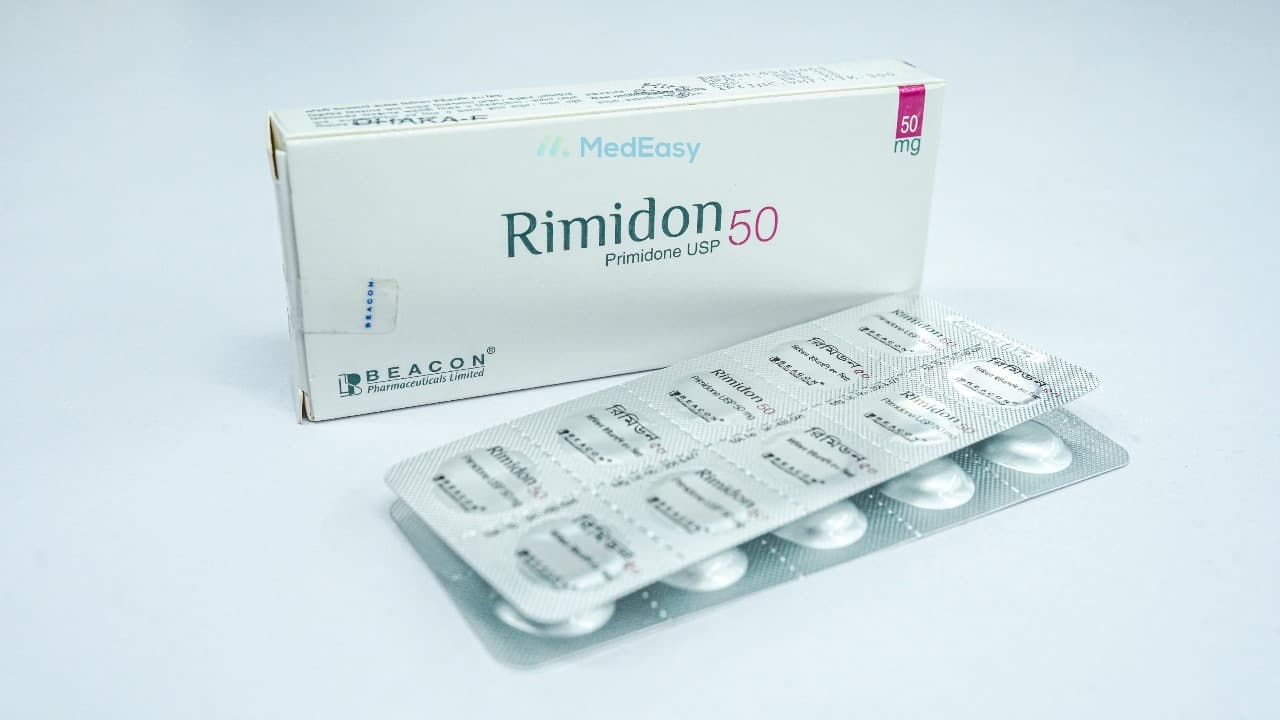

Medicine overview
Indications of Rimidon
Rimidon is an antiepileptic (anticonvulsant) medicine used to control certain types of seizures. Its indications can be classified by strength of evidence as follows:
Established / Approved Uses
- Generalized tonic-clonic (grand mal) seizures - used alone or in combination with other anticonvulsants.
- Complex partial (psychomotor) seizures.
- Simple partial (focal) seizures.
Rimidon may be useful in grand mal seizures that have not responded adequately to other anticonvulsant therapy, generally as an add-on (combination) agent in such cases.
Off-Label Use (Guideline-Supported)
- Essential tremor - Rimidon is commonly used off-label, and is recognized as an evidence-based option by movement-disorder treatment guidelines, for reducing hand tremor in essential tremor, typically at lower doses than used for epilepsy.
The decision to use Rimidon for any indication, and the specific regimen, should be individualized by a qualified physician based on seizure type, response, and tolerability.
Composition
Each tablet contains Primidon as the active ingredient. Primidon tablets are commonly available in strengths such as 50 mg and 250 mg. The exact strength(s) and available dosage form(s) may vary by manufacturer; refer to the product label/pack insert for the specific formulation dispensed.
Description
Rimidon is an antiepileptic drug that is structurally related to the barbiturates. It is used to control several types of seizure disorders and, off-label, essential tremor.
Rimidon itself has anticonvulsant activity, and it is also metabolized in the liver into two active metabolites, phenobarbital and phenylethylmalonamide (PEMA), both of which contribute meaningfully to its overall anticonvulsant effect.
Therapeutic Class
Rimidon belongs to the antiepileptic / anticonvulsant therapeutic class, specifically the group of barbiturate-related anticonvulsants.
Pharmacology
Primidon and its two pharmacologically active metabolites, phenobarbital and phenylethylmalonamide (PEMA), act together to raise the seizure threshold and reduce the spread of abnormal electrical activity in the brain.
The precise mechanism is not completely understood, but is believed to involve enhancement of GABA-mediated (gamma-aminobutyric acid) inhibitory neurotransmission and modulation of neuronal ion channels, which together reduce high-frequency repetitive neuronal firing.
Onset of full clinical (anticonvulsant) effect may be delayed until steady-state concentrations of the active metabolites, particularly phenobarbital, are reached, which can take one to three weeks of regular dosing.
Dosage & Administration of Rimidon
Dosage of Rimidon must be individualized by the treating physician based on indication, age, and response. Treatment is typically started at a low dose and gradually increased ("titrated") to reduce sedation. The tables below summarize typical regimens; see also Dosage for a brief summary and Administration for how to take it.
Epilepsy - Adults and Children Over 8 Years
| Day(s) | Dose |
|---|---|
| Days 1-3 | 100-125 mg once daily, at bedtime |
| Days 4-6 | 100-125 mg twice daily |
| Days 7-9 | 100-125 mg three times daily |
| Day 10 onward (maintenance) | 250 mg three times daily (250 mg three to four times daily as needed); usual maximum 500 mg four times daily |
Epilepsy - Children Under 8 Years
| Day(s) | Dose |
|---|---|
| Days 1-3 | 50 mg once daily, at bedtime |
| Days 4-6 | 50 mg twice daily |
| Days 7-9 | 100 mg twice daily |
| Maintenance | 125-250 mg three times daily, or approximately 10-25 mg/kg/day in divided doses |
Switching From Another Anticonvulsant
When Rimidon is added to or substituted for another anticonvulsant, it is usually started at 100-125 mg at bedtime and increased gradually over about two weeks while the other drug is slowly withdrawn, under close physician supervision.
Essential Tremor (Off-Label)
Lower doses are generally used, started very low (e.g. 25-50 mg at bedtime) and titrated slowly upward based on response and tolerability, as directed by the physician.
Renal and Hepatic Impairment
Rimidon and its active metabolites are eliminated substantially by the kidneys; dose reduction and/or longer dosing intervals are generally required in significant renal impairment. In hepatic impairment, use with caution and closer monitoring, as metabolism to active metabolites may be affected. Specific adjustment should be individualized by the physician.
Administration of Rimidon
Rimidon tablets are taken by mouth, with or without food; taking it with food may reduce stomach upset. Doses are usually spread through the day as prescribed, with an extra portion often given at bedtime to reduce daytime sedation.
Take Rimidon at the same time(s) each day. Swallow tablets whole with water unless the physician has advised that the tablet may be split (if scored). Do not stop taking Rimidon suddenly without medical advice, as abrupt discontinuation can trigger withdrawal seizures (see Precautions and Warnings).
Interaction of Rimidon
Rimidon (via its active metabolite phenobarbital) is a hepatic enzyme inducer and has several clinically significant interactions:
- CNS depressants (alcohol, benzodiazepines, opioids, other sedatives): additive sedation and risk of respiratory depression - avoid or use with caution.
- Hormonal contraceptives: enzyme induction can reduce contraceptive efficacy - an alternative or additional method of contraception should be used.
- Warfarin and other oral anticoagulants: enzyme induction can reduce anticoagulant effect - closer INR monitoring is needed when Rimidon is started, changed, or stopped.
- Other antiepileptic drugs (e.g. phenytoin, valproate): complex bidirectional interactions can alter levels of Rimidon, its active metabolites, and the co-administered drug - levels should be monitored by the physician.
- Isoniazid: can inhibit metabolism of Rimidon, increasing its levels and toxicity risk.
- Acetazolamide: may reduce absorption/levels of Rimidon, potentially reducing seizure control.
Always inform the physician or pharmacist of all other medicines being taken before starting Rimidon.
Contraindications
Primidon is contraindicated in:
- Patients with known hypersensitivity to Primidon or to phenobarbital (its active metabolite).
- Patients with porphyria.
Side Effects of Rimidon
The most common side effects of Rimidon, especially at the start of treatment or after a dose increase, are:
- Ataxia (unsteadiness) and vertigo (dizziness) - these often improve with continued therapy.
- Sedation/drowsiness and fatigue.
- Nausea, vomiting, loss of appetite.
- Double vision (diplopia) and abnormal eye movements (nystagmus).
- Skin rash.
Less common but serious effects include blood cell abnormalities (e.g. low white cell counts, megaloblastic anemia), and mood/behavioral changes including suicidal thoughts (see Precautions and Warnings). Any severe rash, unusual bleeding/bruising, or thoughts of self-harm should prompt immediate medical attention.
Pregnancy & Lactation
Pregnancy: Antiepileptic drugs, including Rimidon and its active metabolite phenobarbital, are associated with an increased risk of birth defects. Rimidon should be used during pregnancy only if clearly needed and the potential benefit to the mother justifies the potential risk to the fetus; the physician may recommend vitamin K1 supplementation in the weeks before delivery to reduce the risk of neonatal bleeding. Rimidon should not be stopped abruptly during pregnancy without medical advice, as this can precipitate seizures that carry their own risks to mother and fetus. All use in pregnancy should be supervised closely by a physician.
Lactation: Rimidon and its active metabolite pass into breast milk in significant amounts. Breastfeeding is not generally recommended during Rimidon therapy unless a physician determines the benefits outweigh the risks; if breastfeeding is continued, the infant should be monitored closely for excessive drowsiness or poor feeding. Consult a physician before breastfeeding while taking Rimidon.
Precautions & Warnings
- Suicidal thoughts/behavior: Antiepileptic drugs, including Rimidon, are associated with a small increased risk of suicidal thoughts or behavior. Monitor for new or worsening depression, anxiety, agitation, or unusual changes in mood/behavior, particularly in the first weeks of treatment, and seek medical attention promptly if these occur.
- Physical dependence and withdrawal: Long-term use can lead to physical dependence. Do not stop Rimidon suddenly - abrupt discontinuation can precipitate withdrawal symptoms and rebound or worsening seizures, including status epilepticus. Any dose reduction or discontinuation must be done gradually under physician supervision.
- Sedation: Rimidon commonly causes drowsiness and impaired coordination, especially when starting treatment or increasing the dose. Caution is needed when driving or operating machinery until the individual response is known.
- Long-term bone effects: As with other enzyme-inducing antiepileptic drugs, long-term use of Rimidon has been associated with reduced bone mineral density and osteomalacia; adequate calcium and vitamin D intake and periodic monitoring may be advised by the physician.
- Cognitive/behavioral effects: Some patients, particularly children and the elderly, may experience irritability, hyperactivity, or cognitive slowing.
- Monitoring: Periodic blood counts and general health monitoring are advisable during long-term therapy.
- Hepatic/renal impairment: Use with caution and closer monitoring, as elimination of Rimidon and its active metabolites may be reduced (see Use in Special Populations).
Overdose Effects of Rimidon
Overdose of Rimidon can cause severe sedation, confusion, slurred speech, marked ataxia, low blood pressure, slowed or difficult breathing, and, in severe cases, coma. Overdose is a medical emergency.
If overdose is suspected, seek immediate medical attention or contact emergency services/poison control right away. Treatment is supportive and should be carried out in a hospital setting; there is no specific antidote. Do not attempt to treat a suspected overdose at home.
Storage Conditions
Store at room temperature (below 30°C), in a tight, light-resistant container, away from direct light and moisture. Keep out of reach of children.
Use In Special Populations
- Renal impairment: Rimidon and its active metabolites are cleared substantially by the kidneys; dose reduction and closer monitoring are generally needed in significant renal impairment.
- Hepatic impairment: Use with caution, as metabolism of Rimidon to its active metabolites occurs in the liver; closer monitoring is advised.
- Elderly: May be more sensitive to sedative effects; a lower starting dose with slower titration and close monitoring for falls/confusion is generally recommended.
- Pregnancy and breastfeeding: See Pregnancy and Lactation for detailed guidance.
- Children: See Pediatric Uses and Dosage and Administration for age-based dosing.
Duration Of Treatment
Duration of treatment with Rimidon is individualized by the physician based on the underlying condition, seizure control, and tolerability. For epilepsy, treatment is typically long-term, with periodic physician review of continued need and dose. For essential tremor, duration is likewise individualized based on symptom control. Any decision to stop Rimidon must involve a gradual, physician-supervised taper rather than abrupt discontinuation (see Precautions and Warnings).
Drug Classes
Primidon belongs to the antiepileptic drug class, within the subgroup of barbiturate-related anticonvulsants (deoxybarbiturates).
Mode Of Action
Primidon exerts anticonvulsant activity both directly and through its two active metabolites, phenobarbital and phenylethylmalonamide (PEMA). Together they are believed to enhance GABA-mediated inhibitory neurotransmission in the central nervous system and to modulate neuronal sodium and calcium channel activity, which raises the seizure threshold and limits the spread of abnormal, high-frequency electrical discharges responsible for seizures.
Because clinically meaningful levels of the active metabolites accumulate gradually, the full anticonvulsant effect of Primidon may take one to three weeks of consistent dosing to become apparent.
Pregnancy
D
Pediatric Uses
Rimidon may be used in children for the epilepsy indications listed above, with weight/age-based dosing that differs for children under and over 8 years of age (see Dosage and Administration). Children should be started at a lower dose with careful, gradual titration.
Children may be more susceptible to certain adverse effects, including paradoxical hyperactivity/irritability and cognitive or behavioral changes; close monitoring by the physician is advised, particularly at treatment initiation.
Safety and efficacy of Rimidon for essential tremor in children have not been well established; use for this off-label indication in children should only be under specialist guidance.
Frequently Asked Questions
Q: What is Rimidon 50 mg Tablet used for?
A: Rimidon 50 mg Tablet is an antiepileptic medicine used to control generalized tonic-clonic (grand mal), complex partial, and focal seizures. It is also used off-label to help reduce hand tremor in essential tremor.
Q: How should I take Rimidon 50 mg Tablet?
A: Take Rimidon 50 mg Tablet by mouth exactly as prescribed, at the same time(s) each day, with or without food. Treatment is usually started at a low dose and increased gradually to reduce sedation. Do not change your dose or stop taking it without talking to your physician.
Q: Can I stop taking Rimidon 50 mg Tablet suddenly if I feel better?
A: No. Stopping Rimidon 50 mg Tablet suddenly can trigger withdrawal symptoms and rebound seizures, including status epilepticus, which can be dangerous. Any reduction or stopping of Rimidon 50 mg Tablet must be done gradually under a physician's supervision.
Q: Is Rimidon 50 mg Tablet safe during pregnancy or breastfeeding?
A: Rimidon 50 mg Tablet carries a risk of birth defects and should be used in pregnancy only if clearly needed, with the potential benefit outweighing the risk, and under close physician supervision; it should not be stopped abruptly. Rimidon 50 mg Tablet also passes into breast milk in significant amounts, so breastfeeding should only be done after consulting a physician, with the infant monitored for excessive drowsiness.
Q: What are the common side effects of Rimidon 50 mg Tablet?
A: The most common side effects are unsteadiness (ataxia), dizziness (vertigo), drowsiness, nausea, and vomiting, especially when starting treatment. These often improve as the body adjusts. Severe rash, unusual bleeding, or thoughts of self-harm should be reported to a physician immediately.
Q: What should I do if I miss a dose or take too much Rimidon 50 mg Tablet?
A: If a dose is missed, take it as soon as remembered unless it is close to the next dose, in which case skip the missed dose - do not double up. If an overdose is suspected (e.g. severe drowsiness, confusion, slowed breathing), seek immediate medical attention or contact emergency services/poison control right away.
Disclaimer
The information provided is accurate to the best of our knowledge, but it does not replace professional medical advice. We cannot guarantee its completeness or accuracy, and the absence of specific information about a drug should not be taken as an endorsement. We are not responsible for any consequences arising from this information, so please consult a healthcare professional for any concerns or questions.
