
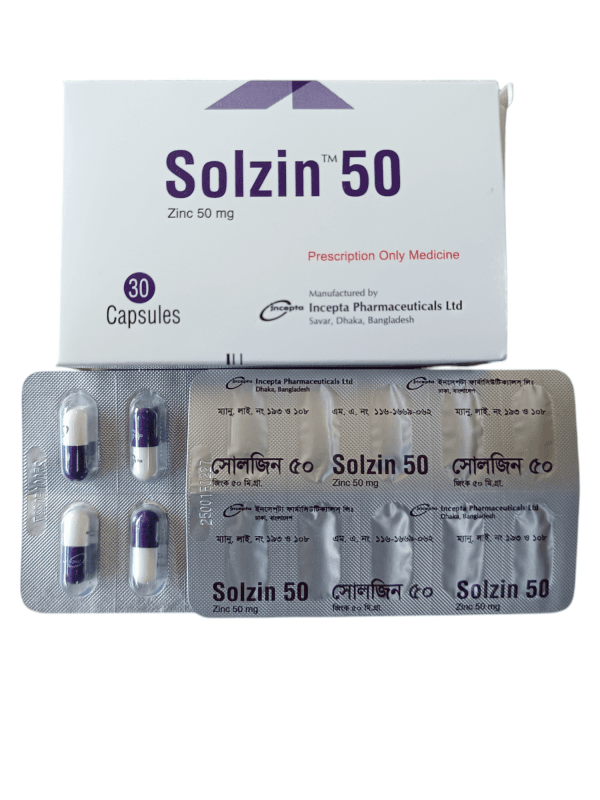

Medicine overview
Indications of Solzin
Solzin is an essential trace mineral used for the following indications:
Established / Well-Supported Uses
- Treatment and prevention of Solzin deficiency due to inadequate dietary intake, malabsorption syndromes, chronic diarrhea, sickle cell disease, or other chronic illnesses that increase Solzin requirements.
- Adjunct management of acute diarrhea in children - per World Health Organization (WHO) and UNICEF guidance, oral Solzin given alongside oral rehydration salts (ORS) reduces the duration and severity of acute diarrheal episodes and lowers the likelihood of recurrence over the following 2-3 months. Solzin is an adjunct to, not a replacement for, oral rehydration therapy.
- General nutritional supplementation to prevent deficiency in individuals with increased requirements or reduced intake, including pregnant and lactating women, older infants on complementary feeding, and some vegetarians/vegans.
Adjunct / Supportive Uses
- Supportive therapy for wound healing in patients with documented Solzin deficiency.
- Nutritional support in malabsorptive conditions (e.g., Crohn's disease, short bowel syndrome, celiac disease) where Solzin losses are increased.
Uses With Limited/Mixed Evidence
- Solzin lozenges, if started within 24 hours of symptom onset, may modestly shorten the duration of the common cold in some studies; evidence is mixed and this is not a formally approved indication for Solzin.
Composition
Each formulation of Zinc supplies elemental zinc from a zinc salt. Common salts include:
- Zinc sulfate - available as tablets, dispersible tablets, oral syrup, or drops.
- Zinc gluconate and zinc acetate - used in some oral supplements and lozenges.
Strength is expressed as elemental zinc content (e.g., a dispersible tablet commonly provides 20 mg elemental zinc; syrup commonly provides about 10 mg elemental zinc per 5 mL). The exact salt, strength, and dosage form of Zinc vary by manufacturer and market.
Description
Solzin is an essential trace element that the body cannot synthesize and must obtain from diet or supplementation. It functions as a cofactor for more than 300 enzymes involved in DNA synthesis, protein synthesis, cell division, and immune function. Solzin also plays an important role in wound healing, normal growth and development, and normal taste and smell perception. Deficiency is more common in populations with limited dietary diversity, malabsorption, or increased physiological demand such as pregnancy, lactation, and childhood illness.
Therapeutic Class
Trace Element / Mineral Supplement (Nutritional Supplement)
Pharmacology
Zinc acts as a catalytic and structural cofactor for numerous enzymes (e.g., carbonic anhydrase, alkaline phosphatase, RNA and DNA polymerases) and is essential for the normal function of zinc-finger transcription factors that regulate gene expression. It supports T-lymphocyte function and other immune mechanisms, contributes to epithelial integrity and wound repair, and is required for normal taste bud and olfactory function. In acute diarrheal illness, Zinc is thought to support enterocyte regeneration and mucosal immune function, which is proposed to explain its benefit as an adjunct to oral rehydration therapy.
Absorption occurs mainly in the small intestine and is variable (roughly 20-40%), influenced by dietary phytates and concurrent intake of iron or calcium. Excretion of Zinc is primarily fecal, with smaller amounts lost in urine and sweat.
Dosage & Administration of Solzin
Dosing of Solzin is expressed as elemental Solzin and should be individualized based on indication, age, and formulation.
| Indication | Population | Typical Dose |
|---|---|---|
| Solzin deficiency (treatment) | Adults | Elemental Solzin 25-50 mg orally once daily, or as directed by a physician based on severity |
| Solzin deficiency (treatment) | Children | 0.5-1 mg/kg/day elemental Solzin, as directed by a physician |
| Acute diarrhea (adjunct to ORS; WHO guidance) | Infants younger than 6 months | Elemental Solzin 10 mg orally once daily for 10-14 days |
| Acute diarrhea (adjunct to ORS; WHO guidance) | Children 6 months to 5 years | Elemental Solzin 20 mg orally once daily for 10-14 days |
| General nutritional supplementation | Adults | Elemental Solzin 8-11 mg orally once daily, or as directed |
Continue the full course of Solzin even if diarrhea resolves before completion, as recommended by WHO, to restore losses and reduce the risk of recurrence. Solzin does not replace oral rehydration therapy; continue oral rehydration salts as directed by a physician.
Administration of Solzin
Take Solzin with food if stomach upset occurs, although absorption may be slightly reduced with food. Dispersible tablets may be dissolved in a small amount of clean water or breast milk before giving to infants or young children. Space dosing at least 1-2 hours apart from iron supplements, calcium supplements, and certain antibiotics (tetracyclines, fluoroquinolones) to avoid reduced absorption of either agent.
Interaction of Solzin
Solzin has clinically significant interactions with several medicines and nutrients due to chelation and competition for absorption:
- Tetracycline and fluoroquinolone antibiotics (e.g., doxycycline, ciprofloxacin) - Solzin can form insoluble complexes with these antibiotics, reducing absorption of both. Separate dosing by at least 2 hours before or 4-6 hours after the antibiotic.
- Penicillamine - Solzin may reduce the absorption and effectiveness of penicillamine; separate administration by at least 2 hours.
- Iron and copper - concurrent high-dose iron can reduce absorption of Solzin, and prolonged Solzin supplementation without adequate copper intake can cause copper deficiency; separate dosing and monitor with long-term co-administration.
- Calcium and phosphorus supplements - high doses taken together with Solzin may reduce Solzin absorption.
Contraindications
Zinc is contraindicated in patients with known hypersensitivity to zinc salts or any component of the specific formulation.
Side Effects of Solzin
Common (particularly with higher doses of Solzin or when taken on an empty stomach):
- Nausea and vomiting
- Abdominal cramping or discomfort
- Metallic or unpleasant taste
- Diarrhea
Less common, generally associated with high-dose or prolonged use of Solzin:
- Copper deficiency with associated anemia and neurological symptoms (see Precautions and Warnings)
- Headache
- Reduced HDL cholesterol with very high chronic intake
Pregnancy & Lactation
Pregnancy: Solzin is an essential nutrient, and supplementation at standard recommended dietary doses is generally considered acceptable during pregnancy and is often included in prenatal nutrition. Doses above the recommended dietary allowance should be used only if clearly needed and under medical supervision, since potential benefit must be weighed against potential risk; consult a physician before use.
Lactation: Solzin at recommended doses is generally considered compatible with breastfeeding, as it is a normal component of breast milk. Higher-than-standard doses of Solzin should be used only on physician advice.
Precautions & Warnings
Use Solzin with caution in the following situations:
- Prolonged high-dose use: can cause copper deficiency, leading to anemia and neurological problems (e.g., myeloneuropathy); high-dose Solzin use beyond short courses should be medically supervised, with monitoring of copper status where indicated.
- Drug/mineral spacing: Solzin may reduce absorption of certain antibiotics and minerals if taken together (see Interactions); separate dosing as directed.
- Acute diarrhea: Solzin is a proven adjunct per WHO recommendations but is not a substitute for oral rehydration therapy. Seek prompt medical attention if there are signs of severe dehydration, high fever, blood in stool, or the illness does not improve.
- Renal impairment: use Solzin with caution, as it is renally excreted and dose adjustment may be warranted.
Overdose Effects of Solzin
Acute overdose of Solzin can cause nausea, vomiting, abdominal pain, and diarrhea. Very high acute or chronic intake has been associated with more serious effects, including copper deficiency, anemia, neurological problems, and, rarely, renal impairment. If overdose of Solzin is suspected, seek immediate medical attention or contact a poison control center; do not attempt specific home treatment.
Storage Conditions
Store Solzin at room temperature (below 30°C), away from light and moisture. Keep out of reach of children.
Use In Special Populations
Pediatric: Solzin is used in children as young as a few months of age for acute diarrhea management per WHO guidance, and for treatment of documented deficiency under medical supervision with weight-based dosing; see Dosage and Administration.
Elderly: no specific dose restriction for Solzin is established; standard dosing is used, with attention to renal function and concurrent medications.
Renal impairment: use Solzin with caution; dose adjustment may be needed since it is renally excreted.
Hepatic impairment: no well-established dose adjustment of Solzin is required; use as clinically indicated.
Duration Of Treatment
For acute diarrhea, a 10-14 day course of Solzin is recommended by WHO, continued for the full duration even after diarrhea resolves. For deficiency treatment, duration is individualized by a physician based on clinical response, often several weeks to months. For general nutritional supplementation, duration depends on dietary needs and physician guidance.
Drug Classes
Trace Minerals / Nutritional Supplements
Mode Of Action
Zinc acts as an essential cofactor for numerous metalloenzymes and zinc-finger transcription factors, supporting DNA and protein synthesis, cell division, immune cell function, epithelial integrity, and wound healing.
Pediatric Uses
Solzin is commonly used in pediatric patients for the adjunct management of acute diarrhea (per WHO guidance, from infancy through 5 years, using age-based dosing) and for treatment of documented Solzin deficiency. Use of Solzin in neonates and very young infants should be guided by a pediatrician. Safety and efficacy of high-dose Solzin supplementation in children for indications outside established deficiency treatment and diarrhea management have not been fully established.
Frequently Asked Questions
Q: What is Solzin 50 mg Capsule used for?
A: Solzin 50 mg Capsule is used to treat and prevent Solzin 50 mg Capsule deficiency, as an adjunct (alongside oral rehydration therapy) in the management of acute diarrhea in children, and as a general nutritional supplement.
Q: Can Solzin 50 mg Capsule be taken during pregnancy?
A: Solzin 50 mg Capsule at standard recommended doses is generally considered acceptable during pregnancy and is often part of prenatal nutrition. Higher doses of Solzin 50 mg Capsule should be used only if clearly needed and with a physician's guidance, since potential benefit must be weighed against potential risk.
Q: Can Solzin 50 mg Capsule replace oral rehydration solution (ORS) in diarrhea?
A: No. Solzin 50 mg Capsule is a proven adjunct to, not a substitute for, oral rehydration therapy in acute diarrhea. Continue ORS as directed and seek prompt medical care for signs of severe dehydration, high fever, or blood in the stool.
Q: Are there any medicines that should not be taken together with Solzin 50 mg Capsule?
A: Solzin 50 mg Capsule can reduce the absorption of certain antibiotics (tetracyclines and fluoroquinolones) and of penicillamine if taken at the same time. Space these medicines at least 2 hours before or 4-6 hours after Solzin 50 mg Capsule, or as directed by a physician.
Q: What happens if too much Solzin 50 mg Capsule is taken for a long time?
A: Prolonged high-dose use of Solzin 50 mg Capsule can cause copper deficiency, which may lead to anemia and neurological symptoms. Long-term high-dose use of Solzin 50 mg Capsule should be medically supervised.
Q: What should I do if I suspect a Solzin 50 mg Capsule overdose?
A: Seek immediate medical attention or contact a poison control center. Do not attempt to treat a suspected Solzin 50 mg Capsule overdose at home.
Disclaimer
The information provided is accurate to the best of our knowledge, but it does not replace professional medical advice. We cannot guarantee its completeness or accuracy, and the absence of specific information about a drug should not be taken as an endorsement. We are not responsible for any consequences arising from this information, so please consult a healthcare professional for any concerns or questions.
