
10% Off
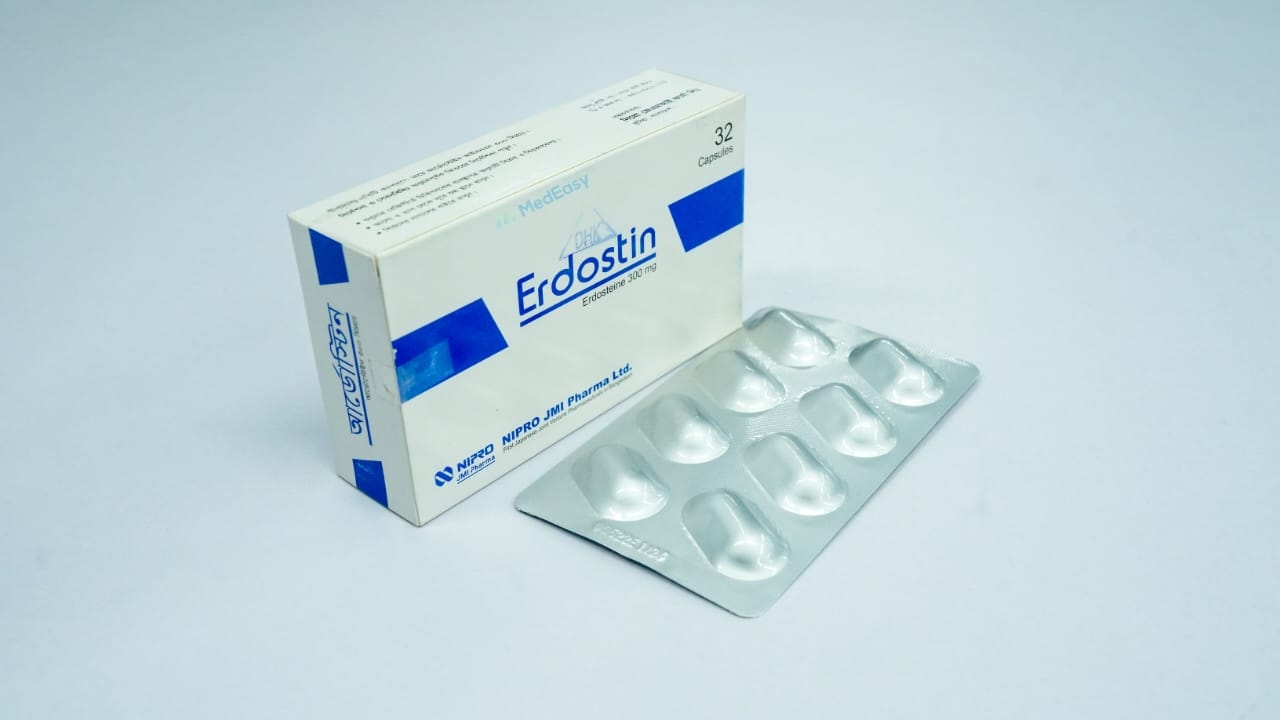
Erdostin300 mg
NIPRO JMI Pharma Ltd.
৳108.00
Add to cart


Spusoft is a thiol-derivative mucolytic (mucoactive) agent used to reduce the viscosity of respiratory mucus and facilitate its clearance.
Spusoft is not indicated for dry (non-productive) cough, and it is not established as a treatment for asthma or for chronic use outside of defined exacerbation episodes. A physician should confirm the diagnosis and appropriateness of Spusoft before use.
Erdosteine is available internationally in several oral dosage forms, most commonly 300 mg capsules and 300 mg granules/sachets for oral suspension; pediatric oral suspension formulations (a lower-strength liquid) also exist in some markets. Each dosage unit contains Erdosteine as the active ingredient along with standard pharmaceutical excipients (fillers, binders, and, for the granule/suspension form, sweetening and flavoring agents).
The exact strength, dosage form, and excipients vary by manufacturer and market; the product label of the specific Erdosteine formulation dispensed should always be checked and followed.
Spusoft is a synthetic thiol (sulfhydryl-group) derivative belonging to the mucolytic/mucoactive class of respiratory medicines. Chemically, it is a homocysteine thiolactone derivative that acts as a prodrug: after oral absorption, it undergoes hepatic first-pass metabolism to active free-thiol metabolites that are responsible for its mucus-thinning effect.
Spusoft has been used in clinical practice, principally in Europe, Asia, and Latin America, for several decades for the symptomatic management of acute exacerbations of chronic bronchitis, marketed under various brand names. It is not currently an FDA-approved product in the United States and does not have a DailyMed listing; product information referenced here reflects internationally approved labeling (e.g., UK/EU Summary of Product Characteristics).
Mucolytic / Mucoactive agent - thiol (sulfhydryl) derivative expectorant; Respiratory system - Cough and Cold Preparations (ATC class: Mucolytics, R05CB).
Erdosteine is a prodrug that is converted in the liver to active metabolites bearing free thiol (-SH) groups. These free thiol groups break the disulfide bonds within mucoprotein/mucopolysaccharide complexes in respiratory mucus, reducing its viscosity and elasticity and making it easier to clear by coughing or ciliary action.
In addition to its mucolytic action, Erdosteine has been shown to reduce bacterial adhesion to the bronchial epithelium (which may reduce the frequency of exacerbations), to exert antioxidant activity by scavenging reactive oxygen species (including those generated by cigarette smoke), and to increase the concentration of certain antibiotics (e.g., amoxicillin) in bronchial secretions when co-administered, potentially enhancing antibiotic efficacy in respiratory infections.
Erdosteine is well absorbed after oral administration and undergoes extensive first-pass hepatic metabolism to its active metabolites. Peak plasma concentrations of the parent drug are reached within about 1-1.5 hours. The elimination half-life of Erdosteine and its metabolites is short (approximately 1.5-2 hours), and elimination occurs mainly via renal excretion of metabolites, which is the basis for dose caution/contraindication in significant renal impairment.
| Population | Dose | Maximum Duration |
|---|---|---|
| Adults (including elderly with normal renal/hepatic function) | 300 mg twice daily | Up to 10 days per course, per the treated exacerbation; do not continue beyond this without medical reassessment |
Spusoft is contraindicated in patients with creatinine clearance below 25 mL/min (see Contraindications). No formal dose adjustment is established for mild-to-moderate renal impairment, but use with caution and physician supervision (see Use in Special Populations).
Spusoft is contraindicated in severe hepatic impairment (see Contraindications). Use with caution in mild-to-moderate hepatic impairment.
See Pediatric Uses; a defined pediatric dosing regimen for the reference-labeled capsule/granule product has not been established, and pediatric use should only follow a physician's specific instructions where a suitable formulation is available.
Spusoft capsules should be swallowed whole with a full glass of water, with or without food; the capsule should not be chewed or opened. Where a granule/sachet-for-suspension formulation is dispensed, the contents should be dissolved in a suitable amount of water immediately before drinking (see Reconstitution). Doses should be spaced approximately 12 hours apart. Spusoft should not be taken together with cough-suppressant (antitussive) medicines, as this can cause dangerous retention of loosened mucus in the airways (see Interactions).
Concurrent use of Spusoft with antitussive/cough-suppressant medicines (e.g., codeine, dextromethorphan) should be avoided. Suppressing the cough reflex while Spusoft is thinning and loosening bronchial secretions can lead to dangerous accumulation and retention of mucus in the airways, increasing the risk of airway obstruction and infection.
Spusoft has been shown to increase the concentration of certain antibiotics (e.g., amoxicillin) in bronchial secretions when given together, which may enhance antibiotic effectiveness in respiratory infections; this is generally considered a beneficial interaction and does not require dose adjustment, but should be noted by the prescriber.
Clinically significant interactions with other commonly used drug classes (e.g., bronchodilators, corticosteroids, theophylline) have not been well established; nonetheless, patients should inform their physician of all medicines they are taking before starting Spusoft.
Patients who develop signs of a severe allergic reaction (facial/throat swelling, difficulty breathing, widespread rash) should stop Spusoft and seek immediate medical attention.
Pregnancy: There is insufficient robust safety data on the use of Spusoft during human pregnancy. It is not recommended for use during pregnancy; if considered necessary, Spusoft should be used only if a physician judges the potential benefit to justify the potential risk to the fetus.
Lactation: It is not known whether Spusoft or its metabolites pass into breast milk. Use during breastfeeding is not recommended; a physician should be consulted, and an alternative approach may be preferred given other options for managing productive cough.
Use Spusoft with caution in patients with mild-to-moderate hepatic or renal impairment; it is contraindicated in severe impairment of either organ (see Contraindications).
Spusoft should be used with caution in patients with a history of peptic ulcer disease, as it is contraindicated in active disease and gastrointestinal irritation is a recognized effect (see Contraindications, Side Effects).
Do not combine Spusoft with cough-suppressant medicines, due to the risk of dangerous mucus retention (see Interactions).
No specific dose adjustment is required for elderly patients with normal renal and hepatic function, but age-related decline in organ function should be assessed before use (see Use in Special Populations).
Spusoft is intended for short defined courses (see Duration of Treatment); it is not a substitute for treatment of the underlying cause of an exacerbation (e.g., appropriate antibiotic therapy for bacterial infection).
Limited data exist on Spusoft overdose in humans; excessive doses may be expected to increase the frequency or severity of known side effects, particularly gastrointestinal symptoms (epigastric pain, nausea, vomiting). There is no specific antidote.
If an overdose of Spusoft is suspected, seek immediate medical attention or contact a poison control center/emergency services; management is supportive and symptomatic. Do not attempt unsupervised home treatment.
Store at room temperature (below 30°C), away from light and moisture. Keep out of reach of children.
The standard adult dose is generally used in elderly patients with adequate renal and hepatic function; renal function should be assessed before treatment given age-related decline (see Precautions and Warnings).
Contraindicated when creatinine clearance is below 25 mL/min; use with caution and physician supervision in mild-to-moderate impairment (see Contraindications, Dosage and Administration).
Contraindicated in severe hepatic impairment; use with caution in mild-to-moderate impairment (see Contraindications, Dosage and Administration).
See Pregnancy and Lactation.
See Pediatric Uses.
For acute exacerbations of chronic bronchitis, Spusoft is typically used for up to 10 days per course, corresponding to the duration of the exacerbation. Treatment should not be continued beyond this period without medical reassessment, and Spusoft is not intended for indefinite or continuous long-term daily use.
Where Spusoft is dispensed as granules or a sachet for oral suspension, the contents of one sachet/dose should be emptied into a glass and dissolved in approximately half a glass of water (or the volume specified on the product label) immediately before drinking; do not prepare the suspension in advance for later use. Capsule formulations of Spusoft do not require reconstitution and should be swallowed whole (see Administration).
Mucolytics; Expectorants; Respiratory tract mucoactive agents (thiol-derivative class).
Erdosteine is an inactive prodrug that undergoes hepatic first-pass metabolism to active metabolites carrying free thiol (sulfhydryl, -SH) groups. These free thiol groups cleave the disulfide bonds that cross-link mucoprotein and mucopolysaccharide chains in bronchial mucus, lowering its viscosity and elasticity and making it easier to expectorate.
Erdosteine's active metabolites also reduce adhesion of certain bacteria to the respiratory epithelium, which may help reduce the frequency of infective exacerbations, and exert antioxidant activity by scavenging reactive oxygen species generated during airway inflammation and by cigarette smoke exposure. Erdosteine additionally increases penetration of some antibiotics into bronchial secretions when co-administered.
The safety and efficacy of Spusoft have not been formally established in children and adolescents under 18 years of age for the standard adult capsule/granule formulation, and it is not recommended for use in this age group outside of specific physician guidance. In some markets, dedicated pediatric oral liquid formulations of Spusoft at reduced, weight-based dosing are available; however, any pediatric use of Spusoft should be undertaken only under the direction of a pediatrician, using an appropriate age-specific formulation and dose.
Q: What is Spusoft 300 mg Capsule used for?
A: Spusoft 300 mg Capsule is a mucolytic medicine used to help thin and clear thick mucus in adults having an acute exacerbation (flare-up) of chronic bronchitis, including COPD exacerbations, making coughing more productive and breathing easier. It may also help antibiotics work better in the airways when a bacterial infection is present.
Q: How should I take Spusoft 300 mg Capsule?
A: Spusoft 300 mg Capsule is usually taken as 300 mg twice daily, swallowing the capsule whole with water, for up to 10 days per exacerbation, unless your physician advises otherwise. If you have a granule or sachet form, dissolve it in water immediately before drinking.
Q: Can I take a cough suppressant together with Spusoft 300 mg Capsule?
A: No. Spusoft 300 mg Capsule should not be combined with cough-suppressant (antitussive) medicines, because suppressing the cough while Spusoft 300 mg Capsule loosens mucus can cause dangerous mucus buildup in the airways. Speak to a physician if you need cough symptom relief.
Q: Who should not take Spusoft 300 mg Capsule?
A: Spusoft 300 mg Capsule should not be used by anyone with a known hypersensitivity to Spusoft 300 mg Capsule or other thiol-containing compounds, severe liver or kidney impairment (creatinine clearance below 25 mL/min), active peptic ulcer disease, or cystinuria/hereditary thiol-metabolism disorders. Discuss your full medical history with your physician before starting Spusoft 300 mg Capsule.
Q: Is Spusoft 300 mg Capsule safe in pregnancy or while breastfeeding?
A: There isn't enough reliable safety data on Spusoft 300 mg Capsule in pregnancy or breastfeeding, so it is not generally recommended in these situations. If treatment is being considered, a physician should weigh the potential benefit against the potential unknown risk before prescribing Spusoft 300 mg Capsule.
Q: What side effects can Spusoft 300 mg Capsule cause?
A: The most common side effect is upper abdominal (epigastric) discomfort. Less commonly, Spusoft 300 mg Capsule can cause headache, altered taste, nausea, vomiting, diarrhea, or skin reactions such as hives; rarely, more serious allergic reactions (angioedema) can occur, and immediate medical attention should be sought if this happens.
Disclaimer
The information provided is accurate to the best of our knowledge, but it does not replace professional medical advice. We cannot guarantee its completeness or accuracy, and the absence of specific information about a drug should not be taken as an endorsement. We are not responsible for any consequences arising from this information, so please consult a healthcare professional for any concerns or questions.
