8% Off
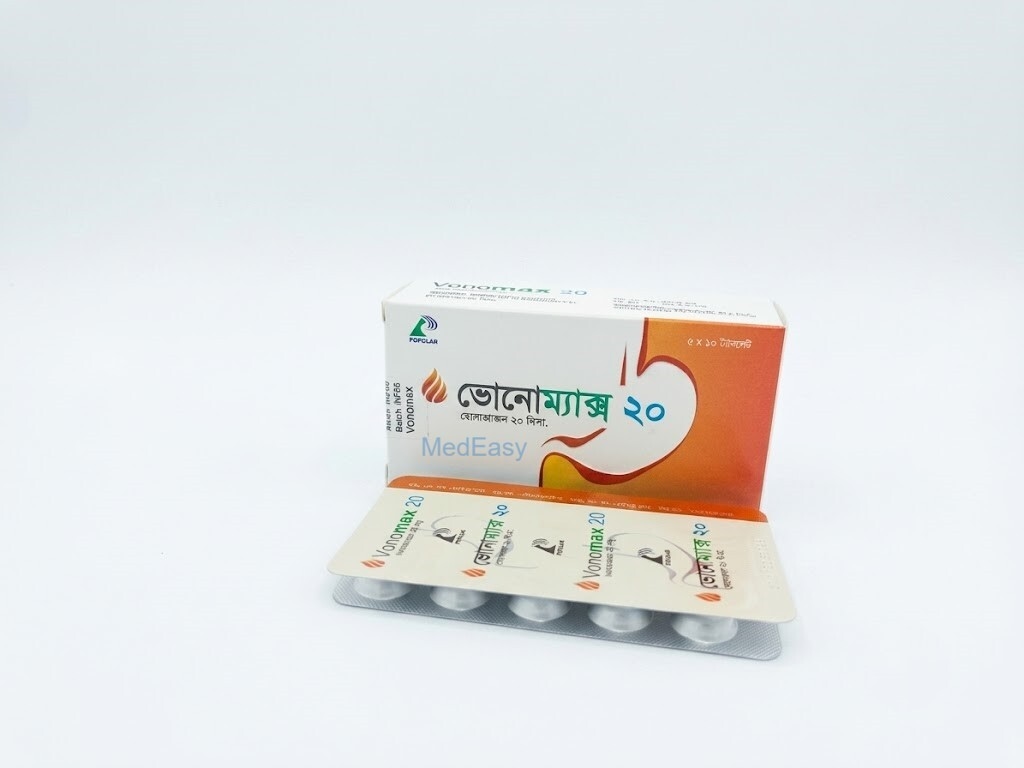
Vonomax20 mg
Popular Pharmaceuticals Ltd.
৳92.00
Add to cart
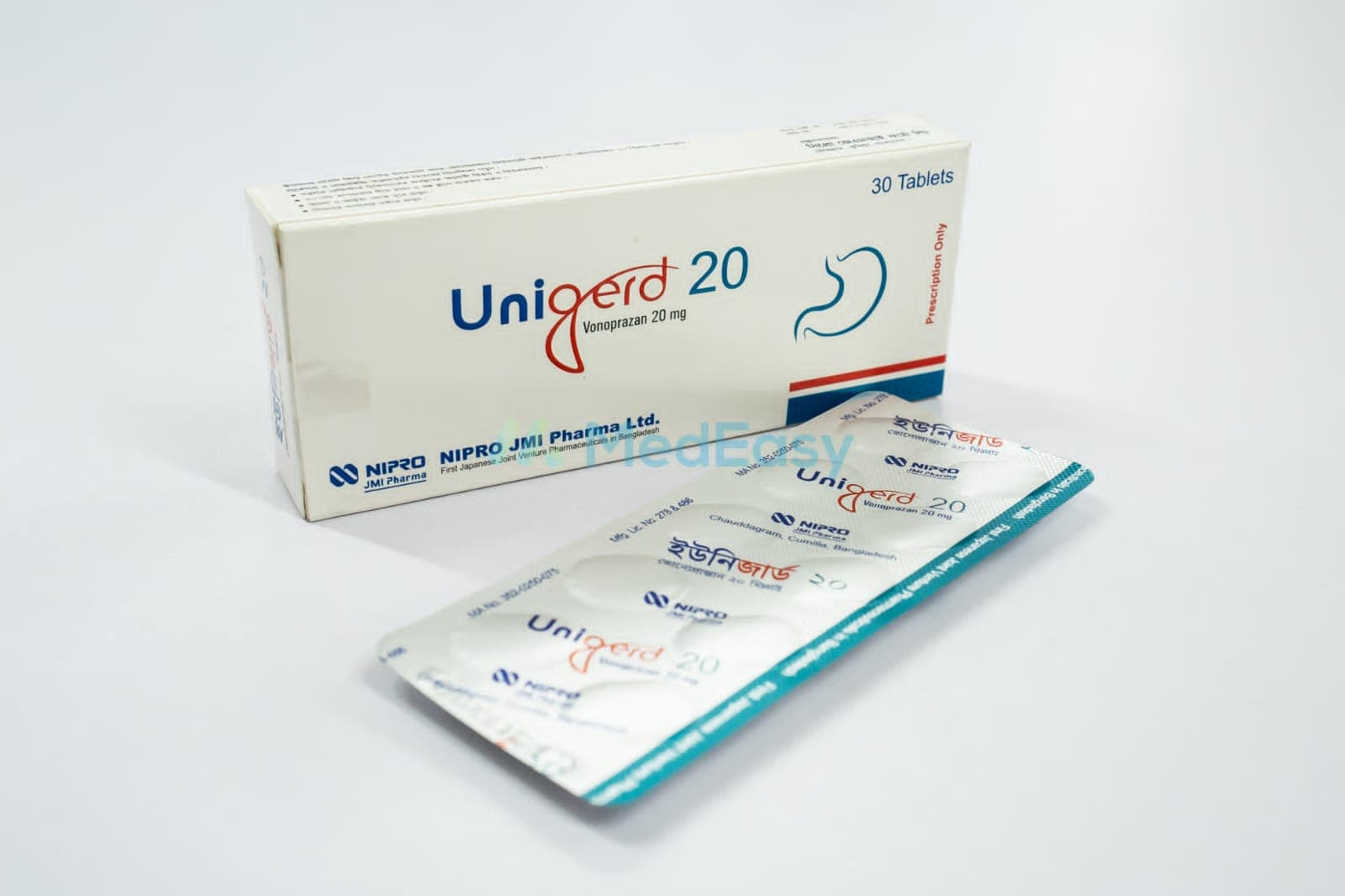

Unigerd is a potassium-competitive acid blocker (P-CAB) indicated for the following uses:
Unigerd belongs to a newer drug class (P-CABs) that is distinct from proton pump inhibitors (PPIs), though it is used for overlapping acid-related indications.
Each tablet of Vonoprazan contains Vonoprazan (as the fumarate salt) as the active pharmaceutical ingredient, along with pharmaceutically acceptable excipients. Vonoprazan is available in strengths such as 10 mg and 20 mg oral tablets. When used for H. pylori eradication, Vonoprazan is co-packaged or co-prescribed with amoxicillin, with or without clarithromycin, as part of a combination regimen.
Unigerd is an orally administered potassium-competitive acid blocker (P-CAB), a class of gastric acid suppressants that is mechanistically and structurally distinct from proton pump inhibitors (PPIs). Unigerd works by reversibly and competitively blocking potassium binding at the H+/K+-ATPase (the gastric "proton pump") on parietal cells, resulting in potent, rapid, and sustained inhibition of gastric acid secretion.
Unigerd is used to heal erosive esophagitis, relieve heartburn associated with gastroesophageal reflux disease (GERD), and, in combination with antibiotics, to eradicate Helicobacter pylori infection. Compared with some PPIs, Unigerd has a faster onset of acid suppression and does not require activation in an acidic environment, allowing more consistent acid control from the first dose.
Unigerd belongs to the potassium-competitive acid blocker (P-CAB) class of gastric acid suppressants, a therapeutic category distinct from proton pump inhibitors (PPIs) and H2-receptor antagonists, though used for similar acid-related conditions.
Vonoprazan is a potassium-competitive acid blocker (P-CAB). It reversibly and competitively inhibits the H+/K+-ATPase enzyme (the proton pump) on the luminal surface of gastric parietal cells by blocking potassium ion binding, thereby suppressing both basal and stimulated gastric acid secretion. Unlike proton pump inhibitors, which are prodrugs requiring acid activation and irreversible covalent binding, Vonoprazan accumulates in the acidic parietal cell canaliculus and binds to the proton pump in a pH-independent, non-covalent, and reversible manner.
| Indication | Dose | Duration |
|---|---|---|
| Healing of erosive esophagitis | Unigerd 20 mg orally once daily | 8 weeks |
| Maintenance of healed erosive esophagitis | Unigerd 10 mg orally once daily | Up to 6 months |
| Heartburn relief in non-erosive GERD | Unigerd 10 mg orally once daily | 4 weeks |
| H. pylori eradication - Triple therapy | Unigerd 20 mg + amoxicillin 1,000 mg + clarithromycin 500 mg, each twice daily | 14 days |
| H. pylori eradication - Dual therapy | Unigerd 20 mg twice daily + amoxicillin 1,000 mg three times daily | 14 days |
Unigerd tablets should be swallowed whole and may be taken with or without food, generally at approximately the same time each day. When used for H. pylori eradication, Unigerd must always be taken together with the prescribed antibiotic(s) as a complete combination regimen — see Precautions and Warnings regarding treatment adherence.
No dose adjustment is needed for mild-to-moderate renal impairment. In severe renal impairment (GFR <30 mL/min), the erosive esophagitis dose should be reduced to 10 mg once daily; Unigerd-based H. pylori eradication regimens are not recommended in patients with severe renal impairment.
No dose adjustment is needed in mild hepatic impairment (Child-Pugh Class A). In moderate-to-severe hepatic impairment (Child-Pugh Class B or C), the erosive esophagitis dose should be reduced to 10 mg once daily, and Unigerd-based H. pylori eradication regimens are not recommended.
Unigerd tablets are taken orally, swallowed whole with water, with or without food. For H. pylori eradication regimens, all component medicines (Unigerd plus antibiotic(s)) must be taken together for the full prescribed course to ensure effective eradication and to reduce the risk of antibiotic resistance.
Unigerd is contraindicated for concomitant use with rilpivirine-containing products (see Contraindications), because the profound and sustained acid suppression from Unigerd significantly reduces rilpivirine absorption and plasma concentrations, risking loss of antiretroviral efficacy and HIV treatment failure.
Vonoprazan is contraindicated in the following situations:
Unigerd is generally well tolerated. Reported adverse effects include:
Patients should seek prompt medical attention for signs of severe allergic reaction, unexplained rash, severe or persistent diarrhea, muscle spasms, seizures, or unusual fatigue/weakness.
Data on the use of Unigerd in pregnant women are limited, and animal reproduction studies do not reliably predict human risk. Unigerd should be used during pregnancy only if clearly needed and if the potential benefit justifies the potential risk to the fetus. Pregnant patients or those planning pregnancy should consult a physician before starting or continuing Unigerd.
It is not known whether Unigerd is present in human milk or what effect it may have on a breastfed infant or on milk production. A decision should be made whether to discontinue breastfeeding or discontinue Unigerd, taking into account the benefit of breastfeeding and the mother's clinical need for Unigerd, and should be made in consultation with a physician.
Limited clinical experience is available with Unigerd overdose. Based on its pharmacological profile, overdose would be expected to primarily cause exaggerated effects of profound gastric acid suppression. There is no specific antidote for Unigerd overdose. In case of suspected overdose, seek immediate medical attention or contact a poison control center; treatment should be symptomatic and supportive, as directed by a physician. Do not attempt unsupervised home treatment for a suspected overdose.
Store at room temperature (below 30°C), away from light and moisture. Keep out of reach of children.
The safety and efficacy of Unigerd in pediatric patients have not been established. Unigerd is not recommended for use in children.
No overall differences in safety or effectiveness have been observed between elderly and younger adult patients, though greater sensitivity in some older individuals cannot be ruled out; no dose adjustment based on age alone is required.
No adjustment needed in mild-to-moderate impairment; dose reduction required in severe renal impairment for erosive esophagitis, and H. pylori regimens are not recommended (see Dosage and Administration).
No adjustment needed in mild impairment (Child-Pugh A); dose reduction required in moderate-to-severe impairment for erosive esophagitis, and H. pylori regimens are not recommended (see Dosage and Administration).
Duration of Unigerd therapy depends on indication: 8 weeks for healing of erosive esophagitis, up to 6 months for maintenance therapy, 4 weeks for symptomatic relief of non-erosive GERD heartburn, and 14 days when used in combination with antibiotics for H. pylori eradication. Unigerd should be used for the lowest effective dose and shortest duration appropriate to the clinical indication, and continued use beyond the recommended duration should be re-evaluated by a physician.
Potassium-competitive acid blocker (P-CAB); gastric acid suppressant. Vonoprazan is used, alone or in combination with antibiotics, for acid-related gastrointestinal conditions.
Vonoprazan reversibly and competitively blocks potassium binding at the gastric H+/K+-ATPase (proton pump) on parietal cells, producing potent, rapid, and sustained suppression of both basal and stimulated gastric acid secretion, without requiring acid activation as proton pump inhibitors do.
The safety and efficacy of Unigerd have not been established in pediatric patients of any age group. Unigerd is therefore not recommended for use in children and adolescents outside of a clinical trial setting. Use in this population should only be considered under direct specialist supervision if no suitable alternative exists, and only if a physician determines the potential benefit outweighs the unknown risks.
Q: What is Unigerd 20 mg Tablet used for?
A: Unigerd 20 mg Tablet is used to heal erosive esophagitis, maintain healing of erosive esophagitis, relieve heartburn associated with gastroesophageal reflux disease (GERD), and, in combination with antibiotics, to eradicate Helicobacter pylori (H. pylori) infection.
Q: How is Unigerd 20 mg Tablet different from a proton pump inhibitor (PPI)?
A: Unigerd 20 mg Tablet is a potassium-competitive acid blocker (P-CAB), a newer class of acid suppressant that works differently from PPIs. Unigerd 20 mg Tablet binds reversibly and does not require acid activation, which allows it to act faster and provide more consistent acid suppression from the first dose compared with many PPIs.
Q: Can I take Unigerd 20 mg Tablet with rilpivirine or other HIV medicines?
A: No. Unigerd 20 mg Tablet is contraindicated with rilpivirine-containing products because it can significantly reduce rilpivirine absorption, risking HIV treatment failure. Always tell your doctor about all medicines, including HIV treatment, before starting Unigerd 20 mg Tablet.
Q: Is Unigerd 20 mg Tablet safe during pregnancy or breastfeeding?
A: Data on Unigerd 20 mg Tablet use during pregnancy are limited. Unigerd 20 mg Tablet should be used during pregnancy only if clearly needed and the potential benefit justifies the potential risk to the fetus. It is not known if Unigerd 20 mg Tablet passes into breast milk, so breastfeeding mothers should consult a physician before use.
Q: What are the common side effects of Unigerd 20 mg Tablet?
A: Common side effects of Unigerd 20 mg Tablet include diarrhea, nausea, indigestion, abdominal pain, headache, elevated blood pressure, and urinary tract infection. Long-term use may be associated with low magnesium, vitamin B12 deficiency, and fundic gland polyps; contact your doctor if you experience persistent or severe symptoms.
Q: Why is Unigerd 20 mg Tablet sometimes combined with antibiotics?
A: When used for H. pylori eradication, Unigerd 20 mg Tablet is combined with antibiotics (such as amoxicillin, with or without clarithromycin) because Unigerd 20 mg Tablet alone does not eliminate the bacteria; it improves the acidic environment so the antibiotics can work effectively. It is important to take Unigerd 20 mg Tablet and the antibiotics exactly as prescribed, completing the full 14-day course without skipping or stopping doses early, to ensure successful eradication and reduce the risk of antibiotic resistance.
Disclaimer
The information provided is accurate to the best of our knowledge, but it does not replace professional medical advice. We cannot guarantee its completeness or accuracy, and the absence of specific information about a drug should not be taken as an endorsement. We are not responsible for any consequences arising from this information, so please consult a healthcare professional for any concerns or questions.