
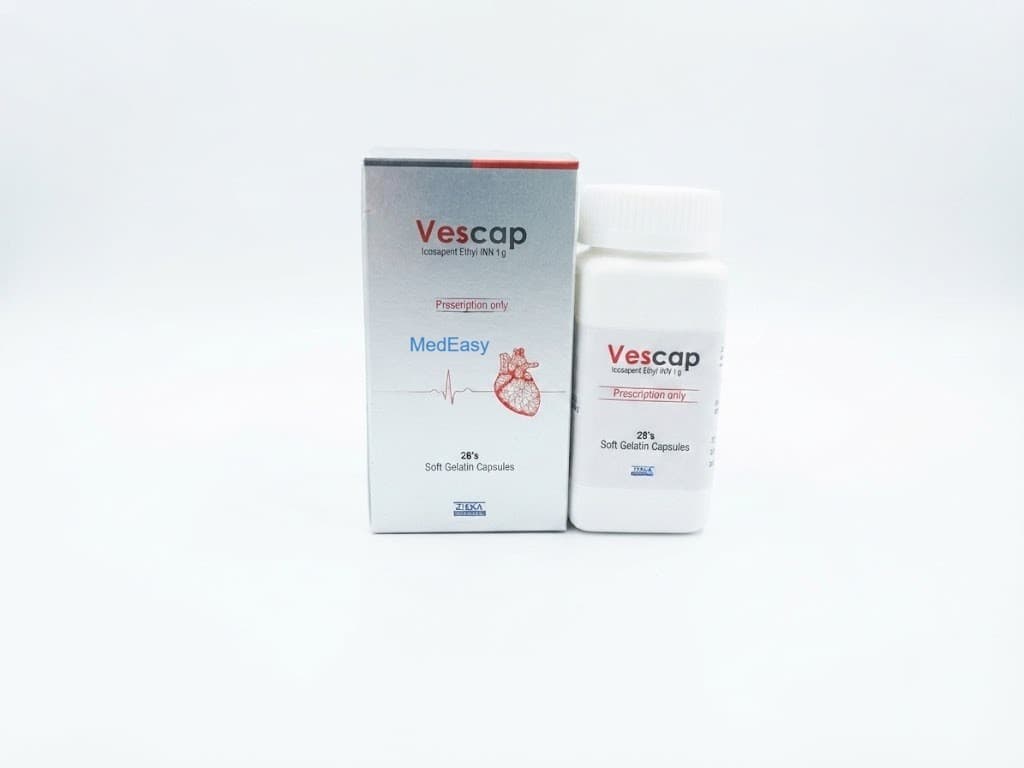

Medicine overview
Indications of Vescap
Vescap is a highly purified ethyl ester of eicosapentaenoic acid (EPA) used in the management of triglyceride disorders and cardiovascular risk reduction. Its approved and evidence-based uses are classified below by strength of evidence.
Established / Approved Uses
- Cardiovascular risk reduction (adjunct therapy): Vescap is indicated as an adjunct to maximally tolerated statin therapy to reduce the risk of myocardial infarction, stroke, coronary revascularization, and hospitalization for unstable angina in adults with elevated triglyceride levels (≥150 mg/dL) who have established cardiovascular disease, or diabetes mellitus with two or more additional cardiovascular risk factors.
- Severe hypertriglyceridemia: Vescap is indicated as an adjunct to diet to reduce triglyceride levels in adult patients with severe hypertriglyceridemia (triglycerides ≥500 mg/dL).
Important Notes
- Vescap must always be used together with dietary modification and, where indicated, maximally tolerated statin therapy — it is not a substitute for these measures.
- Vescap is not indicated for weight loss, general cardiovascular prevention in the absence of the specific risk factors above, or as a first-line lipid-lowering agent.
Composition
Each soft gelatin capsule contains Icosapent Ethyl (a highly purified ethyl ester of eicosapentaenoic acid, EPA) as the active ingredient, typically available in 0.5 gram and 1 gram capsule strengths. Capsules also contain inactive ingredients used in softgel formulation.
Description
Vescap is an omega-3 fatty acid derivative — specifically a highly purified and stable ethyl ester form of eicosapentaenoic acid (EPA), a naturally occurring polyunsaturated fatty acid. Unlike many over-the-counter fish oil products that combine EPA and DHA, Vescap contains essentially no DHA, which distinguishes its lipid effect profile (notably, it does not raise LDL-cholesterol the way some mixed omega-3 products can).
Vescap is supplied as an oral soft gelatin capsule and is used long-term as part of a comprehensive strategy to lower triglycerides and reduce cardiovascular risk in appropriately selected adult patients.
Therapeutic Class
Vescap belongs to the therapeutic class of omega-3 fatty acid derivatives (antihyperlipidemic / triglyceride-lowering agents), used adjunctively for lipid management and cardiovascular risk reduction.
Pharmacology
The precise mechanism by which Icosapent Ethyl reduces triglyceride levels and cardiovascular risk is not fully established. Proposed mechanisms include:
- Reduction of hepatic very-low-density lipoprotein (VLDL) triglyceride synthesis and/or secretion.
- Enhanced clearance of triglyceride-rich lipoproteins from the circulation, potentially via increased lipoprotein lipase activity and decreased apolipoprotein C-III.
- Additional proposed anti-inflammatory, antioxidant, membrane-stabilizing, and antithrombotic effects that may contribute to the observed reduction in cardiovascular events, independent of its triglyceride-lowering effect.
In a large cardiovascular outcomes trial, Icosapent Ethyl added to statin therapy significantly reduced the composite risk of major adverse cardiovascular events compared with placebo, an effect considered to extend beyond simple triglyceride reduction.
Dosage & Administration of Vescap
Adult Dose
| Indication | Dose |
|---|---|
| Cardiovascular risk reduction (adjunct to statin) | 4 grams by mouth per day, taken as 2 grams twice daily with food |
| Severe hypertriglyceridemia (adjunct to diet) | 4 grams by mouth per day, taken as 2 grams twice daily with food |
The 4 gram total daily dose may be given as two 1 gram capsules twice daily, or four 0.5 gram capsules twice daily, always taken with food.
Pediatric Dose
Safety and efficacy of Vescap have not been established in pediatric patients; it is not recommended for use in this population.
Renal Impairment
No specific dose adjustment has been established for renal impairment; formal dedicated renal-impairment studies are limited, so use with routine clinical monitoring.
Hepatic Impairment
Vescap has not been specifically studied in patients with severe hepatic impairment; use with caution and clinical judgment in this group (see Precautions).
Administration of Vescap
Take Vescap capsules by mouth twice daily with food. Swallow capsules whole; do not break, crush, dissolve, or chew them.
Interaction of Vescap
The following clinically significant interaction has been well established for Vescap:
- Anticoagulants and antiplatelet agents (e.g., warfarin, aspirin, clopidogrel, heparin, NSAIDs): Vescap, like other omega-3 fatty acid products, may prolong bleeding time. Concurrent use increases the risk of bleeding, and patients on these combinations should be monitored periodically for signs of bleeding.
No clinically significant cytochrome P450-mediated drug interactions have been well established for Vescap to date.
Contraindications
Icosapent Ethyl is contraindicated in patients with known hypersensitivity (including anaphylactic reactions) to Icosapent Ethyl or to any of its capsule components.
Side Effects of Vescap
The most commonly reported side effects of Vescap in clinical trials include:
- Musculoskeletal pain
- Peripheral edema (swelling, usually of the legs/ankles)
- Constipation
- Gout
- Atrial fibrillation or atrial flutter (see Precautions)
- Arthralgia (joint pain)
- Oropharyngeal pain
- Bleeding events (see Precautions)
Patients should seek prompt medical attention for palpitations, irregular heartbeat, unusual bruising or bleeding, or any severe or persistent adverse effect while taking Vescap.
Pregnancy & Lactation
Pregnancy
Data on the use of Vescap in pregnant women are limited. Animal reproduction studies have not shown clear dose-related harm at clinically relevant exposures, but human data are insufficient to establish safety. Vescap should be used during pregnancy only if clearly needed and if the potential benefit justifies the potential risk to the fetus; a physician should be consulted before use in pregnancy.
Lactation
Omega-3 fatty acids, including EPA, have been detected in human breast milk. There is limited information on the effects of Vescap on the breastfed infant or on milk production. A physician should be consulted to weigh the benefits of breastfeeding against any potential risk before using Vescap while breastfeeding.
Precautions & Warnings
The following precautions apply to the use of Vescap:
- Atrial fibrillation/flutter: Vescap has been associated with an increased risk of atrial fibrillation or atrial flutter requiring hospitalization, particularly in patients with a prior history of these arrhythmias or other significant cardiovascular conditions. Patients should be monitored for symptoms such as palpitations, irregular heartbeat, or shortness of breath.
- Bleeding risk: Vescap may increase the risk of bleeding, particularly in patients also taking anticoagulant or antiplatelet medications, or who have an underlying bleeding disorder. Monitor for signs of bleeding or bruising (see Interactions).
- Hepatic function: Periodic monitoring of liver function is advisable during long-term therapy, particularly in patients with pre-existing hepatic impairment.
- Allergy considerations: Because Vescap is derived from fish sources, patients with known fish or shellfish allergy should use it with caution and discuss the specific product source with their physician.
Overdose Effects of Vescap
There is limited clinical experience with overdose of Vescap. In the event of a suspected overdose, seek immediate medical attention or contact a poison control center right away. Management should be supportive and symptomatic, guided by a physician or emergency medical personnel; no specific antidote is known.
Storage Conditions
Store at room temperature (below 30°C), away from light and moisture. Keep out of reach of children.
Use In Special Populations
- Pediatric patients: Safety and efficacy of Vescap have not been established; not recommended for use in children.
- Elderly patients: No overall differences in safety or effectiveness have been observed between elderly and younger adult patients in clinical trials, but elderly patients often have more comorbidities and concomitant medications, so use with routine clinical monitoring.
- Renal impairment: No specific dose adjustment is established; use with routine monitoring (see Dosage and Administration).
- Hepatic impairment: Use with caution in patients with severe hepatic impairment, as this population has not been specifically studied (see Dosage and Administration).
Duration Of Treatment
Vescap is generally intended for long-term, ongoing use as part of ongoing cardiovascular risk reduction or triglyceride management, with the need for continued therapy periodically reassessed by the prescribing physician based on lipid response and clinical status.
Drug Classes
Omega-3 fatty acid derivatives; Antihyperlipidemic agents; Triglyceride-lowering agents
Mode Of Action
Icosapent Ethyl is thought to lower triglycerides by reducing hepatic synthesis/secretion of VLDL-triglycerides and enhancing clearance of triglyceride-rich lipoproteins from circulation; additional anti-inflammatory and antithrombotic effects are proposed to contribute to its cardiovascular risk-reducing benefit, independent of triglyceride lowering alone.
Pediatric Uses
The safety and efficacy of Vescap in pediatric patients have not been established. Its use is therefore not recommended in children and adolescents.
Frequently Asked Questions
Q: What is Vescap 1 gm Capsule used for?
A: Vescap 1 gm Capsule is used as an add-on to maximally tolerated statin therapy to reduce cardiovascular risk (such as heart attack and stroke) in adults with high triglycerides and either established heart disease or diabetes with additional risk factors. It is also used, together with diet, to lower triglyceride levels in adults with severe hypertriglyceridemia (triglycerides ≥500 mg/dL).
Q: How should I take Vescap 1 gm Capsule?
A: Vescap 1 gm Capsule is usually taken as a total of 4 grams per day, split into two doses of 2 grams each, taken with food. Swallow the capsules whole; do not crush, break, or chew them.
Q: Can Vescap 1 gm Capsule cause an irregular heartbeat?
A: Yes. Vescap 1 gm Capsule has been associated with an increased risk of atrial fibrillation or atrial flutter, especially in people with a prior history of these heart rhythm problems. Tell your doctor right away if you notice palpitations, an irregular heartbeat, or shortness of breath while taking Vescap 1 gm Capsule.
Q: Does Vescap 1 gm Capsule increase bleeding risk?
A: Vescap 1 gm Capsule can increase the risk of bleeding, particularly if you are also taking blood thinners or antiplatelet medicines such as warfarin, aspirin, or clopidogrel. Watch for unusual bruising or bleeding and inform your doctor if this occurs.
Q: Is Vescap 1 gm Capsule safe during pregnancy or breastfeeding?
A: Information on Vescap 1 gm Capsule use during pregnancy and breastfeeding is limited. It should be used in pregnancy only if clearly needed and if the benefit outweighs the potential risk to the baby, and a doctor should be consulted before use while breastfeeding.
Q: What should I do if I miss a dose or take too much Vescap 1 gm Capsule?
A: If you miss a dose, take it as soon as you remember unless it is close to the next dose. If you suspect you have taken too much Vescap 1 gm Capsule, seek immediate medical attention or contact a poison control center; do not attempt to treat an overdose at home.
Disclaimer
The information provided is accurate to the best of our knowledge, but it does not replace professional medical advice. We cannot guarantee its completeness or accuracy, and the absence of specific information about a drug should not be taken as an endorsement. We are not responsible for any consequences arising from this information, so please consult a healthcare professional for any concerns or questions.
