
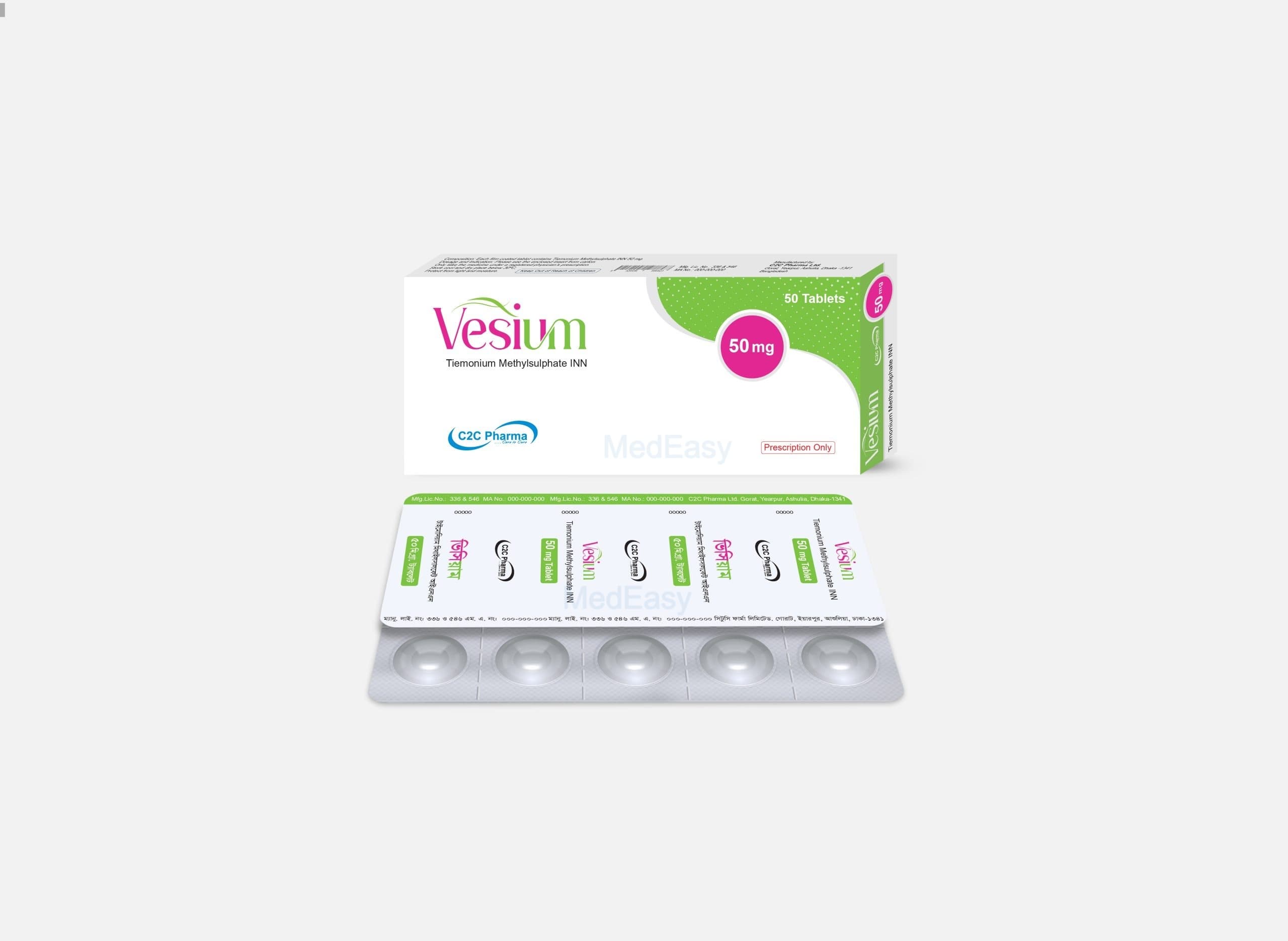

Medicine overview
Indications of Vesium
Vesium is an antimuscarinic (anticholinergic) antispasmodic agent used for the symptomatic relief of pain and spasm arising from the gastrointestinal, biliary, and genitourinary tracts.
Established/labeled uses
- Symptomatic relief of gastrointestinal spasm and associated colicky abdominal pain (e.g., functional/irritable-bowel-type spasm, enteritis-associated cramping).
- Symptomatic relief of biliary tract spasm (biliary colic).
- Symptomatic relief of genitourinary tract spasm and pain, including renal/ureteric colic and bladder (detrusor) spasm.
Adjunct/procedural use
- As an adjunct premedication to reduce smooth-muscle spasm and associated discomfort during certain gastrointestinal or gynecological instrumental or radiological procedures (e.g., endoscopy, hysterosalpingography); it is used together with, not instead of, the primary procedure and analgesia.
Vesium provides symptomatic relief of spasm and pain; it does not treat the underlying disease process causing the spasm. Persistent, severe, or worsening abdominal or pelvic pain requires medical evaluation to establish a specific diagnosis.
Composition
Each dosage form contains Tiemonium Methylsulfate (INN) as the active pharmaceutical ingredient. Tiemonium Methylsulfate is formulated as immediate-release oral tablets in most markets; other dosage forms (e.g., suppositories or injectable solution) exist in some countries. Exact strength and excipients vary by manufacturer and market — refer to the specific product's package insert for the precise composition.
Description
Vesium is a synthetic quaternary ammonium anticholinergic (antimuscarinic) compound used as an antispasmodic. In addition to its antimuscarinic action, Vesium is reported to have a direct musculotropic (papaverine-like) relaxant effect on smooth muscle and a local, membrane-stabilizing analgesic action that reduces the sensitivity of visceral pain receptors, which together account for its effectiveness against smooth-muscle spasm and the pain that accompanies it.
Being a quaternary ammonium compound, Vesium is poorly and variably absorbed after oral administration and does not readily cross the blood-brain barrier, so central anticholinergic effects are generally less prominent than with tertiary-amine antimuscarinics, although they can still occur, particularly in the elderly or at higher doses.
Therapeutic Class
Vesium belongs to the antispasmodic (anticholinergic/antimuscarinic) class of drugs, used to relax smooth muscle spasm of the gastrointestinal, biliary, and genitourinary tracts.
Pharmacology
Mechanism of action
Tiemonium Methylsulfate is a competitive antagonist at muscarinic (M) acetylcholine receptors on gastrointestinal, biliary, and genitourinary smooth muscle. By blocking these receptors, Tiemonium Methylsulfate inhibits acetylcholine-mediated smooth-muscle contraction, reducing spasm, motility, and associated colicky pain.
Tiemonium Methylsulfate also exerts a direct (musculotropic) relaxant action on smooth muscle independent of its antimuscarinic effect, and has a local anesthetic-like action that dampens the excitability of visceral sensory (nociceptive) nerve endings, contributing an additional analgesic effect on visceral pain.
Pharmacokinetics
As a quaternary ammonium compound, oral Tiemonium Methylsulfate undergoes limited and variable gastrointestinal absorption. It is metabolized and eliminated mainly via hepatic and renal routes. Its quaternary structure limits penetration across the blood-brain barrier, which reduces (but does not eliminate) the likelihood of central anticholinergic effects compared with tertiary-amine antimuscarinics.
Dosage & Administration of Vesium
Dosage of Vesium should be individualized by a physician according to indication, severity of symptoms, dosage form available, and patient factors (age, renal/hepatic function). The following reflects typical adult dosing ranges used in markets where Vesium is available; always follow the prescriber's instructions and the specific product label.
| Indication | Typical adult dose | Notes |
|---|---|---|
| Gastrointestinal spasm / colicky abdominal pain | One tablet 2–3 times daily, taken before meals | Reassess if pain persists beyond a few days |
| Biliary tract spasm (biliary colic) | One tablet 2–3 times daily, or as directed for acute episodes | Investigate underlying biliary pathology if recurrent |
| Genitourinary spasm (renal/ureteric colic, bladder spasm) | One tablet 2–3 times daily, or as directed for acute episodes | Seek urgent care for suspected renal colic with fever, obstruction, or inability to pass urine |
| Pre-procedure antispasmodic (e.g., endoscopy, hysterosalpingography) | Single dose shortly before the procedure, as directed by the treating physician | Used as an adjunct at the discretion of the treating team |
Renal/hepatic impairment
Specific validated dose-adjustment data for renal or hepatic impairment are not well established; use Vesium cautiously and at the lowest effective dose in patients with significant renal or hepatic impairment, under medical supervision.
Pediatric dosing
Well-established pediatric dosing for Vesium is not established; see Use in Special Populations.
Administration of Vesium
Vesium tablets are usually taken orally with a glass of water, generally before meals unless otherwise directed. Swallow the tablet whole; do not crush or chew unless the product labeling states this is acceptable. Where non-oral dosage forms (e.g., suppository or injection) of Vesium are prescribed, they should be administered only by or under the direction of a qualified healthcare professional, following the specific product instructions.
Interaction of Vesium
The following interactions with Vesium are clinically relevant and should be considered before co-administration:
- Other anticholinergic/antimuscarinic drugs (e.g., certain antihistamines, tricyclic antidepressants, other antispasmodics, some antiparkinsonian agents): concurrent use with Vesium can produce additive anticholinergic effects such as dry mouth, blurred vision, constipation, and urinary retention.
- CNS depressants (e.g., sedatives, opioids, alcohol): may add to the drowsiness that can occur with Vesium; caution is advised with concurrent use.
- Drugs whose absorption depends on gastrointestinal motility: because Vesium can slow gastric emptying and gut transit, it may alter the rate or extent of absorption of other concurrently administered oral medicines.
Inform the prescribing physician or pharmacist of all other medicines being taken before starting Vesium.
Contraindications
Tiemonium Methylsulfate is contraindicated in patients with:
- Known hypersensitivity to Tiemonium Methylsulfate or to any component of the formulation.
- Narrow-angle (angle-closure) glaucoma.
- Urinary retention due to bladder outlet or prostatic obstruction.
- Pyloric stenosis or other mechanical gastrointestinal obstruction.
- Paralytic ileus.
- Severe ulcerative colitis with risk of toxic megacolon.
- Myasthenia gravis.
Side Effects of Vesium
Adverse effects of Vesium are mainly related to its anticholinergic activity and are generally dose-related.
Common
- Dry mouth
- Blurred vision / accommodation disturbances
- Constipation
- Urinary hesitancy
- Drowsiness or dizziness
Less common
- Tachycardia (rapid heartbeat)
- Urinary retention
- Skin flushing, dryness
- Confusion, particularly in elderly patients
Report any severe, persistent, or bothersome side effect from Vesium to a physician.
Pregnancy & Lactation
Pregnancy: Human safety data on Vesium in pregnancy are limited. As with other anticholinergic antispasmodics, Vesium should be used during pregnancy only if clearly needed and if the potential benefit justifies the potential risk to the fetus; consult a physician before use in pregnancy.
Lactation: It is not well established whether Vesium passes into human breast milk. Because anticholinergic drugs can theoretically affect a nursing infant (e.g., reduced milk production, sedation), Vesium should be used during breastfeeding only under medical advice, weighing the benefit to the mother against potential risk to the infant.
Precautions & Warnings
Use Vesium with the following precautions:
- Anticholinergic effects: Vesium can cause dry mouth, blurred vision, constipation, and urinary hesitancy; use with caution in patients who may be particularly sensitive to these effects.
- Drowsiness: Vesium may cause drowsiness or dizziness; caution patients about driving or operating machinery until they know how Vesium affects them.
- Elderly patients: older adults are more sensitive to the anticholinergic effects of Vesium, including confusion, and should be treated with a cautious, individualized dose.
- Cardiac disease: use Vesium cautiously in patients with tachycardia or cardiac arrhythmias, as anticholinergic agents can increase heart rate.
- Hot environments: anticholinergic agents such as Vesium can reduce sweating; use caution in hot weather or with strenuous activity because of a theoretical risk of heat-related illness.
- Vesium is intended for symptomatic relief only and is not a substitute for medical evaluation of persistent, severe, or worsening abdominal or pelvic pain, which may indicate a condition requiring specific diagnosis and treatment.
See Contraindications for situations in which Vesium must not be used, and Interactions for clinically important drug interactions.
Overdose Effects of Vesium
Overdose of Vesium would be expected to produce an exaggeration of its anticholinergic effects, potentially including marked dry mouth, flushed/dry skin, blurred vision, dilated pupils, tachycardia, urinary retention, fever, agitation, confusion, or hallucinations; severe cases could progress to convulsions or coma.
If overdose of Vesium is suspected, seek immediate medical attention or contact emergency services/a poison control center right away. Do not attempt specific home treatment; management should be provided in a medical facility and is generally supportive (e.g., monitoring, symptomatic and supportive care), guided by a physician.
Storage Conditions
Store at room temperature (below 30°C), away from light and moisture. Keep out of reach of children.
Use In Special Populations
- Pediatric patients: The safety and efficacy of Vesium in children are not well established; use in children is generally not recommended unless specifically directed by a physician. See Pediatric Use for further detail.
- Elderly patients: Older adults are more susceptible to the anticholinergic adverse effects of Vesium (e.g., confusion, urinary retention, constipation) and should generally be started on the lower end of the dosing range with close monitoring.
- Renal impairment: Data are limited; use Vesium cautiously at the lowest effective dose, with medical supervision.
- Hepatic impairment: Data are limited; use Vesium cautiously at the lowest effective dose, with medical supervision.
- Pregnancy and lactation: See Pregnancy and Lactation for detailed guidance.
Duration Of Treatment
Vesium is intended for short-term symptomatic treatment of spasm-related pain. If symptoms do not improve within a few days, worsen, or recur frequently, treatment with Vesium should be reassessed by a physician to identify and address the underlying cause rather than continuing symptomatic therapy indefinitely.
Drug Classes
Antimuscarinics / Antispasmodics (anticholinergic agents)
Mode Of Action
Tiemonium Methylsulfate acts primarily as a competitive antagonist at muscarinic acetylcholine receptors located on gastrointestinal, biliary, and genitourinary smooth muscle, blocking the contractile effect of acetylcholine and thereby relieving spasm. Tiemonium Methylsulfate additionally has a direct (musculotropic) smooth-muscle-relaxant action independent of receptor blockade, and a local anesthetic-like effect that reduces the excitability of visceral sensory nerve endings, adding an analgesic component to its antispasmodic effect.
Pediatric Uses
The safety and efficacy of Vesium in pediatric patients have not been well established, and robust pediatric dosing data are lacking. Use of Vesium in children should generally be avoided unless specifically directed and closely supervised by a physician, who will weigh the potential benefit against the limited safety data and the child's particular clinical situation. Parents/caregivers should not give Vesium to a child without medical advice.
Frequently Asked Questions
Q: What is Vesium 50 mg Tablet used for?
A: Vesium 50 mg Tablet is an antispasmodic (anticholinergic) medicine used to relieve pain and spasm of the gastrointestinal tract (such as colicky abdominal pain), biliary tract (biliary colic), and genitourinary tract (such as renal/ureteric colic or bladder spasm).
Q: How should I take Vesium 50 mg Tablet?
A: Vesium 50 mg Tablet is usually taken by mouth, generally before meals, exactly as directed by your physician. Do not take more than the prescribed dose, and do not continue taking Vesium 50 mg Tablet for longer than advised without medical review.
Q: Can I take Vesium 50 mg Tablet during pregnancy or while breastfeeding?
A: Data on Vesium 50 mg Tablet in pregnancy are limited, so it should be used in pregnancy only if clearly needed and if the potential benefit outweighs the potential risk to the fetus. It is also not well established whether Vesium 50 mg Tablet passes into breast milk. In both situations, consult a physician before use.
Q: What are the common side effects of Vesium 50 mg Tablet?
A: The most common side effects of Vesium 50 mg Tablet are related to its anticholinergic action and include dry mouth, blurred vision, constipation, urinary hesitancy, and drowsiness or dizziness. Less commonly, Vesium 50 mg Tablet can cause a fast heartbeat or urinary retention.
Q: Who should not take Vesium 50 mg Tablet?
A: Vesium 50 mg Tablet should not be used by people with narrow-angle glaucoma, urinary retention due to bladder outlet or prostate obstruction, pyloric stenosis or other bowel obstruction, paralytic ileus, severe ulcerative colitis with risk of toxic megacolon, myasthenia gravis, or known hypersensitivity to Vesium 50 mg Tablet.
Q: What should I do if I take too much Vesium 50 mg Tablet?
A: If an overdose of Vesium 50 mg Tablet is suspected, seek immediate medical attention or contact emergency services or a poison control center right away rather than attempting to treat it at home.
Disclaimer
The information provided is accurate to the best of our knowledge, but it does not replace professional medical advice. We cannot guarantee its completeness or accuracy, and the absence of specific information about a drug should not be taken as an endorsement. We are not responsible for any consequences arising from this information, so please consult a healthcare professional for any concerns or questions.
