
5% Off
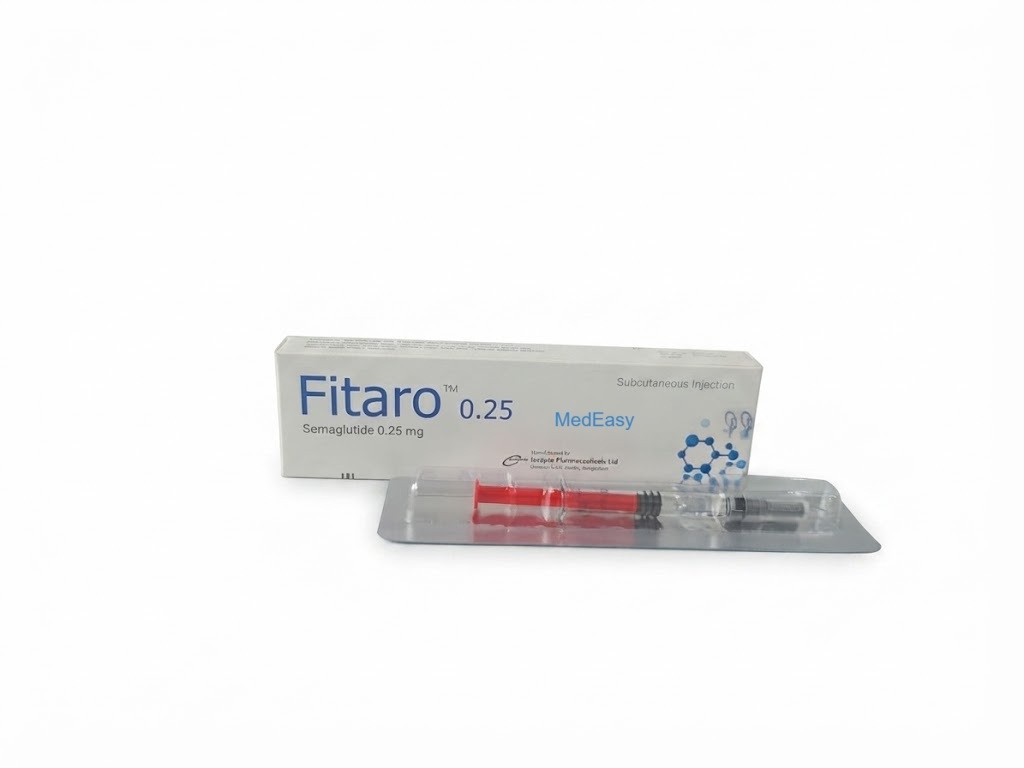
Fitaro0.25 mg/0.
Incepta Pharmaceuticals Ltd.
৳427.50
Add to cart


Mylenda is a glucagon-like peptide-1 (GLP-1) receptor agonist available as a once-weekly subcutaneous injection and as a once-daily oral tablet, marketed at different dose ranges for glycemic control and for chronic weight management. Indications are classified below by strength of evidence.
Semaglutide is available in more than one formulation and strength. The injectable form is supplied as a clear, colorless to slightly yellow solution in prefilled, multi-dose subcutaneous injection pens, with dose strengths that vary by brand/indication (for example, doses ranging from about 0.25 mg up to 2.4 mg per injection for weekly use), together with standard pharmaceutical excipients. The oral form is supplied as film-coated tablets (commonly 3 mg, 7 mg, and 14 mg strengths) in which Semaglutide is combined with an absorption-enhancing excipient that allows this peptide molecule to be absorbed after oral dosing.
Mylenda is a human glucagon-like peptide-1 (GLP-1) analog with approximately 94% sequence homology to native human GLP-1. Structural modifications, including a fatty di-acid side chain that promotes reversible albumin binding, protect Mylenda from rapid enzymatic degradation and give it a long elimination half-life of about one week, allowing once-weekly injectable dosing; a specially formulated oral tablet form also allows once-daily oral dosing.
Mylenda is used clinically both to improve blood glucose control in type 2 diabetes and, at higher doses, to promote sustained weight loss in patients with obesity or overweight with weight-related health problems. It works together with, not instead of, lifestyle measures such as a reduced-calorie diet and increased physical activity, and treatment is intended to be individualized and monitored by a physician.
Mylenda belongs to the glucagon-like peptide-1 (GLP-1) receptor agonist class of medicines, also called incretin mimetics. Depending on formulation and dose, it is used as an antidiabetic agent for glycemic control in type 2 diabetes, or as an anti-obesity agent for chronic weight management.
Semaglutide binds to and activates the GLP-1 receptor, the same receptor targeted by the naturally occurring incretin hormone GLP-1. Receptor activation stimulates glucose-dependent insulin secretion and reduces inappropriately elevated glucagon secretion from pancreatic islet cells, both in a glucose-dependent manner, which lowers blood glucose while limiting the risk of drug-induced hypoglycemia when used alone. Semaglutide also slows gastric emptying and acts on appetite-regulating centers in the hypothalamus and brainstem to reduce hunger and food intake, which underlies its weight-lowering effect at higher doses.
After subcutaneous injection, absolute bioavailability of Semaglutide is approximately 89%, with peak plasma concentrations reached 1 to 3 days after a weekly dose; steady state is reached after 4 to 5 weeks of once-weekly dosing. The oral tablet formulation, which co-formulates Semaglutide with an absorption enhancer (SNAC) to permit uptake of this peptide across the stomach lining, has much lower absolute bioavailability (roughly 0.4-1%), which is why the oral tablet must be taken on a strictly empty stomach with only a small amount of plain water. Semaglutide is extensively bound to plasma albumin (>99%), which contributes to its long elimination half-life of approximately one week for both formulations. It is metabolized by proteolytic cleavage of the peptide backbone and beta-oxidation of the fatty acid side chain, with no single organ responsible for elimination; metabolites are excreted mainly in urine and feces.
Dosing of Mylenda depends on the formulation (weekly subcutaneous injection or daily oral tablet) and the indication, and must always be individualized and titrated by a physician. Gradual dose escalation is used for all formulations to improve gastrointestinal tolerability; lower starting doses are not intended to be effective for glycemic control or weight loss and exist only to allow the body to adjust.
| Formulation / Indication | Starting dose | Titration | Typical maintenance dose |
|---|---|---|---|
| Weekly injection - type 2 diabetes (glycemic control / cardiovascular risk reduction) | 0.25 mg subcutaneously once weekly for 4 weeks (dose-initiation only, not effective for glycemic control) | Increase to 0.5 mg at week 4, then to 1 mg at week 8 and 2 mg at week 12 if additional glycemic control is needed, at intervals of at least 4 weeks | 0.5-2 mg once weekly, individualized |
| Weekly injection - type 2 diabetes with chronic kidney disease | 0.25 mg once weekly for 4 weeks | As above | Target maintenance dose of 1 mg once weekly |
| Weekly injection - chronic weight management / cardiovascular risk reduction with obesity / MASH | 0.25 mg once weekly for 4 weeks | Increase every 4 weeks in steps (0.5 mg → 1 mg → 1.7 mg) up to the maintenance dose | 2.4 mg once weekly (physician may adjust within the approved range for the specific product and indication) |
| Oral tablet, once daily - type 2 diabetes (glycemic control / cardiovascular risk reduction) | 3 mg once daily for 30 days (dose-initiation only, not effective for glycemic control) | Increase to 7 mg once daily after 30 days; may increase further to 14 mg once daily after at least another 30 days if additional control is needed | 7 mg or 14 mg once daily |
If a weekly injection dose is missed, it should be administered as soon as possible within 5 days of the missed dose; if more than 5 days have passed, that dose should be skipped and the next dose taken on the regularly scheduled day, on a physician's or pharmacist's advice. Oral tablets should simply be taken the next day as scheduled if a dose is missed; a double dose should never be taken to make up for a missed dose. See Administration for injection technique and the specific oral-tablet dosing rules.
Injectable Mylenda: Administer once weekly, on the same day each week, at any time of day, with or without meals. Inject subcutaneously into the abdomen, thigh, or upper arm, rotating the injection site with each dose. The day of weekly administration can be changed if needed, as long as at least 2 days (48 hours) have passed since the last dose. Each injection pen is for single-patient use only and must never be shared between patients, even if the needle is changed. Follow the specific pen instructions provided with the product for priming and dose selection.
Oral Mylenda: Take one tablet by mouth once daily, first thing in the morning, on an empty stomach, with no more than about 120 mL (4 ounces) of plain water only - not with any other liquid. Swallow the tablet whole; do not split, crush, chew, or dissolve it. Wait at least 30 minutes after taking the tablet before eating food, drinking any other beverage, or taking other oral medications, since food, drink, and other pills taken sooner can significantly reduce absorption of the tablet.
Semaglutide is contraindicated in:
Data on Mylenda use in human pregnancy are limited. Animal reproduction studies have shown adverse fetal effects (including structural abnormalities and fetal/ embryonic loss) at maternal exposures relevant to clinical use. Because of Mylenda's long half-life, it should be discontinued at least 2 months before a planned pregnancy. Mylenda should be used during pregnancy only if clearly needed and only when a physician determines that the potential benefit justifies the potential risk to the fetus; it is not recommended for weight management during pregnancy.
There are no data on the presence of Mylenda in human breast milk or its effects on the breastfed infant or on milk production; Mylenda has been detected in the milk of lactating animals. A physician should be consulted to weigh the developmental and health benefits of breastfeeding against the mother's clinical need for Mylenda and any potential risk to the infant.
In rodent studies, Mylenda caused dose-dependent and treatment-duration-dependent thyroid C-cell tumors, including medullary thyroid carcinoma (MTC), at clinically relevant exposures. Whether Mylenda causes MTC or other thyroid C-cell tumors in humans is unknown, as human relevance of these rodent findings has not been determined. Mylenda is contraindicated in patients with a personal/family history of MTC or MEN 2 (see Contraindications). Patients should be counseled on the symptoms of thyroid tumors (e.g., a lump or swelling in the neck, hoarseness, difficulty swallowing, shortness of breath) and told to report them promptly.
Overdose of Mylenda may cause more pronounced gastrointestinal effects (severe nausea, vomiting, diarrhea) and an increased risk of hypoglycemia, particularly if taken together with insulin or a sulfonylurea. Because of Mylenda's long elimination half-life of about one week, effects of an overdose - including hypoglycemia and gastrointestinal symptoms - may be prolonged and require extended monitoring.
If overdose is suspected, seek immediate medical attention or contact emergency services / a poison control center right away. There is no specific antidote; management is general and supportive, based on the patient's clinical signs and symptoms (including monitoring and treatment of hypoglycemia and correction of fluid losses), and should only be carried out under medical supervision. Do not attempt to manage a suspected overdose at home.
Injectable pens: Store unopened/unused Mylenda pens in a refrigerator (2°C to 8°C). Do not freeze, and discard the pen if it has been frozen. Once in use, a pen may generally be stored either in the refrigerator or at room temperature (below 30°C) for a limited period specified in the product's patient information (commonly several weeks) - always check the specific product leaflet for the exact in-use storage duration. Keep the pen cap on when not in use and protect from direct light and excessive heat.
Oral tablets: Store at room temperature (below 30°C) in the original container, away from light and moisture; do not remove the desiccant.
Keep all forms of Mylenda out of reach of children.
Mylenda is generally used as a long-term, ongoing treatment for both type 2 diabetes and chronic weight management, for as long as a physician determines it is effective and appropriate, with periodic reassessment of glycemic control, weight, and tolerability. It is not a short-course medicine. For weight management specifically, most weight regain occurs after Mylenda is discontinued, so the decision to stop treatment should be made together with a physician, who will weigh the ongoing benefits against any side effects or other individual factors. Duration and the appropriateness of continuing therapy should not be decided by the patient alone.
Glucagon-like peptide-1 (GLP-1) receptor agonists; Incretin mimetics; Antidiabetic agents; Anti-obesity / weight-management agents (higher-dose formulation)
Semaglutide is a selective agonist at the glucagon-like peptide-1 (GLP-1) receptor. By activating this receptor on pancreatic beta cells, it stimulates insulin secretion in a glucose-dependent manner (i.e., mainly when blood glucose is elevated), and it suppresses glucagon secretion from alpha cells when glucose levels are high, together lowering blood glucose while limiting the risk of hypoglycemia when used without insulin or sulfonylureas. Semaglutide additionally slows gastric emptying and acts on GLP-1 receptors in appetite-regulating areas of the brain (hypothalamus and brainstem) to reduce hunger and caloric intake, which produces clinically significant weight loss at the higher doses used for chronic weight management.
Use of Mylenda in children differs by formulation and indication. The higher-dose weekly injectable formulation used for chronic weight management is approved for pediatric patients 12 years of age and older with obesity, as an adjunct to a reduced-calorie diet and increased physical activity, using a weight-management dosing and titration schedule similar to that used in adults, under physician supervision.
For the formulations and doses of Mylenda indicated for type 2 diabetes glycemic control and cardiovascular risk reduction, safety and effectiveness in pediatric patients (under 18 years) have not been established, and these should not be used in children outside of the approved pediatric weight-management indication described above.
Q: What is Mylenda 0.25 mg/0.5 ml SC Injection used for?
A: Mylenda 0.25 mg/0.5 ml SC Injection is a GLP-1 receptor agonist used, depending on the specific product and dose, to improve blood sugar control in type 2 diabetes, to reduce cardiovascular risk in people with type 2 diabetes or with obesity/overweight and heart disease, and, at higher doses, for chronic weight management in adults and some adolescents with obesity. Your physician will select the product, dose, and formulation appropriate for your specific condition.
Q: Why does my dose start low and increase slowly over several weeks?
A: Mylenda 0.25 mg/0.5 ml SC Injection dosing always starts at a low dose and is increased gradually, typically every 4 weeks for the injection or every 30 days for the oral tablet. This gradual titration is not the treatment dose itself - it allows your digestive system to adjust and significantly reduces the chance and severity of nausea, vomiting, and other gastrointestinal side effects. Never increase your dose faster than your physician has prescribed.
Q: Is Mylenda 0.25 mg/0.5 ml SC Injection safe for me if a family member has had thyroid cancer?
A: Mylenda 0.25 mg/0.5 ml SC Injection is contraindicated in people with a personal or family history of medullary thyroid carcinoma (MTC) or Multiple Endocrine Neoplasia syndrome type 2 (MEN 2). This is because Mylenda 0.25 mg/0.5 ml SC Injection caused thyroid C-cell tumors in rodent studies at clinically relevant exposures; whether this risk applies to humans is not known, but the precaution is taken seriously. Tell your physician about any personal or family history of thyroid cancer or MEN 2 before starting Mylenda 0.25 mg/0.5 ml SC Injection, and report any neck lump, swelling, hoarseness, or difficulty swallowing promptly.
Q: Will the nausea and other stomach side effects from Mylenda 0.25 mg/0.5 ml SC Injection go away?
A: Nausea, vomiting, diarrhea, constipation, and abdominal pain are the most common side effects of Mylenda 0.25 mg/0.5 ml SC Injection, and they are usually mild-to-moderate, dose-related, and most noticeable during dose increases; they often improve over time as your body adjusts. However, if you develop persistent, severe abdominal pain (possibly radiating to your back), with or without vomiting, this could be a sign of pancreatitis, and you should stop Mylenda 0.25 mg/0.5 ml SC Injection and contact your physician or seek medical care immediately.
Q: Can I take Mylenda 0.25 mg/0.5 ml SC Injection with insulin or my diabetes pills?
A: Mylenda 0.25 mg/0.5 ml SC Injection is often used together with other diabetes medicines, but combining it with insulin or a sulfonylurea (a type of diabetes pill) increases the risk of low blood sugar (hypoglycemia). Your physician may lower the dose of your insulin or sulfonylurea when you start Mylenda 0.25 mg/0.5 ml SC Injection, and you should know the signs of low blood sugar (such as shakiness, sweating, confusion) and how to treat them. Always tell your physician and pharmacist about every medicine you take.
Q: How exactly should I take the oral Mylenda 0.25 mg/0.5 ml SC Injection tablet?
A: The oral tablet must be taken on a completely empty stomach, first thing in the morning, with no more than about 4 ounces (120 mL) of plain water - not tea, coffee, juice, or any other liquid. Swallow it whole without splitting, crushing, or chewing it, and wait at least 30 minutes before eating, drinking anything else, or taking any other oral medicine. Taking it any other way can significantly reduce how much of the medicine your body absorbs and make it less effective.
Disclaimer
The information provided is accurate to the best of our knowledge, but it does not replace professional medical advice. We cannot guarantee its completeness or accuracy, and the absence of specific information about a drug should not be taken as an endorsement. We are not responsible for any consequences arising from this information, so please consult a healthcare professional for any concerns or questions.

