8% Off
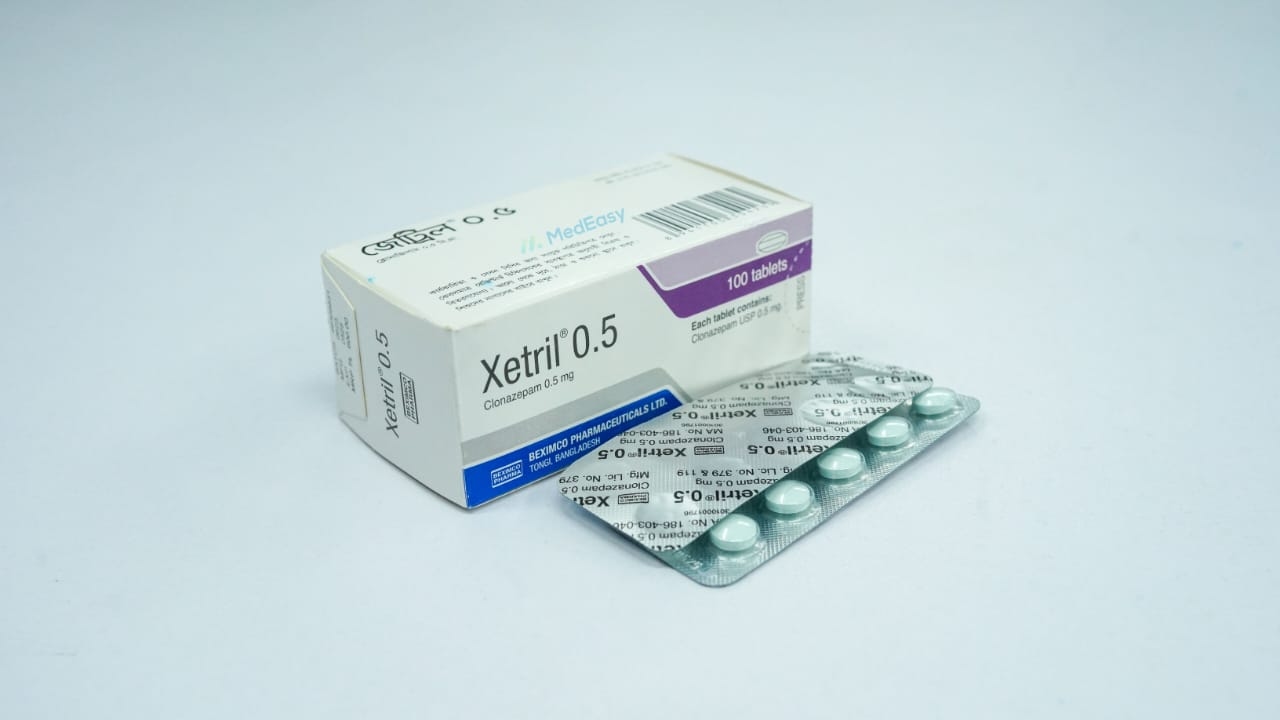
Xetril0.5 mg
Beximco Pharmaceuticals Ltd.
৳55.20
Add to cart
Seizure Disorders Clonazepam is established (FDA-approved) as adjunctive or sole therapy in the management of certain seizure disorders, including Lennox-Gastaut syndrome (petit mal variant) and more.
Clonazepam is established (FDA-approved) as adjunctive or sole therapy in the management of certain seizure disorders, including Lennox-Gastaut syndrome (petit mal variant), akinetic seizures, myoclonic seizures, and absence seizures (petit mal), particularly when other agents have proven ineffective or are only partially effective.
Clonazepam is established (FDA-approved) for the treatment of panic disorder, with or without agoraphobia, in adults.
Clonazepam is also used off-label, under specialist guidance, for conditions such as certain movement disorders (e.g. restless legs syndrome, akathisia), acute mania or agitation as an adjunct, and short-term management of severe anxiety symptoms; these uses are not FDA-approved indications and evidence is more limited than for the approved uses above.
Clonazepam is not a first-line or standalone treatment for ordinary, situational anxiety or insomnia, and is not indicated for long-term use as a general sedative given its dependence potential.
Clonazepam dosing is individualized by indication and is started low, then increased gradually to the lowest dose that provides adequate control with tolerable side effects. Regimens differ for seizure disorders and panic disorder; see the table below and the Pediatric Uses and Use in Special Populations sections for further detail.
| Indication / Population | Typical Regimen |
|---|---|
| Adults - seizure disorders | Initial dose not exceeding 1.5 mg/day, given in 3 divided doses; increased in increments of 0.5-1 mg every 3 days until seizures are controlled or side effects preclude further increases; maximum recommended dose is 20 mg/day |
| Children - seizure disorders | Initial dose of 0.01-0.03 mg/kg/day (not to exceed 0.05 mg/kg/day), given in 2-3 divided doses; increased by 0.25-0.5 mg every third day to a target maintenance dose of about 0.1-0.2 mg/kg/day (see Pediatric Uses) |
| Adults - panic disorder | Initial dose of 0.25 mg twice daily; increased to the target dose of 1 mg/day after 3 days; some patients may require up to 4 mg/day, increased cautiously in increments of 0.125-0.25 mg twice daily every 3 days |
| Renal or hepatic impairment | Use with caution and consider a lower starting dose and slower titration, since Clonazepam is hepatically metabolized and impairment may prolong its effects (see Use in Special Populations) |
| Discontinuation (any indication) | Reduce the dose gradually, typically by no more than 0.125 mg twice daily every 3 days (or a comparably slow schedule set by the physician); never stop Clonazepam abruptly except in a medical emergency (see Precautions and Warnings) |
Clonazepam is contraindicated in patients with known hypersensitivity to Clonazepam or other benzodiazepines, in patients with significant liver disease, and in patients with acute narrow-angle glaucoma.
Disclaimer
The information provided is accurate to the best of our knowledge, but it does not replace professional medical advice. We cannot guarantee its completeness or accuracy, and the absence of specific information about a drug should not be taken as an endorsement. We are not responsible for any consequences arising from this information, so please consult a healthcare professional for any concerns or questions.